Saturday, March 11, 2006

The Amazing Disappearing Breasts: Being Anal About LOVE STREAMS


Hrrrmmmm.... Here's some weirdness for obsessive cinephiles out there. As some of you may know, I attended a recent screening of John Cassavetes' Love Streams with a stopwatch and am in touch with Tom Charity, the directors of the Vancity Theatre, and the guy with the bowtie himself, Ray Carney, about the issue of whether or not the new print is complete; I'm also trying to note differences between it, the old VHS, and the new French DVD. Professor Carney -- whom I once actually suggested was WRONG about the material missing from the VHS release, clarifies that the cuts occur during the first dream sequence; strips of black leader -- which either were designed to give a jumpy, dreamlike quality to the scene, or perhaps "slugs," filling spaces where material was to be added, which were kept because Cassavetes liked the effect -- were edited out by the Golan/Globus guys for the video release, perhaps because they thought they were left in erroneously; there's also a jump cut that happens around the same time that is removed, giving a more seamless feel to the scene, which is restored in the new print. Tom Charity, who owns the DVD, confirms that the DVD leaves the black strips in; the new print has them; and I can confirm that the VHS is missing them -- so Ray is RIGHT. So far, so good: but now it gets much stranger. The VHS version INCLUDES MATERIAL THAT IS MISSING FROM THE NEW PRINT!!!!!!! You heard it here first, folks (probably): and all of this revolves around BREASTS.

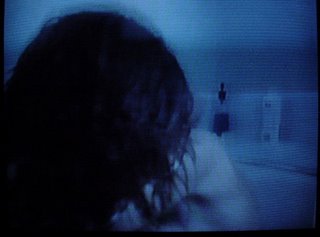
Those who know Cassavetes' cinema in depth know he was sheepish around nudity; that he is said to have disapproved of the nude scenes in Scorsese's Mean Streets, and only has any substantial nudity in one film of his, The Killing of a Chinese Bookie, which, being set in a strip club, sorta required a bit of flesh (tho' even there, so little skin is actually on display that at one point Ben Gazzara, playing the club owner, Cosmo Vitelli, improvises the complaint, "what the hell kinda strip joint is this, nobody takes their clothes off!'"). It is said that in one sequence in Love Streams, where Cassavetes, as Robert Harmon, is in bed with two of the young girls he gathers around him, he had initially scripted nudity into the scene, but when the girls said they felt a little uncomfortable about it, provided them with nighties. It is somewhat noticeable, then, when, early in the film, Robert Harmon comes upstairs and discovers two of these girls frolicking nude in his shower. In the VHS edition, tho' the sequence only lasts a few seconds, you see the breasts of BOTH girls, quite clearly.

The new print, while otherwise excellent, and including the missing black leader, LACKS said breasts. The girls, I believe, are the same, but the shot is framed such that you can see neither of their breasts, not at all. And now we have several possible theories that come to mind:

1. There are alternate cuts of Love Streams, as with so many of Cassavetes' films, and some have more breast in them than others. This may be a matter of Cassavetes' restless nature, or it could be that Golan and Globus pressured him to include the fleshier take, though it seems pretty unlikely that he would give way to such a cheap demand. It is also quite possible the film was changed without his knowledge or approval -- there are many instances of studios meddling with Cassavetes' films; for instance, apparently all recent releases of Husbands are missing about 12 minutes of material, including (I am told, tho' I only recall one) two songs sung by John "Red" Kullers and several minutes of toilet sounds during the infamous puking scenes. (There have been debates about the quality of the UCLA print of the film, but there are, according to Ray Carney, two versions of the film that were prepared by UCLA -- see his note, above. By the way, if anyone cares, there is a petition to have Husbands released on DVD here). In any event... Under this thesis, the Sony people either happened on a breastless version, or sought one out, believing it truer to Cassavetes' intentions.

2.The Bagel Boys, as Cassavetes called Golan and Globus, decided when they were snipping out the black leader that they should also change the shower sequence so there was more skin, true to their exploitation background, and substituted an alternate take of this scene; in fact (under this thesis), only the VHS version has the breasts in it; they aren't supposed to be there, and the new print is based on the correct theatrical version of the film, somehow restored posthumously to Cassavetes intentions, as with Touch of Evil. This seems quite unlikely, but I mention it to be complete... Though I've seen Love Streams on the screen previously, it was around 1990, and can't decisively confirm that there were breasts visible, tho' it seemed to me there were...

3. The breasts were always meant to be there, were part of Cassavetes' final cut, and have been edited out by Sony for reasons as yet unknown, having to do with MPAA ratings, TV broadcasting considerations, legal issues, or irrational prudery, perhaps centering around a fear of showing what could be seen as representation of lesbianism... This seems the most likely thesis.

I do not know. I will be at the theatre tomorrow, with my stopwatch again (to check a couple of other minor points) and will attempt to get a decisive record of the absent breasts in the new print. And then... well, I dunno what I'll do then. Ask Tom to check the DVD. Email Ray. Email Sony. Post links on IMDB and various other places to this article and plead strangers to solve the mystery... It isn't like I'm discovering a lost version of a Cassavetes' film, but... Gee, this is all kinda exciting.

Much yelling -- a drunken party -- is occuring across the alley outside my window. Can't people sense that important work is being done here?

POST-SCRIPT:

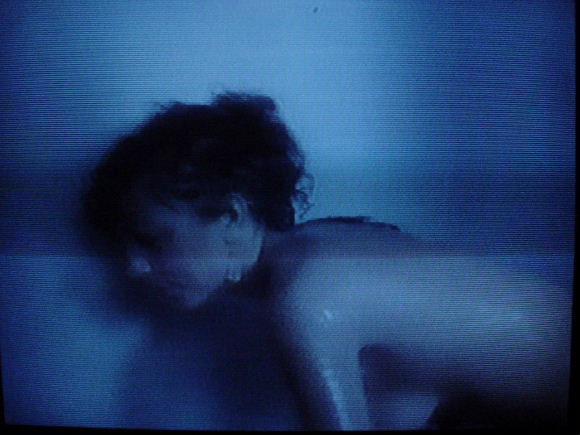
Having seen the film again, I can confirm that the image source is the same, but zoomed in on/cropped and shortened. You see only the head and upper shoulder of the girl pictured above; they are much larger on the screen; you do not see her breasts, and you do not see the girl on the left in the image below-- who, in the VHS edition, you actually see rise from a seated to a standing position, glimpsing her breasts on the way. (The VHS scene is at least 3 seconds longer, maybe more -- I'm afraid I couldn't see the stopwatch well enough to get a sense of the exact time of any specific scene in the projected film). In the new print, you also don't see the back wall of the bathtub, the bottles, etc. I am not even sure if a viewer of the new print would realize that there are two girls in the tub; a friend present said it went by in a "flicker" and he really didn't see what was going on. Very curious.

Pancakes and Noise


Come Sunday, prior to the final screening of Love Streams (see below), you will find me flipping (and, I hope, eating) pancakes at Vancouver's first (annual?) noise pancake breakfast at the relocated Blim. I suppose we could also call it our first pancake noise breakfast, tho' that does suggest that the pancake is the source of the sound... A mild sizzle, the scrape of a spatula on a pan, the gentle sigh of releasing air as it is flipped... Ahh... A description of the event follows:

Dear friends.. we are pleased to invite you to a noise event.

Vancouver's first noise pancake breakfast - Sunday March 12th. 11am - 4pm.

Blim #197-east 17th (@ Main)

$5-10 sliding scale, includes free breakfast (or while supplies last..)

featuring:

Eric Lanzillotta (Allan asks: anyone got a better site for me to link?)

Eric Lanzillotta has been involved in sound in various aspects over the last two decades. In this time, a few fragments have been released for public consumptions on labels such as Anomalous Records, Selektion, Alluvial Recordings, Beta-Lactam Ring Records, RRRecords, EE Tapes and Jnana Records. Some of these recordings have involved collaborations with Ralf Wehowsky, Andrew Chalk, and John Hudak. He has also contributed to recordings by Hands To, AMK, Ultra, Edward Ka-Spel and irr.app.(ext.). As a live performer, he has appeared in United States, Canada and Japan, both solo and in duets with Bernhard Gunter and Aube.

Sistrenatus

Sistrenatus comes forth as a bleak industrial presence against a backdrop of harrowing white noise and dark ambient textures. The audible essence of degeneration and decay. Cold Spring Records will be releasing Sistrenatus' debut album "Division One" in 2006.


Flatgrey

.horrible misanthropic noise.
(DeadbyDawn Soundsystem)

Coelacanth (Allan notes: I have no handy links for this band, but I have corrected the spelling of the name, and if anyone wants to read about the fish, they may do so here).

paperbagepoxy (also apparently siteless)

pbe provides protection for his instrument during transit and should be retained in case subsequent shipment becomes necessary. Repackaging instructions can be found in section six of his manual. all sales final.

G42 (pictured above at 1067)


alienatedinvancouver.blogspot.com assumes no liability for hearing loss, ear damage, or indigestion as a result of your participation in this event.

Thursday, March 09, 2006

John Cassavetes' Love Streams at the Vancity Theatre


Ah, happy day! My Discorder article on Cassavetes' Love Streams is online -- the piece that "Cassavetes in the Provinces," below, is meant to complement. I've been three times to see the film at the Vancity, and can report that there were definitely fewer than 100 people in total who saw the film during its Monday to Wednesday run -- tho' all appeared to enjoy it; I was so pleased to hear the audience laughing (or going really quiet) -- so pleased to be able to experience the film socially, as films are meant to be experienced. I don't think Tom Charity got to explain the mysteries of Jim the Dog (or to point out Xan Cassavetes' cameo -- she's cute!), but he did an excellent job framing the movie before the Tuesday screening, despite a few technical difficulties, and he was most happy to sign my copy of his book, John Cassavetes: Lifeworks (since, as he put it, I'm probably "the only person in Vancouver who's bought it!"). It's such a delightful film -- a far sweeter experience than Cassavetes' most difficult fare (Faces, A Woman Under the Influence) -- but by no means a lesser film of his... For those who haven't gone, it screens again on Sunday at 4PM. It's probably your last chance to see the film on the screen, and unless you know me personally, it's unlikely you'll be seeing it on VHS, since I believe I own the only copy in the city (there used to be a copy at a certain Rogers' video, but I sent it to a now-lost ladyfriend in New Jersey... it's available in France on DVD, but otherwise it's very hard to find). Cinema lovers will be doing themselves a grave disservice if they miss it...

Alas, I couldn't even use my birthday to leverage people into coming to the screening (it's your souls I'm thinking of, folks, really... when judgment day comes, make sure you mention that I tried...!). Of the 20 or so people I invited myself, only one showed up (thanks, Dan!) -- but he'd invited Heather of the Creaking Planks along, too, so really there were three of us (thanks, Heather! Glad you liked the film...!)... I'll be in attendance Sunday, so those of you who skipped the 7th have one last chance... For your souls...!

Seriously.

Wednesday, March 08, 2006

Furry Lobster

Controversial Japan-based foreign-rights activist D. Ashton provides this story, with the comment, "I wonder what one of these tastes like."

Sunday, March 05, 2006

Al on Al: an Exclusive Interview with the Minimalist Jug Band

…I’m a physical moron
A physical fool
I should have gone to guidance
Back in high school
Instead of Joy of Sex
I read John Paul Sartre
Instead of falling in love
I just fell apart
And I’m not bragging
I’m not gay
I’m just a lousy lover
I’m a lousy lay…
No good in the sack
No good in the hay
Conversation that’s my forte
But I’m a lousy lover
I’m a lousy lay…

-- “I’m a Lousy Lay” by the Minimalist Jug Band

I’d worked at the same used book and record store with Al Mader for a couple of years before discovering that he was a performer with a CD recorded. It took me a couple of months after that to remember to ask him to bring me a copy of his CD, For Crying Out Loud – they’re made with homemade covers drawn on the back of cardboard boxes, one of which is pictured above, but they’re factory-pressed, not CDRs – and a couple of weeks further for him to do that. Seeing him play live took another few months, since usually I would be filling in for him at the store on nights when he had a gig; finally managed it at the Marine Club last week, where he opened for Rodney Decroo. After he tried to warm the crowd up with a few lighter numbers – “Posting Crap on eBay,” for instance – he got down to the gut-wrenching, self-deprecating, morbidly humorous matter at the heart of his work, and the audience – particularly those who had been drinking a bit – gave more than a few whoops and cheers during such numbers as “Making Myself Sick” (“I’m having dizzy spells, things are shifting, turning/ and every day my guts are churning/ and I ask myself, well what’s the answer/ Is it a brain tumour or stomach cancer?”) and his Reveen-impersonating “Problems in a Box” (particularly after the box overflowed). I went into the store, on a night when he was working and I wasn’t, to interview him, as a doo wop record by the Spaniels (Great Googly Moo!) played in the background. I started by asking him about how he conceived of his work; it’s designed, he said, as a vehicle for a “songwriter who can’t sing” – someone with plenty of musical desire, but no ability.

“In my mind, they’re songs, but when people hear it, they often go ‘oh, spoken word.’ But yeah, I think of it as music, though there are obviously connections to poetry... Initially I began playing in clubs, opening for bands, but then I chanced on a slam poetry event at the Press Club, and I thought I could do it this way, too. You have to do it without props, so I did it without the bass. Actually, I started doing this in the 1980s, before slam poetry existed, but I’ve known about the scene for awhile now, so it may have subliminally influenced me...” Al accompanies himself on a washtub bass during his club performances – it’s basically a washtub with a hole in it and a string attached. That's the whole band, and the inspiration for his song, "A Washed Up Guy on a Washtub Bass."

Al lists influences like John Otway and John Cooper Clark (“a punk rapper, a rapper before there was rap”), and admits to being encouraged by the existence of bands like the Nihilist Spasm Band, who also can play no conventional instruments (my review of the NSB’s sole Vancouver show is here; I’m rooting for a collaboration – the Minimalist Spasm Band, or maybe the Nihilist Jug Band) and Eugene Chadbourne, who self-markets CDs with homemade covers. He has one Jandek record in his collection (“the one with a faded grey cover with a photo of Jandek on it,” he told me, prompting me to explain just how unhelpful that was as a means of narrowing down which recording it is) and thinks that it’s pretty interesting. I asked him how he feels about the term outsider music– the existence of the genre seems to suggest there’s a target market out there that Al could pitch himself to, but he bristles a bit at the suggestion.

“Yeah, I’ve had people say that before, but ‘outsider music’ suggests a performer who is deluded and oblivious, who doesn’t really know what they’re doing. The performer is found art – you’re like a piece of wood that happens to look like something else, and it’s the person who ‘discovers’ you who gets to define you as an artist. You’re the soup can. I’m not that concerned with defining what I do, and I don’t want to close any doors, but I don’t really want to be compared with Wesley Willis. Hasil Adkins might be all right.” (Some readers may be familiar with Hasil Adkins through the Cramps' cover version of "She Said," the one with the "Oo-ee-aa-aa" chorus that appears on Bad Music for Bad People. An odd archive of various pieces that could be considered outsider music is included on Ubuweb, here).

Al got started in Toronto in the 1980s, on the fringes of the punk scene. Initially he’d just bring objects, and “play on pots and pans,” and busk his lyrics until someone gave him the washtub. He’s performed with various roots and bluegrass musicians – some conventional musicians are “less disappointed than others” by what he can do with his bass – and he’s performed with Rowan of the local trio the Creaking Planks (who cover, somewhat more tunefully than the original, his hilarious thrift-store-shopping opus, “Dead Man’s Pants”); he’s also a long-term co-conspirator with the Hate Filled Man himself, Chris Houston, who produced For Crying Out Loud gratis. At various points, though he rarely gets paid more than $50 for a gig, he has opened for Nick Cave, Blurt, They Might be Giants, and, to his great pleasure, John Otway; he’s played festivals and poetry slams in Providence and in Minneapolis, and toured around Canada. He appears on a tribute album to former Rank and File member Alejandro Escovedo, doing a cover version of Escovedo’s “Thirteen Years” (“No Depression magazine reviewed it; they liked most of it but they hated me”). His unreleased, unfinished, but hopefully eventually upcoming CD features collaborations with rockabilly artist Ronnie Hayward and former Ray Condo sideman Stephen Nikleva. Al also notes that on the upcoming release, “finally the jug band has a jug;” the artist currently known as Petunia, with whom Al has toured, provides blown accompaniment and some background vocals. (Hey, Al -- did I link to the right Petunia? I mean, how many Petunias could there be?).

Most copies of the run of 250 of his first, self-released CD have sold, though Al thinks there are probably some left at Red Cat Records, or maybe Zulu. You might be able to get one off him if you can figure out when and where he's playing next -- he sometimes gigs at the Railway Club. Or you could phone Carson Books' Broadway store on a Saturday night... There is no release date yet on the second disc. His stuff is really designed to be appreciated live, anyways, he notes.

I asked Al if “I’m a Lousy Lover” (which has also been covered) has gotten him laid and he responded, “People ask me that,” and that’s about as far as that went, so I asked him about crowd responses to his work.

“Well, I used to play in clubs where there were a lot of old guys still in there, drinking from the afternoon, and they’d sometimes figure that this was some sort of open mike event, and they’d come up to the stage with their drink and wait there for a moment where they could cut in or interact with me, but since I don’t really stop, they’d just be standing there, right in front of me, with their drink… I’ve played a lot of shows like that,” he chuckled. “I’ve had people stand on stage beside me, too. Sometimes people can just hate what I do; other people have said, ‘you’ve got a lot of guts,’ which is a kind of mixed review if you think about it… Sometimes there are small pockets of attention in the room – you can feel that a few guys over there are listening, and if they look interested enough sometimes other people start listening too. It really varies. I’ve had standing ovations and I’ve had the plug pulled, so to speak.” (Al gestures the traditional head-being-cut-off semaphore signal for “get off the stage”). Thinking of a story, he smiles: “One time this young guy was heckling me at the start of the show and then by the end he wanted me to come with him and help him quit his job.”
Some pieces on the disc are autobiographical -- "I Feel Great Today 'Cos I Ate Today" is about a period of homelessness Al survived in Toronto in the '80s -- but not everything should be taken at face value; like a novelist, Mader bends facts to the needs for emotional authenticity, which is his main concern.

One of the funnier aspects of the Minimalist Jug Band’s performances is his tendency to insert ironic references to pop songs and pop culture into his lyrics; he’ll close a dark tour through his emotional difficulties and eccentricities by dropping a deadpan “You may be right I may be crazy but it just may be a lunatic you’re looking for;” “I’m a Lousy Lay” ends with him tossing off – no pun intended – a reference to Bob Dylan’s “It Ain’t Me, Babe” (“...it ain’t me you’re looking for.”) Often he would use a collage of these quotes as a way to build bridges between songs, but he also acknowledges that part of his intention is to point up the hollowness of the source material. “A lot of stuff that you hear out there is pretty insufficient, emotionally. Take a song like the Flying Lizards’ ‘Money.’ They’ve taken the song and they’ve actually removed the emotion from it, made it just a pure flat product, which is all right, too, I guess, but what I try to do is to reattach the emotion. These words should have meaning.”

Whenever the new CD comes out, there’ll be a track on it about a guy who uses music to get through emotional difficulties. Al admits there’s a cathartic element to his work, and if the Marine Club show was any indication, he’s helping at least a few of the people who paid attention to achieve their own catharsis, too. It’s a pretty positive social function for any artist to aspire to. Godspeed, Minimalist Jug Band!

Wednesday, March 01, 2006

Obscenity

George W. Bush plans to place flowers on Gandhi's grave on his tour of India.

Arundhati Roy writes on it here. Some useful background on the political context and possible repercussions of Bush's trip to India here.

After the fact:

Turns out that Bush's security team had sniffer dogs go over the Ghandi shrine, to the dismay of the priests who attend it. They had to purify it.

Lacking cable, I usually don't get to see Bush's speeches, but it happened I was wide awake and channel surfing through the wasteland when Bush's press conference in Pakistan aired. It was fascinating to watch -- I've never gotten to see Bush's arrogance in such detail, or the surreal ambience of a press conference where the only people who get to ask questions -- or indeed, are in attendance -- have been hand-picked based on their willingness not to ask or say anything that might embarrass anyone. President Musharraf looked like he was straining from the discomfort of having Bush's hand up his ass, but it didn't stop Bush from using him as a ventriloquist's dummy... It was a fascinating, disturbing experience.

Tuesday, February 28, 2006

Fassbinder and My Birthday


Bumped into a great quote from Fassbinder in a Senses of Cinema article -- I've never seen a director so concisely sum up his project: “Every decent director has only one subject, and makes the same film over and over again. My subject is the exploitability of feelings.” It puts its finger exactly on the pulse of his work.

Poking about such articles as a follow up to a viewing of Mother Kusters Goes to Heaven this evening, it occured to me today that I am now the same age as Fassbinder at the time of his death (also the same age as Lucy Jordan in the Marianne Faithfull song...). He had, in his 37 years, directed over 40 feature films. I've directed none, and never will; in about a week's time, though, I'll have outlived him...

Monday, February 27, 2006

Difficult to Explain

One of those trivial amusements I sometimes report.

(...at a convenience store where I was working, I once had a customer microwave a butter tart in a tinfoil package, which caused the microwave to start to smoke, spit sparks, and ultimately to melt -- there was a big hole inside. Then there's the story about the drunk who tried to shoplift a can of tuna by stuffing it down the front of his track pants. I had to clean it, tho' honestly I can't remember if I put it back on the shelf, or just left it with a note for the manager... And then there's the one about the Slurpee syrup container that had green sheets of mold growing in it, which I was instructed to scoop off the surface during the night shift, since it kept regenerating; the station was changing hands and the old owners didn't want to pay to get the machines professionally cleaned, and would continue to sell Slurpees during the day. If a convenience store clerk ever says, "trust me, you really don't want to drink that," but refuses to explain -- don't ask questions, and, for God's sake, trust him).

Sunday, February 26, 2006

Monsanto Vs. Farmers and the Ecology

A worthwhile article on terminator genes that produce sterile seeds in GM crops... and a list of organizations petitioning to ban terminator technology here. Anyone scared about GM food is directed to seek out the film The Future of Food, which is available on DVD, tho' if it's being widely stocked in Vancouver I know not...

Friday, February 24, 2006

Interesting Local Filmmaker

A fellow named Russell Hunt has come to my attention. Check out Island Universes, in particular -- it's very friendly to altered states of consciousness, note.

Peter Watkins' EDVARD MUNCH issued on DVD

Peter Watkins, British born media critic and filmmaker whose Punishment Park was by far the most interesting DVD release of last year -- though he's best known for The War Game -- has a new film available, a biopic on Edvard Munch, which has been much praised. Heads up.

Charles Mudede on Horse Fucking

Like it says -- Mudede is reacting to the Kenneth Pinyan case of last year. Somehow I find the link he's provided to a picture of Sam the Eagle very, very funny, as do I find the whole article, really, tho' explaining why would be difficult. I hope Police Beat opens here soon -- I want to see it again; the Pinyan case would fit right in to the picture of American life that film crafts.

Cassavetes in the Provinces: on Love Streams Upcoming Vancouver Screening


PROVINCIAL
(ADJECTIVE):

1. Of or relating to a province.
2. Of or characteristic of people from the provinces; not fashionable or sophisticated.
3. Limited in perspective; narrow and self-centered.


“Who are you doing the piece for?” Tom Charity asks me.

I hesitate. “Well, so far I’ve contacted the Georgia Straight, the West Ender, and a couple of the free papers around town, but no one’s gotten back to me. Certainly it’ll end up online on my blog, and if I can get it into print elsewise… We’ll have to see.” I sigh, afraid that something so provisional won’t excite him. “Do you still feel… is it worth your while doing?”

He laughs. He knows what it’s like; also a writer – the former film editor of Time Out magazine, and the author of John Cassavetes: Lifeworks – Charity has a lot more experience in these matters than I do. It turns out he’s also pitched a similar piece to a local paper that sometimes publishes him. Thus far no one really cares.

I had no idea until recently that the British-born author was based in Vancouver. It happens that I was carrying his book with me as part of a Cassavetes project that I was working on when I happened upon the new Vancouver International Film Center program, and discovered that Charity would be introducing a screening of my favourite Cassavetes’ film, Love Streams, on March 7th (which by coincidence happens to be my birthday). I would write a piece and promote the event, I decided – assuming then that Charity was still based in the UK and would be flying out. Imagine my surprise when I discovered he was here all along…!

Charity first came to BC in 1999, as a juror for the Vancouver International Film Festival, and found the city very appealing. “I was looking for a change of pace. My wife came over the following year and she felt the same way, so we decided to change our life… Which was perhaps not a shrewd career move, but it’s a beautiful city and we’re glad to be here.”

I asked Charity if he felt somewhat stifled by the cultural life in Vancouver. I have several friends who do; though I was born in Vancouver, I grew up in the suburbs, and spent three years on the outskirts of Tokyo before moving back here, living in Kits for a year and then finally settling in downtown. I find myself often drawn to outsiders in their perspectives of the city, and agree with many of my friends from elsewhere that Vancouverites tend to be clannish and mistrustful, and that there can be dry spells where not much of any note happens.

Charity sighs in agreement. “It’s more provincial than we’d realized… But we’re very pleased with the Vancity Centre. The arrival of the Vancity Theatre has focused the Cinematheque’s programming in a good way. I think it’s nothing to be ashamed of, the rep scene here.” The problem is that a lot of the films that screen at these theatres fly beneath the notice of the local newspapers, as both he and I are discovering recently.

I ask him about the policy of certain papers to focus on local movie news, to the expense of commenting on events like the Cassavetes screening. “I think it’s a Philistine position – and you can quote me on that. I know that Pieta Woolley” – the movie editor of the Georgia Straight – “was interviewing Mark Peranson earlier this week, and her angle was, why aren’t you showing more BC films? It’s very, very sad.”

I have my own history with Pieta Woolley, which I don’t mention. I’d had an interview with her a few weeks’ previous, during which she’d asked me to pitch several ideas about the local movie industry that I could write about for her paper. When she finally arrived at the Starbucks, where I’d been waiting for half an hour, she seemed enthusiastic about the stuff I’d come up with: a profile of Leonard Schein, the film entrepreneur who started the VIFF and now runs Festival Cinemas, including the Fifth Avenue and the Ridge; an article, cutely called (I thought,) “Vancouver Plays Itself,” about films where Vancouver, instead of standing in for some large American city, actually represents Vancouver – which I thought would, at the very least, give me a chance to write about Bruce Sweeney’s delightfully local Dirty and Last Wedding, two of the best films this province has produced (I have yet to see his Live Bait). Following the thread, I then suggested a profile of film industry folks caught up in “Servicing the Beast,” working for the obnoxiously big Hollywood productions that tend to take over blocks of our city at a time, often incurring the resentment of local residents and rubbing Vancouverites’ noses with the fact that we’re more important as a stand-in for other North American cities than we are significant in our own right. They all seemed good ideas, and fit her requirement that I write things that are “local film-industry related.” She hasn’t gotten back to me about any of them. Maybe I just didn’t seem enthusiastic enough?

The problem is, I’m not. I’m glad that there are interesting filmmakers in BC, and it’s great that the Straight wants to promote them, but my concern as a cinephile ultimately is to write about films that are worth seeing, wherever they’re from – particularly if they’re going to be playing in Vancouver. We’re one of the first cities in the world to play the new print of Love Streams, which was struck in November for a Gena Rowlands retrospective in Brooklyn. It’s a film which actually has merit in film history -- unlike the relatively worthless Hollywood movies the Straight spends pages reviewing. To ignore it simply because it’s not BC-made seems like a disservice to one’s readership.

Alan Franey, the director of the Vancity Theatre, agrees that a too-local focus is problematic. “We wouldn’t be doing this if we were showing just BC or Canadian film – that’s not the way to serve the industry. The best way to cultivate an industry and to serve BC filmmakers is to be showing the best cinema internationally.”

This is not to say that the Vancity is hostile to Canadian content; in the three months since they’ve opened, Moving Pictures has screened The Grey Fox and Michel Brault’s very interesting Les Ordres, about the FLQ crisis there, and will be running Quebec filmmaker Mort Ransen’s Margaret’s Museum on March 9th. The Vancouver-shot Masters of Horror series screened in January, featuring local actors like Thea Gill and Terry David Mulligan in roles; and Amnon Buchbinder’s Whole New Thing – the runner up for the “Most Popular Canadian Film at the 2005 VIFF” – will be premiering there later this month. A special rental on April 2nd will see Velcrow Ripper’s Scared Sacred playing in a matinee.

I asked Franey if the small turnouts for Vancity events thus far are dispiriting to him.

“I would think that Vancouver is sophisticated enough to sustain what we’re doing, but… well, we’re not New York. The question is what sort of audience is there locally who’s sophisticated enough to know the good of what we’re offering… That almost sounds elitist, but you have your cosmopolitan centers where cutting edge art can be supported, and then you have your smaller cities where that doesn’t happen… I think I have a more resilient spirit in this regard than some of the other people who are working here, who are just so disappointed. I’ve been in exhibition for pretty much all my life – my wife and I owned and operated the Vancouver East Cinema for years, and I was the manager of the Ridge – so on the one side I’m quite used to disappointment, and as far as cinema attendance goes, it just gets worse and worse and worse. But on the other end of things I know it takes awhile, and I know the fundamentals are in place at our theatre… I mean, we’ve got state of the art seats and projection equipment, the building’s fabulous, and we’ve had excellent word of mouth from people who do attend, so I’m confident that it’s going to build and build…”

Jim Sinclair, the director of the Pacific Cinematheque, Vancouver’s other downtown arthouse cinema, agrees with this view. “I think there is an audience for these kinds of movies in Vancouver. It’s not a question of not being sophisticated enough. The Cinematheque has just had its best three years ever,” he reports happily. “We had a record year in 2003, our second best year in 2004, and then again our second best year in 2005 – it surpassed 2004, but didn’t quite make it to the high mark of 2003.” With time, word of mouth, and a sign so that people can see it when they drive by – something Franey admits the theatre is lacking – attendance at Vancity events should grow.

I asked Sinclair if there is any feeling of competition between the Vancity and his theatre. He dismisses the thought. “Anything that contributes to film culture in Vancouver and in BC is going to be good for the Cinematheque. It seems to me that both organisations have a vested interest in seeing the other do well.” Asked about the question of seats, he laughs and says he is “painfully aware” that those at the Vancity are much, much more comfortable than those at the Cinematheque; but he wishes the Vancity nothing but success.

Certainly with events like the upcoming Cassavetes screening, I hope that Franey and Sinclair are right that it’s just a matter of time. I’ve yet to be disappointed by an event at the Vancity, having seen several excellent films there as part of the film festival – most notably the Seattle-made Police Beat, co-written by Zimbabwe-born, Seattle-based Stranger writer Charles Mudede – reviewed here – and several things since, including Joe Dante’s Homecoming, and the eye-opening documentary Workingman’s Death (with a great John Zorn score). Most recently, of course, I attended their screening of Sokurov’s The Sun, about the final days of the Japanese Emperor’s existence as a divine being (reviewed below) and the Les Ordres event. I have tickets for the African film Yeelen, later in the week, and am drooling to see Love Streams again on the big screen. It hasn’t played locally since a Cinematheque retrospective on Cassavetes’ work, shortly after the director’s death in 1989.

As for our being provincial... I admit that the term rankles just a little. I have enough identification with the scene here that I'd like to see venues that do matter to me flourish, and it depresses me, when I see the lineups of obnoxious idiots on Granville Street every weekend or the crowds of young people packing the Paramount, to see truly exciting cultural events attended by a handful at best. The issue doesn't seem to me to be one of BC-made film vs. the rest of the world, but life-sustaining art vs. mindless entertainment. There's far too little of the former in the world for me to go about inquiring where it comes from, when it knocks at the door...

Tom Charity will be in attendance for the March 7th screening of Love Streams, and will introduce the film and provide a Q&A at the end. (The film will also be playing on the 6th, 8th, and 12th). For more of my interview with him, see the March edition of Discorder – I finally found a local paper that would run the piece, and they’ve been most supportive, so perhaps hope is not quite lost…!

I really would have liked to have gotten a piece in the Straight… Guess that won't be happenin' anytime soon...


Post Script:

Blogger Filmbrain points out an interesting little detail of the Criterion Cassavetes Box Set: If you take the slipcase off and look inside of the first pressing of the set, down at the bottom, you’ll find the tiny words “Jimmy Crack Corn.” Whatever this is a reference to – aside from the song, obviously – is a mystery to me, but according to Filmbrain, its inclusion greatly angered the Criterion folks, and the phrase has been removed from later editions, something confirmed on the Criterion Forum, where theories of the meaning of the phrase range from a meaningless personal in-joke between designers and a not so meaningless snipe at Cassavetes’ alcoholism (which, as is explained there, what the song, "Blue Tail Fly," is about -- a slave being happy that his master is dead from drinking. I never knew that). Note, finally, that I have been unable to substantiate the rumour that first pressings of the “Jimmy Crack Corn” edition are fetching a premium on eBay… as of yet.

Post-postscript:

The Discorder article is online here, along with the opportunity to comment! Cool!

Thursday, February 23, 2006

New Cinematheque Program is Out

Music fans might be excited to note that there'll be documentaries on Townes van Zandt, Shane MacGowan, and Daniel Johnston screening over the next couple of months at the Pacific Cinematheque, whose spring programme is out now. Now if only they'd bring the Minutemen film, We Jam Econo, to town...!

The samurai movies they plan to show will make the wait endurable...

Wednesday, February 22, 2006

Walter Murch Introduces THE CONVERSATION at Vancity Theatre


Film editor and sound designer Walter Murch spoke at the Vancouver International Film Centre, also known as the Vancity Theatre, last night, giving one of several sold out talks to a crowd largely consisting of young filmmakers from SFU’s Praxis Centre for Screenwriters. After his introduction, we watched Francis Ford Coppola’s The Conversation – my favourite of the films he’s worked on, though he is perhaps better known for participation in films like THX 1138, Apocalypse Now, The English Patient, and Cold Mountain, and for his work on the posthumous “director’s cut” of Orson Welles’ Touch of Evil – many of which he discusses with Michael Ondaatje in the book The Conversations: Walter Murch and the Art of Editing Film.(Murch has also written In The Blink of an Eye , which discusses his work in greater depth). The evening was a most engaging consideration of the crafts of both editing and sound design, and I think everyone left feeling quiet respect and fondness for Mr. Murch. For those who couldn't be there, here's a rough recounting of events.

Murch has a fine speaking voice – a deep, rich baritone; and he has the gift of being able to describe subjects ordinarily regarded as somewhat arcane in a fascinating, accessible way, in part due to his facility with metaphors. Anyone unfamiliar with him is invited to explore this article on sound mixing (“Dense Clarity, Clear Density”) here, linked off Filmsound.org’s archive of Murch articles. Since last night’s event, like all of Murch’s Vancouver engagements, sold out shortly after tickets went on sale, I had to sit for two hours on the cold concrete outside the box office in hope of a cancellation; I was first in a long line, and, along with a young actor and Vancouver Film School TA named Dean and an unidentified SFU film student who bitched about the cold an awful lot (but had interesting things to say about the reception of Jarhead), one of three people who were let in at the last minute. (I have seldom had such enjoyable conversations while waiting in a line up with strangers; cinephiles all, we discussed our disappointments with Terence Malick’s The New World, the upcoming screening of a new print of Cassavetes’ Love Streams, and recent exciting Criterion titles, from The Bad Sleep Well to Bad Timing; Dean had the enthusiasm of a true believer, and, coming from Alberta, lacked the Vancouver reticence about talking with strangers; I suspect those who didn’t interact with us directly greatly enjoyed eavesdropping on our conversation).

Murch introduced The Conversation by relating that people often comment that “they don’t make films like that anymore,” telling us that he usually replied by saying, “‘They didn’t make films like that then, either…’ Francis had been nursing the project since the 1960’s, and it was only after the success of the first Godfather film – the film was made between The Godfather I and II – that Paramount grudgingly agreed to produce it.” Murch detailed the production problems of the film; the original DOP, Haskell Wexler, quit and was replaced by Bill Butler; the film went overbudget; and, because Coppola was committed to beginning preproduction on the Godfather II at a fixed date, also went over schedule; there were 15 pages of screenplay – 10 days of material – that they didn’t get a chance to shoot. Francis told him, “Well, Walter, I don’t know – there’s all this unshot material. I think the best thing to do is to cut it all together and see how big the holes are.” Murch shrugged. “There I was with all this footage, and I thought, ‘Well, okay.’”

It was to be Murch’s first feature film; he was to edit it on a KEM Flatbed, a piece of editing technology that was relatively new to American cinema and quite unlike the industry standard Moviola. If I got the anecdote correct, Coppola had brought the Flatbed over from Europe, and The Conversation was the first American film to actually employ it. On top of all this, Murch was trying to edit a film that wasn’t, in fact, complete. (The audience laughed warmly at Murch’s dry delivery; he conveyed his sense of haplessness quite well, though he later explained that in fact being a beginner was probably an asset for him, since he had no previous feature work to compare the experience to). At the start of the shoot, “Watergate was a tiny blip on the horizon – nobody expected it would lead to Nixon’s resignation.” “Sadly,” he concluded, “the film is still very relevant today.”

On seeing it again for the first time in years, The Conversation reminded me, to my surprise, of David Mamet’s Homicide. As in Homicide, a character with a bad conscience becomes morally involved in a situation he doesn’t fully understand, making assumptions about what is happening that are more informed by his own guilt than by a clear perception of events. (The following telling of the film will contain mild spoilers). Gene Hackman, as Harry Caul, gives one of his best performances, as a careful, privacy-obsessed Catholic wiretapper (violating the unofficial film rule that all Catholic voyeurs must be played by Harvey Keitel) whose previous work led to a murder, for which he is trying to escape a feeling of responsibility; he was modelled – as Murch also explains in The Conversations – on Steppenwolf’s Harry Haller, and the film conceived of as “a cross between Herman Hesse and Hitchcock,” though the character study supersedes the mystery. As with Brian DePalma’s Blow Out (Murch would later explain), the film was intended as an “audio version” of Antonioni’s Blow Up, a vastly influential film (actually my least favourite of Antonioni’s) in which a photographer believes he has captured a murder; as with both of those films, everything hinges on the character’s ultimate failure to make a difference in the world he perceives – which can be read as a figuring of the ultimate failure of the audience to intercede in the events it observes on screen, a theme that sometimes crops up in self-reflexive cinema.

Watching the film last night, I was compelled for the first time to wonder about the film’s politics. Caul, at the beginning of the film, believes that he is “just doing his job;” he vociferously denies any responsibility for the moral effects of his work, though his lingering guilt suggests that in his heart he knows better. In hindsight, at the end of the film, it could be argued that he in fact would have been wisest to maintain his distance from the events. Is the film subtly trying to argue against “getting involved,” telling people that they had best not meddle in corporate politics, not to “get in over their heads” in matters they know little about? It seems like a possible reading -- the apathy that stems from hopelessness could be seen as validated by the events of the movie -- but this perhaps doesn’t do justice to the complexity of the film’s final images. When last we see Caul, his cherished privacy permanently lost due to his involvement in the job, there is the sense that he actually has been liberated; he appears to have finally given up his attempts to maintain control of his circumstances, which, given how obsessive and paranoid he has been previously, might just be good for him. The paradoxical liberation he undergoes complicates attempts to read the film as reactionary, as does the ultimately depressing effect the film has on its audience; if a weight has been lifted from Harry’s shoulders, it has been placed squarely on ours, since we leave the theatre feeling both vaguely compromised (having ourselves misunderstood what was going on, alongside Caul) and even more mistrustful of corporate politics than we were on going in.

The most satisfying image in the film for me is that of a hotel toilet, clogged with rags after a murder has taken place, overflowing with blood. Toilets should always overflow with blood: it’s actually an image of great (if unsubtle) poetry, in which shit, guilt, shame, and death all merge together as one. Nothing suggests a universe gone wrong like a bloody toilet.

After the film, Murch returned to the front of the auditorium for a Q&A. I had a question that I have nursed for years about the film, never suspecting that I would actually be able to ask the man, and was the first to put up my hand. (Here the spoilers become terminal, and you are advised to stop reading and see the film before proceeding). The success of the film hinges on one line. Caul has recorded a young couple, played by Frederic Forrest and Cindy Williams, discussing their presumed infidelity; they say, at one point, of the man who is paying Caul to record them, “He’d kill us if he got the chance.” The line is given a flat reading, one that you hear fifteen or more times throughout the film, as Caul replays the tape, again and again; he believes he is about to become complicit in a murder, and delays in giving the tape to the director of the corporation who has paid him to make it. Since the film keeps us very close to Caul’s perspective, when the murder finally takes place (with Caul eavesdropping from the hotel room next door), we believe that it is the husband killing the wife. The film has a surprise for us: it is, in fact, the director of the corporation who has been murdered, killed by Forrest and Williams as part of a corporate takeover, the actual machinations of which are somewhat obscure. We hear the tape played one final time, and now, given our new understanding of things, hear it differently. Instead of hearing, “He’d KILL us if he got the chance,” the normal reading of such a line, which suggests it is the couple who have something to be afraid of, we hear, “HE’D kill US if he got the chance” – contrastive stress being cleverly used to imply, “So WE should kill HIM first.”

Clever, right? The first time you see the film, you honestly believe, for a few seconds, anyhow, that you’ve heard the line differently, given your recent experiences; you’ve been taught a lesson in how unreliable perception is. In fact, all you’ve learned is how unreliable film editors are. Perception has nothing to do with it: Murch has played a trick on us, a very clever one, but which, for me, caused me briefly to reject the film. The second recording of the line is different from the first, places stress on different words. This was my question to Murch: what was the history of the cheat? Was it conceived of at the screenplay stage, or added in later?
(My scribbled notes are as complete as scribbled notes can be, but I should note that occasionally I am resorting to paraphrase in my attempt to transcribe Murch’s answer, below):

“The intention was for there to be no alteration at all, for the film to be an anti-Rashomon; the key to the film would be that the meaning would change because you knew different things as the story progressed. We found, once we’d finished, though, that audiences had a hard time figuring out what had happened… It was one of the premises of the film that we didn’t want to specify everything. What were the exact relationships between these characters? We presume that Cindy Williams is Robert Duvall’s wife, but she could be his daughter. Is Harrison Ford the mastermind? We don’t know, because Francis didn’t know; he felt that if we knew, the pressure to get rid of the character study and focus on the murder mystery would be overwhelming, so we put…” Murch hesitated. “What do you call those things you put in the ground, in VietNam, that you… Uh…”

After no one else said anything, I offered, “punji sticks.”

Murch nodded. “We put these punji sticks in the story to prevent this from happening.” (This is the one metaphor drawn by Murch in the evening that left me completely puzzled). “You only know what he knows, so we couldn’t do a Perry Mason at the end explain everything that’s gone on. We tried all sorts of things to get the idea across; we added material to the screenplay, and near the end of the process we’d screen it for 10 to 15 people at a time, nothing like these big preview screenings nowadays, and tried to find different ways to do it, but in the end no one really understood what had happened.”

“Well. I was mixing the film – Francis was in New York shooting The Godfather II – and I remembered a reading where Frederic had put emphasis on a different word.” Murch explained that during the Union Square scenes in San Francisco – the opening crowd shots, where the recording of the couple takes place – it was next to impossible to get a decent audio track of everything; after six days of shooting, Murch couldn’t assemble a complete version of their conversation. He took Cindy Williams and Frederic Forrest aside and, walking alone with them with a Nagra tape recorder, recorded a “wild track” in which the two said their lines. “In the end, we had a fifty/fifty mix of the actual location recording and the wild track. The giveaway, that you’re hearing the wild track and not the location shoot, is that occasionally you’ll hear killdeer in the background… On take two, Frederic spontaneously came up with an alternate reading, and at the time, I said, no, that’s the wrong inflection, and we did it again. Well, there I was, mixing it alone, and I thought, why don’t I put in that reading? Maybe it will tip people that these are the perpetrators. It was risky; it violated the principles of the film, but I took it to New York and I prepared Francis for it, saying ‘I’ve done this thing with the inflection,’ and he liked it… That’s why it happens to be the way it is. In a way, it’s a case of the exception proving the rule; it’s almost because it violates the principle that we could get away with it.”

Other questions during the Q&A took us to areas covered in the Ondaatje Conversations; what scenes were not in the screenplay? The dream sequence, for one; it was never intended to be a dream sequence, but the “connective tissue” that would have allowed it to be incorporated into the narrative wasn’t there, so the only way to include it was as a dream. The murder scenes, too, weren’t actually part of the script, but were filmed by Francis with no clear how idea how they would fit, and merged into the film as an “editorial improvisation that emerged out of the peculiarities of the film.” Much was also cut from the film, including a complicated subplot in which Caul turns out to be the owner of the building he lives in, which he is not repairing, since he hopes to profit from an urban renewal project in the neighbourhood; when the other tenants get upset about the lack of repairs, they elect Caul, not knowing he actually owns the building, to represent them, in a scene which featured Abe Vigoda. (Somehow mention of Abe Vigoda was sufficient to get a titter from the audience; those of you who are curious may wish to note that there is a Firefox extension that will automatically inform you of Vigoda’s alive or dead status – he is, as of this writing, still alive; there is also a spoof of “Bela Lugosi’s Dead,” with modified lyrics to refer to Vigoda, available for download - we assume this is all meant fondly). In the end, only one scene required that new material be shot: Meredith’s theft of the tapes.

“When he collects his money, in the original, he’s actually bringing the tapes. Meredith stealing them was actually a plot invention after the fact, done with editorial jiu-jitsu; initially, in the screenplay she was an agent of Moran, and she was there to steal the rolled up plans that you see Harry with. When you see Caul saying, ‘bitch,’ as it was shot, that’s what he’s discovered she’s stolen. We decided to bring the business with Meredith closer to the heart of the matter, but it required one extra shot, of Harry discovering the tape cases empty… In Los Angeles, we made a set of the tape recorder and the background. We were on a soundstage where Roman Polanski was shooting Chinatown, also a Paramount picture, and Polanski was a friend of Francis’. We asked to borrow his camera, and he said okay; we got Gene Hackman’s brother, who was a stuntman, to stand in, and that’s his shoulder you see. If you panned to the side, you’d see Jack Nicholson, with the cut nose, and Roman waiting impatiently to get their camera back.”

Murch continued with the Q&A for a good half an hour after this, giving elaborate, well-spoken, and most illuminating answers, to questions which were uniformly well-considered. Asked about it, he told us there is nothing about the film that he now would change in hindsight, regardless of what new technology makes possible, and he disagrees with the decisions to meddle with Star Wars, THX 1138, and, indeed, Apocalypse Now, though he was involved in Apocalypse Now Redux (no one mentioned Touch of Evil in this context, but assumedly he would approve of that bit of meddling, since it conformed to Welles’ original vision of the film). “If you’re going to revisit these films, you should at least include the originals on the DVD.” He told us that the music existed previously to the post-production of the film, and that the actors, at various points, could hear it prior to shooting their scenes; “knowing the wind of the music could help them set their sails at a certain angle.” (I helpfully butted in to say that Ennio Morricone’s score for Once Upon a Time in the West also pre-existed the movie, and that the film was shot into it; Murch nodded at the non-question and politely reported it via his microphone to the rest of the auditorium.) One of the later questions involved the differences between a flatbed and a Moviola or digital editing, and Murch talked – something he also discusses in his books – about how, with an analog system, you are forced to review material, rather than just cutting directly to the scene you want; this can be a very useful process – “you keep stirring up the compost, aerating the film – things don’t get buried. Linear systems force you to go through the stuff, and you frequently discover jewels. Creativity is frequently liberated by the limitations you face.” Though he acknowledges that digital technology’s advantages outweigh the disadvantages that stem from the lack of rescanning, he feels he needs to compensate for the loss, so he now uses still photographs from scenes he is editing, mounting them on a board in front of him as he works. Discussing this led us into philosophical territory – Murch digressed into thoughts on evolution and how “culture evolves through software” – but I’m afraid his ideas became too complex for me to be able to take adequate notes.

A final discussion involved the creation of distorted digital sounds – Murch’s invention at the time. Digital technology was a “hot topic” in the early 1970’s, and Murch presumed that if Harry could actually edit out the waveforms of the band playing in Union Square and so forth, it would have to be done digitally. Murch had never heard a digital recording at that point, let alone a digital distortion, but he realized that to do justice to Harry’s technology – the device on the rolled up blueprints that Moran is hot to get a look at – and make the scenes believable, the distortions would have to be digital. He used an ARP synthesizer, and filtered voices through it to produce the distortions that you hear in the film. (Apparently THX 1138’s later digital distortions were done by broadcasting recordings of voices over radio and setting the channel slightly off).

After a round of applause, Murch waited at the front to sign books, and I was first in line for that, too. I’d already bought a signed copy of The Conversations at the “merch” – get it? – table out front, but I had important business to attend to. My friend Dan Kibke, a local musician and audio technophile who has done much to stimulate my interest in Murch, had been unable to get in – he arrived too late, was about the twentieth person in the lineup, and was not rude enough to successfully butt ahead of the SFU student who’d bitched at such length about the cold. He passed on his copy of In the Blink of an Eye for me to get signed. I had the perfect inscription suggestion ready for Murch. Dan is a great fan of THX 1138, and one of the canned voices you hear in that dystopian vision repeatedly asks the unhappily sedated consumers and workers, “What’s wrong?” Dan is fond of riffing on this line in conversation, so I briefly explained this to Mr. Murch and asked him if he could sign the book, “To Dan – ‘what’s wrong?’ – Walter Murch.”

I liked Murch a lot for his smirk as he proceeded to do this.
Monday, February 20, 2006

More on Torture in Iraq

The Australian news report, including images from Abu Ghraib that I have not yet seen, has been posted online (it takes awhile for the stream to start, and the images are quite disturbing).

Sunday, February 19, 2006

Sokurov's THE SUN at the Vancity Theatre


Everyone should go to the Vancity Theatre, also known as the Vancouver International Film Centre, at least once a week. In fact, there is no reason to go to any cinemas downtown other than the Vancity Theatre or the Pacific Cinematheque -- if I thought someone would give me money for it, I'd make a pledge. I mean, what have I seen elsewhere in 2006 that has truly been worth my time? (Okay, so I saw King Kong four times. What's your point?).

Alexander Sokurov, the Russian filmmaker responsible for Russian Ark -- which I did not like -- and for several films that a good Russian friend of mine, whose tastes I respect, assures me are fascinating (but which I have not seen yet, myself) has a new film playing at the Vancity: The Sun, which is described in English on Sokurov's website here. (Rotten Tomatoes reviews here). It portrays the Japanese Showa Emperor as if he were some sort of oddly delicate species of marine animal, which is fitting, since marine biology was a hobby of his; the film is worth seeing alone for a jaw-dropping nightmare sequence in which he imagines the bombing of Tokyo as performed by ghostly winged fishlike creatures flying through the clouds and smoke. It's an odd portrait of an odd sort of power, intended to show the "positive" side of the Emperor's decision to surrender; it underplays his complicity in the war and suggests that, sheltered and eccentric, his life controlled by others, he was more relieved than saddened to renounce his divinity -- the act the film builds itself around, though it in fact occurs off-camera. The Sun is slow but gripping; the intensity of its focus made it difficult for me to look away, though the excitements the film has to offer are all perceptual, and I have my doubts about how morally defensible it is, ultimately, particularly given the steady swing to the right going on in Japan... I'd very much like to know of any Japanese reactions to the film, should any readers know of them. Recall that I lived in Japan for three years, and that I got to know a Japanese far-right winger who still asserts that the current Emperor is divine; the issue is not a dead one, over there, with both the flag and the national anthem remaining very controversial among Japanese leftists, suggesting state Shintoism and Emperor worship, inextricably linked with miltiarism in the minds of many. (This controversy is why neither the anthem nor the flag were made official until 1999. Certain teachers at my high school - usually unionists - would refuse to stand when the anthem played, as a symbol of protest). Liam Lacey of the Globe and Mail has called the film morally indefensible; if anyone here is an online subscriber and can send me the text of the article, I'd be most interested in reading it (but not enough so as to give the Globe my credit card info)... Due in part to Issei (for some reason rendered as Issey) Ogata's superb performance, we end up fond of the eccentric Emperor by the end of the film, and sympathetic to his position, which I suppose would be more acceptable (though less likely!) if the film made more clear the suffering that Japanese aggression inflicted on the whole of Asia; the greatest suffering the film shows is that of the Japanese under American bombs, and the second-greatest suffering suggested is that of the Japanese at seeing their Emperor reduced to mere humanity. Pearl Harbour is brought up briefly, but the rape of Nanjing, Unit 731, comfort women, the treatment of prisoners of war, and the cannibalism to which starving Japanese soldiers were reduced are not mentioned (an overview of other war crimes here; for current Japanese commentary, focused on the controversial Yasukuni war memorial, see here). Oh, doesn't the Emperor look like Charlie Chaplin! Isn't he cute!

...and yet the film is interesting, the performances good, and there may be some reason to view the Emperor as removed from the crimes of Japan... so I don't really know; I wasn't truly troubled by the film until after I'd slept on it; I left the theatre with a mild unease, but felt rewarded at the time... Anyhow, as enthusiastic as I am for the venue, I can't entirely recommend The Sun to non-cinephiles out there; it's an intense, well-crafted, and thought-provoking film experience, and perhaps would reward people interested in history, power, or given to a deep interest in Japan, but it's not going to be to everyone's tastes (even my Russian friend nodded off for a few minutes, as she sometimes does). The film runs til Tuesday. I'd recommend going based on the delightful aspects of the venue alone, if any of you haven't been there yet; there are wonderful things happening throughout the next couple of months, too -- well, I could do without the Chinese martial arts films, but let's hope they get the attendance up. (They keep teasing us with this Harry Smith thing... hope it finally makes it here).

I was at the Walter Murch screening of The Conversation, by the way -- one o' the three lucky bastards who got let in at the last minute, since at least THAT event sold out (as opposed to the generally piss-poor attendance I've seen at Vancity events). I'm hoping that I can get the piece I wrote on it published elsewhere, so I'm holding off on posting it here for the time being. If they don't run it, we'll see what I can do -- figured it couldn't hurt to spread my writing around a bit. Besides, nothing I wrote is as interesting as reading Murch himself.

(Matthew Englander, by the way, has also written about The Sun on his blog, and has included links to yet more blogging on the film. Nice that people out there read each other's blogs -- I too seldom explore the blogsphere, but often it's more interesting than what makes it into the papers...)

Thursday, February 16, 2006

Sleep Apnea kills Wrestler


Michael Durham, AKA Johnny Grunge -- don't ask me -- died at age 39 this week from complications from sleep apnea, which I also have. (That's me in the CPAP mask, used to treat the condition; when I sleep, air is blown up my nose -- sounds fun, eh? -- to keep my airways open; the chinstrap keeps my mouth shut, so the air doesn't escape). The condition is related to being overweight, so I guess I better not skip today's trip to the gym after all...

UN to US: Shut Down Gitmo

I agree.

Wednesday, February 15, 2006

Dinosaurs, Doggies, and the Persistence of Advertising

Notice anything?:


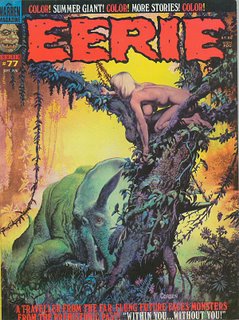
After stumbling upon a screening in Stanley Park of the 1933 version of King Kong last summer, as part of the Monsters in the Meadow series, I got to thinking about the horror comics of my youth -- I read Warren publications pretty much ceaselessly. I actually picked up a couple recently, for old time's sake -- mostly stuff focusing on Richard Corben's art, since I'm a fan, including a copy of Eerie #97, which collects Corben and Bruce Jones' time travel stories (I was really fond of dinosaurs when I was a kid). Actually, the original Corben cover, when the first story ran, in Eerie #77, was better. Bear in mind that I was about 11 years old at the peak of my enthusiasm for this stuff -- the naked women were interesting, but not yet a point of obsession:

Anyhow, I just today realized that the cover for #97, by Val Mayerik, is a play on the famous old Coppertone ads of yore (which actually predate me -- interesting that an ad should be so famous that, even though I never saw it at any point in my life, I should have awareness of it now).

While I'm sharing favourites with you, I also always loved this piece by Berni Wrightson, from Creepy #113:

There's a couple of galleries of old Warren covers online here and here. They make delightful desktop themes... I'm surprised the stories in them don't get plundered more often for Hollywood movies; I always thought "Night of the Jackass" would make a very interesting film, in particular, though I haven't read it since I was a teenager...