There are questions people ask themselves privately all the time, as they experience the disconnect between their public lives and their private experiences, that are seldom made a matter of record, seldom publicly discussed, difficult even to articulate in the current milieu, since they interfere too much with the daily business of getting up and going to work; questions that deeply resonate with the way most of us live: for instance, what value does any of it have, to stuff away the most personal aspects of your life, to deny or ignore your authentic experience of things, your deepest feelings, so you can strap yourself into a suit and go shake people’s hands and try to make money? What is the worth of “growing up and getting a job” – or, once you’re there, of “being an adult” – if it means spending most of your day not being yourself, not even needing to be yourself; not needing to feel or think about the things that matter most to you, that reach the very ground of your being, that most personally speak to your experience, so that you can do “productive,” money making, but ultimately impersonal WORK, to which the majority of your time needs to be devoted? Thoreau, in Walden, says: “Actually, the labouring man has not leisure for a true integrity day by day; he cannot afford to sustain the manliest relations to men; his labour would be depreciated in the market. He has no time to be anything but a machine. How can he remember well his ignorance – which his growth requires – who has so often to use his knowledge?” Given the boring, impersonal realities of functioning in capitalist society, selling your very self for the price of shelter and “comfort” and entertainment – wondering every day if the trade is worth it – wouldn’t it be better to just burrow into your fear, confusion, loneliness, and private obsessions, and seek self-respect (and the love and attention and respect of others) not through knowing that you are regarded as a productive member of a community that you feel no personal connection to whatsoever, but by making your soul public, by producing art that DOES speak of your private experience? If you could fulfill your need for love and attention and esteem in the community that way – if you could somehow produce work that got their attention and won you the acclaim and notice you need -- wouldn’t that be better than a day-to-day life as a drone?
I wonder how Daniel Johnston would respond to these questions? (The Q&A after the film I just saw certainly didn’t do them justice -- not that he was in attendance, and not that anyone asked anything very challenging). It remains unknown at the end of the film how much insight Johnston has into his own career; it seems possible his talk of Satan could productively be attached to my rants about consumer capitalism - he does at one point assert that Satan drinks Mountain Dew in the film -- and that maybe we're getting at the same thing (the religious formulation of the above questions asks what it profits a man to gain the world but lose his soul, and one imagines Johnston has pondered the quote). All the same, there is an aspect of uncontrolled spiralling in his impassioned metaphoric experience of the world -- a condition commonly described as "religious delusion" -- that makes it hard to know how objective he is capable of being about himself. In any event, The Devil and Daniel Johnston just played to a sold out and appreciative audience at Vancouver's Pacific Cinematheque, as a Big Smash/ Frames of Mind - affiliated sneak preview before it opens next week at Cinemark Tinseltown. It’s a fascinating film, but it raises far larger questions than it could possibly hope to deal with, and it’s these questions that are interesting – the film is only the springboard. I could toss off a few more, since it pleases me to frame them: what is the function of the art of a man like Johnston in a consumer capitalist society? How would we describe it? If only Rainer Werner Fassbinder were alive to make a film about Johnston, he could maybe do it justice – making sort of a black comedy of it all: a mentally ill man, as part of his illness, is inwardly compelled to produce art; the rest of the community around him at first despise and reject him as a freak, but somehow he develops a huge following of young people who, ambivalent about losing their own identity to their jobs and social roles, seize on his “authentic expression” of emotion as a passport to connecting with their own personal, private, but publicly unspeakable selves (we could drop references to the Pied Piper into the mix, perhaps, and have parents expressing dismay about their children's taste in music). The man personally cannot be dealt with – he is deeply mentally disturbed and needs to be institutionalized and medicated and controlled by others, and in his daily life is treated as an object, a patient, an inferior; but he is periodically let out into the world to perform his songs, which his fans so need. He is loved by them (tho’ they’d rather be spared the details of what his personal life is like); and to him, all is right with the world -- he is happy to be a star, and that's how he thinks of himself. (Though it's an unkind analogy, I remember Brian Fawcett writing somewhere, perhaps apocryphally, that Zip the Pinhead -- not to be confused with the cartoon character -- believed he was in charge of the circus he was a part of and would occasionally bark orders from his cage to people around him, which P.T. Barnum encouraged them to indulge, since it made him more manageable). After soaking up their love, at the end of the tour, he is driven back to the institution, medicated, and kept quiet. What a relationship of the artist to society…! And what a society, to produce and support it!
(Note: Daniel actually seems to live most of the time with his parents, who obviously love him deeply, though he has caused them much worry and fear and anxiety. The above is a sort of "fictionalized" scenario -- one which does resonate against tonight's documentary, tho').
On some level, tho' I liked the film far more than I suspect she did, I think Penelope Mulligan is absolutely right in her Discorder column; this film fails to really ask the important questions about Daniel Johnston. It contents itself with participating as enthusiastically as possible in the adulation of the man, while “objectively” (and creatively – Gibby Haynes is interviewed while receiving dental surgery) documenting the details of his illness, which is given second place. It's certainly an entertaining ride -- in a more superficial way than a "serious" treatment of the subject matter would be. At one point, for instance, we are shown footage shot, apparently, by Lee Ranaldo and Thurston Moore of Sonic Youth, as they drive around NY looking for Daniel, who has gone off his meds and is wandering the streets in the grips of religious delusion and ambitions to be famous. They believe he gets on a bus to go back to his parents, but awhile later, he is seen again in NY, and eventually ends up in Bellevue, institutionalized. He gets out after a few days and, as the story goes, ends up opening for fIREHOSE that night at CBGBs. That this is the punchline to the story got a hearty laugh from the audience, which is a testament to just how "entertaining" the film manages to be, but maybe just a few people were, like me, left just a little uncomfortable about what we were laughing at. It didn't seem cruel, exactly -- I think most of the audience love Johnston and his music and see bits of themselves in him -- but there are definitely questions of "exploitation" that come up, and of voyeurism, and of the entire nature of this transaction -- questions which Johnston himself is inclined to occasionally voice, tho' not in this film, where he is mostly spoken about (or represented through his tapes and songs), rather than being given a chance to express his own views for the camera. Still, I remember him singing on one of the tapes of his I had, back in the 1980's, about how it's easy for us to come and listen to his songs, but he has to live with his problems all the time...
I can’t wait to see how tomorrow’s screening of Watkins’ Privilege -- which posits the pop-star as the manipulated messiah of a totalitarian state, controlled by the powers that be to help fans conform – resonates against tonight’s show. Daniel Johnston as Christ? Why not? I wonder if he's seen the film...?
Artists occupy a privileged place in North American life: they connect us to the real emotions and private experiences that we, by taking the path most taken, have forsaken. All the better if the artists are insane – all the more “authentic” their expressions. Anyone concerned about these issues, whether they care about pop music or not, is strongly urged to see The Devil and Daniel Johnston. It’s an amazing, bizarre experience. And it's bound to sell the man a few CDs -- he apparently has a new "greatest hits" thing out this week -- which doesn't seem like a bad way for people to spend their hard-earned money, I suppose.
Speaking of which, I now must curtail my writing and go to bed, that I may get up for work in the morning. Be free, Daniel! ...because many of us aren't...
Wednesday, April 19, 2006


Tuesday, April 18, 2006
Upcoming Vancouver Nomeansno Gig (a ways off)
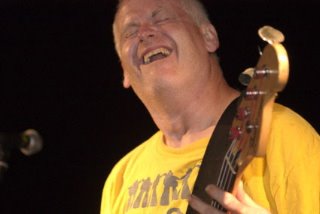
(Photo of Rob Wright taken by Yari in Italy, borrowed shamelessly from the website linked below. Yari, if you object, let me know! -- I'm assuming no one will care or notice. I'm not sure yellow is Rob's colour -- it's a bit shocking, wot?).
Locals who measure out their lives in terms of Nomeansno gigs will be happy to know that the band will be playing June 29th in Vancouver, as part of a CD release party (which is news in and of itself -- I wonder if they'll actually do the Mission of Burma cover I chatted with Tom about at the Mission of Burma gig awhile back? I suggested "Fun World" and he said that band had been thinkin' of doing "Outlaw." Either would work... Note: new Mission of Burma album coming soon! Now if only we could get a reissue of the Volcano Suns' All Night Lotus Party... apparently you can download it here). To put a cherry on the fact o' the gig, Nomeansno will be playing with the heavy Italian avant-jazz unit, Zu -- who have recorded with The Ex and others, so they're no stranger to rock. Zu will also be performing with Mats Gustafsson at the Commodore and the Culch as part of the jazz fest that week).
Seeing Nomeansno live is like therapy for me -- once a year at least, I need to mosh to "The River," to purge myself of the pain of being constantly made aware of how true the lyrics are... Nothin' spells catharsis like that song.
The first glimmers of a good musical summer on the horizon... Hmmm...
Sunday, April 16, 2006
Peter Watkins and Oliver Groom
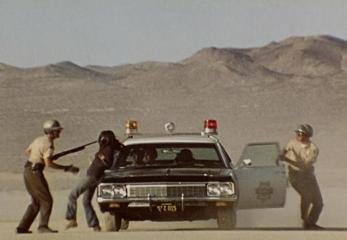
(above: a still from Peter Watkins' Punishment Park).
Since Privilege is screening at the Cinematheque this week, I thought it would be timely to put up some comments from Oliver Groom on distributing Peter Watkins' films, which he has been doing through his Toronto-based company, Project X. See my column in Discorder in May (the current one is on Fassbinder) for more on Watkins, focussing on Punishment Park, which I'll be playing at Blim on May 30th. I'd never heard of Watkins -- save for a couple of comments from friends about The War Game -- until I stumbled onto Punishment Park and was intrigued by the box art; if it weren't for the earnest efforts of Mr. Groom to bring Watkins back from total obscurity and marginalization, I probably would have never explored his work -- I wouldn't have had the opportunity to see it, for one, though the Cinematheque DID screen Edvard Munch a couple of months back (their site includes a link to more press material on the film, through Capri films). The interview with Mr. Groom follows...
1. On the reception of Punishment Park:
Punishment Park is being very well received, both critically and by the public, who unsurprisingly respond strongly to the political and the dramatic content. I think that many are surprised at how effective and topical it still is and wonder how it has remained undiscovered for so long. I've seen a couple of reviews that dismiss it for being dated and naive but these are more the exception. DVD sales have been ok but not gangbuster. Such is the fate befalling older indies without star names or reputations. There is a small hard core of Watkins afficionados but obviously, to be worthwhile from a release economics point of view, we have to go beyond these and I think that we're getting there. As far as I'm concerned it's also very important to get the film out there without compromising it.
2. On the Masters of Cinema edition
There was no serious competition from the MoC release and vice versa, principally because we're talking about different countries and different TV systems. In fact, we (MoC and I) collaborated somewhat in that I provided them with stills, the commentary and Watkins intro.
I think that Peter feels a little less marginalised. He gets regular e-mails through his website (and so he may well reply to yours...) from the aforementioned hard core and from newbies who are discovering his work. However whether he will have the opportunity to return to filmmaking remains to be seen. I know he'd like to and, if that happens because his star has risen a bit more on account of these releases, that would please me enormously.
3. On Watkins the expatriate, his experiences in Canada, and meeting Groom
Peter's currently living in Vilnius. He and his wife Vida have considered moving to France. They were in Canada for about 2 1/2 years and I met him in late summer 2003. About 3 years previously I had suggested collaborating on a Watkins retrospective with the Cinematheque Ontario but they blew me off (although they did finally go ahead with it in March 2004). I was aware of Peter's work but mostly he'd slipped off my radar after Punishment Park because of the increasingly lack of proper releases his films were getting. I was moving ahead with setting up this DVD label in 2003 when I found out that he was living in Hamilton - about 100 km down the road! He was initially a bit diffident about meeting up but we did and we talked about the problems his films had had over the years. In particular he was concerned about Edvard Munch and apparent damage to the original negative, etc.. Well, one thing led to another and the DVD series was born. In spite of the Cinematheque Ontario retrospective and involvement in the restoration and new video transfer of Edvard Munch, Peter was not happy in Canada. He'd had a bit of a bust-up with the NFB and he wasn't getting the opportunities to work and so he and Vida returned to Lithuania in June 2004.
4. The history of Project X's Watkins series
I first saw Punishment Park back in 1972, when I programmed it for a university film society that I was running back in England. I remembered it vividly but hadn't seen it since. That day I first met Peter, he kindly lent me a copy of the French release DVD and, since it's one of the films for which he retains the rights, soon afterwards we agreed a deal so that it could be my first DVD release. There are a number of good reasons why this was the best title to launch the series with: it was immediately available and had been recently re-mastered to video in France; it's a US subject; it's dramatically more direct than some of his others ( - that's not a criticism of the others, I hasten to add!). An important part of rekindling awareness of Peter as a filmmaker is to take advantage of "recognisability" and, for Punishment Park, this involved presenting it as a political thriller (again without compromising it). Meanwhile Edvard Munch has a different kind of recognisability and arguably a different (older) target demographic. So to follow Punishment Park with Munch is, I think, to expand the potential awareness that we're striving for. Currently US sales on Munch (release date 21st Feb 2006) are running at about 60% of those of Punishment Park (release date 28th Nov 2005) but I think that, in the long run, Munch will overtake it.
5. Current and future releases:
The Gladiators has just been reviewed by Glenn Erickson.
This will be followed by The War Game/Culloden on one disc. Then there will be The Freethinker, which will be a challenge (4 1/2 hours) but I haven't started work on it yet. We've spoken about The Journey (14 1/2 hours!) but that's even trickier and so I don't recommend you hold your breath for that one. Meanwhile we have tried to work something out with Universal for Privilege but those discussions have foundered a little. Other titles (Eveningland, The 70's People) are merely possibilities at this stage. And, finally, one of my pet ideas is to publish in print or CD-ROM form a script that Peter wrote in 1968 or thereabouts called Proper In The Circumstances, which was a big project that didn't happen with Universal and Marlon Brando about Custer and the Indian Wars: it's very violent and very Watkins.
6. On net rumours that Punishment Park was "banned"
I don't think that anybody has come up with a White House directive banning Punishment Park! I think that things happen more subtly and more insiduously in the States. I haven't seen much right wing vitriol poured on it. The World Socialist Web Site was negative from the other perspective and I saw one UK review that took the opportunity to have a go at hippies (duh!).
7. Rumours of a Watkins bio
I was in touch last year with one of the guys writing this new book about Peter for Manchester University Press and he said that it was being targeted for early 2006 but it's been very slow coming and I didn't really believe that that would happen then. Hopefully it will be out eventually.
(...thus ends Mr. Groom's interview. He's been most facilitating of the article and has expressed his happiness that Privilege will be screening here -- cheers to him, both for the interview and for making it possible for film geeks to actually SEE Peter Watkins films, and cheers yet again to Kier-la Janisse for her amazing skill at organizing festivals in Vancouver from Texas). Interested parties might want to note that one other of Watkins' films is currently available on VHS, La Commune, distributed by the NFB, who also sell a documentary on his work, on both VHS and DVD, The Universal Clock.
Saturday, April 15, 2006
Peter Watkins' PRIVILEGE to screen at Cinematheque
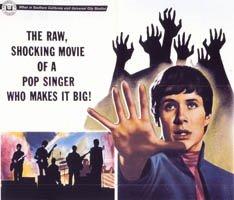
Exciting news: Peter Watkins' PRIVILEGE, a rarely-seen film of his made for Universal just after his controversial THE WAR GAME was banned from the BBC, will be screening at the Pacific Cinematheque as part of the upcoming Big Smash Festival, on April 20th. Kier-la, to her surprise, scored the print directly from Universal, who apparently struck it about 5 years ago for festival purposes (and have yet to make plans to release it on DVD). Oliver Groom, the man behind Project X, who have distributed three of Watkins major films on DVD, says "its very nice;" Privilege is one the Watkins' films he would like to see released, but says that discussions with Universal "have foundered a little." (See last months' articles on the "censorship" of the new print of Cassavetes' Love Streams and the chopping up of his Husbands -- as written about by Ray Carney --for an indication of just how much Sony seem to care about film as art; and watch these pages -- or this screen, I guess -- ? -- for more of my interview with Groom). By the way, I'll be writing about Watkins' PUNISHMENT PARK for the May issue of Discorder and screening the film (on DVD, that is) on May 30th at Blim. It is long past time that people knew this man and his films. I will probably mention the May 30th screening in every second post from now on...
Oh, also: in the odd event that a Peter Watkins fan stumbles across this and doesn't know, THE GLADIATORS is now available on DVD... One wonders if Watkins sometimes feels suspicion about the slow increase in excitement about his films -- since its linked in part to the elite shopping activities of film buffs...
Monday, April 10, 2006
Mecca Normal: New CD, upcoming concert
Never really followed these guys, but I kinda like the song "Attraction" on their Myspace account -- some nice lyrical twists, an eccentric sense of detail and authenticity in their observations. They have a new CD, and play June 4th in Vancouver at Pub 340. I think I might go... but it's a ways away...
Now there's a phrase I'm grateful I don't have to teach my ESL students...
Now there's a phrase I'm grateful I don't have to teach my ESL students...
Sunday, April 09, 2006
Friday, April 07, 2006
BIG (Fucking!) SMASH!!!!!!!!!!!!!!!!!!!!!!!!!!!!!!!!!!

(Note: links below are to things generally MORE INTERESTING than IMDB listings, and often are to official sites. I advise you to click on every single fucking one).
Sometimes I don't pay attention to stuff. Sometimes there are surprises. Like this month's BIG SMASH festival, put on by some of the same people who used to (and may yet still...?) bring us Cinemuerte (since there's an Alamo Drafthouse connection I'm takin' this to mean Celluloid Horror-girl herself Kier-La Janisse, whom I've just sent a fawning email of thanks and devotion). I didn't bother to look into Big Smash until this very night, and what a surprising night it is. The films lined up for this are nothing short of fuckin' STUNNING, from my point of view -- the Minutemen movie, We Jam Econo, My Name is Albert Ayler, Peter Watkins' Privilige -- very rarely seen and important; CLICK THE LINK! -- and a Rip Torn vehicle called Payday, considered his best film; I've heard about it, but never much thought I'd get to see on screen. The Devil and Daniel Johnston is being brought to us in affiliation with this festival, and Dick Rude (the "white suburban punk" with a shaved head in Repo Man, one of the coffee addicts in Straight to Hell, and a former Circle Jerk, if I recall) has a film on Joe Strummer, Let's Rock Again -- I didn't even know it existed! (I was priviliged to see Mr. Strummer four times in my life -- once with his altered Cut the Crap Clash lineup, once with the Pogues, and twice in Tokyo with the Mescaleros). There's soooo much more, too -- including concert performances by (the apparently not dead) Paul Williams (and a screening of DePalma's Phantom of the Paradise) and Wreckless Eric, from whose 1970's pop classic, pictured above, the title of the festival is lifted... Anyone remember "Semaphore Signals" or "It'll soon be the Weekend?" I actually OWNED Big Smash when I was a kid). There's too much more for me to drool over in so short a space -- Jeff Buckley, Roky Erickson, Esquivel, Nina Simone, dub documentaries and more -- so check out the festival program -- some AMAZING music-related films are happening! Hell, I might even buy a festival pass and see Stunt Rock... I only had to sit thru the preview a dozen times during Cinemuerte...
Wednesday, April 05, 2006
Fingers! (and more!)

James Toback always seemed like an odd fellow to me. An early film based on a screenplay of his, The Gambler (1974), is as dark and Dostoevskian a film portrait of a self-destructive, hubristic gambler (James Caan) as one can find; it actually is a bit creepy when you discover that Toback is a gambler himself, since the film doesn't leave one particularly comfortable with its title character. Exposed (1983), starring Nastassja Kinski, Rudolf Nureyev and Harvey Keitel, is a quirky film that locates itself at the nexus of fashion and terror, which is a streetcorner filmmakers seldom visit; I remember thinking that the film was subtle and intelligent enough, when I first watched it, that many people would fail to perceive its true theme -- but now I forget what I thought that was; I recall that Keitel's performance is interesting enough to make the film worth seeing, tho'. I've only seen one other of Toback's films, his first as writer/director, Fingers (1978), a bizarre, troubling, and fiercely, strangely intelligent character study of a concert pianist who is also a gang enforcer -- another unusual nexus to locate a film at -- that stars Harvey Keitel; I like that film a lot, but since I've seen nothing else by Toback, my ability to comment knowledgeably about him ends there, save to say that there's a reason I've seen none of his later output. Since I associate him with the gritty, challenging, character-driven cinema that occupied a certain corner of American moviemaking in the 1970s, I don't know what to make of, an am a bit put off by, the fact that he made a movie with Robert Downey Jr. and Molly Ringwald (The Pick Up Artist, 1987), wrote the screenplay for Bugsy (1991) and has gone on to make movies about race and hip hop (Black and White, 1999). His recent venture with Neve Campbell, When Will I be Loved (2004), got good reviews from some quarters, and he seems to have retained a certain degree of independence, but I've found the recent careers of many American filmmakers active in the '70s to be somewhat depressing -- compare David Holzman's Diary with The Big Easy (Jim McBride) or -- well, actually, I won't even watch any of the later output of Jerry Schatzberg, but I have a strong feeling it doesn't measure up to Scarecrow or The Panic in Needle Park. I want to retain my sense of Toback as an outsider, an obsessive, an eccentric making curious little films on the fringes, in a quietly uncompromising and oddly confident way; I don't want exposure to his later films to threaten that image, because it's important to me to believe that people like Toback are out there on the margins, doing what they do (even if they really aren't, anymore).
And the thing is: I didn't think anyone cared but me, so there was no pressure to explore his later films. Who would I discuss them with? Who do I know that cares? ...Well, apparently the world is catchin' up with me, or else I'm nowhere near as far ahead of it as I think, because a documentary has just been made about Toback, The Outsider, and there's a French remake of Fingers that sounds like a must-see, The Beat that My Heart Skipped. (Note: those two links were to official film sites, not just to the IMDB listings). And both these films, along with a projection of the DVD of Fingers, will be coming to the Vancity Theatre in April! There'll be a special event on the 15th where both Fingers and The Beat that My Heart Skipped screen, with a critical introduction to the films, so that sounds like the night to catch them. Mark Peranson of the Vancity is continuing to surprise and intrigue me with his programming choices -- I hope their attendance is improving! (New programs are out now, btw).
Anyhow, I gotta get to work...
Tuesday, April 04, 2006
Cane Toads for Beer

Thought this was a charming story on innovative solutions to Australia's cane toad problem. Once again, thanks to the Fortean Times for making such delightful news available for easy access...
Sunday, April 02, 2006
Triple Book Launch Poetry Event featuring Elizabeth Bachinsky, Michael V. Smith, and Jennica Harper

Photo by Dave Aharonian
Odd to see someone you grew up with succeeding at what they do. It's almost as strange as starting to feel like you're making some headway yourself... I've known Elizabeth Bachinsky for longer than anyone else in my circle, growing up with her in the suburban-white-trash backwater of Maple Ridge, where the absence of cultural artefacts (aside from the odd neon sign or the Coke cans in the ditch) played a role in our development into creatures hungry for art, literature, film, music, knowledge, and so forth -- though it's really only since that Damo Suzuki show where we ran into each other that we've been socializing regularly (Damo leapt down from the stage, hugged me and kissed her... it was the sweetest thing I've seen a performer do and not at all a bad memory to share in common with someone). It's starting to seem like the day may come where those early chapbooks I have of hers (Skylab and A Grease Fire in the Diner of Your Heart) are actually going to be worth money -- too bad it probably won't be in my lifetime, but this IS Canadian poetry we're talking about. Liz has had two books published this last year, one through Bookthug (given a glowing review here -- I pitched in on a few lines of her anagram of -- all of -- TS Eliot's "The Wasteland," by the way, tho', as fond of anagrams as I am, I couldn't possibly make it through the whole of that poem, so hats off to her) and one through Nightwood Editions, Home of Sudden Service, which is the more personal of the two and speaks to our shared background in a way I find jarring, recognizable, and oddly comforting -- to know that someone else with aspirations could not only survive the 'burbs, spiritually speaking, but live to write about it, and well... Elizabeth will be shortly embarking on a cross-Canada tour, reading at some fairly significant venues, beginning on April 20th in Vancouver, in conjunction with her cohorts Michael V. Smith (aka Cookie LaWhore) and Jennica Harper, both of whom are also launching books. (Matt Rader of Mosquito Press will also be on the bill for the Vancouver gig and is also a fine writer indeed). The event will occur at the downtown UBC bookstore at 7 PM. I've never yet seen Liz fail to win the audience when she reads; Michael I know better for saucy jokes, his novel Cumberland, and his gender politicking more than I do for his poetry, but he's always engaging and thought-provoking. Jennica I don't really know, tho' she has a fine title indeed for her newest book, The Octopus and Other Poems (how deeply pleasing to imagine an octopus as a poem). April IS National Poetry Month, after all -- or so Liz tells me, and I assume she'd know. Read more about the tour and the reading here, on Michael's site -- and come to the event! April 20th, 7pm. Mark the calendar NOW...
Cool Ray Carney article
I continue with my ambition of going to study under Cassavetes' scholar Ray Carney. For those curious as to why, read this.
Cinema Aspirant is Underway: Fassbinder
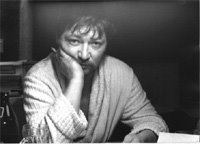
My new column, Cinema Aspirant, is underway at Discorder, with the first article being on Rainer Werner Fassbinder. Next month it's going to be on Peter Watkins, with a screening of Punishment Park on May 30th at Blim.
Saturday, April 01, 2006
Timothy Carey on Farting and more
Just read this great article on Timothy Carey, pictured below.

It includes anecdotes about Carey and Kubrick and Carey and Cassavetes ("theanthropist" is misspelled -- it means the union of God and man, usually figured in the person of Christ, but here applied to Cassavetes) -- Carey worked with both men; apparently they were two of the very few directors who could deal with him. The article also includes a brilliant passage on Carey's feelings about farting; one line of Carey's is so good that I hereby declare it to be my quote of the week: "I always thought if you really want to be a good actor, you've got to be able to fart in public." Amen to that -- I'd place it on the fart-shelf next to Robert Stone's description of the attitude of a hippie guru towards flatulence, in his novel, Dog Soldiers (my favourite book): "Dieter farted loudly and without embarrassment. For every Cassavetes out there, who manages to beat the odds and make a few great films -- I wonder how many Careys there are?
An interesting profile/interview with Carey is here; plus you can apparently buy copies of some of Carey's work from his son's appreciative website, here. I feel so fond of this man tonight, I think I'll go pick myself up a copy of Kubrick's The Killing, or maybe Paths of Glory, just to see him in them again.
Tuesday, March 28, 2006
The Sounds of Sex
It's really annoying listening to the grunts and moans of this female neighbour of mine. She's getting laid a few times a week, at least as far as I can tell. Happy for her, really, but I don't really want to share in the experience. Maybe if I started screaming "Oh, baby" out my window, she'd take a hint...
Sunday, March 26, 2006
Brian DePalma adapts James Ellroy's BLACK DAHLIA
Read a discussion about it here... I was an Ellroy fan for awhile, and I've always liked some things about dePalma...
Bob Ostertag's New Website
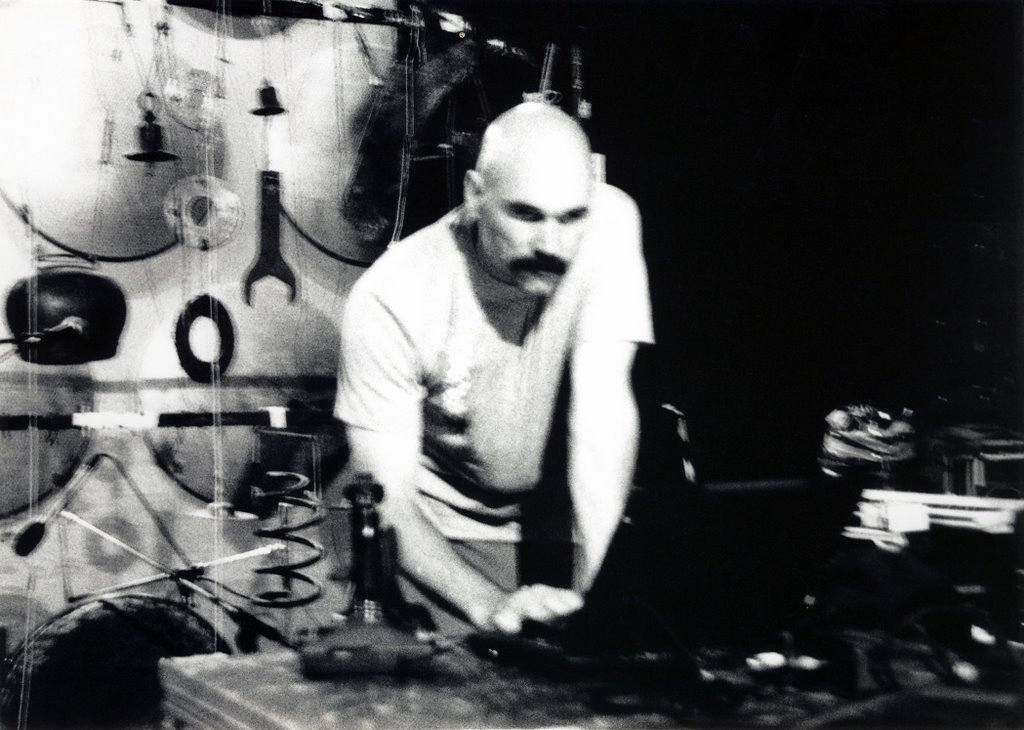
Bob Ostertag has done something very exciting with his new website: he has taken all the works for which he has the rights and made them available for free download. He notes: "I am doing this both to make my music more widely available, and also as a political move in opposition to the interests which have turned 'intellectual property rights' into a battering ram for corporate power;" his homepage goes into greater depth. There's some very exciting music to be found on his site, too -- most of it noisy, weird, postmodern (poststructuralist? postmusical?), and stitched-together from distorted samples and wind-up toys. (Devoted readers might recall that I once mailed a Japanese wind-up toy, a Skull Ball, to Mr. Ostertag as an expression of appreciation for his wonderful concert here a couple of years ago, with animator Pierre Hebert, at the Western Front...) The site also features a lot of Mr. Ostertag's writing, which I've perused before and found interesting... Hours of pleasure to be found on one website alone. Perhaps he'll return to our humble city someday...
Friday, March 24, 2006
Are the Sun City Girls Anti-Semites?
Hey, is anyone else out there disturbed by the shadows of anti-Semitism in the lyrics of the Sun City Girls? These guys are inventive, funny, and sometimes produce brilliant music, and I really respect their Sublime Frequencies side-project, which, in its video manifestation, offers a sort of camcorder verite attempt to document the sounds of indigenous cultures at the crossroads of westernization/erasure (they also have radio collage stuff, field recordings and other valuable archival releases in the audio arm of the project). I met Alan Bishop up here when he was touring their Niger video, and I thought he seemed like an interesting guy, and I liked what he had to say, about how there is some fantastic music being made out there in the world that no one in the west is documenting or listening to, much of which stands at risk of being lost. It deeply disturbs me, though, that they have songs like “I knew a Jew Named Frankenstein” (the words of which are suspiciously absent from the lyric archive linked above, and are sufficiently garbled as to frustrate transcription, though they don't seem very Jew-friendly). They have other anti-Zionist and what start to seem like anti-Semitic barbs in their lyrics, and after awhile, they start to add up. I know that taking any of what they say too seriously or literally is kind of a doubtful enterprise, since their songs often have the quality of ridiculous, self-mocking put-ons and put-downs, but… here are a few examples of why I begin to get disturbed.
Their take on the Fugs’ “CIA Man” has a couplet to the effect of, “Who can hand feed a Zionist with a spoon/ While kicking Palestinians to the moon,” and refer to the “Mossad Institute of Terror."
In X+Y= Death, on KALIFLOWER they have a put-on line about how “26 billion non-Jews died” in an "Eat My Holocaust" -- a pretty questionable target of mockery.
“I Deal a Stick” on BOX OF CHAMELEONS has the verse,
They uncritically repeat one of the sillier rumours about 9/11 – one which is debunked in the film PROTOCOLS OF ZION – in the "song," "WFMU Station ID: Palmer" on Carnival Folklore Resurrection 11, presenting the following as a radio broadcast:
This resonates against their rhetorical, “So, do you still think Bin Laden did it?” on “Where is What it Was?” -- though I'm not sure what the band's pet theory is.
On 98.6 IS DEATH, they refer to Israel as the “angel of death” in a long surreal rant called "Without Supervision/Radio ID #3."
On NAPOLEON AND JOSEPHINE, we get:
They also have a preponderance of Sublime Frequencies projects from Middle Eastern, Arab, and Muslim countries, and on one – I Remember Syria – have photographed a sign in memory of Golan Hospital, "destructed by Zionists." I also read a concert review somewhere online (I think -- or was it in an issue of Bananafish?), describing a concert where one of the band members, at some point, shouted from stage, "Fuck Zionists." (I can't find a link, sorry).
I mean, I know, I know: you could probably compile an equal number of lines from Sun City Girls songs that advocate drinking blood, cooking with Satan, and "going fishing with a hammer and sickle and a bone crusher attached to a pickle," and none of them would add up to anything you’d want to take very seriously... but given their fondness for conspiracy theories, and the seriousness, evil history, and sheer stupidity of antiSemitism... I get kinda worried by quotes like the above. Anyone have anything else to add to the list, or a rebuttal they'd care to offer?
Their take on the Fugs’ “CIA Man” has a couplet to the effect of, “Who can hand feed a Zionist with a spoon/ While kicking Palestinians to the moon,” and refer to the “Mossad Institute of Terror."
In X+Y= Death, on KALIFLOWER they have a put-on line about how “26 billion non-Jews died” in an "Eat My Holocaust" -- a pretty questionable target of mockery.
“I Deal a Stick” on BOX OF CHAMELEONS has the verse,
Don't ask me who they are, because they taught you to ask me that question, so
they could hide among the ambiguous slime that shrouds their diabolical empire,
yeah, well it's been too late for centuries: Cum on them before they cum on
you!
They uncritically repeat one of the sillier rumours about 9/11 – one which is debunked in the film PROTOCOLS OF ZION – in the "song," "WFMU Station ID: Palmer" on Carnival Folklore Resurrection 11, presenting the following as a radio broadcast:
This is Palmer from Asia and Emerson, Lake and Myself, and when I'm in the New
York area watching Israelis celebrate on rooftops as the remote-controlled
aircraft fly into two towers, and the American public are duped, as they
usually are, I always listen to WFMU Radio.
This resonates against their rhetorical, “So, do you still think Bin Laden did it?” on “Where is What it Was?” -- though I'm not sure what the band's pet theory is.
On 98.6 IS DEATH, they refer to Israel as the “angel of death” in a long surreal rant called "Without Supervision/Radio ID #3."
On NAPOLEON AND JOSEPHINE, we get:
"Well when you -- I don't recognize no boundaries. Try drinking a
beer. You know they say when you're Roman do -- in Rome, do as the Romans do
-- or when in Israel you do as the Palestinians do, well when on the planet
of Earth, you do as you wish."
They also have a preponderance of Sublime Frequencies projects from Middle Eastern, Arab, and Muslim countries, and on one – I Remember Syria – have photographed a sign in memory of Golan Hospital, "destructed by Zionists." I also read a concert review somewhere online (I think -- or was it in an issue of Bananafish?), describing a concert where one of the band members, at some point, shouted from stage, "Fuck Zionists." (I can't find a link, sorry).
I mean, I know, I know: you could probably compile an equal number of lines from Sun City Girls songs that advocate drinking blood, cooking with Satan, and "going fishing with a hammer and sickle and a bone crusher attached to a pickle," and none of them would add up to anything you’d want to take very seriously... but given their fondness for conspiracy theories, and the seriousness, evil history, and sheer stupidity of antiSemitism... I get kinda worried by quotes like the above. Anyone have anything else to add to the list, or a rebuttal they'd care to offer?
Thursday, March 23, 2006
Ab Baars is coming!
In April, Dutch saxophonist and avant garde/ free player Ab Baars will be bringing his quartet to the Ironworks, a cozy little venue in the back o' Gastown. Read about it here!
Wednesday, March 22, 2006
Thinkin' About Charles Gayle
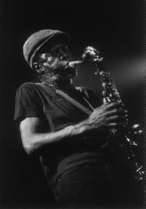
Dunno why I'm thinking of Charles Gayle lately. He's a free jazz saxophonist and sometimes pianist from New York who performed here a few times in the 1980s. He is best known for having been homeless for a long period, playing on the streets; he can afford a small apartment in New York, now -- I imagine in one of the less expensive areas. Gayle has a powerful style -- like someone who is trying to blow his guts out through his horn, trying to force more experience, more raw emotion, more of his soul out of the instrument than it can actually channel; more interestingly, the two times I saw him, when the mood overcame him, he stopped playing and began preaching onstage -- what seemed at the time a particularly hostile form of evangelical Christianity. At the Glass Slipper -- anyone remember that delightful little venue? See here for an undated article on an attempt to reinvent it -- I recall him leaving aside his sax, taking up the microphone and saying a few things about Christ; it was at a peak point of intensity, musically, and came as quite a shock. There was an occasion -- I don't remember if it was the night in question or not, since for some reason (drugs?) the memories of that evening are vague for me -- where it is said he actually cleared the venue, testifying and haranguing the unbelieving audence until they walked out. I don't think that happened that night, if it ever did; but I do recall quite clearly that at a subsequent Vancouver International Jazz Festival, at one of the free shows, he started to preach in a similarly inappropriate manner -- while playing the piano, as I recall. He told the audience that he wasn't there to ENTERTAIN them -- as I recall it, he said something like, "white middle class folks think they're gonna come to a jazz festival and be entertained, but I'm here to tell you that YOUR SOUL CANNOT BE SAVED except through Christ. Maybe you think you're saved but I'm telling you if you don't accept Christ you are going to burn in hell..." It didn't seem like jazz to me, and it definitely didn't feel like entertainment, but it caught my notice and stayed in my memory (and in fact is about the only thing I recall from that year's festival, other than thinking Paul Dolden had a silly hairstyle). I don't believe that Mr. Gayle has played here since. He's a bit sheepish about the testifying thing -- and downplays the hostility of it -- in this interview, which makes for an interesting read; but actually, testifyin' or not, I think I'd like to see Mr. Gayle play again. I'm listening to Kingdom Come, my favourite of his discs, as I write this... This is a man with something to say, something to offer, something he BELIEVES; and it's pretty interesting to see free jazz as a form of evangelism (which it seemed to be with Coltrane and Ayler as well, tho' perhaps not as overt). Cheers to Charles Gayle.
Tuesday, March 21, 2006
The Donner Party They Ain't
Buncha Americans in an RV got stuck in the snow in some offroads place and were stranded for two weeks. Somehow I find this story amusing. I would prefer not to analyze why.
Friday, March 17, 2006
Twisted Little Japanese Horror Film: Marebito


Oh: serious Tsukamoto fans in our damp city are advised to scour their nearest Book Warehouse for the Tom Mes book, Iron Man, about his life and films; it's been marked down to $14.99 and there are a few copies still out there...
Furry Lobster Plush Toy
Yet more fun from our intrepid overseas correspondent. (He also offers us this optimistic prediction of the future of America, from Salon).
Not much impressed with the Shane MacGowan documentary
 I remember, as a young man, being pissed off with Bruce Weber’s Let’s Get Lost, a documentary about jazz trumpeter and vocalist Chet Baker. Baker was still alive when the film was made – he fell, was pushed, or jumped from a hotel balcony in Paris near the end of the shoot, depending on which rumour you abide by; I vote for suicide, since it seems to me it’s very unlikely someone could live as dissolute a life as Baker and not be, on some level, deeply ashamed of himself. Weber, at one point – clearly judging his subject – confronts him about the issue of the children he’s fathered, asking him if he remembers all their names. Baker takes offence, and so did I – it seemed to me a lousy thing to do to someone on camera. Weber was also pretty judgmental about Baker’s drug use, getting Baker to describe his intake, his fondness for speedballs, and so forth, while the cameras captured it all in unforgiving black and white – it seems a humiliating thing to do to a human being, a cruelty, and one could easily theorize that the scrutiny of the filmmaker had something to do with Baker’s killing himself, if that’s what, in fact, he did. I recall that at the time I left the theatre more disgusted with Weber than with Baker, and went home and took a shower, metaphorically speaking... I haven’t seen Let’s Get Lost in a long time, but I wonder now if I’d feel the same way about it; having just sat through If I Should Fall from Grace: The Shane MacGowan Story at the Pacific Cinematheque, I suspect I wouldn’t, since at least Let’s Get Lost tries to be about something, tries to give its audience something to think about, tries to take a position in regard to its subject... There’s not much of that in If I Should Fall from Grace; it’s basically a series of rock videos and performance clips punctuated with fairly informal interviews where few probing questions are asked. Here are a few questions that I would have liked to have seen the filmmakers grapple with – that I occasionally found myself trying to think about while the film did its best to distract me with far more trivial matters:
1. So here we are in a commodity-driven consumer culture which periodically seizes on this poor idiot or that and elevates them head and shoulders above the rest, to suddenly be a spokesperson for something; even forms of music that are meant to be rebellious (punk) or defiantly local (like Irish music) are included in this phenomenon, such that angry young men with bad teeth and ears that stick out can become famous as (pop) cultural icons – but only insofar as they assent to their expressions of angst, dismay, alienation, anger, whatever-the-hell-you-want-to-call-it, being made into product and mass-marketed, which in turn will have a deleterious effect on their ability to continue doing what they’re doing... The more successful you are, the better you are at speaking from your local perspective, communicating your authentic experience – which is what being a songwriter is kinda about – the harder it will be for you to maintain your connection to the very conditions that drive and inspire you. In some odd way, the story of Shane MacGowan intersects with the story of Kurt Cobain, because there is a fundamental conflict between their starting point and the fame which it led them to; you can’t be a pissed-off, alienated kid and a superstar goose who lays golden eggs at the same time – and this probably informs the self-destruction of both men. Cobain killed himself, and it looks from the film that MacGowan retreated back into his roots – into pubs, the Irish diaspora in London, and his family life (while continuing to drink far too much, though in a way, that could be viewed as an aspect of his roots, too, rather than as a form of self-destruction -- he is Irish, after all; maybe it's just a stereotype of mine, but there seems to be a larger place allowed for alcoholism in Ireland than in many places in the world; we see Shane piss drunk through most of the film, but seldom, even as he actually dribbles a bit of drool, object to it, as I think we would if someone from North America were THIS intoxicated on film...). Why not examine all this? Why not actually think about what the life trajectory of MacGowan means or teaches us, rather than just filming him talking about the good old days, with a misty golden tint to evoke a mood of nostalgia and lots of clips of his music?
2. And what ABOUT nostalgia? I mean, there’s something kind of suspect about it, ain’t there – something that has all too much to do with the way the marketplace functions...? In the 1980s, I clearly recall that a LOT of the music you heard on the radio was from the 1960s; everyone talked about the 1960’s as a special time, and valorized its heroes – Hendrix or Led Zep or the Who or the Beatles or whatever – and films about them played on TV and their successes were made to seem glamorous and significant. In the 1990s, there was a resurgence of disco and funk and so forth – remember Boogie Nights? Now we’re busily re-consuming the music of the 1980s, punk and “New Wave” and all that, and re-experiencing how wild and rebellious we all were back then… It’s not that one decade is in fact more significant than another, it’s just that mass culture is perpetually about 20 years out of sync; the youth of any given generation have fuck all purchasing power, and little access to the channels by which information is disseminated, so their own “authentic” cultural expressions are more or less ignored at the time when they’re happening, until such a time as they’re old enough to actually start laying down some money and/or making films themselves. This is why we now have films about artists like Townes van Zandt, the Minutemen, and Jandek being made – I knew who these guys were when I was young, but certainly none of my friends knew or cared, and they received zero attention from the mainstream media; even the Pogues were a fairly obscure band, up until “Fairytale of New York” beat the odds and got a smidgen of radio play… Most media attention was either focused on transparently plastic and forgettable mass-produced crap – the stuff we want the kids to buy, rather than what the really bright ones were trying to seek out – or on the music of 20 years previous…
What this probably means is that there’s in fact a fair bit of interesting music being made today that I have no idea exists, being produced and consumed by extremely eager and attentive youth, like I was back in 1985, and being completely ignored by the media and by the generation who can actually afford to support it – who are too lost in their narcissism, too busy (re-)consuming the tokens of their own youth, to take any interest. (The media, busy selling their own image back to them, certainly won't try to call anything current to their attention). Many of these artists will retire or die in obscurity (like d. boon of my day) or stop making music long before anyone makes a documentary about them or before they attain iconic status, and there’s something really tragic and unfortunate about that, which this film does nothing to acknowledge or even mention. (Are there young bands, influenced by the Pogues, who are doing stuff that's attracting attention in London or elsewhere? Did the Pogues play a part in the development of any trends in music that currently exist? Are there current roots-music-revivalists whom MacGowan admires? No such questions are asked... No NOW is allowed to interfere in our comfortably basking in THEN). No wonder the audience at the Cinematheque was uniformly in their mid-30s... Wherever the hip kids were in the city -- it was probably more interesting.
3. ...And while we’re talking about the global marketplace, what exactly IS the relationship between consumer culture and folk culture? Songs of the sort MacGowan sings predate punk, predate pop, predate CDs and LPs and recording technology of any sort, and have deep, deep roots in traditional/folk culture. In fact, that’s a lot of what people are trying to connect with when they buy CDs by bands like the Pogues; they’re trying to find some connection to roots, to place, to a people, which is increasingly hard to find in urban life in North America, and generally has to be packaged with a generous dollop of postmodern irony (which, really, the Pogues didn't trade much in -- they had a bit of that rare commodity, authenticity, to them). Much as there are things I like about life in Vancouver, there’s not much sense of belonging to a human community, of being a person with a people in a place that has meaning; I spend far more time wandering through an impersonal concrete market, shopping for meaning, than I do in groups that I feel profoundly personally connected to. It’s precisely because of this condition – and the need to compensate for it – that one of the most enjoyable concerts I’ve ever been to was seeing the Pogues perform with Joe Strummer at the Commodore Ballroom in the 1980s. Even tho’ I’m not Irish and don’t have any great connection with the half-Celtic blood that runs in my veins – as my last name, MacInnis, attests, my father’s side of the family is Scottish, by way of Nova Scotia – coming together to share in the experiences and feelings sung about by MacGowan that night (as he passed whiskey bottles down into the front rows and a young fan, riding the shoulders of her boyfriend on the dance floor, flashed her tits at him, to his clear delight), I felt like I belonged to something, that I had a place in a community (pressed there up against hundreds of other happy fans, singing along to the songs and swaying to the music). Briefly, hearing MacGowan belt out his own alienation, I didn’t feel alienated any more; hearing him sing his desires, I felt mine validated and expressed and made real, which is, in fact, an increasingly rare and precious feeling… Why not explore the connection, between this deep need for authentic expression and belonging, and the alienation and dislocation that are its ugly urban twin?
4. And though, really, the politics of all that is fine and well by me – I mean, what else are we supposed to do? We need to compensate for how fragmented we are by some means or other, need to find community where we can – here’s the catch: it’s still not great art. Pop music (and even consumer capitalism) latches on to real human needs, sure, let’s grant it that; but the fact is that I just spent about two hours of my time and ten dollars of my money watching what mostly amounts to the rock videos of yesterday, interspersed with the commentaries of the people who made them. I doubt anyone watching the film with me learned much of anything at all, particularly given that the only questions the film asked (did the band fire Shane or did he use a passive-aggressive strategy of self-destruction to quit?) shed light on nothing much larger than the personalities of the people on the screen, who, in the big picture, just aren't that important. It amounts to merely another manifestation of celebrity worship, which is basically just narcissism by proxy. There are better things I could have done with my time, better uses of music, better uses of cinema, and I mildly resent having had my time wasted, even by people who try so hard to flatter my former tastes. Fond as I am of pop music, enough is enough; the audience, whether it knows it or not, basically just spent two hours masturbating to its own image, and its starting to seem like a far too common vice... The premise that the film proceeds on, that the music and the celebration of it after the fact is enough, is in fact a little scary, as was the applause and happy buzz with which the film was received. Most people in the audience seemed to have had a satisfying experience -- but why?
These are a few questions that I struggled with while watching as Shane MacGowan’s front teeth steadily decayed as the archival footage progressed towards his present vast gap (and why is it that the British Isles have such atrocious dentistry, anyhow?). It would have been interesting, too, to think about the relationship of alcoholism to music; I recall the question coming up during one of the interviews in the (only marginally more interesting) documentary on Townes van Zandt that played the other week – why is it that musicians, more than any other group of creative people, seem so inclined to fuck themselves up on alcohol and/or drugs? And just how fucked up is MacGowan, anyhow? He seems like a more or less happy man, though it would have been interesting to see what he’s like sober, to get a proper sense of that -- he likely isn't, very often. One imagines that at least some of the people around him suffer from the fact that he constantly drinks, and that he has a few bad days himself -- he doesn't look particularly healthy or alert, and his songwriting and singing certainly don't seem to be what they were. The film doesn’t probe too deeply into these questions, either. It interferes with the audience being able to get off, I suppose, like seeing the track marks on the arms of a pornstar might intrude in one's pursuit of orgasm. Easier to stay on the surface, to not interfere with the happy vibe. Because that's what we want, a happy vibe. So we can keep up the rituals of production and consumption, so we can maintain our own shallow coast through life... To that end, we'll indulge MacGowan his drinking and basking in past glories -- as long as he's not so far gone as to interfere with our good time.
Ach: I guess the only conclusion I can draw is that I need to start being even more discriminating about the films I attend. I really was a big Pogues fan, once -- I thought it would've been enough. I hope the documentary about Daniel Johnston coming up is going to be more interesting… I’m almost tempted not to attend.
Post-script: those not completely dissuaded from their desire to see the film can catch it one last time at 3:45 PM Saturday, March 18, at the Pacific Cinematheque, 1131 Howe St.
Wednesday, March 15, 2006
The Winks play March 24th!
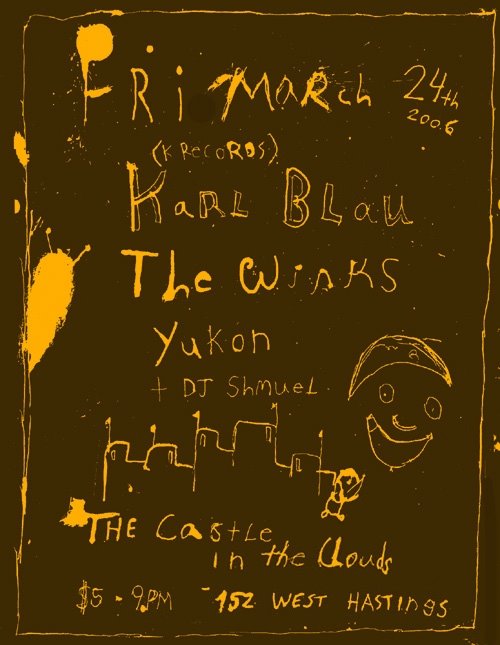
It is long past time that I actually made it out to another Winks show and this looks like the one. Wishing them well on their Canadian tour. The email from their mailing list follows the gig poster: 
Hi there,
Its 5:30am and we're about to leave for tour. When we get back there's going to be quite a happening at our space, The Castle in The Clouds, Friday March 24th.
There will be music by Karl Blau(K Records), la Winks,Yukon & DJ Shmuel.
Karl Blau is really neat and from a strange and distant land. Check him out: http://www.myspace.com/karlblau
Attached is a poster but what it won't tell you is that Richard Beddoes & Marek Bula will be hanging art work from the walls.
And how to find this show you might ask. Well the address is 152 West Hastings. That's a little ways down the block(south side) from Cambie and Hastings. Look for friendly people behind a brown gate.
Doors are @ 9pm and cover is five dollars.
Sincerely,
Todd, Tyr & Tim.
Hi there,
Its 5:30am and we're about to leave for tour. When we get back there's going to be quite a happening at our space, The Castle in The Clouds, Friday March 24th.
There will be music by Karl Blau(K Records), la Winks,Yukon & DJ Shmuel.
Karl Blau is really neat and from a strange and distant land. Check him out: http://www.myspace.com/karlblau
Attached is a poster but what it won't tell you is that Richard Beddoes & Marek Bula will be hanging art work from the walls.
And how to find this show you might ask. Well the address is 152 West Hastings. That's a little ways down the block(south side) from Cambie and Hastings. Look for friendly people behind a brown gate.
Doors are @ 9pm and cover is five dollars.
Sincerely,
Todd, Tyr & Tim.
Monday, March 13, 2006
Nice Note from Ray Carney
Allan,
Thanks VERY MUCH for the able reporting on the Love Streams print. You are doing to it what I did to Shadows. (Well, not quite, since my Shadows project took four or five years and about a hundred viewings, but you have the same spirit.)
Thanks also for clarifying the "Ray Carney is right/wrong" statement. People take what I say out of context and then accuse me of the mistake. Just to clarify another thing about Husbands that has been misunderstood by misreading my writing: UCLA created TWO master prints. Two. Not one. One print is almost complete. It lacks one or two minutes of footage. But that's pretty close to complete. The other lacks approximately 11 minutes of footage, including most of the Leola Harlow and some of the vomiting scene. Rowlands asked for the creation of the second print because she found the Harlow and vomiting stuff "in bad taste." That's what I wrote. I think it's disgraceful of course to tell someone to cut her husband's work because SHE finds it tacky. But that's a fact. The cut print was in fact the one shown at the UCLA premiere screening of the film where Rowlands was present. And it was the one used for later video releases. And used for later print creation. But there is a long print that exists and that was part of the UCLA project. I hope that clarifies my point. What I wrote was not wrong and should not be in dispute. I was writing about the way an instiution like UCLA honors Rowlands's wishes, and how wrong I think that is, and how much it tells us about the priorities of film preservation. I never said that the long print was not obtainable at all. It is. But it is darn rare and almost never seen. The short print, the Rowlands approved print, is the one generally screened, at UCLA and elsewhere.
You may add this to your blog or post it as you see appropriate.
All best wishes and thanks for your sleuthing.
Ray Carney
www.Cassavetes.com
Ray Carney, Prof. of Film and American Studies
Author: Cassavetes on Cassavetes (Farrar, Straus and
Giroux/Faber and Faber); Shadows (British Film
Institute/University of California Press); John
Cassavetes: The Adventure of Insecurity; The Films of
Mike Leigh (Cambridge University Press); The Films of
Frank Capra (Wesleyan University Press); Speaking the
Language of Desire: The Films of Carl Dreyer
(Cambridge University Press); The Films of John
Cassavetes: Pragmatism, Modernism, and the Movies
(Cambridge University Press), and other works.
Thanks VERY MUCH for the able reporting on the Love Streams print. You are doing to it what I did to Shadows. (Well, not quite, since my Shadows project took four or five years and about a hundred viewings, but you have the same spirit.)
Thanks also for clarifying the "Ray Carney is right/wrong" statement. People take what I say out of context and then accuse me of the mistake. Just to clarify another thing about Husbands that has been misunderstood by misreading my writing: UCLA created TWO master prints. Two. Not one. One print is almost complete. It lacks one or two minutes of footage. But that's pretty close to complete. The other lacks approximately 11 minutes of footage, including most of the Leola Harlow and some of the vomiting scene. Rowlands asked for the creation of the second print because she found the Harlow and vomiting stuff "in bad taste." That's what I wrote. I think it's disgraceful of course to tell someone to cut her husband's work because SHE finds it tacky. But that's a fact. The cut print was in fact the one shown at the UCLA premiere screening of the film where Rowlands was present. And it was the one used for later video releases. And used for later print creation. But there is a long print that exists and that was part of the UCLA project. I hope that clarifies my point. What I wrote was not wrong and should not be in dispute. I was writing about the way an instiution like UCLA honors Rowlands's wishes, and how wrong I think that is, and how much it tells us about the priorities of film preservation. I never said that the long print was not obtainable at all. It is. But it is darn rare and almost never seen. The short print, the Rowlands approved print, is the one generally screened, at UCLA and elsewhere.
You may add this to your blog or post it as you see appropriate.
All best wishes and thanks for your sleuthing.
Ray Carney
www.Cassavetes.com
Ray Carney, Prof. of Film and American Studies
Author: Cassavetes on Cassavetes (Farrar, Straus and
Giroux/Faber and Faber); Shadows (British Film
Institute/University of California Press); John
Cassavetes: The Adventure of Insecurity; The Films of
Mike Leigh (Cambridge University Press); The Films of
Frank Capra (Wesleyan University Press); Speaking the
Language of Desire: The Films of Carl Dreyer
(Cambridge University Press); The Films of John
Cassavetes: Pragmatism, Modernism, and the Movies
(Cambridge University Press), and other works.
Sunday, March 12, 2006
Pancakes and Noise and Blim, Oh My: a photo document

Above: your humble flipper, complete with Nihilist Spasm Band T-shirt (it seemed apt).

Above: I was able to take a photograph of some of the noise being produced.
 The artist known as Coelacanth, unless, in the manner of Pharoah Sanders, the misspelling elsewhere mentioned (Ceolacanth) is intentional (a Corporate Executive Officer previously thought to be extinct, or such), in which case, Ceolacanth. Great (Canadian minimalist garage punk blues duo) Deja Voodoo couplet, from the song "Coelacanth:" "They used to think/ I was extinct/ But then one day/ Somebody finked," with Muddy-Waters-esque "da DAH da dah" punctuation between phrases.

Volunteer Yuko hard at work. A vegetarian, she sacrificed her comforts for the event and turned many a sausage, even (yuck!) getting some on her finger. Alina is not pictured, our other pancake volunteer. Hi, Alina. The musician who has a recording bearing your name, if you forgot, is Arvo Part... (Correction: Dan of G42 informs me that Alina's name is spelled Alena, which blows the Arvo Part reference. Sigh).
 Mark likes syrup!
Though in fact I was only another mere volunteer, it seems that thanks are in order, so I will provide some: thanks to Yuriko of Blim for her part in the event and to... Noel, was it? for extension cords and to everyone whose name I forgot, or am simply neglecting to mention. Thanks to Emma (sp?) for the beer and for organizational duties. Thanks to Dan for the grills, organizational duties, and for getting everyone to applaud me for my role as (free) pancake huckster. Thanks to me for flipping. Artists at the event are listed below, and should also consider themselves thanked! A fine day of pancakes and noise.
Now to wash the batter off the Nihilist Spasm Band shirt...
Saturday, March 11, 2006
The Amazing Disappearing Breasts: Being Anal About LOVE STREAMS
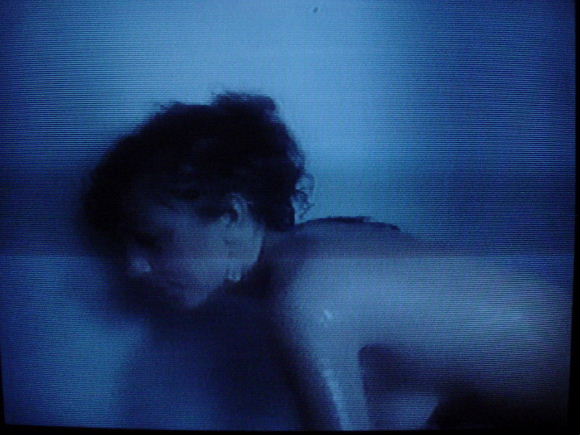
Hrrrmmmm.... Here's some weirdness for obsessive cinephiles out there. As some of you may know, I attended a recent screening of John Cassavetes' Love Streams with a stopwatch and am in touch with Tom Charity, the directors of the Vancity Theatre, and the guy with the bowtie himself, Ray Carney, about the issue of whether or not the new print is complete; I'm also trying to note differences between it, the old VHS, and the new French DVD. Professor Carney -- whom I once actually suggested was WRONG about the material missing from the VHS release, clarifies that the cuts occur during the first dream sequence; strips of black leader -- which either were designed to give a jumpy, dreamlike quality to the scene, or perhaps "slugs," filling spaces where material was to be added, which were kept because Cassavetes liked the effect -- were edited out by the Golan/Globus guys for the video release, perhaps because they thought they were left in erroneously; there's also a jump cut that happens around the same time that is removed, giving a more seamless feel to the scene, which is restored in the new print. Tom Charity, who owns the DVD, confirms that the DVD leaves the black strips in; the new print has them; and I can confirm that the VHS is missing them -- so Ray is RIGHT. So far, so good: but now it gets much stranger. The VHS version INCLUDES MATERIAL THAT IS MISSING FROM THE NEW PRINT!!!!!!! You heard it here first, folks (probably): and all of this revolves around BREASTS.
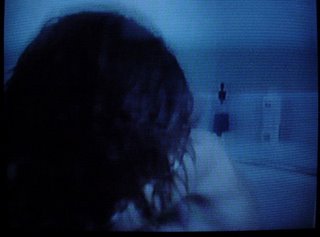
Those who know Cassavetes' cinema in depth know he was sheepish around nudity; that he is said to have disapproved of the nude scenes in Scorsese's Mean Streets, and only has any substantial nudity in one film of his, The Killing of a Chinese Bookie, which, being set in a strip club, sorta required a bit of flesh (tho' even there, so little skin is actually on display that at one point Ben Gazzara, playing the club owner, Cosmo Vitelli, improvises the complaint, "what the hell kinda strip joint is this, nobody takes their clothes off!'"). It is said that in one sequence in Love Streams, where Cassavetes, as Robert Harmon, is in bed with two of the young girls he gathers around him, he had initially scripted nudity into the scene, but when the girls said they felt a little uncomfortable about it, provided them with nighties. It is somewhat noticeable, then, when, early in the film, Robert Harmon comes upstairs and discovers two of these girls frolicking nude in his shower. In the VHS edition, tho' the sequence only lasts a few seconds, you see the breasts of BOTH girls, quite clearly.
The new print, while otherwise excellent, and including the missing black leader, LACKS said breasts. The girls, I believe, are the same, but the shot is framed such that you can see neither of their breasts, not at all. And now we have several possible theories that come to mind:
1. There are alternate cuts of Love Streams, as with so many of Cassavetes' films, and some have more breast in them than others. This may be a matter of Cassavetes' restless nature, or it could be that Golan and Globus pressured him to include the fleshier take, though it seems pretty unlikely that he would give way to such a cheap demand. It is also quite possible the film was changed without his knowledge or approval -- there are many instances of studios meddling with Cassavetes' films; for instance, apparently all recent releases of Husbands are missing about 12 minutes of material, including (I am told, tho' I only recall one) two songs sung by John "Red" Kullers and several minutes of toilet sounds during the infamous puking scenes. (There have been debates about the quality of the UCLA print of the film, but there are, according to Ray Carney, two versions of the film that were prepared by UCLA -- see his note, above. By the way, if anyone cares, there is a petition to have Husbands released on DVD here). In any event... Under this thesis, the Sony people either happened on a breastless version, or sought one out, believing it truer to Cassavetes' intentions.
2.The Bagel Boys, as Cassavetes called Golan and Globus, decided when they were snipping out the black leader that they should also change the shower sequence so there was more skin, true to their exploitation background, and substituted an alternate take of this scene; in fact (under this thesis), only the VHS version has the breasts in it; they aren't supposed to be there, and the new print is based on the correct theatrical version of the film, somehow restored posthumously to Cassavetes intentions, as with Touch of Evil. This seems quite unlikely, but I mention it to be complete... Though I've seen Love Streams on the screen previously, it was around 1990, and can't decisively confirm that there were breasts visible, tho' it seemed to me there were...
3. The breasts were always meant to be there, were part of Cassavetes' final cut, and have been edited out by Sony for reasons as yet unknown, having to do with MPAA ratings, TV broadcasting considerations, legal issues, or irrational prudery, perhaps centering around a fear of showing what could be seen as representation of lesbianism... This seems the most likely thesis.
I do not know. I will be at the theatre tomorrow, with my stopwatch again (to check a couple of other minor points) and will attempt to get a decisive record of the absent breasts in the new print. And then... well, I dunno what I'll do then. Ask Tom to check the DVD. Email Ray. Email Sony. Post links on IMDB and various other places to this article and plead strangers to solve the mystery... It isn't like I'm discovering a lost version of a Cassavetes' film, but... Gee, this is all kinda exciting.
Much yelling -- a drunken party -- is occuring across the alley outside my window. Can't people sense that important work is being done here?
POST-SCRIPT:
Having seen the film again, I can confirm that the image source is the same, but zoomed in on/cropped and shortened. You see only the head and upper shoulder of the girl pictured above; they are much larger on the screen; you do not see her breasts, and you do not see the girl on the left in the image below-- who, in the VHS edition, you actually see rise from a seated to a standing position, glimpsing her breasts on the way. (The VHS scene is at least 3 seconds longer, maybe more -- I'm afraid I couldn't see the stopwatch well enough to get a sense of the exact time of any specific scene in the projected film). In the new print, you also don't see the back wall of the bathtub, the bottles, etc. I am not even sure if a viewer of the new print would realize that there are two girls in the tub; a friend present said it went by in a "flicker" and he really didn't see what was going on. Very curious.
Pancakes and Noise
Come Sunday, prior to the final screening of Love Streams (see below), you will find me flipping (and, I hope, eating) pancakes at Vancouver's first (annual?) noise pancake breakfast at the relocated Blim. I suppose we could also call it our first pancake noise breakfast, tho' that does suggest that the pancake is the source of the sound... A mild sizzle, the scrape of a spatula on a pan, the gentle sigh of releasing air as it is flipped... Ahh... A description of the event follows:
Dear friends.. we are pleased to invite you to a noise event.
Vancouver's first noise pancake breakfast - Sunday March 12th. 11am - 4pm.
Blim #197-east 17th (@ Main)
$5-10 sliding scale, includes free breakfast (or while supplies last..)
featuring:
Eric Lanzillotta (Allan asks: anyone got a better site for me to link?)
Eric Lanzillotta has been involved in sound in various aspects over the last two decades. In this time, a few fragments have been released for public consumptions on labels such as Anomalous Records, Selektion, Alluvial Recordings, Beta-Lactam Ring Records, RRRecords, EE Tapes and Jnana Records. Some of these recordings have involved collaborations with Ralf Wehowsky, Andrew Chalk, and John Hudak. He has also contributed to recordings by Hands To, AMK, Ultra, Edward Ka-Spel and irr.app.(ext.). As a live performer, he has appeared in United States, Canada and Japan, both solo and in duets with Bernhard Gunter and Aube.
Sistrenatus
Sistrenatus comes forth as a bleak industrial presence against a backdrop of harrowing white noise and dark ambient textures. The audible essence of degeneration and decay. Cold Spring Records will be releasing Sistrenatus' debut album "Division One" in 2006.
Flatgrey
.horrible misanthropic noise.
(DeadbyDawn Soundsystem)
Coelacanth (Allan notes: I have no handy links for this band, but I have corrected the spelling of the name, and if anyone wants to read about the fish, they may do so here).
paperbagepoxy (also apparently siteless)
pbe provides protection for his instrument during transit and should be retained in case subsequent shipment becomes necessary. Repackaging instructions can be found in section six of his manual. all sales final.
G42 (pictured above at 1067)
alienatedinvancouver.blogspot.com assumes no liability for hearing loss, ear damage, or indigestion as a result of your participation in this event.
Thursday, March 09, 2006
John Cassavetes' Love Streams at the Vancity Theatre

Ah, happy day! My Discorder article on Cassavetes' Love Streams is online -- the piece that "Cassavetes in the Provinces," below, is meant to complement. I've been three times to see the film at the Vancity, and can report that there were definitely fewer than 100 people in total who saw the film during its Monday to Wednesday run -- tho' all appeared to enjoy it; I was so pleased to hear the audience laughing (or going really quiet) -- so pleased to be able to experience the film socially, as films are meant to be experienced. I don't think Tom Charity got to explain the mysteries of Jim the Dog (or to point out Xan Cassavetes' cameo -- she's cute!), but he did an excellent job framing the movie before the Tuesday screening, despite a few technical difficulties, and he was most happy to sign my copy of his book, John Cassavetes: Lifeworks (since, as he put it, I'm probably "the only person in Vancouver who's bought it!"). It's such a delightful film -- a far sweeter experience than Cassavetes' most difficult fare (Faces, A Woman Under the Influence) -- but by no means a lesser film of his... For those who haven't gone, it screens again on Sunday at 4PM. It's probably your last chance to see the film on the screen, and unless you know me personally, it's unlikely you'll be seeing it on VHS, since I believe I own the only copy in the city (there used to be a copy at a certain Rogers' video, but I sent it to a now-lost ladyfriend in New Jersey... it's available in France on DVD, but otherwise it's very hard to find). Cinema lovers will be doing themselves a grave disservice if they miss it...
Alas, I couldn't even use my birthday to leverage people into coming to the screening (it's your souls I'm thinking of, folks, really... when judgment day comes, make sure you mention that I tried...!). Of the 20 or so people I invited myself, only one showed up (thanks, Dan!) -- but he'd invited Heather of the Creaking Planks along, too, so really there were three of us (thanks, Heather! Glad you liked the film...!)... I'll be in attendance Sunday, so those of you who skipped the 7th have one last chance... For your souls...!
Seriously.
Wednesday, March 08, 2006
Furry Lobster
Controversial Japan-based foreign-rights activist D. Ashton provides this story, with the comment, "I wonder what one of these tastes like."
Sunday, March 05, 2006
Al on Al: an Exclusive Interview with the Minimalist Jug Band

…I’m a physical moron
A physical fool
I should have gone to guidance
Back in high school
Instead of Joy of Sex
I read John Paul Sartre
Instead of falling in love
I just fell apart
And I’m not bragging
I’m not gay
I’m just a lousy lover
I’m a lousy lay…
No good in the sack
No good in the hay
Conversation that’s my forte
But I’m a lousy lover
I’m a lousy lay…
-- “I’m a Lousy Lay” by the Minimalist Jug Band
I’d worked at the same used book and record store with Al Mader for a couple of years before discovering that he was a performer with a CD recorded. It took me a couple of months after that to remember to ask him to bring me a copy of his CD, For Crying Out Loud – they’re made with homemade covers drawn on the back of cardboard boxes, one of which is pictured above, but they’re factory-pressed, not CDRs – and a couple of weeks further for him to do that. Seeing him play live took another few months, since usually I would be filling in for him at the store on nights when he had a gig; finally managed it at the Marine Club last week, where he opened for Rodney Decroo. After he tried to warm the crowd up with a few lighter numbers – “Posting Crap on eBay,” for instance – he got down to the gut-wrenching, self-deprecating, morbidly humorous matter at the heart of his work, and the audience – particularly those who had been drinking a bit – gave more than a few whoops and cheers during such numbers as “Making Myself Sick” (“I’m having dizzy spells, things are shifting, turning/ and every day my guts are churning/ and I ask myself, well what’s the answer/ Is it a brain tumour or stomach cancer?”) and his Reveen-impersonating “Problems in a Box” (particularly after the box overflowed). I went into the store, on a night when he was working and I wasn’t, to interview him, as a doo wop record by the Spaniels (Great Googly Moo!) played in the background. I started by asking him about how he conceived of his work; it’s designed, he said, as a vehicle for a “songwriter who can’t sing” – someone with plenty of musical desire, but no ability.
“In my mind, they’re songs, but when people hear it, they often go ‘oh, spoken word.’ But yeah, I think of it as music, though there are obviously connections to poetry... Initially I began playing in clubs, opening for bands, but then I chanced on a slam poetry event at the Press Club, and I thought I could do it this way, too. You have to do it without props, so I did it without the bass. Actually, I started doing this in the 1980s, before slam poetry existed, but I’ve known about the scene for awhile now, so it may have subliminally influenced me...” Al accompanies himself on a washtub bass during his club performances – it’s basically a washtub with a hole in it and a string attached. That's the whole band, and the inspiration for his song, "A Washed Up Guy on a Washtub Bass."
A physical fool
I should have gone to guidance
Back in high school
Instead of Joy of Sex
I read John Paul Sartre
Instead of falling in love
I just fell apart
And I’m not bragging
I’m not gay
I’m just a lousy lover
I’m a lousy lay…
No good in the sack
No good in the hay
Conversation that’s my forte
But I’m a lousy lover
I’m a lousy lay…
-- “I’m a Lousy Lay” by the Minimalist Jug Band
I’d worked at the same used book and record store with Al Mader for a couple of years before discovering that he was a performer with a CD recorded. It took me a couple of months after that to remember to ask him to bring me a copy of his CD, For Crying Out Loud – they’re made with homemade covers drawn on the back of cardboard boxes, one of which is pictured above, but they’re factory-pressed, not CDRs – and a couple of weeks further for him to do that. Seeing him play live took another few months, since usually I would be filling in for him at the store on nights when he had a gig; finally managed it at the Marine Club last week, where he opened for Rodney Decroo. After he tried to warm the crowd up with a few lighter numbers – “Posting Crap on eBay,” for instance – he got down to the gut-wrenching, self-deprecating, morbidly humorous matter at the heart of his work, and the audience – particularly those who had been drinking a bit – gave more than a few whoops and cheers during such numbers as “Making Myself Sick” (“I’m having dizzy spells, things are shifting, turning/ and every day my guts are churning/ and I ask myself, well what’s the answer/ Is it a brain tumour or stomach cancer?”) and his Reveen-impersonating “Problems in a Box” (particularly after the box overflowed). I went into the store, on a night when he was working and I wasn’t, to interview him, as a doo wop record by the Spaniels (Great Googly Moo!) played in the background. I started by asking him about how he conceived of his work; it’s designed, he said, as a vehicle for a “songwriter who can’t sing” – someone with plenty of musical desire, but no ability.
“In my mind, they’re songs, but when people hear it, they often go ‘oh, spoken word.’ But yeah, I think of it as music, though there are obviously connections to poetry... Initially I began playing in clubs, opening for bands, but then I chanced on a slam poetry event at the Press Club, and I thought I could do it this way, too. You have to do it without props, so I did it without the bass. Actually, I started doing this in the 1980s, before slam poetry existed, but I’ve known about the scene for awhile now, so it may have subliminally influenced me...” Al accompanies himself on a washtub bass during his club performances – it’s basically a washtub with a hole in it and a string attached. That's the whole band, and the inspiration for his song, "A Washed Up Guy on a Washtub Bass."
Al lists influences like John Otway and John Cooper Clark (“a punk rapper, a rapper before there was rap”), and admits to being encouraged by the existence of bands like the Nihilist Spasm Band, who also can play no conventional instruments (my review of the NSB’s sole Vancouver show is here; I’m rooting for a collaboration – the Minimalist Spasm Band, or maybe the Nihilist Jug Band) and Eugene Chadbourne, who self-markets CDs with homemade covers. He has one Jandek record in his collection (“the one with a faded grey cover with a photo of Jandek on it,” he told me, prompting me to explain just how unhelpful that was as a means of narrowing down which recording it is) and thinks that it’s pretty interesting. I asked him how he feels about the term outsider music– the existence of the genre seems to suggest there’s a target market out there that Al could pitch himself to, but he bristles a bit at the suggestion.
“Yeah, I’ve had people say that before, but ‘outsider music’ suggests a performer who is deluded and oblivious, who doesn’t really know what they’re doing. The performer is found art – you’re like a piece of wood that happens to look like something else, and it’s the person who ‘discovers’ you who gets to define you as an artist. You’re the soup can. I’m not that concerned with defining what I do, and I don’t want to close any doors, but I don’t really want to be compared with Wesley Willis. Hasil Adkins might be all right.” (Some readers may be familiar with Hasil Adkins through the Cramps' cover version of "She Said," the one with the "Oo-ee-aa-aa" chorus that appears on Bad Music for Bad People. An odd archive of various pieces that could be considered outsider music is included on Ubuweb, here).
Al got started in Toronto in the 1980s, on the fringes of the punk scene. Initially he’d just bring objects, and “play on pots and pans,” and busk his lyrics until someone gave him the washtub. He’s performed with various roots and bluegrass musicians – some conventional musicians are “less disappointed than others” by what he can do with his bass – and he’s performed with Rowan of the local trio the Creaking Planks (who cover, somewhat more tunefully than the original, his hilarious thrift-store-shopping opus, “Dead Man’s Pants”); he’s also a long-term co-conspirator with the Hate Filled Man himself, Chris Houston, who produced For Crying Out Loud gratis. At various points, though he rarely gets paid more than $50 for a gig, he has opened for Nick Cave, Blurt, They Might be Giants, and, to his great pleasure, John Otway; he’s played festivals and poetry slams in Providence and in Minneapolis, and toured around Canada. He appears on a tribute album to former Rank and File member Alejandro Escovedo, doing a cover version of Escovedo’s “Thirteen Years” (“No Depression magazine reviewed it; they liked most of it but they hated me”). His unreleased, unfinished, but hopefully eventually upcoming CD features collaborations with rockabilly artist Ronnie Hayward and former Ray Condo sideman Stephen Nikleva. Al also notes that on the upcoming release, “finally the jug band has a jug;” the artist currently known as Petunia, with whom Al has toured, provides blown accompaniment and some background vocals. (Hey, Al -- did I link to the right Petunia? I mean, how many Petunias could there be?).
Most copies of the run of 250 of his first, self-released CD have sold, though Al thinks there are probably some left at Red Cat Records, or maybe Zulu. You might be able to get one off him if you can figure out when and where he's playing next -- he sometimes gigs at the Railway Club. Or you could phone Carson Books' Broadway store on a Saturday night... There is no release date yet on the second disc. His stuff is really designed to be appreciated live, anyways, he notes.
I asked Al if “I’m a Lousy Lover” (which has also been covered) has gotten him laid and he responded, “People ask me that,” and that’s about as far as that went, so I asked him about crowd responses to his work.
“Well, I used to play in clubs where there were a lot of old guys still in there, drinking from the afternoon, and they’d sometimes figure that this was some sort of open mike event, and they’d come up to the stage with their drink and wait there for a moment where they could cut in or interact with me, but since I don’t really stop, they’d just be standing there, right in front of me, with their drink… I’ve played a lot of shows like that,” he chuckled. “I’ve had people stand on stage beside me, too. Sometimes people can just hate what I do; other people have said, ‘you’ve got a lot of guts,’ which is a kind of mixed review if you think about it… Sometimes there are small pockets of attention in the room – you can feel that a few guys over there are listening, and if they look interested enough sometimes other people start listening too. It really varies. I’ve had standing ovations and I’ve had the plug pulled, so to speak.” (Al gestures the traditional head-being-cut-off semaphore signal for “get off the stage”). Thinking of a story, he smiles: “One time this young guy was heckling me at the start of the show and then by the end he wanted me to come with him and help him quit his job.”
Some pieces on the disc are autobiographical -- "I Feel Great Today 'Cos I Ate Today" is about a period of homelessness Al survived in Toronto in the '80s -- but not everything should be taken at face value; like a novelist, Mader bends facts to the needs for emotional authenticity, which is his main concern.
One of the funnier aspects of the Minimalist Jug Band’s performances is his tendency to insert ironic references to pop songs and pop culture into his lyrics; he’ll close a dark tour through his emotional difficulties and eccentricities by dropping a deadpan “You may be right I may be crazy but it just may be a lunatic you’re looking for;” “I’m a Lousy Lay” ends with him tossing off – no pun intended – a reference to Bob Dylan’s “It Ain’t Me, Babe” (“...it ain’t me you’re looking for.”) Often he would use a collage of these quotes as a way to build bridges between songs, but he also acknowledges that part of his intention is to point up the hollowness of the source material. “A lot of stuff that you hear out there is pretty insufficient, emotionally. Take a song like the Flying Lizards’ ‘Money.’ They’ve taken the song and they’ve actually removed the emotion from it, made it just a pure flat product, which is all right, too, I guess, but what I try to do is to reattach the emotion. These words should have meaning.”
Whenever the new CD comes out, there’ll be a track on it about a guy who uses music to get through emotional difficulties. Al admits there’s a cathartic element to his work, and if the Marine Club show was any indication, he’s helping at least a few of the people who paid attention to achieve their own catharsis, too. It’s a pretty positive social function for any artist to aspire to. Godspeed, Minimalist Jug Band!
One of the funnier aspects of the Minimalist Jug Band’s performances is his tendency to insert ironic references to pop songs and pop culture into his lyrics; he’ll close a dark tour through his emotional difficulties and eccentricities by dropping a deadpan “You may be right I may be crazy but it just may be a lunatic you’re looking for;” “I’m a Lousy Lay” ends with him tossing off – no pun intended – a reference to Bob Dylan’s “It Ain’t Me, Babe” (“...it ain’t me you’re looking for.”) Often he would use a collage of these quotes as a way to build bridges between songs, but he also acknowledges that part of his intention is to point up the hollowness of the source material. “A lot of stuff that you hear out there is pretty insufficient, emotionally. Take a song like the Flying Lizards’ ‘Money.’ They’ve taken the song and they’ve actually removed the emotion from it, made it just a pure flat product, which is all right, too, I guess, but what I try to do is to reattach the emotion. These words should have meaning.”
Whenever the new CD comes out, there’ll be a track on it about a guy who uses music to get through emotional difficulties. Al admits there’s a cathartic element to his work, and if the Marine Club show was any indication, he’s helping at least a few of the people who paid attention to achieve their own catharsis, too. It’s a pretty positive social function for any artist to aspire to. Godspeed, Minimalist Jug Band!
Wednesday, March 01, 2006
Obscenity
George W. Bush plans to place flowers on Gandhi's grave on his tour of India.
Arundhati Roy writes on it here. Some useful background on the political context and possible repercussions of Bush's trip to India here.
After the fact:
Turns out that Bush's security team had sniffer dogs go over the Ghandi shrine, to the dismay of the priests who attend it. They had to purify it.
Lacking cable, I usually don't get to see Bush's speeches, but it happened I was wide awake and channel surfing through the wasteland when Bush's press conference in Pakistan aired. It was fascinating to watch -- I've never gotten to see Bush's arrogance in such detail, or the surreal ambience of a press conference where the only people who get to ask questions -- or indeed, are in attendance -- have been hand-picked based on their willingness not to ask or say anything that might embarrass anyone. President Musharraf looked like he was straining from the discomfort of having Bush's hand up his ass, but it didn't stop Bush from using him as a ventriloquist's dummy... It was a fascinating, disturbing experience.
Arundhati Roy writes on it here. Some useful background on the political context and possible repercussions of Bush's trip to India here.
After the fact:
Turns out that Bush's security team had sniffer dogs go over the Ghandi shrine, to the dismay of the priests who attend it. They had to purify it.
Lacking cable, I usually don't get to see Bush's speeches, but it happened I was wide awake and channel surfing through the wasteland when Bush's press conference in Pakistan aired. It was fascinating to watch -- I've never gotten to see Bush's arrogance in such detail, or the surreal ambience of a press conference where the only people who get to ask questions -- or indeed, are in attendance -- have been hand-picked based on their willingness not to ask or say anything that might embarrass anyone. President Musharraf looked like he was straining from the discomfort of having Bush's hand up his ass, but it didn't stop Bush from using him as a ventriloquist's dummy... It was a fascinating, disturbing experience.
Subscribe to:
Posts (Atom)