Sunday, June 11, 2006

Maurice Spira at the Grunt Gallery and Paneficio Studios


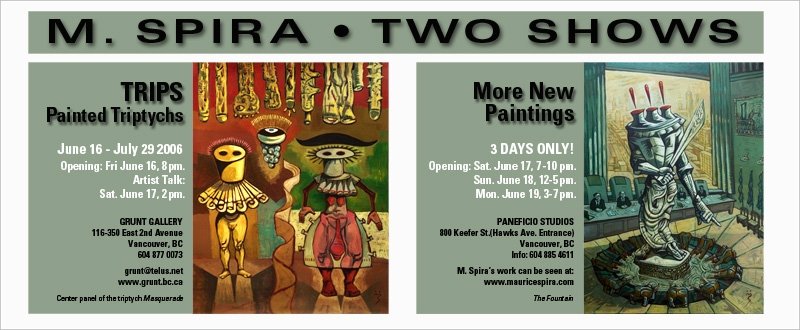
A few weeks ago, I interviewed Sunshine Coast artist Maurice Spira about two upcoming shows, one at the Grunt Gallery and one at Paneficio, both starting this weekend. The Paneficio Studios show, which are in fact in the working space of Spira's friend, Richard Tetrault, will only take place from the 17th to 19th and will nicely compliment the Grunt show, so I'd advise going to both if possible -- click on the banner, above, for times, including those of the openings and Spira's artist's talks (the banner was prepared by Thomas Ziorjen, another Sunshine Coast artist and friend to both Spira and myself; he also took all photographs that you see here, and several of Spira's home and studio that didn't make the article). The interview ran in the Nerve Magazine, though this month's issue is not yet online. Spira is small, articulate, and intense, and rather ran with the ball, talking freely and and cogently about many topics; while it is easier to get a sense of what Spira doesn't believe in (and what he isn't) when talking with him than to arrive at any positive definition of the man or his work, it is difficult to resist his charm or his intelligence. An interview with Spira will also be featured -- not by me, alas -- in SubTerrain magazine. Copies of the Nerve Magazine, with the finished article, are available around town and will also be available at Spira's two shows. Rather than rewrite it, I've decided to just stick the whole damned transcript up here, lengthy as it may be (we talked for almost two hours).


(When I arrive at the Whip coffee shop, there is a discussion ongoing between Maurice and Karen, another artist showing at the Grunt, of a place where two mountains meet – she can’t think of the word, he’s trying to think of it)

You know, she’s going back to a show I had at Burnaby Art Gallery probably in the early 80s, and Todd was the curator there at that time and I had to cancel the show in a gallery on Beatty St, because the person running the gallery refused to accept a painting into the show… The painting was called, um… I’ve forgotten what it was called now but it was sort of a sex act, a dreamscape sex act and anyway, they said no no, you can’t have that painting in the show, and so on and so on and anyway, I had a big battle and eventually I withdrew from the show, and Todd, just by a fluke, just happened to be there that day, an hour later of something, and he said I think there’s a gap on the calendar out at Burnaby Art Centre. We’ll put the whole show on, including this painting, and we’ll sort of save the day. Anyhow, Karen attended that show, and she claims – of course I have no memory of this – that in my artist’s talk, I talked about landscape, somehow, and I talked about the - about something that’s not a valley – the space between two mountains. I have no idea what she’s referring to.

There’s no sexual connotation to this?

I don’t think so, I don’t think so, I mean it’s curious, it sounds like I would be, you know, speaking symbolically and metaphorically…

You don’t do landscapes?

As I matter of fact, I worked with landscape for years in the early 70s – uh – in the mid and late 70s. I lived in Vancouver and I went out regularly with my easel and I worked outside en plein air for at least, I would say, three, close to four years, up and down the waterfront, where BC Place is now, it used to be the old CP pier, and, uh, and I worked up and down… I’ve still got a few of those paintings. I did quite a bit of landscape work and occasionally I’d get out and go to White Rock and Steveston, places like that. I’d go with a friend, Richard Tetrault, who was very keen on, y’know, painting out of doors… and now, lo and behold, all these years later, 2005, last summer, with two other artist friends, I spent, uh, July August September working out of doors on the Sunshine Coast and I produced 13 canvases. It’s a return to direct painting out of doors. You go to your site, you have no idea what you’ll find… you make very rapid decisions because light is changing, wind direction is changing, everything’s in flux, and you set your easel up and you start to work…

(The waitress comes, I attempt to order a coffee and Maurice orders another beer. Maurice jokes with the waitress about her saying she’s “signing off” instead of “signing out,” and Maurice orders a Stella Artois. I ask if there are muffins, but the waitress doesn’t know her menu. She suggests a bagel and lox, if there’s no muffin available).

So… at what point… I don’t know how to describe your work. It seems like it owes to surrealism, but it also seems to owe something to underground comics…

(Maurice interrupts to pass me his invitation, as designed by Thomas)

Do you consider yourself a surrealist?

No. I realize the term surrealism is exceptionally malleable and elastic, but you know, it’s a catch all phrase, and I’m willing to point to certain surrealistic conventions, odd, even bizarre juxtapositions, depictions of what might be termed absurdist situations, or, for instance, I have no problem in revealing that I do feel that I’m working with my subconscious, when I develop imaginative ideas. I work in a series of books often through the winter months in which I employ a kind of stream of consciousness approach – I scribble every little thing down and see what it looks like, then I might choose bits and pieces and random, which is a classical surrealist approach… You’re familiar with … um, what the hell’s that term? Corpse… exquisite corpse, corpse exquisite, anyway, what’s the French term for it, where, you know, you get two or three people working on a single sheet of paper and one does the head and one does the middle and one does the lower third and that – and it frees up, the, uh, the imagination. It’s randomized, you don’t know what’s going to come out. They do it with texts, as well. Like Burroughs did it with cut ups. So in a way I’m doing that but I’m not doing it as consciously. I just fill these pages with, um, scribbles. Some of them are somewhat abstract, they’re often figurative, and they really do reveal what’s buried in me. They might reflect my concerns that I’ve picked up off the radio. I’ve said this elsewhere recently, but I don’t have television or a computer, so it’s just audio, I listen in to the radio, and I pick something up, something’s happening, 6 o’clock news, some… and I go whoa, y’know, and I scribble in my book, and it’s not a direct correlation but there’s no question that some of what flows out is influenced by what I’ve heard earlier in the day or perhaps the day previous, and very much like the way dreams work – I mean, dreams really do reflect what’s going on currently in your waking life, so that, you know, if I’m anxious about a certain thing, that might show up in a wildly amplified and peculiar manner in your dream… so to that extent I don’t mind opening up to admitting that surrealistic devices may be discernable in my work, but I’m not…


(The waitress arrives, fails to give a beer to Maurice, gives a coffee to me, and reports that there are no muffins. She uses the phrase “I just thought it was a random thing,” but the referent is not discernible. I look at the menu. Maurice reports that they have good hash browns. I order the lox and bagel and a mojito, to go with my coffee. Joking with the waitress ensues, and Maurice sips his beer).

So, y’know, of course what, what concerns me is when people in a rather loose and ineffectual manner refer to me as surrealist. I do object to it, and what they’re thinking of is, of course, is the cliché of Salvador Dali. I’ve had people with no background whatsoever or grasp of art history say oh, your work is just like Salvador Dali, well of course it’s absolutely not like Dali whatsoever. What they mean is, oh, it’s not, y’know, flowers in a vase… Since we don’t recognize it as sort of normalized bourgeouis material, therefore you’re a surrealist. It’s weird, therefore… I remember a comment in the guest book at a show I had up on the coast years ago, and this comment was, “M. Spira is sick,” and I thought, okay, this is good, not “M. Spira is a surrealist,” and I thought, okay, I can accept this!


(Mojito and beer arrive. Maurice asks for a glass).

Talking about channelling things that you hear on the radio into your notebooks – it seems that there’s a fair bit of anger in some of your works…

Oh, absolutely, I find myself – well – it’s Allan, isn’t it? Allan, here’s the thing… It’s very important to point out, Allan, that I also … not ameliorate, but, uh, perhaps, it’s, um, balance out my irritability and anger, my sometimes ferocious critique of what I consider to be really abhorrent and ugly traits in, in, y’know, contemporary life, I balance that out with humour, which is often absurdist… So… I wouldn’t want anything to think – I hate to feel – I sort of see myself, some of the time, anyway as somewhat of a satirist, it really bothers me to think that I’m a dry polemicist. You know, I mean, I’m sort of throwing that out almost as a joke, because, I mean, it’s obvious I’m not a polemicist, however, earlier on, I was a young Marxist and then after that an anarchist in a somewhat doctrinaire style in Montreal of the late ‘60s and early 70’s, and I found out – I found out about being doctrinaire and inflexible with this group of very intellectually elevated socialists and Marxists, and I kind of moved through that, and so now I’m, my irritability or anger takes the form of an anti-authoritarianism… So you know, yes, I’ll own up to that, I’m not concerned by that, but I’m not, personally, a person with a big chip on their soldier, uh, shoulder who is continually angry. In fact, I’m a very keen gardener, and I actually have a very extensive vegetable garden. It’s bigger this year than it’s ever been and I’m completely absorbed in the world of, y’know, micro-organisms, worms, and tiny plants that I nurture along, and it really is – it’s a relief from the contemporary world, which is so often, frankly, infuriating. And uh… So I mean, sure, when I listen in to the brief sound bites, which is what I get mostly what I get from, mostly the CBC – though I do tune in to CHLY, the Malaspina College station, which has remarkably radical, very interesting political and social programming – I do tune into them; you get more of a broad analysis, a deeper critique of contemporary matters – but even then – I am hoping that I’ve attained some kind of equilibrium, some kind of balance, because I have been, y’know, all twisted out of shape as a younger person and I simply haven’t the stamina to be that way today, and it’s counterproductive as an artist. I would rather generate a kind of absurdist critique, rather than uh – for instance, I don’t offer solutions, and this is something that fellow anarchists and anti-authoritarians and most especially people who ally themselves somewhere on the, kind of, amorphous left will often look at someone like me and only see someone who generates negative value, negative ideas, without any positive solutions, and it’s true that I no longer have the blueprint that I carried with me when I was in my 20’s. When I was in my 20’s I had a blueprint, and it was simply a case of encouraging people to follow my blueprint. Well, I abandoned that a long time ago.

(I comment on dogmatism as the vice of the young)

Precisely. It’s pretty much like straight medicine’s idea of “If you do this, you’ll be fine, if you don’t do this you’ll regret it.” It’s much more complex than that, y’know? There are many, many influential factors around – and not to mention age. I mean, I’ll be 62 in July, so I imagine my life experience, stuff I found out. I found out it’s not a good idea to be bummed out all the time! It’s like, uh… It’s just stupid. It seems to be a good idea at the time, earlier on, y’know, to be pretty defeated and miserable – I presented this to the world, and as you know, if you present a kind of a, a kind of a negativized field, people will rebound from you like crazy… So I haven’t been that way for a long time. I’m very disciplined however… People often ask me how I can be so productive. Even Thomas marvels at my productivity, but the answer is, that’s it, that’s what I want to do, it’s the way I define who I am and it’s how I use my creative powers and insights in this visual and graphic form. Also in gardening. I love to build garden structures and it gives me a bit of an outlet – y’know, for three dimensional labours. I also heat exclusively with wood, so I split my own firewood – I don’t actually use a chainsaw anymore, but… All these things give me an opportunity to feel a little more grounded a person.


How did you get out to the Sunshine Coast?

Well, what happened was, that, um – I’ll sort of give you the extremely brief trajectory. I left England in 1966. I was there for more than, for my first 20 years or so. I came to Montreal, I, um, had a ex-brother in law – now ex-brother in law, at that time -- who sort of took me under his wing and suggested that, you know, he would turn me into a decent citizen and an all-around successful person. I very quickly horrified and disappointed him by starting to do LSD, and getting involved –

(Food arrives. Maurice comments that he loves how the lox looks on my blue plate, but declines my offer to share. The lox really does look beautiful)

…and so I very quickly moved on, different jobs, got involved with a silkscreen company, was in Montreal from 66 to 74, got caught up in revolutionary and radical activities, primarily against the Viet Nam war, with the American deserters committee and draft resistance, but also the Quebecquois aspirations at that time. By ’74 that chapter was coming to a close – it was an extremely exciting and rewarding period. I worked on an underground paper called The Local Rag and did illustrations for it…

(I ask about the FLQ.)

FLQ involvement? No, no, I wasn’t, of course not, you pretty much have to be Quebecquois, but I was there, absolutely. I was there in 71 when they had the war measures act. I was there, yeah. I was frisked on the street, there was curfew, and so on and so on.

Were you known as a socialist at that time?

By 71, I had quit belonging to the socialist party – this was not, this was the socialist party that’s affiliated with the socialist party in Great Britain and the United States, they were a very, I would say, intellectually elevated Marxist organization, not to be confused with NDP or anything like that. For instance, their reading list, which they introduced me to as soon as I joined up, was, uh, y’know, Peter Kropotkin, Mutual Aid, the autobiography Emma Goldman, Karl Marx’ Das Kapital, of course, volumes 1 and 2 – it was in English, fortunately, although it might as well have been in German as far as I was concerned – it was just a fabulous reading list, y’know, Orwell, Homage to Catalonia, all these things – and I very quickly found out – I began to get a bigger grasp of labour history, the wobblies, Sacco and Vanzetti… All these exciting historical trends. Also, I was introduced – I was not aware, I was unaware of any of this while I lived in England – although I was off on a bit of a different tangent in England as a reader… Anyway, in Montreal, I really got an education, a historical education. I found out about Utopian experiments of the 19th century, whether religious or secular… All very very interesting. So anyways, in 74, someone said, haven’t you ever been to the west coast, and I said no, and they said that’s ridiculous, you’d better go, and I said okay, I’ll go, and the Montreal chapter was closing down, it was coming to a close, it seemed like a natural ending of various things going on there for me and I hitchhiked out west, took 9 days, had an absolutely tremendously interesting 9 days, met genuine hobos on the road – not young people, but older, y’know, old time hobos, very interesting that way… Came out west, lived in many different locations. My longest stint was in the west end in a communal house in the mid and late 70s. I… What I haven’t mentioned is, that, uh, that I became after, after a truly depressing stint of wage labour at an electro-plating factory in old Montreal, I, um, became an artist’s model at the encouragement of this guy that I was hiring for this small life drawing group I was running, and lo and behold he said, you know, this is bullshit, you don’t want to go to this job every day and torture yourself, y’know, earn a living as a model and I said “Well, is that really possible?” and he said “Yes, absolutely possible” and I became a model in Montreal, even before leaving and then I continued that here on the west coast. I modeled actually, for ten years, a full ten years. And, um, then I met my friend Richard, Richard Tetrault, we started going out doors to paint, and I started printmaking quite seriously…

Were you making a living?

I was making a living as a model.

Were you also selling paintings?

Occasionally. Yeah. Occasionally supplementing my income with paintings. So I really got going with working out of doors, en plein air in the mid and late 70s…

En plein air? My French is atrocious and my art history is not so good, either --

Painting out of doors. That’s what the impressionists did, it was called en plein air, Monet and all those guys, they all went out of doors and stood there whether it was raining, windy, they had to tie their easels down, which is something you find out about very quickly, a wind will whip your canvas off your easel into the gravel or wherever. These contingents – you have to be aware of this, and it really is a challenge, and the light is changing… Everything’s in a state of… You know, your painting becomes a composite over about three hours, approximately three hours… three or four hours. You’ve got to realize that what you observe when you first get going is going to be completely gone and changed 15 times by the time you’re ending you’re painting, and then, and now, last summer when I rediscovered this, when I re-established this, uh, habit of going out of doors with these 13 canvas, 6 of which I’ll be showing at Paneficio, they’re all industrial sites, but in the landscape, right, so there’s mountains and oceans but they’re industrial. They’re quite realistic, they’re not very stylized at all. They’re… I think most people would say that they’re pretty realistic, though not very polished, we’re not talking about an 18th century concepts of realism, I would say anyone looking at them would say that’s a 20th century painting, they wouldn’t confuse it with the polish of an earlier era.

If not surrealist, then what? You call your more "surreal" works your "poltical/personal works on your website...

I don’t think I can give it a satisfactory label. I don’t think, that would… Over time… Have you seen my book? It’s too bad I didn’t bring one along… I have a book which I self-published, it’s quite a beautiful book… in 1990… Over the years, people have suggested that I’m an expressionist, that I’m a social realist, that I’m a surrealist, and a number of other things. I have not wanted to agree to any of these titles. They seem insufficient. As we’ve already said, there are surreal elements, and what might be termed classically surreal approaches –

And also your anti authoritarianism allies you with the surrealists –

So for instance… Someone has writing something for me which is going into SubTerrain, with some images, and they’ve pointed up that some of my influences, which I don’t object to, such as Robert Crumb – although that’s not very direct, though I’m a great admirer of Crumb, and I did read Zap comics in the late 60s… They’ve also pointed up people like Otto Dix and those people who use strong figurative elements in their work -- Max Beckmann, Otto Dix, those people… I certainly love… The print makers I’m really very excited by are Mexican woodcut artists, so of course Rivera, Arusco, Tischiros... all were hugely influential on me in the 70s, I thought WOW, this colour, this way of stylizing form were really amazing.

(I don't recognize some of these names, and can't find them all on the Artchive, so please feel free to correct my spelling in the comments section, folks... I attempt to order more coffee. Thinking of Spira's earlier piece, In the Chamber, and knowing he'd spent some time in Mexico, I ask him if he's been influenced by Mexican religious iconography)


Well, again, some people have suggested that the use of the skeleton in Spanish calaveras which is very prominent in Mexican work, particularly Posada… Posada is the man, he was a popular graphic artist at the turn of the 20th century before 1910, when the revolution broke out, he ridiculed the church and politicians and the dictatorial Diaz regime at the time by making them do crazy foolish stuff, but it was skeletons that were doing it, you had the skeleton priest, skeleton politicians, the skeleton bullshitter, the skeleton musicians, the skeleton everything, and that’s what that is, the Day of the Dead, that’s the tradition, that’s that Aztec/Catholic fusion. So I do have skeletons, even the work at the Grunt has skeletons in it and there’s definitely some at the Paneficio show, so yeah, there’s a connection to the Mexican vitality and robustness in the presentation of the work…

...but here’s a clue, Allan, if I’m not being too verbose about it: my work, my painting and my printmaking is very strongly informed by drawing. I am someone who draws. I have never, ever stopped working directly from the human figure. I’m very concerned with anatomy, structure, volume, mass, all the fundamentals. I do not produce a kind of polished, realist work, although I can – I’ve done, almost, in the past, I’ve done almost what could be called Victorian study sheets of botanical subjects, like, like horse chestnuts, of ferns, I’ve done a series of study sheets of insects, of dead creatures and the like. I’ve included dead creatures in still lifes, small still lifes, so that really harkens back to a kind of quasi-scientific interest that I have in closely observing things, but what you can see in these large triptychs and in virtually all the work here, including these outdoor industrial scapes, is my ability to draw. I really like to draw and I’m very, very… It’s the utmost priority to me. I also do portraiture, which you’ve seen on the website… so… observation, analysis and interpretation.

The industrial sites were drawn from actual sites?

Direct. Set the easel up, put the blank canvas on your easel, make choices, and paint.

Why industrial sites? Is this a critique?

Not at all, not at all.

I ask him about the Bechers and their photographs of industrial sites, which are quite beautiful, but he doesn’t know the work.

These are categorically – someone has suggested this, but they are absolutely not critical of the industrial model, that is not my intention, in fact it’s quite the opposite. I was very excited by what was going on, by the shapes, the forms, the lighting, and such, and that was what excited me. They’re quite representational.

I can’t imagine you painting an industrial site, because your work is so non-mechanical, quite organic.

But then when you look at the still lifes on my website you’ll see cabbages, vegetables that I’ve grown, they’re from my garden and they’re quite realistic, I’ve got some dope images, some marijuana, they’re quite realistic… Well I mean… So I can be quite realistic. Matter of fact, not to seem too outlandish, but some of my portrait drawings really do harken back to someone like Hans Holbien. They are very realistic indeed; my aim is to get everything right.


But the still lifes are still very ORGANIC, not mechanical...

For the most part, of the 13 canvases, probably only two or three are machines, uh, front and center. What you’ll see, these industrial scapes are generally large activities, such as a mill, a pulp mill, seen from a distance. One or two are closer, log booms, log booms as log booms, and shipping grounds and tugs, as they appear set in the beautiful landscape of the west coast, with mountains beyond. There are certainly a few that focus on machines; there are these rusting old boom boats, these boats they push the log booms around with, I do have one of that sort of set up on the dry dock, it’s kind of rusting out and decaying… But… Your difficulty in imagining the leap from here (indicates invitation) to that is that you might not realize the range of what I’ve done. For instance if I tell you that I’ve made close studies of ferns unfolding, you might say wow, that’s pretty far from this, but the fact is I’ve done all these things and actually I’m still doing them, in fact I recently did two dead birds that people gave me. One was a little owl. Somebody gave me some mummified mice. I’ve done a study sheet – 7 or 8 studies in ink and wash, quite classical. And there my intentions are quite the opposite. Here, I absolutely am never heading in the direction of, uh, classical formalism, I’m moving completely away into an amplified and imaginative series of juxtapositions which should have symbolic and metaphorical connections… And that’s another thing. I have to mention this briefly and then I’m going to take a pause… There’s a studied – I’ve used this word before but I can use it again because I think it makes sense. There’s a studied ambiguity in all these types of things which predominates in both shows. People say what the hell’s going on, what the hell does it all mean, and I say well, you know what, uh, several different people will draw several different, uh, narratives or implications from this work depending on what you bring to it, and that’s fine with me. You will see a couple of things in SubTerrain, reproduced in SubTerrain, not at either of these shows, where I actually have a story, I have a story, and so when someone… For instance, I did this very big, elaborate print called Procrustes on the Job, and people say, well, who’s Procrustes, and I have a whole story, so it’s not that I don’t, it’s not that I cannot always offer a coherent narrative. Sometimes I can and I want to, but most of the time there’s a range of possible interpretations.

(So sometimes you don’t know what your work is about?).

Well, it depends. I know exactly what was happening here and how it got that way (points to Fountain) but not here (indicates the other piece on the invite). This is a tryptich, actually…

Let me ask you about Fountain – it seems to be an image of Christian authority committing suicide in a corporate boardroom; is it connected to the war in Iraq?


I’d have to say all of the above, and you’ve got pretty close straight away, but you’ve stopped short of the three monotheisms. They’re all clamouring for some kind of re-emergence in what they perceive of as a sinful and disorderly world, and, y’know… The fiasco of orthodox Islam these days, with its denials about women’s roles, the fiasco of the Danish cartoons, etc., etc, etc., this got me going, and I simply combined this sort of statue, this sort of warrior statue with of course a corporate boardroom, it makes perfect sense, actually, oil if you will, the war machine, the military industrial complex, it really doesn’t matter, and when you see the painting proper you’ll sort of see – you kind of recognize or think you can almost recognize certain character types in these men, y’know, the suits…What you may not realize that around here, this is a ring of decapitated bowing figures with their bums in the air, and then here – you wouldn’t see it on this little scale, you have the execution of Louis the XVI on June 3rd, 1793, I believe it was, or was it June the 23rd 1793… the thing about beheadings – beheadings are very popular these days. It’s everywhere these days, it’s in movies, it’s everywhere, it’s on Al Jazeera, it’s on the internet. It’s also historically very popular. You had the guillotine in the 1790s in Paris. The Nazis also used it. And then of course you have your classical beheadings of Charles II and various people right down through the ages. Very popular. The Japanese in the second world war, the Bushido – cut off heads. Very popular, and I… As far as I’m concerned – I’m sort of trying to draw this all together. The three systems are delusional systems, they’re absolutely delusional systems, where the disciple literally becomes headless, you know, in other words, you give up all possibility of the ability to critically evaluate who you are or where you’re headed, because by this time you’ve subscribed to this delusional and doctrinaire system. As a matter of fact, in this show, I have an elongated scroll like painting called The Triumph of Theology which is truly absurdist and scatological, and it’s quite a good one, I’m quite pleased with it.

Did you have a religious upbringing?

Yes, I mean, no. I didn’t have a really religious upbringing, but I did have one, which was Judaism, which most people found astounding, that I would turn out to be an atheist. Well, I… The thing I offer up are the three A’s, Artist, Anarchist, and Atheist. No, it was a very wishy-washy, nothing-happening form of Judaism. My parents were much more involved, being the older generation, and I resented it, I had my teenage arguments and upsets, and pretty early on I concluded this was hogwash and was something I didn’t want to be a part of. And by the time I got to Montreal in my early 20’s, I of course ran into Marxists who were invariably atheists, and they’d come from all sorts of backgrounds, they could be from any one of the three monotheisms, though I don’t recollect a Muslim at that time, but you know, as I’m sure everyone realises now, people who, like that woman Karen, she’s coming from a Catholic background and she’s got the most severe criticism of the church, needless to say, and so… It kind of got going with me during the 1960s, because I realized that priests and rabbis and Mullahs are blessing bombs before they were loaded into airplanes… this kind of stuff, you know, and then I did all my reading, y’know, the anti-war novels and accounts of all of this, The Good Soldier Svejk, and things like that, so that now today I’ve come to this point where I’m very intolerant… I don’t want to get too carried away with this, but I’m very intolerant of religion of any description, and I certainly find a lot of fault with what most people call spirituality.

You have no spirituality?

Absolutely not. My compost. My compost, because I’m a very keen organic gardener. And, uh, you know… People say that as an atheist you’re missing out on some of the deeper material in life, and I say it’s a bunch of crap, y’know? I open up my compost and here is a cosmology, and a deeper meaning about transitional form in life that is so much more profound than your ridiculous, imaginary supposed deities and their dreadfully psychotic trips that they pull… and people go oh really…


But there are earth-based religions. They have no appeal, you’re totally a materialist?

No, no… Because I like anyone… I mean, I… You might not want to necessarily put this in your piece, but another thing that’s happened to me in the last 6 or 7 years is that I’ve rediscovered psychedelics, mostly in the form of psilocybin mushrooms which grow, y’know, readily available where I live, you pick them in the fall, and I’ve actually rediscovered these, these more profound connections with the landscape, the crystalline structures of rocks and the cellular and atomic of even air, and so on and so, and these are all familiar things that happen to most people when they do psychedelics.

But you have no desire to see these things as sacred?

Not at all, not at all. Here’s the thing, Allan, with me, I’ve abandoned that vocabulary, never use the word sacred, don’t like it, not interested in it; never use the word spiritual, not interested in it. They all harken back to older systems still evolving and still in place that have to do with an embrace of a systemized value system. I do not want to be obedient to or submissive to any of these systems, no matter how benign they seem to appear, so nothing’s sacred to me, but if you can come up with a different term that points in that direction, I don’t mind it… What happens with people who are spiritual and see things as sacred is that they imagine that someone who eschews that vocabulary is somehow an ignorant redneck or is a plank of wood, but I couldn’t be more opposite.

But this comes back to a problem of words, as with surrealism: if you don’t describe the psychedelic experiences as sacred, what vocabulary do you use?

Well, they’re marvellously sensual, they’re hedonistic, and they put me in touch with the organic and transformative nature of the world that I’m part of. I mean, I’m the opposite of the sort of the, y’know, the sort of one-dimensional narrow range of the sort of real estate developer or business head who is only interested in getting from A to B right now, regardless of what any repercussions might be. Of course I feel part of a bigger order of things, but there is nothing directing it. There’s no architect.

There are non-theistic religions… no pantheism, no animism?

Yeah, I don’t like’m. Everyone for decades now’s been saying, oh, you sound like a Buddhist. No. I’m not a Buddhist. Buddhism is pay attention, be present, now – I do it all the time, and I don’t have to be quiet, I can have a very animated mind…

(I ask the waitress for another coffee)


I’m very productive, I’m a gardener, I’m active, I split wood, I paint, I produce prints, I draw, I run a life drawing group, I have a girlfriend, I have a relationship, so no, I’m not, I don’t sit in silence. Nope. I listen to the radio, I like to drink beer. I can hang out with people.

So do you see yourself as more sensualistic and hedonistic, than spiritual?

Yeah, I would say so. But you see, experiencing these marv – experiencing what’s marvellous, what’s profound – I’m choosing my words carefully -- doesn’t therefore make me want to say they’re sacred, because sacredness implies a system that is somehow ordered…

Does it?

You tell me, how do you use the word?

Profoundly important, beautiful, moving, something that touches the core of being and connects you to the world.

Here’s my problem with that. I accept your definition, and I like it, you’re very eloquent, and very coherent, I accept what you just said, but it is the case is that the word sacred almost universally to the three monotheisms. That is my problem with it. Therefore, I don’t use it. I don’t have a problem with deeply felt, profound experiences. For me, they’re not sacred. For me, they’re simply a marvellous evidence of my biological existence in this extraordinary web or relationships.

(I ask the waitress if she has no dessert-like things at all. Nope. Maurice and I joke about how I’m going to chop this down to 500 words)

Would it be fair to say, then that you have a profound mistrust of organized religion and authoritarian power structures such that anything that reminds you of these things stimulates a rebellion –

Absolutely…

…but perhaps there is some value to the concept of the sacred, and other people may use productively, and you don’t necessarily have an objection to that…

What a lot of people have said to me, more than one person, actually, has said to me, ah Maurice, you’re throwing the baby out with the bathwater, what about those Catholic priests down in South America, what about the Berrigan brothers of the late 60s throwing buckets of blood on the steps of the draft office, and I say, okay, I’m not really throwing the baby out with the bathwater, of course there are people who are ordained who… Let’s face it, there are Jungian priests, there are Jungian Rabbis and Jungian Mullahs for all I know. My point is, it’s important to me to extricate myself from this frame of reference in order to tread my own path. Now, I have to have a piss…

(As Maurice visits the men's room, I talk into the microphone about how I’m dreading having to edit this, and make notes about things I want to ask him about, including reclusiveness, the anus, and “just how little I can talk about drugs in my article.” Coffee arrives. I sip. Music plays in the background. Why is he so angry at authority? Is he also an authority, is his rebellion at attempt to place himself into a position of authority…? I tell him when he returns from the washroom that I also have to go to the washroom, but I’ll leave the recorder running on the table, if anything occurs to him. While I'm away, though, he says nothing, organizing his thoughts instead).

You put it very well before I left. I’m picking up clues through vocabulary, through terms, behaviour, attitudes, ideas expressed, and I determine whether this seems like something that… Y’know, I would never put up an exhibit in a church basement, I would never be involved in any way or with anyone or any organization that characterized themselves as being… Even the whole concept of self-improvement, you know, the self-improvement industry, and all these things; they’re not right for me. Anyway, I don’t know why I’m… Like I said Allan, you summed it up. I’m very loath to associate with myself, least of all involve myself with, anything that seems to require my obedience, or my – like the census, the current census is a good example. All such things leave me feeling like I need to just leave right now. And, um, I’ve had these arguments with people over all the years, and of course I know many people who do not have my radical views of many different matters, and so they say, well, you know, your revolutionary ideas are bullshit, because there’s no such thing, and what you have to do is, it’s evolution, and it’s incremental change, and vote for your, vote for your local slightly left-leaning candidate and hope for the best, and all of this, and I say no, I don’t do this.

You don’t vote?

Nope. Absolutely not. I voted once, when I was still in England. I voted for Harold Wilson, the working man’s representative for a so-called labour government. This would be another… You’d have to get another one of those. We’d have to get on to the absolute bankruptcy of the idea of universal suffrage, but anyway, we won’t go into it, and actually all sorts of people have written about it extensively and have very coherently demonstrated why it’s a complete bust. In the allegedly social-democratic west, the civilized west, you have people marking their ballots for the next bunch of exploiters and y’know, criminals to rule over their lives, and then they complain…!

(I comment on voting. I used to agree with him, but what about Bush vs. Gore? Gore would have been much, much better…).

Well, I’m going to give you my cynical retort. It’s choose your poison. I don’t want to choose either one, you know? I don’t want… Of course Bush will be replaced by somebody who is not quite so psychotically, stupidly distorted, but you know what, nothing is solved, nothing is solved, and I’ve said this to people – we really shouldn’t get off on this tangent, because it’s going to go on and on, but, y’know, people have said homeland security and the generalized hysteria that has built under the Bush administration since 9/11, this will somehow ameliorated or perhaps even largely, uh, dissolved away when a more humane person, a more humane regime comes into office. I don’t… There’s simply no evidence to support such an idea. On the contrary. Everything that’s gone backwards now with regards to the generalized hysteria about terror, and, um, y’know, the way it impinges on civil rights, all this stuff, free speech, it’s going to continue, because structurally, this civilization needs that, they need those controls, it’s absolutely foolish to imagine that we can return to a situation that has never really existed.

I cut in. It seems to me we’re fundamentally hierarchically organized, as apes, and apes need leaders. We can’t throw off that baggage. I ask Maurice if he’s allied with Sade in Marat/Sade.
Absolutely. Oh yeah, definitely.You’d be very clever to bring this up, because there it is there (indicates the guillotine in Fountain).

I quote: “now I know what it’s like when the head is cut off from the body…”

There it is, that’s Louis the XVI, and you know, Allan, I accept everything you’ve just said and whatever you were about to say, I accept it completely. I’ve long ago thrown out the blueprint. I have the socialist blueprint, I still have my critique of why the Bolshevik coup d’etat was doomed to failure, I know my sort of elementary Marxist, the means of production has to be such that… etc etc. You know, the Bolsheviks took over the Tzarist secret police apparatus immediately in 1917 and ran it. Oh, of course. I have have no argument with what you’re saying, but that doesn’t lead me to be a reformist. I don’t feel like a reformist. I feel like I… I certainly want to aspire to radical solutions. I don’t mind the suggestion that I’m a hypocrite. I don’t mind partial failures or downright failures. I don’t mind my comforts and, y’know, routines that I have, I’m not like a friend of mine who’s still in Montreal, who steals food, who combats police in the streets – he’s practically my age.

You participate in capitalism.

Well, of course. I mean, this is not going to make me a card carrying member of some purist sect – as it happens I don’t have a car, but that’s just because I never learned to drive, but --

Me neither!

Oh really, that’s far out… (We laugh)

So, no, I make no great claims to being a just, y’know, a marvellously clear person on every level, not a bit of it. And, um, y’know, I do know anti-authoritarians and anarchists and all kinds of people who find all of this a little bit cynical and self-serving, and so on, and that doesn’t bother me. If someone wants me to join them in some Utopian commune on an island to make anarchism work, I’m not gonna join them. It doesn’t interest me. I’m quite a bit of an individual, very important for me, not to work on projects that allegedly demonstrate our ability to practice Mutual Aid. You’re right, I read Robert Ardrey in the late 60’s… Have you read The Territorial Imperative…? Sure, Desmond Morris, Robert Ardrey, I don’t mind that, I also recommend Mutual Aid, which is Kropotkin’s much earlier idea that people practice altruism, they also practice altruism, they don’t only chop each other up. So… The point here is to resist these recipes, these kinds of recipes for success, just as all the religions – you know, they do say that some political movements are like secularized religions, I mean, that’s obviously true. They’ve got leadership, they’ve got, they’ve got the, uh, the sacred texts, and so on… I don’t… I remove myself from all of this, which is why this is happening. Certainly on my website you don’t see my uplifting suggestions for, y’know, justice, uh, y’know… No!

Do you feel, as an artist, that you have any responsibility to the community?

No. I don’t. My friend Richard is the antithesis. He works with school children, there’s a mural project, he’s involved with all… He works with community organizations, he’s extremely different from me. I left for the Sunshine Coast almost 24 years ago, and I… I’ve not sat on any committees, I don’t even teach – people always say Maurice, why don’t you teach, why don’t you pass it on? I’m not really interested in teaching…

So you don’t see your work as being a way of fulfilling your responsibility to the community?

No. My responsibility is to myself. Now, I have to clarify this by saying that I’m not an isolated misanthrope. I’m not, not at all. In fact, quite the opposite. I’m a gardener, I share the garden with two others, I’m involved with, I guess, you know, it’s like a community, life drawing, I’ve been involved with that for 20 years. So no, I’m the very opposite, in some ways, to, uh, the sullen misanthrope. I’m a member of the CARFAC – the artist right’s organization in Canada? They’re the people that fought to be paid a fee paid for artists at galleries like the Grunt. But other than that, unlike my friend Richard, who works very hard for Libby Davies, works… sits on boards, really offers himself to assist all kinds of people – well, he’s even assisting me. He’s letting me take over his studio for three days. Mind you, I’ve known him – since 74 or something. 75. I think that’s the jist of it, Allan. No, I’m not responsible, but I’m not irresponsible. I’m actually law-abiding for the most part… You know, I mean, I’m not, uh, I’m not a nihilist, right? I’m not actually a nihilist.


Is there art you think that is socially irresponsible?

No. None. This is the censorship issue. We’d need another couple of hours over censorship over my time as an artist. I’ve had quite a bit of it, quite a bit. Prohibition doesn’t work, let’s put it that way, prohibition doesn’t work, for words, for images, for beverages, for mind altering substances, and for a variety of reasons, it’s, it’s untenable, and from a libertarian POV, when people have free access to, more or less to anything, uh, the the criminalization, the distortion and the obsession and the anxiety goes away. There’s a reason why the human body is considered so… makes everybody so anxious, even in 2006, right? They’re still covering up the genitals of the reproductions of David in 2006! Why is this? Well, it’s because we deny our animal natures, so no, you can’t ban, you can’t burn, you can’t suppress…

This is another one of those baby and bathwater situations.

Yes it is, I know it is.

In the same way that I don’t equate the sacred with organized religion, I don’t equate social responsibility with censorship. I’m mostly anti-censorship (save in regard child pornography)… I think it is possible to say that a given artist is socially irresponsible. (I mention gangsta rap) – it does seem socially irresponsible to sing about guns and drugs and…

Well, you don’t then take the next step which is to arrest them throw them in jail and destroy their music. That’s the point. I might dislike, I actually do dislike Mein Kampf, but I defended it many many years ago when I was first on the Sunshine Coast, because someone on a committee said it must be removed from the shelves of this little bookstore, I said that, wait a minute, the Nazis burn books, don’t you see a connection here, isn’t it obvious that this book should be available, and that if you make it unavailable, then people will seek it out elsewhere, and the whole thing becomes repressed and goes underground.

Do you think it’s a bad thing that Ernst Zundel is in prison right now?

I don’t necessarily think it’s a bad thing. But you can’t shut people up, no more than if you… if you’re… uh, what’s the analogy, you know, no more than you can… You know, if you’ve got something, something’s wrong here in your arm, if you can just slap a band aid on in it every time it reminds you of its existence, that it will go away. No. Prosecution doesn’t go away, people’s desire to be sexually aroused by certain images, words or actions doesn’t, can never go away. You mentioned apes and leadership and hierarchy. Can’t go away. In a liberated zone, in a liberated zone, behaviours change. I would be a fool to say that someone might not be influenced by heavy metal music or rap and go out and cause mayhem. It may be the case, but then I would not therefore conclude that repression needed to be exerted immediately to prevent a couple of people from experiencing some dreadful experience. Likewise, it has actually been stated, not as a joke, but for real, that hardware stores shouldn’t sell kitchen knives or ropes, right? It’s unworkable, it’s unworkable. Of course, I don’t personally set out to be socially irresponsible. I mean, if I engage in some mild criminal activity, the likes of which pretty much everyone does from time to time, there’s nothing socially irresponsible about it at all. And, um… It’s like, it’s like the ongoing debate amongst anti authoritarians about the use of violence, well, I mean, this is an old argument, it goes back and back and back, I mean, the state of course uses violence as its main tool. Well, what are you going to do? I mean, uh. Pacifism is a completely different thing. When someone says to you, oh, so you’re a pacifist, so when the stormtroopers are raping your grandmother on your back steps you just sit down and say nothing. Well no, I’m not that, I’m not that at all. One can act dynamically on one’s own behalf. People always want to think you’re, you know, you’re absolutely this or absolutely that. What happens in a dynamically transformed setting where a revolutionary occurrence has taken place, is that automatically, almost automatically some kind of policing takes place in the liberated zone. This happened in Ireland, this happened in Spain in 1936. It’s happened in all sorts of different places. It isn’t necessarily nice, it can be very ugly and retributive (we stumble over the word), but these things happen, it’s not like everyone sits around, and goes, okay, now we’re happy, everything’s nice, no, you know what I mean? Somebody’s busting into your place, ripping you up, you act decisively on your own behalf, that kind of thing, which of course which comes back to this whole idea of autonomy, independent-minded values and action, which are not synonymous with separating yourself from society. I’m not separate from society, very far from it.

But you do what to extract yourself from dominant power structures as much as possible?

That’s right, that’s exactly right, but every day is a compromise. Every day of life is a compromise where you find yourself a part of this vast web of controls.

Do you ever censor yourself? For instance, in regard to your controversial mural for a Sunshine Coast skateboard shop – do you think of your responsibility to young people --

It was banned. It was up for five days and then it was banned by the, not, uh, by the Indian band counsel, by the chief, because, uh, I had a skeleton skateboarding on a crucifix on wheels, like a skateboard, with its foot on Christ’s face, and plus I had a joint, a joint on a skateboard going along being chased by a sort of Keystone Cops figure, so the chief said that this is intolerable. We can’t subject our your to these kinds of images. It was disassembled. It was on big plywood panels, 21 feet long. It was disassembled.


It was on a skateboard shop and he was renting it from the Indians and they said take it down or you’re out of here.

I tell him I was involved with a Native teacher and coming out of a long period of drug use and I also thought at that time that Maurice’s work was socially irresponsible…

Well, I loved every moment of it. The guy that I did it for, he just loved it.

The painting or the controversy or both?

Both. All of the above. I also design tattoos for him, several of which he has done. No no no… I had the local rector of St. Hilda’s church phone me up and tell me what a horror I was.

The kids must have loved it.

Yes, oh, definitely…

How do you feel about punk rock?

I think it’s just fine. The musical form is too raucous for my elderly ear, mostly, but sure, it’s kind of an age thing, Allan… I see the punk affectation and mannerisms, I know they’re anti-authoritarian, I know that some of them are quite knowledgeable about history and what’s going on, and I appreciate all of that. I have no actual involvement which anyone like that myself...

What do you listen to?

I do listen to CHLY, which is 101.7 FM, and they do have a wide range of music. I generally cannot listen to rap, for the most part. I love jazz. This is the older… I love jazz. I do listen to contemporary rock, I love the blues, I still like classic blues, and there’s a little bit of the old hippie in me, I listen to Johnny Winter and Jimi Hendrix, and I still like these people, not that I listen to them a lot.

Do you have a CD player, or…?

I don’t have a computer, but I do have a sound system, a CD player.

Do you watch movies?

My girlfriend has a monitor, so we can rent DVDs. I also belong to a local film society, so I see pretty interesting films quite regularly. One of my very favourite films is The Conformist, Bertolucci, I really like that film. And Marat/Sade is one of the great films. I did see that again recently, it’s just a fabulous film, astoundingly radical.

Do you know Peter Watkins…?

Yes, I do, and I saw Punishment Park. You know when I saw that, in 1970 –

Holy shit!

…which is when I think it first came out. He also did The War Game, which I think is just amazing.

(I mention my interview with Oliver Groom and the screening of Punishment Park that I was, at that point, planning at Blim -- it happened last month, as I type this)

And I’ve seen a certain number of contemporary films. One of my problems with having access to movies these days through the video stores is that people tend to see too much, they see too much, and they’re bludgeoned, they’re bombarded. I can’t handle it. I used to belong to the Cinematheque when it was on Georgia Street, and that was enough. It was exciting to go once a month. Well, as you know, people will now go to the video stores and they’ll come out with three or six films. This is all wrong to me, I can’t handle it. I don’t want to see that much, and I certainly don’t want to see the dreck that they’re watching. I’ll tell you hands down my favourite film, I should have told you right off. I’ve seen it 8 or 9 times by now, Orson Welles’ The Trial.

Really? That’s considered a lesser Welles…

Brilliant film. You haven’t seen it?

I have seen it, a long time ago.

What Welles did with that film is absolutely a masterpiece, it’s a hugely creative and deeply emotional and expressionist film, it’s really an expressionist film, in the way that, what’s his name, Murnau was expressionist, the German Murnau was. I highly recommend that you see it – try to see it on a bigger screen if possible.

(I ask him about his website, but I don't get the name of the person who helped him design it. Patrick something... I then ask him about current artists associated with underground comics, like Robert Williams or Joe Coleman, but he doesn't know their work either. Some of Williams work reminds me of Spira''s, if somewhat superficially).

I'm completely unfamiliar with graphic novels and contemporary cartoon scene. I’d love to meet what’s his face who did Maus, I think that’s pretty astonishing.

I ask him about whether he can support himself with his work. Thomas has marvelled to me about how efficiently Spira has carved out a niche for himself, keeping himself alive as an artist without selling himself to the straight world...

It’s a question of low overhead – I don’t have a car.

One last thing – sex –

"How often?" (Spira laughs)

No… there seems to be an ambivalence about sexuality in your work. It's often rendered darkly – there are images of copulating skeletons, for example, and a larger than normal emphasis on the anus...

That’s true and defecation is featured quite prominently in a few pieces in this show. I was going to actually call it M. Spira’s Decapitation-Defecation Weekend. A darker view… Perhaps. Again, it’s our animal natures. I wouldn’t say that the romantic in me is entirely absent, far from it, but you know… Gender enters into it here… Y’know, men seem to be very phallically oriented and it’s more of a dynamic and physical search for, uh, you know, pleasure, the more immediate the better, and of course… you know, I have been with a few different partners over time, I’ve been with a woman now for almost eight years who’s quite a feminist, so naturally these sorts of conversations come up… Is it darker? I suppose it is. It’s certainly not the sort of frivolous Hollywood version…

Why the anus…?

Okay, well… I suppose that my response to that should be to say that I don’t have any indoor toilet, I have an outhouse. And also I think that, you know, putting food in, and shit coming out, is something that infants are very interested in, and I think that adults are too, except that it’s taboo. When people go to cultures where squatting in public and shitting (is common), they’re horrified. I’m not saying I would go out there and have a shit in the middle of the road, I’m too well conditioned to do that, but I think it is fascinating. I think all of the orifices of the body are very compelling and I think that perhaps one can say that bathroom humour, which is traditionally considered, y’know, adolescent boys’, I would say that it’s not just adolescent boys, I would say that men more than women find amusement in farting and shitting and it can continue into your adult years. If your question is, do I engage in any shit-related sexual activities, no I don’t, and I’m not really interested in that respect. I like it, I like the act of shitting… It seems to me, it’s very metaphorical for one thing… Yeah…

Artaud says something that if there is a God, he is shit…

Okay, and the other thing, Allan, is… Shit is what I use in abundance – it’s not human, it’s rabbit, and I use it a lot in the garden, and animal manures are really an integral component in the organic system.

I mention Bersani’s "Is the Rectum a Grave?", probably the most important piece of theory ever written about anal sex, power, death, shit, and homophobia.

Ooh, I like that title.

Have homosexual activists given you trouble for presenting the anus negatively?

Not at all. It may happen, I don’t know… Well. I don’t think… It’s curious… I’m trying to think… of presenting the anus in a negative way. I don’t think I have.

You’re on the anus’ side.

I think so.


Maurice tells me to come to both shows:

If you can manage it, Allan… What’s on at the three days show is not to be missed, in my opinion, and it really links through to the Grunt. The Paneficio show is a real, is a very important complement to the Grunt. It’s completely different. There’s large triptychs at the Grunt, one of which, and the main missing one will be at panef. Plus smaller triptychs, plus canvas paintings plus paintings of panels and so on…. Thank you very much. I did enjoy it. All your responses and comments were very lucid.

One other question – what was the name of the skate shop?

Unity. Unity Skateboards.

I thank Maurice and pay for his beer. Thanks are also due to Thomas Ziorjen, without whose help and inspiration this interview would not have taken place; all photographs, including the one below, were taken by Thomas, and more photos of the Spira studio can be seen here. Thanks also to Maurice Spira! See y'all at Grunt and Paneficio.

Friday, June 09, 2006

Something I never knew about Yojimbo

Hm. As I wait in fear to see what they do with No Country for Old Men, I got into an online argument with some Coen brothers fans about their plagiarism of Dashiell Hammett, which ruined Miller's Crossing for me (the film NEEDED to acknowledge a debt to Hammett). Someone replied that Kurosawa never acknowledged his debt to Hammett -- "does that make Yojimbo a lesser film?" ...which prompted a bit of online reading: Yojimbo's plot is quite possibly "inspired" by the plot of Hammett's Red Harvest (which I've never read). Since Yojimbo famously was later ripped off as A Fistful of Dollars, and then remade as Last Man Standing, and since film writers (I forget who) have referred to it as the "ur-text" of the whole man-with-no-name spaghetti western, it fascinates me to discover that in fact the lineage extends even further back; I had no idea, and being a Hammett admirer, I'm actually quite delighted. I think I need to read Red Harvest...

Whether it will lessen Yojimbo for me or not remains to be seen, tho' unless there are samurai in it, I can't imagine it will seem as blatant or egregious a theft as Miller's Crossing does...

Tuesday, June 06, 2006

Migraine Week, plus Nels Cline postscript (added)

You’re lying in bed, hoping it won’t happen again. Your head and right eye still feel tender from the last time. If thine right eye offends thee… You feel something inside your head kick, like a baby, a tiny pulse of discomfort from deep within. But you’ve had so many migraines this last week that you’re constantly on guard, and you’re not sure whether this is a warning sign or not. It might not be; you’re afraid enough of them that you often imagine one is coming when it isn’t. You look down beside the bed where there is a small packet of pills and you wonder if you should take one. You decide to wait and see, but you can feel another small pulse of pain swelling up, and you think… maybe… Yes. You reach for a pill, pop it out of the foil, and down it, swigging from a jug of distilled water on the floor that you use to fill the humidifier on the CPAP machine (you’ve collected an undue share of chronic illnesses for someone who is 38). But before you even swallow you’re afraid it isn’t going to work. Only two of the nine of these pills you’ve taken have actually managed to stop the migraine in its tracks; called Sumatriptan, they’re a “vasoconstrictor” – a menacing name indeed – that can avert an immediate attack, but do nothing to prevent the next one from coming on, or the next… One doctor has said that maybe they can “break the cycle” but thus far they’ve done no good.

By the time you lie back down, the pain is unquestionably coming on, though still in its infant state. You feel it like a chill fist clenching the right hemisphere of your brain, squeezing. It is difficult to describe accurately, though. The doctor, the other day, asked if it throbs. Well, yes, sort of. Is it dull or sharp? Both, kind of. Is it persistent, or does it wax and wane? Well… It’s there all the time, when it's happening, but sometimes it’s less intense, say, if I maybe find a way to clench my jaw, or if I put pressure on my eye from just the right angle, or if I push my head into the pillow like this… There’s a new symptom too, a strange feeling at the back of your throat, at the roof of your mouth, like something in your palate has turned icy and hard, but you don’t know what to make of it. You read online that cool ice cream, held at the back of the mouth, can sometimes soothe an attack, and you’ve tried that – you’re willing to try anything – and you’ve come to think of this as the ice cream spot. Thing is, ice cream does no good, either.

You roll over, dragging your sheets and duvet with you. Your first few of these, last week, left you wanting to just lie still, but increasingly they’re making you a bit restless. Despite the pain, despite the nausea, you want to be able to DO something about it, to make it GO AWAY. You also can’t seem to decide if you’re too cold or too hot. You pull the sheet over you, but its pressure and presence are clammy and smothering, so after a few minutes you kick it off again; and now you feel the cool air on your skin, which is no better. You turn on your side, the sheet wrapped around your head to block out light. You don’t get any of the trippy visual effects that are sometimes associated with migraines, just pain, and a bit of nausea and shortness of breath. Your nostrils seem to constrict a bit, too, so you breathe through your mouth, hoping that if you gasp in big gulps of cool air, it will hit the ice cream spot and cool the hypothalamus. It’s folly, but you do it anyhow. You hold your head with your right hand, cupping your eye, and pull the sheet back over your body again. For a few minutes.

It is getting hard for you to tell the time when an attack is happening. The pain seems to inhabit some psychedelic nether region where the clocks don’t count. Five minutes of pain is equal to five hours. You look at the clock on the wall with your left eye, opening it slightly, and see that it has lasted fifteen minutes thus far. If the pill is going to work, it should probably kick in soon; it seems to round off the attacks – if it’s going to – within the first half hour. “Please stop,” you say, because you can’t think o f anything else to say, and because you want to say something. You’ve experimented – since you’re home alone, and no one can hear you – with moaning, to see if it does any good, but it doesn’t appear to. Occasionally you moan anyway.

Suddenly the migraine intensifies, the steel glove crushing, sending you into a spiral downward into a reduced state, a total helplessness; your foetal curl becomes a weak cringe. What does it WANT? You’d do anything to appease it – if there were some psychological trigger, some hidden agenda , you wish only that it would declare itself so that you could do whatever it is the migraine requires. Anything to make it go away, anything to appease the thing in your head that has decided, for no known reason, to do this to you.

And what trigger could there possibly be, anyhow? You were lying in bed sleeping off the exhaustion of last night’s attack. Now you’re having another. Maybe your migraines are giving you migraines? You thumb through things you feel guilty about, just in case the migraine has some Catholic punitive aspect, but introspection doesn’t seem to be a way out. It’s true that after nine days of these you’re taking a couple of days off work, but if work were the stresser, wouldn’t the migraines STOP, now that you’re safely home in bed? Since four of your recent migraines have actually begun when you were napping, maybe you should just try staying awake...?

The pain throbs, and you feel it move around a little in your head, shifting briefly down the right rear of your neck, then occupying the space behind your left eyebrow. Mostly it concentrates behind your right eye. You gulp air and whimper. Nothing helps.

Well, that’s not quite true. Codeine helps. You have a packet of those by the bed, too. The thing is, the doctor has advised you that it can cause “rebound headaches” – whatever they are, they don’t sound very good – and lead to other problems, including drowsiness, drymouth, and constipation. Last night you broke down and bought some anyhow, staggering to the drugstore in the grips of your midnight migraine with your right hand pressed over your eye all the way down the street, blotting out the streetlamps, the headlights, the glaring fluorescents inside the 24 hour Shoppers Drug Mart. The clerks all looked at you with apprehension, like you might be just another street crazy staggering in, but the pharmacist, a polite if officious Asian fellow, gave you want you wanted and provided you a cup of water to down two pills with. The caffeine free kind, since caffeine – or its absence – can apparently serve as a trigger, too. The migraine DID dissolve behind the drug – you lay in bed listening to John Fahey’s America on headphones, feeling pleasantly dreamy, watching as the pain slowly dissipated – but you DID feel pretty sleepy when you woke up this morning. The codeine had probably more to do with the feeling of exhaustion than the migraine per se. You’re exhausted enough after nine days of this to not need the codeine to tire you out, too.

After about forty minutes, you can feel that the current assault is starting to fade. Your mind is returning to you; you can breathe normally, can open your eyes. You glance at the clock, thinking, it was a short one, this time; maybe the pill helped? You can’t know, but most of these have lasted two or three hours.

After a few more minutes, you sit up. Well. Life returns. You’re still exhausted, but you can function, have a little window of normalcy in which to take care of some things. Maybe eat something, while there’s no nausea? Maybe.

You breathe deeply. Probably you’ll feel okay for the next nine or ten hours. It probably won’t hit again until late tonight.

Must remember to ask the doctor next time if there are painkillers other than codeine that I can take...


Post-script:

One of my doctors was most decisive in outlining the painkillers avaible: opiates, anti-inflammatories, and that aceto-something stuff you find in Tylenol. But something occured to me tonight, and I found a whole new option, that worked wonders; with a few puffs on the pipe, I ended up turning a migraine into a pleasant session spent listening to Nels Cline and Devin Sarno's minimal, ambient, and very beautiful Edible Flowers (see my Nels Cline interview here, and watch this blog for more of it). The Vasoconstrictor might have helped a bit, too, but the pot was also very, very useful. Pity I didn't think of it two weeks ago.

It's a shame doctors can't suggest such things openly (or maybe it was just this one guy).

Sunday, June 04, 2006

Nomeansno: live show, new website, new CD

Nomeansno, under the moniker Small Parts, previewed their new CD at the Anza Club last night, and it sounds really promising. Songs are as follows, in alphabetical order, taken off their website (which I only heard about last night...!):

Faith
The Hawk Killed the Punk
Heaven
I’m Dreaming and I Can’t Wake Up
In Her Eyes
Mansion in the Sky
Mondo Nihilissimo 2000
Mr. In-Between
Slugs are Burning
So Low
Till I Die
Wake Up

There was something in some of the rhymes and riffs that seemed more direct than I was expecting, more playful, more "pop;" tho' the songs overall were complex, they all had sections that were surprisingly "hooky" and reminded me of some of their more tuneful moments off The Worldhood of the World as Such (which is good, because that's my favourite album of theirs). Maybe the band has been listening to a lot of country music lately...? It sounds like it's going to be a playful and varied disc, anyhow -- the release date of which unfortunately appears to have been pushed back to September, if you can trust anythin' off their disinformation-laden site.

Last night it was a short set, being an unofficial sort of show, with the band only playing for an hour and twenty minutes. They ended with a few favourites as encores -- "A Little Too High," as a joking shot at the cause of the night, paying off Removal's fine from drug charges in Germany; "Small Parts Isolated and Destroyed," which Tom gave a singularly energetic rendition of; and "Two Lips, Two Lungs and One Tongue." Rob also did a song with Removal, in Mr. Wrong gear... Next gig is June 29th, at the Commodore, with the excellent Italian jazz band Zu (they're really noisy and bass-heavy so it won't be as odd as it sounds. I don't know Wibutee, the other band on the bill, but they're from Norway, so they can't be that bad...). By the way, don't be confused by the fact that they're listing Craig Bougie as their drummer...

Wednesday, May 31, 2006

Captain Beefheart in the Georgia Straight about 35 years ago

...being interviewed by Rick McGrath. Some great quotes...

Aum Cult Leader Death Sentence Upheld

When I was in Japan, from 1999 to 2002, there were big stand-up cardboard posters in the train stations showing images of Aum members still at large in connection with the sarin attacks on the Tokyo subway systems. I could read the Japanese syllabary katakana, used for foreign words, well enough to see the word "aum" written on the standups, but oddly, more conservative Japanese I talked to denied that that's what they were. The cult, at that time, had changed their name to Aleph and were striving to improve their public image, but no one wanted anything to do with them and there were articles in the English editions of Japanese newspapers about conflicts between Aleph and their neighbours. I thought it all fairly interesting. What DOES one do with people who do things as threatening and antisocial as mass murder? Though I'm surprised he hasn't been found innocent due to mental illness, Shoko Asahara, the Aum leader, is going to be hanged for his crime, and really, though I'm not particularly a fan of the death penalty, it doesn't seem like a bad idea at all.

(Trivially, in Japanese train stations, you'd often see posters advising men not to sexually molest schoolgirls on the train. Again, more conservative Japanese were shy on acknowledging that that's what the posters were saying, but the images were pretty unambiguous -- girl in school uniform grimacing, salaryman behind her grinning, his hands not visible)...

Tuesday, May 23, 2006

Peter Watkins Self-Interview on PUNISHMENT PARK


As anyone following this blog -- is anyone following this blog? -- will probably know, I'll be screening Peter Watkins' angry, subversive, and very politically relevant Punishment Park (that's a link to his own writing about the film; see here for images and press) on May 30th at Blim. I also recently wrote about Watkins for Discorder, and I previously posted an interview with Oliver Groom, the Canadian in charge of Project X distribution, which is seeing many of Watkins' films released on DVD for the first time (The War Game and Culloden are to be paired on one disc for their next release, on July 25th). At that time, Mr. Groom e-mailed me the following "self-interview" done by Watkins in 2005; since he has withdrawn from participating in interviews, as a protest against his years of marginalization, this is now really the only way anyone can interact with Watkins about his films -- he hasn't responded to my attempts to email him, and I gather he politely refused to attend Kier-la Janisse's screening - bless her - of Privilege last month as part of the Big Smash festival. I'm very excited about the upcoming event (and a little nervous); the film, made in 1970, posits an alternate America in which radicals are rounded up, tried for their "un-American" beliefs, and forced into a gruelling ordeal in the desert, and it's bound to provoke a reaction, though I'm not quite sure what that will be. (I somehow doubt it will be regarded as left wing hysteria, as it first was when it came out, though not everyone on the left likes it).

Thanks to Mr. Groom for that last link and for having forwarded the self-interview. See y'all on the 30th. The following is the complete text, including copyright disclaimer, as I received it, though the formatting has been changed somewhat by the act of cutting and pasting it, and I've had to re-insert paragraph breaks and boldfacing myself. I did not receive photos, so I am not including any. Those familiar with the DVD will recognize some of this from his statement thereon:

PUNISHMENT PARK Director’s notes

A newly-written self-interview by Peter Watkins

COPYRIGHT AND USAGE

The following text by Peter Watkins is copyright. Under normal circumstances, Peter Watkins is very willing for anyone to use quotes of reasonable length from his texts, for the purposes of education, thesis work, etc.. Peter is also agreeable to anyone printing the entire body of any of his texts, including for the purposes of education, providing that this is not for any commercial gain, and providing that the source is always named.

However, when it comes to the media, including alternative journals, different conditions need to apply for any usage of Peter Watkins’ texts. These different conditions are due to the marginalization of Peter’s work for 40 years by the mass media, who have mostly either attacked his work, accused him of paranoia, or refused to allow his critical analysis of the media to enter the public discourse via the means of the media.

With the advancement of globalization, this professional marginalization of Peter Watkins’ work - especially of his critical writings - has increased. This has manifested itself by journalists removing any critical references made by Peter himself (e.g., in an interview), and only quoting his comments about creative or production matters. Even when journalists do include comments by Peter Watkins re the crisis in the mass media or the political meaning of his own work, these elements are nearly always reduced or entirely removed by copy editors. The result is inevitably an unbalanced article, devoid of any political or critical context.
As a result of these and many other problems, Peter Watkins no longer gives interviews of any kind. His practice now is to prepare texts on his films in which he tries to cover as many creative and critical elements as possible, based on questions he has been asked in the past.

These texts are available to journalists, providing that the following requirements are understood and complied with:

a. that it is recognized that Peter Watkins’ texts are copyright and that due acknowledgment is made to the source.

b. that any quotes from Peter Watkins' texts be taken in fair and balanced measure regarding creative and production, as well as political and media-critical aspects of his work, in approximate proportion vis-à-vis his own reference to these aspects in his original text.

c. that the journalist and/or editor of the journal/newspaper, etc. concerned guarantee that copy editing will not specifically target, reduce or remove the political and media critical elements in any article prior to publication.

Thank you.


What was the background to making Punishment Park?

In 1968 I was in Sweden making The Gladiators. During this time I visited Oslo to screen several of my earlier films, and for the first time encountered the work of the Norwegian painter Edvard Munch. This led to the making of Edvard Munch four years later. But prior to that, in the summer of 1969, I moved with my family to the United States, where I had been engaged to produce a trilogy on the American War of Independence, the American Civil War, and the Wars of Colonialisation against the Native Americans. These films were to be financed by an educational subsidiary of Columbia Pictures, and were intended to be films along the lines of my 1964 BBC documentary, Culloden, for educational use and possibly also for TV screening.
This was a very difficult time in America’s history. President Johnson, a Democrat, is escalating the war in Vietnam. In 1968 the Vietcong and the North Vietnamese army launch their massive Tet Offensive. There are 542,000 U.S. troops in Vietnam. At home, the universities are in an uproar and the peace movement is growing rapidly. The militant branch of the Hippie movement, the Yippies, under the leadership of Abbie Hoffman, Jerry Rubin and others, are preparing to contest President Johnson’s bid for re-election by having Pigasus, a Pig, nominated for President. At the same time, African Americans are demanding their rights, and the militant Black Panther Party is formed.

In March 1968, U.S. troops massacre over 300 unarmed men, women and children in the village of My Lai in Vietnam. A month later Martin Luther King is assassinated. Two months later, Robert Kennedy is assassinated. Then comes the critical Democratic Party National Convention in Chicago. In this period, Chicago is ruled like a medieval fiefdom by its reactionary mayor, Richard Daley, who is determined to prevent any manifestations of anti-war protest in his city; he brings in 12,000 police officers, 7,500 US troops and 6,000 National Guardsmen (a larger force, it is said, than the one led by General George Washington). As the Democratic Convention opens, a 17-year-old Sioux Indian from South Dakota is shot on the street by the police. The following day, seven Yippies and Pigasus the Pig are arrested. During that week, 308 Americans are killed in Vietnam, and over a thousand are wounded. Outside the Convention Centre, demonstrations against the war are savagely attacked by the police, who club, kick, mace and beat unconscious anyone in sight, including local residents. At a press conference, Mayor Daley states: “The policeman isn’t there to create disorder, the policeman is there to preserve disorder.”

Eight activists, including Abbie Hoffman, Jerry Rubin, Tom Hayden, and Black Panther member Bobby Seale, are indicted for conspiring to cross state-lines with intent to incite violence.

In November 1968, Richard Nixon is elected President of the United States.

On September 24, 1969, the Chicago conspiracy trial opens with Judge Julius Hoffman presiding. The defendants constantly ridicule the court proceedings. In November Judge Hoffman orders Bobby Seale gagged and bound in the courtroom. The trial of Bobby Seale is separated from the main trial, which becomes known as the Trial of the Chicago Seven.
On December 4, in an early morning raid, Chicago police fire nearly 100 rounds into a west side apartment. Illinois Black Panther Party chairman Fred Hampton, and Party member Mark Clark are killed.

In the meantime, my educational film project is collapsing. In the winter of 1969, I spend several months completing the script of a long documentary on the Civil War battle of Antietam, The State of the Union, knowing already that the film will not be made. By the spring of 1970, my family and I are preparing to leave the U.S. Then, President Nixon launches his ‘secret’ bombing campaign on Cambodia, and the protests grow even stronger. On May 4, 1970 four white students are killed, and nine others are wounded at Kent State University in Ohio, when a contingent of the Ohio State National Guard opens fire during a noontime demonstration...

This is what made you decide to make Punishment Park?

The shootings at Kent State were certainly the turning point for my decision to stay in America, and to try to make an independent film on what was happening there. At first my idea was to make a dramatized reconstruction of the Chicago trial of Abbie Hoffman, Jerry Rubin, Bobby Seale and the other activists.

A friend in Los Angeles, Robin French, an executive in an actors’ agency, offered to have his company finance this project to the tune of $50,000. Susan Martin, who had been working with me as production manager on the collapsed history series, offered to produce the film. So we all moved to Los Angeles. But as soon as I began to meet people in the process of casting the film - a number of whom had already been arrested for protesting the Vietnam War - it quickly became obvious that their stories and experiences were even more vivid and relevant than a verbatim filming of the Chicago trial.

How did you arrive at the idea of punishment parks?

During this time I came across the anti-Communist ‘McCarran Act’, or the ‘1950 Internal Security Act’, as it was also known. This draconian U.S. legislation provided for the setting up of places of detention (in effect concentration camps) for those accused by the government of subversion, or of even considering subversion. From this nightmarish piece of legislation I devised the idea of ‘punishment parks’ being set up by the U.S. government as a way of dealing with both the increased dissidence, overcrowded prisons, etc., and with the need to provide field training for law enforcement officers faced with having to put down growing public protest against the Vietnam War. This device gave me both a metaphor for the repression and polarization which I saw happening in the United States at that time, and also a framework - a sort of psychodrama - within which the proponents could express themselves.

What can you tell us about the filming?

Punishment Park was filmed in late August and early September 1970. Our location was the El Mirage dry lake in the San Bernardino Desert, about 100 miles from LA. This, we say in the film, is the site of the Bear Mountain National Punishment Park in California. The scenes in the film are cross-cut between the desert - as we follow a group of convicted dissidents carrying out their sentence of having to cross 60 miles of harsh terrain in the extreme heat to reach the American flag, whilst under pursuit from law enforcement officers - and a large military tent on the edge of the Park, where the next group of dissidents is being judged and sentenced by a civilian emergency tribunal.

Amongst the members of the crew were Joan Churchill as photographer, and David Hancock as art director. [PHOTO OF JOAN CHURCHILL] In this photograph you can see Joan Churchill holding a 16mm camera, with which she accomplished one miracle of mobility and improvisation after another. If you’ve ever tried hand-holding a 16mm camera, attending to framing and focus, while running over a scrub- and rock-covered desert, with temperatures soaring into the 40s, you’ll understand what miracles Joan accomplished. In fact, the whole crew - not more than 10 people, including casting assistants - were marvellous, and we managed to film Punishment Park in just under 3 weeks.

Tell us about the cast, and the psychodrama you mentioned.

The cast were as amazing as the crew. With a few exceptions, none of them had ever acted before. In the film you have two categories of ‘performance’: those who were expressing their own opinions, and those who opposed their own personal convictions - who were role playing, if you like. The activists - whether in the desert or in the tent - were all portrayed by young people living in or around Los Angeles. [PHOTO OF THE ACTIVISTS IN THE DESERT] As I recall, in some cases we loosely modeled some of the roles on people like Joan Baez, Abbie Hoffman, Tom Hayden, David Dellinger, Bobby Seale and others, but in all cases it is the actors’ own opinions, arguments and convictions which dominate in PP. Most of the young people in the film were radicals, and some of them had already been in prison for their beliefs. So in the film they are expressing convictions which were very important to them.

[PHOTO OF THE TRIBUNAL JUDGE OR TRIBUNAL MEMBER] In the case of the conservative forces - the members of the tribunal and the law enforcement officers - some were expressing their own points of view, and others - as I say - were role playing. Some of the men playing the police officers had been police officers, others not at all... The amazing thing about this film is that you cannot tell which is which.

I think this says some interesting things about our possibility - even in polarized situations - to be able to see and understand (and even interpret on the screen) an opposing point of view. So, those who accuse Punishment Park of polarizing opinion have not really understand the further dimensions of what happened during the making of this film.

How did you get this level of improvisation from your actors?

First of all, I don’t ‘get’ improvisation from the actors in my films, they have the capacity to improvise within themselves. What I do is provide a framework and an environment for their self-expression. [PHOTO OF FILMING IN THE TENT] In the case of Punishment Park, to help the actors express themselves as freely as possible, and in order to heighten the reality of the circumstances for them, the ‘tribunals members’ and the ‘activists’ did not meet in front of the camera until we began to film their scenes. The main verbal confrontations in Punishment Park - the tribunal scenes - were filmed in a windowless, stiflingly hot military tent. There were no rehearsals. Each person had prepared their own background (largely based on themselves) - each worked out their own position and lines of defence or attack.

I have called this method of filming ‘psychodrama’, and most of my films have worked around the edges of this process. But the degree to which this happened on this film, and the extent to which we digressed from a written script here, represented a decidedly new step in the direction of my work. I had come to realize that allowing the actors - including the conservative members of the tribunal - spontaneity and freedom of expression, would not only strengthen the film, it would act as a practical demonstration of my critique against the traditional methods of the mass audiovisual media, with their rigid adherence to tightly controlled narrative structures, dialogue, and editing patterns, as represented by the Monoform. But what is most important to me about this film are the ‘ordinary people’, the public, who were participating in this challenge - in particular the kind of people, and the kinds of opinion, that you usually do not see or hear represented in, or by, the mass audiovisual media.

You often speak about the Monoform - what do you mean by this?

I have been writing about the Monoform for nearly 30 years, and sending out public statements to the mass media and to media educationalists... You can find an example of my analysis in my latest website at www.mnsi.net/~pwatkins. Basically, the Monoform (an expression I coined in the mid-1970s, after analysing this phenomenon with students at Columbia University) is the internal language-form (editing, narrative structure, etc.) used by TV and the commercial cinema to present their messages. It is the densely packed and rapidly edited barrage of images and sounds, the ‘seamless' yet fragmented modular structure which we have all been staring at on our TV and cinema screens. This language-form appeared early on in the cinema, with the work of pioneers such as D.W.Griffith and others who developed techniques of rapid editing, montage, parallel action, cutting between long shots/close shots, etc. Now it also includes dense layers of music, voice and sound effects, abrupt cutting for shock effect, emotion-arousing music saturating every scene, rhythmic dialogue patterns, endlessly moving cameras, etc.

What is the problem with this method of presenting films?

There are certain variations in how the Monoform is used, depending on how it is structured in a studio-filmed TV soap opera, a Hollywood film, or the TV evening news. But all these popular forms of mass audiovisual media have characteristics in common. They are endlessly repetitive and predictable in their form - no matter what their actual content - and they are closed in their relationship to the audience. Despite any appearance to the contrary, they all use filmic time and space in one rigidly structured and controlled manner: according to the dictates of the media, rather than with any reference to the expanded and limitless possibilities of the audience. It is crucial to understand that these variations on the Monoform are all predicated on the traditional audiovisual media belief that the audience (pople) are immature, and that they need predictable forms of presentation in order to become ‘engaged' (i.e., manipulated). This is why so many audiovisual professionals rely on the Monoform: its speed, shock editing, and lack of time/space guarantee that audiences will be unable to reflect on what is really happening to them.

There are two sides to the problem here. First, the professional and creative one, in which you have the audiovisual industry adopting repressive and widespread measures to standardize the potential complexity of the filmic form. Film can be an immensely fluid and complex form of expression and communication, with the potential for an almost unlimited number of varying forms and processes. To compare this potential with the reality of the Monoform is like comparing the work of thousands of different painters to a paint-by-numbers kit. The second aspect of the problem - in my opinion the more serious one - is the disastrous impact of the standardised audiovisual form on the social and political process.

What is this impact?

For one thing, the essential differences in the wide variety of subject matters and themes covered by TV and the cinema are reduced to one common audiovisual language denominator. I believe that this has had a devastating impact on our sensibilities and sensitivities over the past few decades - confusing and deadening our capacity to distinguish between the superficial and the serious, between (for example) actual death and staged violence.

Isn’t this exactly what Punishment Park is doing?

If this film is viewed and analysed superficially, then yes, you could say that. But as I argue elsewhere, I believe there are many factors structured into the presentation of this film, which - if understood and allowed for - create a critical dialectic which not only challenges its ‘factual’ appearance, but also throws light onto many of the standard practices of today’s mass audiovisual media - for example, the use of the Monoform.

What do you do in Punishment Park that is so different? Your film is also tightly edited, isn’t it?

In 1970, when I filmed Punishment Park, I had not yet made an analysis of the problems of the Monoform. This awareness did not come until several years later. So yes, Punishment Park is certainly using its tightly edited form to hold the audience, and to that extent I agree that this film has a traditional, hierarchical relationship to the audience - there is no question about that. However, at the same time, even in this relatively early film, there are signs that I was attempting to break out of the bounds of the standard structural forms imposed by TV and the commercial cinema, and to establish other forms of relationship and awareness with the audience. The use of improvisation, set within the framework of a quasi-‘realistic’ metaphor, is certainly one aspect of the film which is already straining the Monoform to its limits. Indeed, you could say that there is already an internal dialectic in this film which works against its own form. In a 1972 open letter to the press, I wrote that “Punishment Park breaks new ground in my work. It is a fusion of two seemingly contrasting elements: realism and expressionism.” So although, at this point, I was still using the Monoform to structure this film, I was also working with certain internal elements - including its complex sound track and fractured dialogue - to break with the traditional use of ‘documentary’, and to query its sanctity and its perceived relationship to ‘objectivity’ and ‘the truth’, which we in the mass audiovisual media still like to claim we are giving the audience.

Are you saying that there is no such thing as a documentary film which can give facts to an audience?

Joe Gomez responds to this question in his book Peter Watkins, written in 1979. He notes that in a review of Punishment Park in the London Sunday Telegraph on February 13, 1972, film critic Margaret Hinxman “cannot help wondering, too, about the morality of filming a fake situation (however possible or imminent) not as realistic fiction but as instant newsreel documentary.” “Indeed, - continues Joseph Gomez - for Hinxman, there seems to be something inviolate about documentary form, and thus no concern, no matter how genuine, can ‘excuse the assumption that you can picture as fact in the style of fact what is not scrupulously fact’.”

“Documentary forms, even the newsreel, must not be viewed as sacred cows, and perhaps Hinxman should have carried her analysis a bit further. Does documentary form really allow for the objective presentation of fact? Does the mere presence of the camera alter the event? Does the cameraman merely depict his own limited perspective of the event? Does the editor shape the event? Can a newsreel contain fabrication? Can ‘the style of fact’ deal with opinion and/or speculation? Is there such a thing as ‘the style of fact’?”

I would add to what Joe Gomez writes, by querying - is there any such thing as a concrete ‘fact’ when it is represented by any act of audiovisual media? It is these issues and problematics which Punishment Park is attempting to grapple with. Including - as I think we can now see over the distance of time - with its own form.

What other elements in Punishment Park challenge the notion of ‘documentary fact’?


The film has an ambiguous narrator (me), who takes a variety of shifting positions which confront the role of the God-like narrator used in the news and in so-called informational films. Likewise with the film crew, which on the one hand fulfills the typical professional mandate to be ‘objective’ (by not helping the activists in the desert by offering them water and so on), but at the same time challenges the law officers at the end of the film in a highly subjective reaction to what is happening. Plus, of course, those of us making the film have yet another role - that of producing a film which is challenging the traditional function of the mass audiovisual media! If the audience is prepared, or ready, to consider such devices, they have to ask themselves: “Just a minute, what is going on here?” And it is here that the first doubts about the inviolability of the seeming ‘fact’ emerging on the screen appear.

In a society where genuinely critical media education was allowed to flourish, the public would be more than ready to raise such questions. The audiovisual media would have much less of a hold on us, and a film such as Punishment Park would be seen for what it is - a complex, critical social metaphor. But we don’t have such a society at present. Instead, much of media education has become highly complicitous over the past twenty years in disseminating the popular TV culture and the commercial cinema, and in marginalising nearly all alternative and critical thinking towards the role of the audiovisual media.

What kind of reaction did you get when the film first appeared?

When Punishment Park first appeared in the U.S. at the 1971 NY Film Festival, it was very heavily attacked. The leading film critic for the NY Times wrote: “Peter Watkins’ Punishment Park is a movie of such blunt, wrong-headed sincerity that you’re likely to sit through the first 10 hysterical minutes of it before realizing that it is, essentially, the wish-fulfilling dream of a masochist.” The same critic later added: “...an extravagantly paranoid view of what might happen in America within the next five years... And because all literature, including futuristic nonsense like this, represents someone’s wish-fulfilling dream, I can’t help but suspect that Watkins’ cautionary fable is really a wildly sincere desire to find his own ultimate punishment.”
Another American critic wrote: “the most offensive of the recent festival films I have seen to date... The British director... undoubtedly doesn’t realize... that he is permitted to make and show here (a film) that declares the United States a totally fascist state... His achievement, of course, is in making a 90-minute film in the course of which no one voices an original or positive thought.”

What happened in the U.K. when the film appeared?

There were several positive reactions, but the majority were negative. The Guardian: “Peter Watkins is a sincere, honest and talented filmmaker who wears his heart so obviously on his sleeve that one almost weeps for him, since there are so few romantics left.” The Sun re Punishment Park and Fortune and Men’s Eyes: “... is sincerity a virtue when the eyes of both directors are hooded in the blinkers of their own extreme sickness?... Propagandist Peter Watkins is left hopelessly adrift in his own hopeless mind.” According to The Listener: “Mr. Watkins is a clever filmmaker. The events he describes are more than likely within our lifetime. But he is his own worst enemy. There is a hysterical stridency of tone that somehow, bafflingly, destroys all conviction.” Evening Standard joined the fray: “Punishment Park is an angry allegory whose passion is too hot for its own good. Directed by Peter Watkins, a man of great talent who is exhausting himself by continually imagining there exists a Media Mafia which is out to spite him and suppress his films, it exemplifies how the artist’s own sense of persecution sometimes rubs off fatally on his subject... The film ends with the voice of the camera director... screaming shrilly: ‘You wait till you see yourselves on television.’ It is too like the petulance of the small boy who screams out: ‘You wait till I put my Big Brother on you’.”

Was this film distributed in the United States?

The Hollywood studios refused to distribute the film, for fear - as they frankly told us - of retribution from the federal authorities. We managed to find someone to release it, but either for fear of counter-reaction, or because they could find no other place that would accept to show the film, Punishment Park was opened in an obscure cinema way down in the uninhabited financial district of Manhattan. The film opened - and closed - within four days. It was suddenly pulled off, and we could never find out why. As for American television, a conference of PBS producers (in my presence) all asserted that they would never show such a dreadful film on TV. And as far as I know, in 30 years they never have.

What response have you had from the education system?


First, with regard to the United States, I want to say that in the U.S. there have been at least three film teachers, Joseph Gomez, Scott MacDonald, and Ken Nolley, who have been very supportive of my work, and used a number of my films in their teaching. As I have noted already, Joe Gomez has written a book about my work, and Scott MacDonald has written a number of articles about my films, including on his own use of Punishment Park in the classroom.

However, this has not been the general pattern, either in the U.S. or elsewhere, and my films have been almost as heavily marginalised by film and media academics around the world as they have been by the mass media themselves. This is especially true of my critical media analysis, which has been pretty well marginalised or ignored by media academics. It is for this reason that there is still so little public debate on the role of the Monoform.

Perhaps your film was seen as an attack on the United States?

Yes, I am sure this happened, both in the media and in the education system. In March 1974, at an American state college, some of the faculty became very angry following a showing of Punishment Park to students. One teacher began calling out: “The film is a distortion... you are adolescent, Mr. Watkins! Where have you been all the time? You feel such anguish. We feel so sorry for you - don’t you know that man has always behaved like this, ever since he crawled out of the cave and began using a club?” This teacher, a professor of Romantic Literature, became more and more angry as he shouted: “And what will happen? You and I will be shouting at each other, on our different sides of the room, becoming more and more violent...” Another teacher admitted that a “fantasy” of his was that Richard Nixon might seize arbitrary control of the country with the armed forces, before his senate trial. But, the teacher cried out: “I would never inflict that fantasy on others! I don’t think you should deal with the future like this, you shouldn’t talk about the future... you shouldn’t inflict others with your feelings about the future...” A little later, this teacher left the room.

With all due respect to these people, I think they were missing several rather important points. First of all, although the idea of ‘punishment parks’ is certainly a metaphor of social and political conditions in the United States, at the same time, very much of the rest of what the film is showing - and the basis for the film - was actually happening: from the assaults by a racist police force, to the massive aggression against the people of South East Asia. And it was very disturbing at the time to see Americans, especially those within the media and the education system, go into a state of complete denial about what was happening in their country.

But far more important than this, is the fact that I was not dealing uniquely with the situation in the United States when I made Punishment Park, but with the psychic condition of our contemporary society. The problem of polarization and confrontation, as well as of the repression of alternative visions of society, are not confined to the United States in the 1970s; these remain an acute problem today, all over the world. As I wrote in 1972: “Punishment Park takes place tomorrow, yesterday, or five years from now.”

What do you reply to those who say that your film can cause violence?


As for the accusation that the film Punishment Park can cause violence... This is a complex issue. As I have repeatedly written, not only violent themes and images, but violent filmic structures, such as the Monoform, can themselves create aggression and social divisiveness. I believe this completely. And Punishment Park is filmed with the structure of the Monoform. But, as I have also said, in the form and process of Punishment Park there are a number of facets to the film which work against a strictly violent and hierarchical reading of this film.
In 1979, an article on Punishment Park, written by Scott MacDonald, appeared in the American film press. I quote at length from this article on my website, but in a key passage Scott MacDonald notes: -

“The most fundamental contributor to the widespread audience dissatisfaction with Punishment Park... [in the United States in the 1970s] ...is the fact that, like so many of Watkins' films, Punishment Park loses a great deal of its effectiveness when it is presented in a standard theater situation where the audience arrives for the screening and leaves as soon as it is over. As far as Watkins is concerned, Punishment Park is first and foremost an attempt to create an on-going discussion of the issues raised in the film. It is only when viewed in this context that Punishment Park can be recognized as the fine film it is, for when a screening is followed by a discussion, a fascinating thing frequently happens. Certain specific questions are usually asked, and a certain kind of interaction begins to take place as a result of the questions. Probably the most frequent question is, "Are there really such places as punishment parks?". Generally, the questioner is fairly sure there are not, but needs to be reassured. Almost inevitably, someone else will say something like, "No, of course, there aren't"; a third person - sometimes a member of a minority group - will jump in to say, "What the hell do you mean by ‘of course’?", and a heated argument about whether America is or is not a good place to live, and why, will be underway. In other words, when the film is followed by a discussion, the audience tends to break down into exactly the polarized divisions presented in the film; if the discussion is allowed to continue, one begins to hear the arguments enacted in Punishment Park, all over again...”

Your film has convinced some people that punishment parks actually exist?

Yes. As Scott MacDonald has documented, for example, there are - or were - a number of Americans who were persuaded by the film that punishment parks actually exist. And when Danish TV showed Punishment Park, the Danish press reacted in anger against the U.S. for having such an iniquitous system, then had to retract when they realized that the film was a constructed fiction. Quite why the Danish press should have been surprised by this, I’m not sure, since they should have been aware that all film and TV is constructed, that in many senses every audiovisual act is a fiction - including the evening news.

So despite its challenging form, your film really is manipulative?


I think this is becoming a circular argument! All audiovisual acts, to one extent or another, are manipulative. The key question is the audience’s awareness of how and why this is happening As I stated earlier, in a society where critical thinking towards the mass media was not only tolerated but encouraged in the education system, it would be unlikely that Punishment Park would be seen as ‘the truth’. The film is working with that problematic. We have to try to remove the arbitrary distinctions in the roles allocated to audiovisual ‘fact’ and ‘fiction’, ‘reality’ and ‘metaphor’, ‘objectivity’ and ‘subjectivity’.

For example, if a filmic metaphor is used to depict a social injustice, then what is more ‘real’ to the people who are suffering that injustice - the contrived images given by the status-quo mass media which ignore said problem, or an equally contrived filmic metaphor which draws attention to the injustice which those people are experiencing?

Punishment Park raises all these questions and many more. What remains most important about Punishment Park, in my own opinion, is that the film allows young people the possibility to express themselves, freely and with force, within the framework of an important social metaphor. I have no doubt that it is for these reasons that Punishment Park has been withheld for so long, especially on TV, and not only in the United States. Television remains very afraid of the public voice. The force of the young people in Punishment Park, who openly challenge the corruption and brutality of the existing system in which we still live, combined with the film’s implicit critique of TV’s self-assumed role to use its images to convey ‘the truth’, have undoubtedly led to the 30 year marginalisation of this film.

What is the relationship of your film to today?

There are 2 million people locked up in American jails and prisons - a higher percentage of its citizens behind bars than any other country in the world. There are the brutalities of the American concentration camp at Quantanamo Bay in Cuba, and the sordid U.S.-run prisons in Iraq, as well as the recent discovery of a hitherto unknown American military prison gulag in Afghanistan, in which the inmates - Afghan prisoners of war - are sexually harassed, deprived of sleep, subjected to other various degrees of abuse, brutality and humiliation. There is the loss of civil liberties represented by the recent U.S. Patriot Act, which was passed by Congress before any representative had read it, and which allows the state to treat dissenting citizens as if they were members of al-Qaida. In Britain, the Home Office is proposing to make it an offense to protest outside homes in such a way that causes “harassment, alarm or distress to residents” - in other words, all protest in residential areas could now be treated as a criminal offence. The British government is also seeking to “suggest remedies” for websites which “include material deemed to cause concern or needless anxiety to others”... With all this, and much more happening in our world today, to what degree can Punishment Park remain dismissed as a so-called ‘paranoid fantasy’?

Do you think that if you tried to make this film again, you would find people willing to participate?

Yes, certainly! I realize that it is said that young people today are much less radical and politically active than their forebears thirty years ago, and certainly many people today appear to be hopelessly sold on consumerism, comfort and style. It is true that young people are also being systematically denuded of history, by the mass media and by the education system. And this is very dangerous. But this may only be a part of the reality, because at the same time many people are increasingly seeking alternative paths to globalisation. When I produced La Commune in Paris in 1999, I was very moved by the anger and frustration of some of the cast towards the present world system. So I am sure that if I was to make another film along the lines of Punishment Park, that yes, we would find people who would express themselves very forcefully and cogently against the capitalist world order.

This question brings me back to a central theme of my work, and to my media critique. As I have already said, I believe that many people working within the audiovisual media are very afraid of the public, afraid of any sign of outspoken popular expression - especially if it is critical of today’s system - because this could in turn threaten the very power and privilege of media professionals and the corporations they represent. This fear underlies the central role of the Monoform, which is to homogenize, and thereby to hold potentially dynamic, expanding critical tendencies in check. But I believe that one day a form of revolution will come, and that we will have a far more pluralistic society than now, including one in which the present unequal balance of power between the public and the media will be a thing of the past. Indeed, it may be that the media will be created by the public, for the public, rather than according to the hopelessly hierarchical process of ‘professionals’ and ‘audience’ which exists at this time. This revolution may not happen in my lifetime, but it will come. Those who want to aid in this process can do so by helping the public to develop media forms and practices that use the voices and the visions of the community to dissolve the existing rigid structures.

Are you saying that we don’t need media professionals any more?

I am saying that we need to be open to developing a society where they have a different role. One which includes allowing the public into their decision-making processes and practices. Where they are open to a more equal balance of power. Why not allow what we call the ‘mass media’ or ‘public broadcasting’ to actually involve the voices and visions of the public in their creation and decision-making process? If this were to happen - and I believe it will one day - you would find a substantial number of people immediately opting for alternatives to the Monoform.

So you are not a pessimist?

Abbie Hoffman, founder of the American Yippie movement, and a defendant in the Chicago Seven Trial, was found dead on April 12, 1989. His death was later recorded as suicide. He left a note reading: “It’s too late. We can’t win, they’ve gotten too powerful.” I can certainly understand the meaning and the despair behind that sad message... But at the same time, I think it’s important for us to try to draw strength from the struggle of activists like Abbie Hoffman and Angela Davies, and so many others like them, and from the capacity of people everywhere to resist.

Sometimes, when I get depressed by what is happening in the world around us... I try to remember those scenes we filmed in the desert in 1970, and the faces of the young people in Punishment Park... their commitment to another way of living... And the way they look at us.

[PHOTO OF CAST MEMBER MARY ELLEN KLEINHALL LOOKING AT CAMERA]

Peter Watkins, Vilnius, Lithuania.
ã April 2005.

Saturday, May 20, 2006

Antonio Gaudi at the Cinematheque

Teshigahara's film of the architecture of Antonio Gaudi is a beautiful, eye-opening experience. I highly recommend it, and advise not attempting to see it in a double bill -- it's intense enough to stand on its own. I cannot recommend this film highly enough; nearly without narration, it simply shows us the buildings, letting their bizarre organic beauty speak for themselves. It's cinema of the highest order, a sacrament. GO SEE IT; trust me. It runs Sunday through Thursday at the Cinematheque.

The Naked Guy Kills Himself

I'm drunk-ish and I have to spend most of the weekend working on features on Nels Cline and Maurice Spira. The blog takes a backseat. Here's a crumb from Wikipedia's obits, to maintain a semblance of activity on the site, while I busy myself elsewhere...

Saturday, May 13, 2006

Bookscouting in Vancouver on a Pleasant Spring Morning


Getting ready to sell one of the last items in my Cormac McCarthy collection (now long gone, alas). I'd paid less than ten dollars for the US first of Blood Meridian, and considerably more for the UK first (which you see me holding here), but I couldn't afford to maintain the collection. It was a sad week, listing them on eBay... but it paid my rent that month.


I didn’t bother with the last library booksale, really. I wandered by late one afternoon, and scored a few interesting items out of boxes being just put out – one hardcover called The Decorated Body, while common, should go over well with the body-piercing crowd -- but to really do these sales justice, you have to come out in the early morning and be there when the thing starts. That’s when the bookscouts and bookdealers who have been queuing up for an hour or more are turned loose to gobble up the nicest items, ripping their way through the art section, the reference section, scouring the literature section for any modern firsts, grabbing whatever’s most valuable and, like a plague of locusts, leaving very little behind. They’re generally a humourless bunch; they can be civil in their shoptalk, sitting on the steps beforehand, talking about past finds, occasionally even giving each other tips, but once the doors open, most of them approach the matter with the dead seriousness of a starving shark, and I’ve had a few library volunteers comment that they can be downright rude, manhandling them to get at the new boxes they’re trying to wheel out (there have been stories of violent tussles over books; who wants that?). Not that I’m completely superior; there’s some dark adrenal rush that infects me, too, when I’m set loose in a competitive crowd, not unlike the surge of primal aggression I used to feel during high school wrestling matches, and I’ve gotten a few nasty glances from library volunteers, myself. I know that if I’m not the first to get at a new box coming out, or an unpicked-over section, the Darwinistic nature of the game will see me lose out to some OTHER shark; it’s generally a matter of survival of the rudest. But I don’t like offending people; nor do I care to receive the scowls and occasional disparaging comments from the mere readers, grazing in the aisles and blocking our way to the better books, idly browsing through some crappy thriller wondering if it's worth reading, when so much important matters are at hand. These more bovine types tend to resent the pros for their voraciousness and thrusting arms and I’ve had a few conflicts with them, as well. No, really, these big downtown booksales are not for me; I enjoy a nice leisurely scout, perhaps at an out of town library, or at a thrift store that doesn’t have some predator in the back room siphoning off the nice items before they even make the shelves (or some other local bookscout lurking in the aisles, the sadness in his eyes as I enter telegraphing immediately that the thrift store has long-since been picked over). Swimming in those sorts of waters is less lucrative, but, since I’m usually the only shark there, it’s far less stressful. Beside, for me, bookscouting is more of a hobby than a vocation, and I’m certainly, thank God, not dependent on it for my living.

The thrift sale this morning at St. Andrews Wesley was a bit less of a feeding frenzy, thankfully. There weren’t quite that many sharks this time, and the books were good enough that it seemed like, of the five or so pros there, all of us ended up taking out as many books as we could carry. One of my old tricks is to go straight for the paperbacks, at such sales; bookdealers are generally looking for higher-end items and tend not to bother with the paperback section, and in this case I was handsomely rewarded for the strategy: there were stacks and stacks of Patrick O’Brien novels, a few of Bernard Cornwell’s Sharpe books, a nice Gandhi book, a copy of Plagues and Peoples (it’s not Jared Diamond but it’s an easy sell), and even a copy of John Dunning’s The Bookman’s Promise, the third in his delightful Cliff Janeway series, about a cop turned bookdealer, investigating book-related crimes. (They’re packed with fun anecdotes about books and bookpeople and make an entertaining introduction to the life, though needless to say, they romanticize things quite a bit). I loaded up my backpack and one box, paid $15, and will probably turn them over for around $125, selling them to the bookdealer that I work for; he'll probably double that in time, so he'll be happy, too. The most awkward moments came from having to deal with the thrift sale volunteers, who, time and again, wanted to begin conversations with me – friendly enough – about how much “good reading” I was going to get out of these books. It’s an awkward comment to respond to; to be direct and honest – who, me, read Patrick O’Brien? Are you kidding? These are worth MONEY – would probably win me little favour. I smiled and faked it. "Oh, yeah, nautical novels, just my cup of tea!" It's a lie told for a greater good, since, really (if you look at things from the right angle), I’m doing a public service: not only am I making money for my boss at the bookstore, but I’m rewarding all the customers who weren’t at the thrift sale, but will come to our bookstore (who will be happy to get their favourite novels at a considerable discount from the new price). The only losers are any of the casual readers who hoped to score at the thrift sale themselves... but they had the option of lining up early, and the mere readers at such sales seldom KNOW what they wanna read anyhow. If I hadn't grabbed those books, some other shark would've.

Anyhow, my finds are all bagged up and ready for the bus ride. It’s been a good morning. Maybe I can hit a garage sale or two on the way to the store – the other scouts are probably all glutted now, having earned their keep at St. Andrews. Me, I sense there is still a little money to be made today, out there in the world… Nothing like wandering the west end, from garage sale to garage sale, keeping the wheel of capital turning...

Friday, May 12, 2006

Shh -- it's a secret

Hey. A band by th' code name o' Small Parts will be playing a gig on June 3rd at the (rather tiny) Anza Club, as part of a benefit for Removal (who have some pending, uh, legal fees to pay off in regard an episode in Europe -- info on their site). The Shittys will also be on the bill. Small Parts is a pseudonym for a somewhat well-liked local band. Since the Anza Club is very small and don't want to be mobbed, they're keeping the band's identity kind of discreet. Live Music Vancouver comment that if you can't figure out who Small Parts are, "you don't deserve to go" -- or perhaps wouldn't care anyhow, so go do somethin' else that night, it doesn't make a speck of difference to me.

Tickets are $15 at Scratch, Zulu, Red Cat, and High Life; doors at 8... All ages gig! See you there.

Late News Flash: Stroszek at Blim

Tonight, Werner Herzog's Stroszek, a black comedy of sorts about a smaller-than-life misfit who comes to America, will be playing at the gallery space Blim, at 17th and Main. It's a great film, well worth checking out, and stars Bruno S., the reputedly schizophrenic lead of The Enigma of Kaspar Hauser/Everyman for Himself and God Against All, who has since taken up music and painting and acquired a name as an outsider artist. The film is strange, sad, and bleakly humorous, as the protagonist slowly is pushed from a starting point at the margins to a space entirely off the page. Fans of the film 24 Hour Party People will recognize the dancing chicken sequence, which is playing on the TV when Ian Curtis hangs himself...

There are some cool JPEGS on Werner's site, but they're not for free download, so rather than incite the Wrath of Herzog, I have helped myself to the free ADVERTISEMENT they offer. But what the hell, a box set of Herzog documentaries is a pretty cool idea.

Also of note: scroll down the Blim page for my own event, coming up on May 30th. Watch this blog for more...

Tuesday, May 09, 2006

The Globe and Mail catches up with Elizabeth Bachinsky


I mentioned Elizabeth's upcoming booktour a month ago; I neglected to mention, this weekend, that she was reviewed in the Globe and Mail, and that the first chunk of her recently published Home of Sudden Service is featured in their Chapter One section online. I hadn't realized that they were this attentive to what's happening -- it raises them in my regard considerably.

Victoria residents can catch Elizabeth reading as part of the (fellow-blogging) Mocambopo Reading Series on May 12th, after which she, Michael V. Smith, and Jennica Harper depart for select dates in Toronto and Ontario. Tour dates and such here, on Michael's site. Say you read about it on my blog and tell Liz I promised you she'd give you a dollar off the cover price of her book if you mentioned this fact... ;)

(I never use smileys).

Wednesday, May 03, 2006

A Silent Hill for Liberals and a Hostel for Reactionaries


(Image lifted from the excellent Wikipedia article on the game series. Will remove it on request!)

Watched SILENT HILL last night. It does interesting things, but mostly on a subtextual level, and despite some fascinating, psychologically dense, and beautifully crafted images, it fails on various accounts. I'd still recommend it, if you enjoy trying to figure out what disruptions in the collective unconscious horror films are tapping into, and/or what their buried "politics" are; it's particulary interesting in that, like last year's HOSTEL, it's proven a huge hit, even though it's gotten mediocre reviews. (Joe Dante made the point in an interview I did with him recently that horror films are always popular in times of great social unrest, and the success of these two films seems to be proving his point). HOSTEL is the more coherent, more narratively "effective" film, but also the far more suspect, politically, since its point seems to be to blame antiAmericanism on corrupt and perverse European tastes -- while situating Americans as the victims, and not perpetrators, of torture, and in fact morally requiring them to become torturers in order to "fight back." I suspect it taps into the same unease as SILENT HILL -- a guilt at knowing what has been done in the name of preserving the creature comforts of Americans, and a fear that we cannot possibly expiate that guilt -- but in HOSTEL's case, the guilt is displaced, and Americans are ultimately vindicated and absolved; this seems an immoral and false move, to me, and seems to place HOSTEL roughly in the team Bush camp, helping to cover over Abu Ghraib guilt rather than holding viewers to account -- whether it knows it's doing this or not seems of little account. In SILENT HILL -- which ultimately (spoiler! -- highlight it to read it, if you don't care) takes as its bad guys a group of New-World type Christians -- the sins that must be atoned for are much closer to home, and we/the protagonists are left in a more compromised, thought-provoking, morally ambiguous position -- all of which I like considerably.

The story, very quickly: a young girl, after dangerous episodes of sleepwalking, shrieks "Silent Hill," the name of a deserted West Virginia town. Her mother (by adoption) drives her to the town, to try to find the cause of these episodes; after awhile, the father follows. The mother and young girl find that the town is a ghostly, strange place where bizarre and evil things happen. The girl is separated from her mother, and the mother -- along with some characters she encounters along the way -- tries to solve the mystery and rescue her daughter from the evil at hand; the town is figured as a sort of purgatory where sins must be atoned for, though the film doesn't necessarily explain why the central character must atone for anything.

Some of the flaws of SILENT HILL are as follows:

While I enjoyed the video game immensely -- tho' I've only played the second installment -- and am glad that the film captures the "look" of the series, with its creepy atmospheres and alternately ashen/moldy environments, a movie is not a video game, and really shouldn't feel like one. One scene where the main character finds a flashlight in a drawer feels exactly like you've just added an item to your inventory; another where we are dared to look in the mouth of a corpse to retrieve a clue has none of the effect that a similar scene would have in a game, simply because your hands aren't on the controls. Ditto, the constant walking through fog, the sound of footsteps, the need to explore creepy environments, memorize maps, etc.; they all feel like too-direct transcriptions of a game scenario; more effort in translating the idiom was required. Filmed novels shouldn't make you feel like you're reading, filmed plays shouldn't leave you feeling like you're watching characters on a stage, and filmed video games shouldn't make your fingers twitch with the corresponding keystrokes.

Another problem: the film tries to "explain" what is ultimately an inexplicable scenario. Since we're left confused anyhow -- and the film is quite gutsy in how vague it allows itself to be at various points -- it would have been fine with me to not have to sit through lengthy expositions and declamatory, "clarifying" speeches, which only serve to bog things down. In a video game, where you've committed ten or twelve hours to your explorations, a lengthy explanation of what's going on is proportionate, but the film, clocking under two hours, would have been more effective if it had left more stones unturned (or managed to flip them more elegantly). It doesn't quite seem to trust its viewers enough, and this ultimately lends to the sense that the film is a bit of a mess. Better to not try to explain yourself at all than to try so hard and fail.

Finally: the climax of the film is a particularly ludicrous eruption of spectacular violence, with (spoiler!) various fundamentalists being ripped apart by demon-animated barbed wire. While that has its own charm, the film began to remind me of RAIDERS OF THE LOST ARK at this point, and given how subtle and creepy it manages to be much of the time, that's a shame; it smacks of pandering and radically changes the tone of the film, making it a Hollywood spectacle movie when it doesn't need to be. On the other hand, it's quite surprising, given the degree of violence at the climax, that the film manages to cop out on one piece of suffering it shows that really matters, (spoiler!) where a character we care about is burned alive. The character is underdeveloped to begin with, such that the martyrdom is somewhat meaningless, but since the film purports to deal with the Christian persecution of witches in 17th Century America (the explicit "guilt" that the characters must work their way through in order to restore family harmony), we can't really be "let off the hook" without seeing this character suffer. There are some nice bits where we see (spoiler!) the skin begin to peel off her face as she is lowered over flames, but the film needed to do a full-on PASSION OF JOAN OF ARC and didn't. How can we expiate guilt sufficiently if we only see the bad guys suffer? The film misses an opportunity to sully us.

Here are some interesting things about the film:

The women and the men engage in separate dramas, facing different adversaries and undergoing different trials; the women must deal with women and the men must deal with men. This is interesting and opens the door to interesting gender-political readings of the film, if you want to go there; motherhood is obviously meant to be a theme of some sort. I'll leave it to someone else to puzzle that stuff out -- it didn't really excite me as much as it could have -- but clearly someone somewhere -- Roger Avary? -- had his thinking cap on.

There are moments early in the film, where we still don't know what's going on, that evoke other American guilts in ways that are singularly fascinating. There is a scene where, for instance -- in a destroyed town where ash falls from the sky and the atmosphere is poisoned by the lingering effects of the damage -- the main character is pursued by charred, glowing mutants. One immediately thinks of Hiroshima, another bit of American guilt that is generally denied/suppressed/pushed out of mind, but upon which at least some of middle America's creature comforts depend. Given that the video game series emerged from Konami in Japan, it is very possible that the invocation of the atom bombing is deliberate, if somewhat buried; even if it isn't, it's interesting that the film led me there. (Would be curious if anyone else interpreted this scene that way).

As befits a horror film, there is an abundance of other creepy and unsettling moments, too, and the inventive iconography of the game is carried over intact, with dark nurses, blade-dragging Pyramid Heads, and acid-spitting zombie-things; these are beautifully handled and spooky to look at indeed, even if the film doesn't give us any clue what they might mean (I guess they wanted to save some exposition for the sequel). It is hard to imagine a fan of the games not liking SOME things about this interpretation; it could have been far, far worse. The film also seems quite hostile to aspects of American culture that are worth being hostile towards, and even tho' its invocation of the (spoiler!) persecution of witches is handled a little ham-handedly and incoherently, that someone somewhere has their heart in the right place; so bring on the barbed wire. Worse horror movies have been made, with less sympathetic politics -- Robin Wood would like it.

(Is it unfair that I give Avary credit for the things I like about this film? But I enjoyed KILLING ZOE, and thought THE BROTHERHOOD OF THE WOLF was poop. Sorry, Christophe.)

One final bit of faint praise: SILENT HILL is an interesting experience in that it allows voyeurs like me to see what audiences are getting up to/getting off on/AFRAID OF. (Actually, on that note, so is HOSTEL). Sure, it all gets to feeling a bit like sticking a thermometer up America's ass, but how else can one tell the temperature? Those curious will find America cold, sweaty, and paranoid, haunted by demons of its own making.

In case you weren't clear on that.