Thursday, November 09, 2006

No Neck Blues Band play Granville Island Friday; Stalker at the Cinematheque


The No Neck Blues Band will be appearing at the Arts Club on Granville Island on Friday, November 10th. This should not require explanation to those interested in avant-garde, experimental, or improvised music, but just in case, check out their Myspace page for song samples, or their official site. I am most excited. By the way, their excusion with Krautrock survivors Embryo, EmbryoNnck, is really really cool -- it sounds a little bit like a lost tribe from a rainforest'd country covering Can's Unlimited Edition on traditional instruments. Nuff said, tho' you can get more info about the actual gig through the Vancouver New Music site.


Also seeming to require little explanation or advertisment is Andrei Tarkovsky's Stalker, playing on Friday and Saturday at the Cinematheque in a new 35 mm print (so I'm told). (See this link for an interview with Tarkovsky on the film). At times, I find the film's philosophizing a tad overbearing, and it's heavy as a frozen mammoth uncovered in the wastes of Siberia, but nevermind all that: it's a stunningly beautiful and unique film experience, which you must see to believe. I am not sure what you need to do to understand it; I suspect it's a bottomless experience, and like the greatest of film art, the questions it leaves you with are questions about life itself. In any event, it's not to be missed.

Actually, I'd really like to go see Bonnie Prince Billy, too -- since I saw him in Old Joy at the VIFF, I've been enjoying exploring Will Oldham's music, which I'd never really done before. (The song "Blood Embrace" is chilling, tho' unfortunately not all his work is that powerful). Alas: all three nights are sold out, and I don't much feel like standing outside the venue, hoping to get a ticket.

Tho' that worked for the Hip. More to follow on that.

Wednesday, November 08, 2006

Satantango is coming to Vancouver!!!!


Bela Tarr's 7 hour long masterpiece (or so I'm told), Satantango, about the decline of communism in Hungary (and/or the nature of evil) will be playing at the Vancity Theatre, Saturday, December 23rd! Starts at 1 PM, and it will only screen once. Mark your calendars.

PS. December's listings are up on the VIFC site.

Sunday, November 05, 2006

Monkey warfare indeed


My interview with Reg Harkema on his terrific little film Monkey Warfare (starring Don McKellar and Tracy Wright, above) includes a discussion of Warren Kinsella and Gerry Hannah. (Those of you who haven't read Fury's Hour are directed to Chris Walter’s interview with Kinsella, for a bit of background; my interview with Walter will appear in next month’s Discorder). The article has drawn Mr. Kinsella’s fire (thanks to Reg for forwarding that).

Here’s the thing about monkeys: they operate in hierarchies. Monkeys at the top get the women and the respect. Monkeys at the bottom jerk off a lot. They also need to find a way to deal with the fact that they’re not the top monkey; it's hard on the ego, all this not getting laid. Some low status monkeys like to gain respect by challenging higher-status monkeys (which means occasionally getting beaten up). Some of them like to gain respect by ingratiating themselves (note Gerry’s song “Macho Tough Guy Act,” here, for relevant lyrics). Wherever you stand with Warren, recall that the status ape in this story is Gerry Hannah. (It sure ain't me, except maybe in my own head...). Interpret things accordingly...

Friday, November 03, 2006

Adrienne Shelly is dead (a suicide?)

Sad news. I greatly liked her in Hal Hartley's early films.

The Queen and the Dog

A minor but amusing tale to tell. At the behest of a friend seeking drama along the Merchant/Ivory lines, I ended up watching Stephen Frears' wholly negligible The Queen today. I have nothing to say about this inconsequential little film (though it amuses me that, even looking wholly like Queen Elizabeth II, Helen Mirren still manages to be sexy. Like Jessica Lange and Susan Sarandon, I wait in marvel for the day that aging will diminish her sex appeal; it has not yet arrived - and in fact I think she's far sexier now than in her youth. Nudie pictures of a young Ms. Mirren here, by the way). Anyhow, I couldn't sit with my friend in the aisle we initally chose because there was a large black Lab, I think, in the theatre; the dog was some sort of assistant -- presumably the attendee was not blind, but the dog was let in to accompany her, and was taking up the space in front of a seat. One rarely sees dogs in movie theatres; I sat elsewhere and forgot about the animal. A moment came when two similar looking dogs appeared onscreen, running alongside members of the Royal Family. To everyone's surprise and delight, the dog in the theatre began to bark. It could just as well have been shouting, "Look! Dogs! Dogs on screen! Dogs! Hello, dogs!" The barks sounded very happy, and everyone in the theatre laughed and felt fondness for the dog. As my friend remarked with delight, "The dog is watching the film!"

Nothing in The Queen was equal to that moment.

This leads to the obvious idea that someone should make movies for dogs; which is subsequently followed by the thought that this is so patently obvious, someone must have already done it. Look: they have!

Wednesday, November 01, 2006

Maher Arar

If anyone doesn't know the story of Maher Arar yet, they should read this.

Tuesday, October 31, 2006

Last Chance to see Rituals Onscreen

Looks like Thursday (at the Vancity) is going to be the last chance to see the neglected Canadian horror classic Rituals onscreen (I can't imagine this getting projected again here in the next 20 years, and tho' a DVD release might eventually happen, I wouldn't bet on it). Attentive readers will know that I greatly like this film; I was at Saturday's screening, and can say that while the print shown was a tad pink and that there were indeed some scratches, the damage was not so bad as to hamper my involvement in the story. There's a good description of the plot of the film on the Canuxsploitation site (thanks to Caelum Vatnsdal for pointing that out during his Saturday introduction to the film)... tho' I would disagree that the film simply abandons what they claim is the usual "atoning for bad ethics" theme of urban/rural horror films, preferring -- as the authors seem to suggest -- realism to parable; the film is in fact richly rewarding as parable, though a bit disturbing in its implications. I mean, Hal Holbrook practically looks like Moses when he walks out of the forest -- but what could possibly be carved on the tablets he's carrying? "Thou shall not kill" sure ain't on them, I'll tellya that. If the film indeed charts a ritual, what has he passed from and what has he passed into, and what's the meaning of the dogtags he's given? (How do victims become victimisers, anyhow? Is Matthew trying to pass something on?) Hal, far from being chastened for his vices (which the other doctors are, natch), is punished for his virtues; will he have to rethink them? ...all this makes for a pretty unique variation on the theme.

...I wish I knew if Carol J. Clover had seen this film. She never answers my emails...

Monday, October 30, 2006

Subhumans at the Lamplighter, Oct. 13, 2006, plus Monkey Warfare note

So there I am crouched at the front of the stage, alcohol spilling on me, the occasional mosher jostling me or flying full on into my lap, and I'm tryin' to take pictures with a digital camera that I've borrowed off a friend and don't understand how to use at ALL. I have not been warned beforehand that the exposure time is really really LOOOONNG, and the band stubbornly persist in MOVING, so picture after picture comes out looking a bit too abstract expressionist for my tastes:


Some of these are kinda cool (and one or two end up lookin' really good, by sheer chance, but I'm hopin' to use them elsewhere, so I can't very well stick'em here). Gerry, photographed thus, ends up lookin' kinda like some sorta tough guy, like he could be played by a young Clint Eastwood -- I mean, dig the chiselled facial features on this one:


Or in closeup:


They're kinda ROCKSTAR, despite the blurring, but the problem is they don't really look very much like Gerry! ...Anyhow, eventually I figure out how I can get shorter exposures; the trick is, there's this long unpredictable delay between when I push the button and the photo is taken. This makes the results of any attempt somewhat unpredictable: I end up with a great shot of Brian Goble, with his Insite t-shirt clearly readable, for instance -- but his head is missing. All the same, I manage to get a couple of reasonable, but not great shots -- of Jon:


And of Mike:


Of Brian :


And eventually, shots of Gerry that actually LOOK like him:


Sometimes shots that could have been fantastic are just a little too blurry:


But all told I'm happy with about six pictures, and may have a source for others. Sorry to stick my unusables here, but they're better than nothin' (and better than about another 30 completely worthless snaps I took).

By the way, there's a wry, intelligent, engagin' little film coming out soon that touches on some, er, peripheral history that I think people interested in the Vancouver punk scene (or concerned about activism) would really want to see: it's called Monkey Warfare, stars Don McKellar, and is directed by UBC film school graduate Reg Harkema. He's now based in Toronto -- that last link is from the Eye -- but he says the film is an "East Van movie at heart." Harkema has some very fond memories of his days on the early punk scene here; we didn't figure out any gigs we were at together but there must have been one or two... Check out my upcoming interview with Reg in next month's Discorder (which, for those of you downtown, reliably turns up at Scratch Records), and keep an eye out for the film -- it's a must see, if you were interested in th' above.

Friday, October 27, 2006

Another migrating manatee

I have this theory that global warming has a lot to do with these odd manatee migrations (this is the second one I've posted -- the previous manatee made it to Manhattan). Feel free to keep me posted -- SOMEONE needs to collate this manatee stuff.

Tuesday, October 24, 2006

Norway's Gay Animal Display

It's odd: as I've said before, something about the thriving avant garde music scene, the abundant fjords, the weird night-day stuff (which I do not fully understand) and their weird, backwards insistence on whaling makes Norway somehow singularly appealing to me (well, the whaling I could do without, but still...). Maybe it's just that Norwegian art I care about has reached some sort of critical threshold (Knut Hamsun, Edvard Munch, Odd Nerdrum, Fe-mail and Spunk, Supersilent, and so forth start to add up -- and it's not like I've gone out LOOKING for things Norwegian to like): for a country that is fairly far down on the usual tourist's idea of European cultural centers, there's a whole lot goin' on that I find interesting.

Well, add one more feather in Norway's crazy cap: they have a newsmaking museum display -- well, it's linked on the Fortean Times site, anyhow -- on animal homosexuality. I don't particularly concern myself with human homosexuality -- I'm at a bit of a remove from Vancouver's gay community, and other than standard liberal well-wishings, don't really have any interest in it; but animal homosexuality -- because it fucks up SO many preconceptions about what is and isn't natural -- absolutely delights me. I mean, think of it this way: two male humans fucking aren't going to do a single thing to shut a homophobe up, but two male MONKEYS fucking are gonna force him to actually sit and THINK a bit. So I'm all for it, this animal homosexuality thing... I even sometimes whip out a book I have on the topic in my ESL classes, to give my more conservative students something to ponder (fun review of that book here).

Thursday, October 19, 2006

Gordon Mumma and Matt Rogalsky at the Scotiabank Dance Centre


I love volunteering at Vancouver New Music events: I've gotten to meet some very interesting people by doing so. I spent a couple of hours with Paul Dutton at the 2004 Vox Festival; he eagerly told me all sorts of details of his history as a performer, with Koichi Makigami occasionally weaving in and out of the conversation, sometimes doing weird spontaneous vocal improvs. I first met Maja Ratkje at that festival, starting a dialogue we were able to strike up anew when she and Hild came to town for the jazz festival. Last year, I was privileged to pester Fred Frith a bit (sorry, Fred!). This year, it looks like the merch table conversation of note will have been with Gordon Mumma.

Mumma's bio is here; he is one of the pioneers of electronic composition in America, designing his own instruments and, in the 1950s and 1960s, working with David Tudor, John Cage, and many others. He'll be doing something Cage-related with Vancouver born (but now Ontario-based) composer and performer Matt Rogalsky tomorrow at the Scotiabank Dance Centre, as part of the Silence Festival; I'd be more specific about the nature of the performace, except that neither he nor Rogalsky really know at this point what they'll be doing, either! After a brief chat about William S. Burroughs (a "survival source" in grim times, Mumma called him -- someone whose humour and irreverence and bravery were a source of great inspiration and fortitude), it turned out that Mumma's best story revolved around the Italian Marxist composer Luigi Nono. We were talking about vinyl fetishists -- that is, record collectors -- and I told him a rather fun story told to me by a guy named Brad about his attempts to secure a rare recording by Nono. It turned out that Mumma knew Nono; they were friends, having met at the Venice Biennale. Commence anecdote:

In 1964, the Boston Opera Company, under Sarah Caldwell, were looking to perform Nono's opera Intolleranza, a multimedia work that "attacked racial segregation and nuclear weapons" (it apparently provoked a riot at its 1961 Venice premiere). They wanted Nono to be present for rehearsals; he applied for a visa and was promptly refused, because, as Mumma put it, the US state department "thought he was gonna overthrow the friggin' government." Though very much a left winger, Nono was no particular friend to the USSR, and had long engaged in smuggling forbidden compositions in and out during his tours there -- they were almost as scared of him as the US; but his politics were radical enough to have him branded as an undesirable, no less. This was quite unfortunate for his wife, Nuria Schoenberg Nono, since she was hoping to visit her mother, Gertrude -- Arnold Schoenberg's widow -- in Los Angeles; she, too, was denied a visa. The Boston Globe apparently ran a headline that read, "State Department Says No No to Nono," whereupon several artists, intellectuals, and sympathetic politicians -- including Edward Kennedy -- began to protest, until finally Nono was allowed brief access, with strictly regimented flights to Boston and LA and then back to Italy, so that he wouldn't have the time or leisure to agitate. All of this is fresh in Mumma's memory because he has been digging through his correspondences with Nono for donation to the Nono Archive. (He expressed sympathy for Nuria Schoenberg Nono; between her husband and her father, she has two pretty daunting estates to manage!).

We then went on to talk about him discovering tapes of a performance of David Tudor's "Rainforest" in Rio de Janeiro, with Mumma and Todor and the Merce Cunningham Dance Company, in the summer of 1968. (The booklet notes, minus the photos, can be downloaded here). This is on a recent CD that he's brought to town with him (he did mention that elements of Thursday's performance will resemble that composition.) I am greatly enjoying the Mumma I brought home, Electronic Music of Theatre and Public Activity; I'll probably pick up another of his CDs tomorrow. Matt Rogalsky's CD I have no idea about as yet -- I haven't heard it -- but I always liked the man when I knew him around SFU. He seems to have established himself in the world of avant-garde music -- I'm looking forward to finally hearing him play.

A final detail about Gordon Mumma: he's now local! Or close: he lives in Victoria, having left the US for a more politically comfortable environment (and for other reasons). He doesn't perform that often these days, he said -- but I've dangled the offer of an interview someday, if I can get our local papers interested (what the hell, I got Terry Riley in the Nerve Magazine). By the way, a photograph of Mumma, Luigi Nono, Robert Ashley, and Nuria Schoenberg Nono, taken in Venice, can be seen here. (I had incorrectly identified this photo in an initial version of this article as having been shot in the USA, but Mumma has written in a correction: "No connection or meeting with the Nono's was possible during their USA visit, due to legal restrictions and the constant monitoring and tracking of them by the FBI.")

Tuesday, October 17, 2006

Cris and Curt Kirkwood to record together as Meat Puppets

Holy cripes! Looks like Cris cleaned up and he and Curt will be recording together as the Meat Puppets again (Derrick is standing down)!

I only ever really loved their first few albums, but still...!

John Cage in Vancouver, plus the Rotting Corpses of Halloween

Films on John Cage at the Vancity Theatre -- this happens tonight. Probably a great way to be introduced to Cage, if you only know his name.

New Music Festival of Cage performances (Click the "Launch Silence Flash" link) starting on Wednesday. Thursday, I think, features a guy I know from SFU, Matt Rogalsky, who I thought was a really interesting person (and who turned me on to the Holy Modal Rounders!), but whose music I've never heard. Sounds like the overall thrust is to focus on experimental composition and notation techniques, tho' personally I'm looking forward to John Tilbury doing prepared piano stuff; I don't think I've actually heard compositions for prepared piano -- by Cage or otherwise -- live. A little concerned about the silence-to-sound ratio, but I'll be there. Tons more creative Cage stuff going on in the city, too.

Trouble is that I'm really just not on the John Cage page right now -- I just finished posting some Crass lyrics on my Squamish Five/ Vancouver punk thread on the Nomeansno discussion forum, which shows you more where my head is at these days (it seems more appropriate, given the state of the world, tho' I'm as timid and middleclass as they come, so...).

By the way, speaking of the state of the world, has anyone noticed that Halloween decorations this year are taking on a singularly grim tone? It seems like there are rotting corpses in every window; there's not a trace of innocent kitch -- no pumpkins or black cats or politically incorrect witches' hats -- there's just DEATH, looking you square-on. I've been disturbed by display after display. I can't help but see it as a reaction to the denial of the body count in Iraq, which a lot of people no longer really want to know about -- it just comes creeping in some other way. It's like we're trying to compensate for the fact that we don't have REAL rotting corpses lying around everywhere. What a bummer for those who do.

Sunday, October 15, 2006

The Lives of Others at the Vancouver International Film Festival


The whole point of the film festival appears to see so many films that you really don't mind waiting a year to do it all again... It was a great couple of weeks; thank you to the VIFF and Vancity Theatre people for their work. (Now we can start looking forward to the Canadian horror series; make sure you attend Rituals, it's a must see for horror buffs -- written about here). Hell, I'm not even sure what's coming up at the Cinematheque... I'm kind of exhausted.

The People's Choice Award winner for best international film, The Lives of Others (the link is to an informative online press kit PDF on the film; the festival listing is here) proved to be a very interesting, but questionable, film -- I'm not sure I want to applaud and promote it or write it off (some have done so, for presuming to make an ultimately sympathetic character out of a member of East Germany's secret police, the Stasi -- a conceit that could be seen as dangerously dishonest, whatever its purposes; as with Schindler's List, there is something suspicious about celebrating too enthusiastically the exceptions to a horrible rule). Certainly during my first viewing of the film, I was willing to suspend my disbelief -- if cinema can have elephants that fly, why not? -- and I found the film very moving; it worked. In retrospect, I'm not so sure about it. The director, Florian Henckel von Donnersmarck, has said "More than anything else, The Lives of Others is a human drama about the ability of human beings to do the right thing, no matter how far they have gone down the wrong path." The generally unsympathetic and frightening portrayal of the Stasi, the director's stated moral purpose, and the apparent further intent of the film to heal some of the wounds that exist in Germany, might override these objections. Whereupon, alas, we encounter a whole 'nother set of objections, that the film, gripping tho' it may be, is just a little too pat, a little too manipulative, a little too much like a television drama (I felt that way about The Yacoubian Building, too, but ultimately it didn't bother me that much in that case). The film is scheduled to open in late February; it's certainly worth a look -- would be curious to see how others react. It says something -- not sure what -- that it was voted the most popular film.

The disappointment of the festival -- at least relative to my very high expectations -- proved to be Into Great Silence. An extremely ambitious film -- 2 hours 40 minutes with almost no dialogue, showing us the rituals of monks in a Carthusian monestary -- the film simply didn't have the craft to pull it off. It was intermittently very beautiful -- a few images reminded me of Vermeer, which is no small praise -- but I found it awkwardly edited, with repetitive cutaways to lines of prayer and portraits of the monks which didn't really work. I could never quite adjust to the film's rhythms, and time and again I found the director would cut away from something I really wanted to see and contemplate after only a few minutes. Rather than functioning as a filmed prayer, in the manner, if you will, of James Benning's 13 Lakes last year -- the film mostly just shows people praying. It's not the same thing, and it lost me after about an hour and a half, tho' I kept watching and waiting and hoping it would bring me back in.

Anyhow, I'm looking forward to seeing how my interview with Reg Harkema, about his film Monkey Warfare, looks in print. Really liked his movie (it ties in to stuff I'm thinking about lately; see the previous post) -- the article will be in next month's Discorder. Hi to Reg, and thank you's to Mark, Ellie, and Diane of the festival for keeping me in the loop and for putting up with my sometimes boneheaded questions. Thanks too to Mickey Brazeau, for helpin' make sure I was in the right lineup. I'm gonna cut the list short there, but, uh, thanks to everyone else, too. See you next year.

Friday, October 13, 2006

Direct Action (the Squamish Five), the Vancouver scene, and Punk


(Photo credit: an ongoing eBay auction for the original DOA benefit single for Direct Action, featuring a cover of Gerry Hannah's "Fuck You." It's item number 250038758210, if y'wanna bid! I remember having this single and playing it time and again; I was 15, and both fascinated and scared by the mood of political tension in Vancouver at the time).


I've been working on this feature interview on the Subhumans, and in preparation for interviewing Gerry Hannah, got to reading Ann Hansen's book Direct Action, and really doing research on the history and arrest of the group (who I knew by the media name, back in the day, the Squamish Five -- click the link for an archive of articles on them). It's a chapter of Vancouver/Canadian history that fascinates me, and to that end, I've visited the CBC archives in Toronto, interviewed filmmaker Reg Harkema (whose upcoming feature, Monkey Warfare, deals - sort of - with the Five), and interviewed or talked with many people involved with the Five in some way or other. I hung out with filmmaker Glen Sanford (a clip from his documentary on Gerry, Useless, is viewable here, tho' I would recommend ordering the film directly from Glen at glenette at shaw dot ca). I sent emails to Warren Kinsella and Chris Walter (who had interviewed Kinsella for the Nerve Magazine -- click Warren's name for that, it's a must-read). I talked to Subhumans members Mike Graham, Jon Card, Brian Goble, and of course, Gerry Hannah himself (more later on where that particular article will be published), and interviewed the security guard who was injured at Litton, Terry Chikowski -- tho' it took me some time to get up the nerve to do that. (Though I didn't have much luck engaging Mr. Kinsella in dialogue, he made the point that no look at the subject matter would be complete without talking to Chikowski, which, really, I think is true). What I'd be wondering, tho' - if anyone actually reads this and is interested - is what people made of the impact of the arrest of Direct Action back in the day, on punk and on punk political activism? How did people react to the fact that people were hurt? - because I know I kinda just swept that detail under the carpet and sung along with "Burn it Down." Any stories of how people were affected or how they reacted would be most interesting, be it Vancouver-based or otherwise... I've started a related discussion on the Nomeansno board that has gotten some interesting responses. Feel free to post your thoughts here; I'd be very curious.

See th' Vancouverites out there at tonight's Subhumans gig...

Thursday, October 12, 2006

Gillo Pontecorvo is dead - a sad day for cinema


Pontecorvo is one of the least appreciated of the great Italian filmmakers; his The Battle of Algiers is a very important film for anyone concerned with terrorism, resistance, and the plight of oppressed peoples. It's a shame his follow up documentary is not available on DVD -- to say nothing of the "long cut" of Burn! (Queimada), a cinematic cheat sheet for The Wretched of the Earth. (The link to Burn! is for the MGM DVD released last year, but it's a cinematic scandal to be avoided; they ignored the fully restored, Italian language film, circulated theatrically in the previous year, and distributed the truncated, cropped, inferior English-dubbed version). Perhaps because he made so few films (or because he dealt with serious, controversial political issues in his films), his work hasn't been made widely available here (His early film, The Wide Blue Road, is on DVD, however, and I highly recommend it -- it's a somewhat romantic tale of the struggles of a lone dynamite fisherman in a small Italian village, starring Yves Montand. It would be great fun to watch this back-to-back with Clouzot's The Wages of Fear). It's sad, but I hope his death will trigger a restrospective of his films in cinemas across North America, as I'm sure he also would have wanted. He was a great filmmaker and his films deserve to be appreciated.

Tuesday, October 10, 2006

Subhumans Gig Friday at the Lamplighter!

I am very excited about this. The official (Vancouver) Subhumans site is here. The Subhumans myspace page here. Gerry Hannah's blog here! And y'all should buy the new album -- it's a good healthy dose of no-bullshit political punk ROCK that makes you feel like the 90's never happened, like punk never "broke" (as Sonic Youth put it). It's pretty much impossible for even the same guys to compete with the anthemic/iconic status of "Fuck You," "Firing Squad," and "Slave to my Dick," which are kinda untouchably UP there... but the album as a whole is more solid than Incorrect Thoughts, even (!!!) -- the overall quality of songwriting is higher and the lyrics make me remember the days when I used to SIT DOWN WITH THE LYRIC SHEETS to punk albums, to read along, song by song, which I almost never do anymore. Gerry has a ton of great songs on it, Mike Graham's "Celebrity" is an instant classic, and Brian's "People of the Plague" is the best song I've heard about homelessness: it's a totally a necessary comment on the situation in Vancouver (and can be heard on the Myspace page above). This is cause to be most excited...

By the way, diehard fans who are curious what the pictures of Gerry with little bits of flamin' paper are on his blog are advised to seek out Glen Sanford's documentary, Useless, which can be purchased -- at the moment only on VHS -- from the director directly at glenette (at) shaw.ca . It is short and quite impressionistic, but I really liked it -- will be working on getting a screening of it happening in Vancouver sometime; it's been a few years since it last played here, I believe...

In other news, Barbara Streisand apparently yelled at a heckler to "Shut the fuck up!" during a skit before a concert where she was mocking George W. Bush. It is the first and only time I have ever felt the remotest inkling of liking for Ms. Streisand, so cheers to her!

Saturday, October 07, 2006

A Pain in the Neck at the Movies


Those who attend films with me know that I have a predilection for sitting up front, in what I think of as the Susan Sontag seats (Sontag apparently said somewhere that true cinephiles tend to like to lose themselves in the experience of a film, and naturally gravitate, as did she, to the front row). I've been like this for as long as I've been a hardcore movie buff -- I remember watching Wim Wenders' Wings of Desire in my late teens at the Royal Centre Cinemas (remember those?) on Georgia Street from the very front row -- ditto Reservoir Dogs when it was first run; both those films were distributed here back in the 1980's. While not all movie lovers share this quirk -- Roger Ebert apparently likes to sit at the back -- it does seem that most aesthetes I know like to sit somewhere on the margins; front, back or side are all acceptably elite, just NOT IN THE CENTER WITH THE REST OF THE POPCORN-MUNCHIN', CHIT-CHATTERIN', CELL-PHONE-CHECKIN', SEAT-BACK KICKIN', EVER-INATTENTIVE HERD. Which, alas, tends to be where all my non-cinephile friends like to sit, producing a bit of a tug-of-war sometimes; if you ever find me in the back half of a cinema with you, you should feel flattered. (Unless it's the Cinematheque or the Vancity, where up front really is too close; the screen is very high in both venues, and you might actually find me as far back as row five).

Anyhow, I just wanted to say that the combination of this quirk, my ongoing holiday from work, and my media pass to the VIFF means that I have quite a stiff neck right now. I've been only seeing one or two films some days, as I'm working on writing projects -- tho' on others I've seen five. (Today I'm doing four -- thus far I've seen the terrific Ten Canoes -- from which the picture above is taken; the moving and worthwhile Son of Man, and a good documentary on Walter Murch). I'm really quite sore. Y'all are welcome to give me a massage: post offers in the comments section. And now I must go to see the new Miike Takashi.

Thursday, October 05, 2006

Chris Walter reads at Lucky Red


Was reading Chris Walter's interview with Warren Kinsella recently, which relates to a piece of writing I'm doing. (Gerry, you there? Click the link). Haven't actually read any of Walter's books yet, but I think I'm deciding that I need to, since he's writing from and of the Vancouver punk scene, which I also seem to be writing more and more about lately (tho' nothin' is being published yet... soon, we hope). Walter is doing a reading tomorrow night, in fact, as th' poster above indicates, and I would surely go, but I'm off to see Ellen McIlwaine at the Wise Hall. Maybe you could go in my place?

Noam Chomsky in the Straight (and in Vancouver, awhile ago)


You know, I don't really have anything much to say about Noam Chomsky at the moment, but I really liked the article in the Straight this week, so cheers to Brian Lynch. Plus I wanted the excuse to use this photo, which I took at a rally in Vancouver when Chomsky spoke here in March of 2004, after a demonstration against the Iraq war. He made some points that resonate off Lynch's article -- about how, for instance, the Vietnam war had been going on for years -- with American involvement -- before the American public mobilized against it, while conversely people were protesting America's wars in Afghanistan and Iraq before they began. Something he saw as a cause for hope.

Hey, any of y'all seen The Trial of the Catonsville Nine, based on the play by Daniel Berrigan? Watched it this morning. It's a pretty intense experience; I recommend it. I quite like Dar Williams song about Berrigan, too, "I had no Right," though I don't much like the look of her website (Dar, I really would rather NOT see your thighs; leave it to Liz Phair, okay?).

Wednesday, October 04, 2006

Lost in Tokyo


Cassavetes fans -- if you have any doubt, set it aside. The subtitles are terrible and the title graphics are an embarrassment, but Lost in Tokyo ranks right up there with Signal 7 as a fine tribute to the films of John Cassavetes; it is very raw, real, and moving (and will probably lose a fair share of non-Cassavetes fans, so cinematic dabblers should consider themselves warned). It screens again tomorrow around 4PM. I highly recommend it -- Ikawa Kotaro, the director, the stars, and the guy who scored it are in town, too, and are funny, intelligent, and likable people...

Tuesday, October 03, 2006

Will Oldham in Old Joy, other festival gems, Subhumans afternote


Damn, you know... as a film buff, I always (exclusively!) associated Will Oldham with Danny in John Sayles' Matewan. I had no idea that the Will Oldham whose name I'd seen connected with neo-folk music (I guess -- I don't actually know his stuff, yet -- as soon as these downloads finish I will) was the same guy, also given to recording under the name Bonnie Prince Billy. Anyhow, Oldham will be playing Vancouver November 9th through the 11th, and his newest film is at the ongoing VIFF - a very quiet, gentle, and intelligent (but quite subtle) work, Old Joy. I reviewed it in last month's Discorder, but that's nearly almost long gone, I guess -- the one with the line drawing of a tree on the cover. Washington State is quite lovely and lush (not, um, unlike BC) and the photography for this film is beautifully done, as is a driving sequence set to instrumental music by Yo La Tengo. It's worth checking out -- showtime info here.

What else have I liked? The Host is a well-made action thriller from Korea, but while it does reveal some interesting details about Korean culture and character (and is quite funny -- it seemed a real crowd-pleaser), it partakes of a reactionary Hollywood structural logic that I didn't entirely like, and I was definitely weirded out by aspects of the ending; I've decided to forget it. Haven't seen that many other Korean films yet -- Tom Charity recommends The Woman on the Beach, and my students suggest The King and the Clown -- but the other one I did see, Geo-Lobotomy, was a brilliant, loopy, absurd indictment of capitalism (I missed the Q&A with the director but it's apparently all intended to be read as a political parable, for which it helps to know a bit about Korean miner's strikes of the 1970's, which I don't). I enjoyed the Japanese film Cain's Descendant, a dark, strange, and oddly moving tale that reminds one equally of David Lynch and Dostoevsky; it stars Visitor Q himself, Watanabe Kazushi, who is in town, dressed in the same jean jacket, apparently, that he wore for the film... The only other film I'd really recommend (that I haven't gushed over already) is Michael Glawogger's Slumming. I loved Workingman's Death, his documentary, and found this a fascinating extension of some of his concerns in that film. It's alternately dark and funny, and the character of Sebastian -- whom you will hate at the start and feel at best ambivalent about (but oddly fond of) at the end -- is a fascinating commentary on privileged, nihilistic youth in the age of global capital; you will probably know someone who you think should see this film... Showtimes for that one here.


Really, I'm not seeing as much as I'd like -- I'm trying to work on this Subhumans article, having finally gotten a home for my Nomeansno piece and (I hope) having put the wrap on the Pointed Sticks thing I've been slavin' over. In any event, as we wait for the 13th at the Lamplighter to roll around -- believe it or not, folks -- Gerry Hannah has a blog! Keep yourself well-entertained...

Police Hunt Farting Dissident

I am stunned by this.

All Your Base are Pwnt by Me!

I did not know the word PWNT until this morning. Thanks to Jillo for posting this on the NMN board.

Sunday, October 01, 2006

Volcano Suns Reunite! Waah!


I had no idea these guys were back together! One of the most memorable gigs of my gig-watchin' life was seeing the Volcano Suns at the Cruel Elephant in, I guess, the late '80's. This was the GRANVILLE Elephant incarnation, right toward the end of its tenure as a punk venue; the place was fuckin' FALLING APART. It was raining heavily, and the ceiling was leaking EVERYWHERE, with great clumps of soggy insulation plummeting down onto the stage and industrial-sized white buckets set up in various places to catch the various torrential streams of leakage dribbling down. The overhead lights were fried and steam was coming off the floor lights -- within a very short period of time, the venue would be shut down for good. The band somehow managed to play in these conditions, shirtless and humid and sweaty and soaked with rain -- it was like seeing a concert in a cave; somehow no one got electrocuted. I remember they did stuff off All Night Lotus Party, and maybe a couple of songs off Bumper Crop -- and here's devoutly hoping for a CD reissue of those two fine slabs of musical meat, by the way (the above pictured disc, Career in Rock, can still be found on eBay and is actually a killer recording, of interest to any Mission of Burma fans out there, tho' it's quite a bit heavier and more primitive than MoB). Years later, as a souvenir of this memorable past gig, I got a vintage Volcano Suns t-shirt off eBay, but it doesn't, um, actually fit me, so...

Friday, September 29, 2006

Documentaries at the VIFF

Baku oil field


It’s been a strange few years since September 11th. Things are reminding me more and more of the gloom and doom days of the 1980s, when everyone was bracing themselves for nuclear disaster (fans of The Day After and Threads should definitely check out Peter Watkins’ The War Game, by the way, just released on DVD). End of the world scenarios seem to be regaining their currency, from popular films like The Day after Tomorrow to Cormac McCarthy’s excellent but grim new novel, The Road. (It would be instructive to compare this dark, sad, painful book with the secret-fantasy elements of the post-apocalyptic fiction of yore, which seemed mostly to focus on romantic heroes or, at best, antiheroes battling giant cockroaches and the like, imagining a post-nuclear holocaust world as being something akin to the Old West). Even moreso than in the realm of fiction, lately, documentary after documentary seems to end on chilling notes: “things are more fucked up than anyone realizes and something needs to be done, but no one knows what or how.” The calmest chicken little out there is indisputably Al Gore, but this particular genre of documentary (made up of equal parts talking head and quaint archival footage) seems to thrive on an eerily sedate quality; someone somewhere has figured out that there is nothing quite so terrifying as a recipe for disaster stated in cool and rational terms. Often there’s a fair bit of information provided alongside the reasons to be afraid – and fear is a great motivator towards becoming informed – but there’s also something of the horror movie thrill to it: these films are only really satisfying if they convince you that the world may end tomorrow.

Tho’ that may seem a cynical thing to say, I am a sucker for this particular genre of documentary. Can’t say why, exactly. Perhaps it vindicates my sense of unreality at how insane the current world is, and reassures me that things are not, in fact, all right? (That it’s NOT JUST ME who has a problem?). I’ll be seeing a lot of documentaries at the VIFF, but especially anything that seems singularly doom-and-gloom. Yesterday’s top contender for that spot was Crude Awakening: The Oil Crash. Cut from the template of films like The Corporation and The Future of Food, it delivers no formal surprises, but is packed with interesting and insightful expert commentary. It traces the extent to which western economies – and increasingly the rest of the world – are based on the consumption of fossil fuels, and that it is conceivable that we are now experiencing what is known as peak oil. The film follows the theories of M. King Hubbert, who, we are told, was once considered a laughingstock in predicting that we would run out of oil at some point in the foreseeable future. Completely in keeping with Hubbert’s predictions, the film shows how oilfields once thought inexhaustible, in the USA and in Baku (formerly part of the USSR, now part of Azerbaijan) are depleted. There have been no major new fields discovered in the last 30 years, and the figures for the amount of oil that is claimed to exist in countries like Saudi Arabia may well be inflated. One of the commentators sited says that he thinks it very unlikely that our grandchildren will be able to afford to fly in an airplane, and there is much worry as to what a post-oil economy will look like; it certainly won’t support the world’s grotesquely exaggerated population in anythin’ like the style to which we are accustomed. The film is not entirely optimistic about the alternative energy sources it discusses, but forcefully outlines the need to explore them. There aren’t many surprises here, but it feels good to have some background under one’s belt; these sorts of documentaries end up feeling like Coles’ Notes on the state of the planet. More on the concept of peak oil can be read here.


Less grim, but more formally exciting, is a striking document of the production of food in the age of agribusiness: Our Daily Bread -- see also here -- filmed in Europe, neither moralizes nor even overtly comments, but depicts – without music, without even much in the way of spoken language – various facets of food production today. It is often very strange, reminding me of the scene in Wim Wenders’ Tokyo-Ga where we see plastic food being factory produced and painted for display in restaurant windows – except the food being produced here is real food, of many different varieties. It could just as well be car parts. Dead hogs, hung by their hind legs on a conveyer of sorts, are slit open and gutted entirely by robotics, with a woman in a blue plastic smock shearing off their hooves at the end of the line; later, salmon get much the same treatment. Piglets are mechanically herded in so impersonal (?) a way as to suggest THX 1138. Men in lab coats with computers oversee through a window the harvesting of bull semen. Salt miners, after an apparently endless descent in an industrial elevator, sit aboard their heavy equipment and eat sandwiches on their break; they could be mining for coal, tho’ they aren’t as dirty. Vegetables and fruits are grown and harvested mechanically with a minimum of human participation. Apples are sorted in vast pools and mechanically placed into foam trays for display, with a woman in a facemask facing them red-end-up. In one scene, a tree-shaking machine causes unnamed fruit in an orchard to fall, which is then scooped up by a specially designed fruitsucking bulldozer of sorts. It all makes for a very odd experience; something as intimate as food should never be grown, harvested, or prepared in so alienated a way, but at the same time, one dazzles at the antlike efficiency of it all. It’s stuff we so seldom see, are so in denial about, that really observing how our food gets to us leaves you in a state of wonder and shock: this is what you always imagined was going on behind the scenes, but never saw. The film requires – and amply rewards – effort on the part of the viewer; anyone who really got excited about James Benning’s 13 Lakes last year (or can’t wait for Into Great Silence, later in the festival) is highly advised to check this one out.


More inspiring – it moved me to quiet tears at times, in fact – is Encounter Point, a film about Israelis and Palestinians working together for peace. I have little to say about it. I have personal experience of just how deep prejudices run in regard this conflict – it appears that a friendship I value has ended because I dared to criticize Israel’s recent invasion of Lebanon – so it is very touching indeed to see Israelis and Arabs who have both lost family (and who both previously considered the other an inhumane enemy incapable of seriously discussing peace) coming together and exploring non-violent ways of ending their ongoing conflict. It’s a great experience and I highly recommend it.

There are other films I’ve seen, either at media screenings or yesterday, that I have less commentary to offer on, tho’ that doesn’t mean they’re bad films. The Jonestown documentary is exactly what you’d expect it to be – featuring interviews with various People’s Temple members and survivors. The story is told almost entirely through their testimony, or the testimony of those who were present in Guyana in 1978 on the Day They Drank the Kool Aid; I’m not sure why the filmmakers felt the need to limit themselves this way – a bit of outsider analysis by those familiar with charismatic religions, cult leaders, paranoia, and the like might have been interesting and useful – but the film is powerful and scary as it is, so I suppose it will suffice... Alanis Obomsawin’s Waban-Aki: People from Where the Sun Rises deals with issues of preserving Native culture – specifically that of the Abenaki community of Odanak, in eastern Canada. The film is most interesting in detailing Abenaki women’s resistance to the effects of the Indian Act, which, rooted in a policy of forced assimilation, legislates many women and their children into non-status positions. The stories told of the effects this has had and of the fight to undo the damages are worth hearing recounted. I must admit, tho’, that I find it difficult to get excited or inspired – as the filmmakers appear to be -- about the cultural significance of the fact that some Abenaki still make birchbark canoes and weave baskets. In the age of mass production and globalized sweatshop labour, if cultural survival and cultural identity is contingent on Arts and Crafts, it seems a far more grim prognosis than the filmmakers intend; it fails to inspire, in any case. There is something very gentle about Obomsawin’s film, though, that may please some viewers; it tries to find cause for hope for the endurance, against great odds, of one small community with a long history and its own traditions. Perhaps it’s my fault for not finding the film grim enough; I'm a bit of a cynic, after all, and this IS Doom and Gloom week.

Anyhow, folks, that’s IT for me for film festival writing; I’m actually missing films to write, and that Just Doesn’t Make Sense at All. I'll check in with next month's Discorder, I figure, with a "best of the fest" thing. Maybe; dunno. In any case, I have other writing projects to work on, so... see y’all! Oh: if you are bereft of a program guide, complete listings of all films and dates can be found here -- I really recommend Our Daily Bread, in particular; it's the most memorable and unique of the 15 or so films I've seen in the run up to the fest, and the one, so far, that is by no means to be missed.

Thursday, September 28, 2006

Alienated in Toronto, AKA: What I did on my Summer Vacation


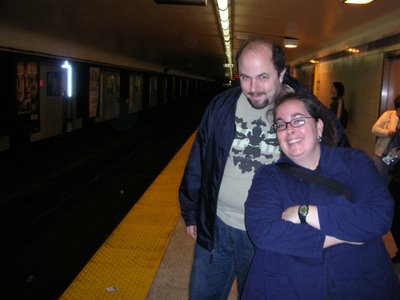
Photo of Allan and Jillo in the Toronto subway by Mark Forest

My ears are still a little tender from the descent into Vancouver yesterday. I went straight from the airport to the Okee Wonton house on Granville for wonton soup and the number 2 special, my regular. (Those who don’t know the Okee Wonton House: it’s the best cheap Chinese restaurant in Vancouver. The décor and location leave a lot to be desired – it’s in the heart of the porn strip approaching the bridge and the colours are faded and bleak, making it look a bit run down, a bit dirty – but the food is terrific). I’d missed Vancouver, was glad to be back; whatever the greater cultural opportunities that Toronto affords, however much I liked the people I met there, Toronto seemed flat and grey and faded – sort of like the Okee, except the food wasn’t as good.

Things began with a phenomenal glitch. Airport security in Toronto notified us that there were problems with the security check out of Vancouver and that it was necessary to screen us all again before we were allowed to go into the city or catch connecting flights. I only had a couple of hours before the Jandek show started and was a little anxious, not knowing how long it would take to make it downtown. I milled around chatting with other passengers about what the security concern might have been, but I'm since convinced that they were just checking up on Vancouver to see if security here had done a decent job; they searched everyone’s luggage and confiscated anything that had been missed. The fellow behind me in line to get his bag searched joked, “just wait til you see the things that you forgot you have in there!” Passengers queued up and meekly submitted to the harsh scrutiny of the men (and a few women) in uniform, who removed them of the possessions that they shouldn’t have had with them in the first place. Gels and liquids, primarily – one woman appeared to lose some expensive makeup – but also sharp objects. A photographer just ahead of me was made to account for a small screwdriver he had packed with his camera kit, the security guard holding it up as an accusation as he stammered his innocent intent. The feisty fellow behind me, as I was being patted down, said to one of the harangued-looking security guards, “Does this mean that if Air Canada hasn’t done its job and I was on the plane with dangerous objects, I can sue them for having put me in danger?” He was regarded with a humourless stare. This guy seemed a bit of a shit disturber; he’d rolled his eyes at the wait, and indeed at the very concept of having to submit to a security check on disembarking from a domestic flight. “What are they doing, clearing us for the city of Toronto?”

The woman to actually go through my carryon was brown and small and pleasant. She struck no authoritarian postures, for which I was most grateful – the bullying manner of some of these folks can get under my skin. I was busy apologizing in advance for a tiny tube of Liquid Paper I’d packed unwittingly when she discovered the thing that I had REALLY forgotten was in there: a jackknife with a three inch blade, bought for a camping trip last year and almost never used. I imagined myself, as she flipped open the blade, being stripped naked in a tiled room and forced to bend and spread for someone with a flashlight. “Oh my God, I completely forgot that was in there!” I think I must have started sweating on the spot. She told me it was all right, that it was Vancouver’s fault for not having found it, then went off to see her supervisors. Men. They gave me dirty looks, but when they found out I was just going to Toronto, they cleared me, without even taking my name (tho’ there was discussion of it).

They kept the knife, though. I didn’t ask for it back.

Having narrowly averted a cavity search, I was, within the hour, sitting at the Centre of Gravity – a very cool space where vaudeville was once performed and, I gather, circus acts sometimes rehearse even now. I passed around a few copies of the Nerve Magazine with my Jandek article in it to interested patrons near me (promoter Gary Topp gave a copy on to the Man Himself) and got ready for the show to start. The talk – which I heard more than once – was that Jandek had flown in the previous Tuesday and had written all the lyrics for the show since; during the performance, I could see his notebook, with blocks of prose in that distinctive Corwood handwriting, broken up where the music was to stop. The man himself was emaciated – there is apparently discussion that he may be ill on the Jandek mailing list – but gave a surprisingly focused performance, with the whole evening being themed around meditations on identity; it had a very Samuel Beckett feeling to it, which author Danen Jobe also remarked on the next night at his reading, to my delight (Jobe says that some of Jandek’s other recent releases are much the same, including Glasgow Monday and the Newcastle show). Live, the Man from Corwood appears to be developing an interest in producing cohesive, hour-plus works of art that cannot be easily broken up into “songs," however often the players stop during a performance. Unfortunately, I napped a bit during the first half-hour, recovering from my flight, and it took me a bit of time to get used to the somewhat simple and surprisingly pretty music that Jandek made on the Korg synths (the bottom tier of which sounded like it was used for New Age music, maybe Ambient 12: Music for Corwood Industries, while the top sounded rather like a church organ) – but by the end of the night, the swirling sounds had captured me – I was particularly impressed with the rhythm section of Rob Clutton and Nick Fraser. The blue gels contributed to producing a spacy, undersea synaesthetic trance.

It was Jandek’s lyrics that really caught my attention, though. At one point he cried “Dissolve your identity! Destroy yourself and live,” and it seemed to riff in fascinating ways off the whole mystery of who Jandek IS. Continued lyrical meditations on the I-he-you of Jandek’s interior realm made it clear that the focus was meant to be a bit broader than that, though. To adopt Corwood's mode of speaking, “he” is a constant disappointment, and “I” spend all “my” time trying to bring him under control, to make "him" obey "my" vision of who "I" am – celebrating those odd moments when "I" win and wondering why having to struggle is so necessary. (“Why can’t I just kill him?” Jandek says at one point; Jobe would make the point the next night that to see all this as being depressing and suicidal misses the point, which is far more philosophical and not without humour. Gary Topp’s tale of Jandek sneaking up on him while seeming to call him on his cell phone would confirm that the man from Corwood – whom both Topp and Jobe have dealt with at length – is actually quite playful, while also being a “gentleman,” a word both Topp and Jobe used). The struggle between "I" and "he" sometimes tilted the other way, though; while at the end of one song, "I" am victorious and “he” is destroyed, bent to “my” will, at the end of a subsequent number, “I” decided that “he” is too strong and must just be assented to, that true freedom lies in doing what “he” wants... A bit of Freudian language becomes inevitable in understanding things; Jandek’s "I" (the “perfection of thought,” as Corwood put it) is the superego, which, as Slavoj Zizek points out in The Perverts Guide to Cinema, playing Thursday at the VIFF, is both authoritarian and capricious – our inner voice, our guide, the voice which berates us and insults us as well as telling us what is right and wrong). "He," meanwhile, is the ego, the stubborn fact of our emotional drives and programs. “You,” under this reading, seemed to vascillate between being the loved one, the Other, and God... (At one point "he" runs back to "me" away from "you;" at another point, "I" and "you" encounter each other directly, without "his" interference, and there is rapture). Through all these heavy thoughts, Jandek’s other eye wanders about and captures particular details of setting – the glass in the French doors, the trees on the street where the introspector walks -- details which don't exactly ground the work in the concrete but at least tether it to the planet. Though a few people in the packed venue (250 people capacity, maybe) snuck out before the end, most of us stayed and were amply rewarded. The Man from Corwood did not so much as glance at the audience, not once, even when we were applauding at the end.

After the show, I trekked down the street, on the advice of a fellow gig attendee, to Toronto’s little India. Everything seemed flat, old, and dirty – three adjectives that seem to apply to almost every urban space in Toronto, save the skyscrapers and such -- and the ethnic mix was noticeably different off the bat; their little India is huge compared to ours, and if the number of Halal restaurants offering beef on the menu is any indication, the dominant religion is Islam, not Hinduism or Sikhisim or such. I ended up having butter chicken at the Lahore King Kabab Halal Restaurant at 1386 Gerrard. It was nothin’ special but it was food! Everyone else in the place was from India. Everyone else on the street was from India. No one seemed to be annoyed by my pestering questions (directions, can I use the phone here, etc) and by the end of the evening, after figuring out the rudiments of the subway and bus system, I was crashed safely in the spare room of Jillo of the Nomeanswhatever discussion forum. Jill and Mark proved excellent, gracious hosts and gave me a base from which to come and go, for which I am most grateful! (Jillo, named for her youthful enthusiasm for Jello Biafra, also hooked me up with rides for the Waterloo and Hamilton Nomeansno shows, introduced me to Ali G’s character Borat, and let me use her computer... Tho’ I wasn’t impressed with the urban environment, I ended up – largely because of Jill and Mark and Jill’s friends -- getting the impression that Torontonians as a rule are unpretentious, down-to-earth, and likable people, lacking any of the snooty cliquishness of Vancouverites and nowhere near as socially challenged. Things seem simpler there, less cluttered with crazy bullshit and affectations; in a city of so many people, it couldn't be any other way.

Monday AM, before Jill or Mark awoke, I was off on my next adventure, catching a subway into town and hopping one of the odd little trolleycars, the mechanical jerkiness of which reminds me for all the world of bumper cars at the PNE. It tooled up Spadina towards Queen and I discovered myself in the midst of Chinatown. I immediately hopped off to see if I could find a Chinese bootleg DVD retailer, to see if any of the Japanese titles available differed markedly from the ones I can find locally. Some offered DVDs at very low prices – 12 for $20 was the best rate I found, tho’ they had the fewest interesting films. I ended up buying 15 films and taking home, I think, 6. Junk, Kichiku Dai Enkai, and Ley Lines were all PAL formatted, useless to me with my primitive technology; the Kurosawa’s I bought had terrible subtitles; and tho’ I was fascinated by Seijun Suzuki’s Pistol Opera, the last ten minutes were missing! Such is life for the buyers of bootlegs -- I get used to writing off every third purchase. Keepers included Miike’s City of Lost Souls and Dead or Alive: Final; Suzuki’s Princess Raccoon; Howl’s Moving Castle; Sonatine; and a Hanzo the Razor instalment, The Snare). I also found a pretty good Jamaican restaurant, the Ackee Tree, on Spadina near Queen (note: the goat roti, tasty as it may be, comes with big chunks of bone in it). It wasn’t a very eventful day – I meditated at the Allan Gardens for awhile, got the feel of the place, and found out the location and hours for a couple of places I intended to come back to. Ugly urban scape or not, there was lots that I wanted to do in the city before it was time to see Nomeansno.

The highlight of Monday night was hearing Mr. Jobe, of Arkansas, read to us from his fictive biography of Jandek; taking particular issue with Irwin Chusid's somewhat brainlessly hyperbolic claim that Jandek has no antecedents, Jobe places the man from Corwood in the tradition of great bluesmen of yore, giving him a suitable backstory which Corwood rather indirectly contributed to by correspondence, occasionally nudging the author (away from claiming the influence of one blind blues musician towards another, for instance -- Blind Willie Johnson apparently plays a role in Jandek's musical past). Alas, copies of the book were still in Glasgow, waiting to be shipped; they can be had online here. It was also fun looking about the bookstore, Circus Books, also on Gerrard, closer to Cabbagetown; there were some cool Ralph Steadman's that I had yet to encounter and I bought a copy of Ingmar Bergman's Images, which I had been looking for for awhile. The owner, who I chatted with, tells me that he's only been open for 9 months, so he couldn't really say if there's been a downturn in the used book business in To. in recent years (there certainly has been in Vancouver). He directed me to a good chicken shawarma dinner, tho'.

The next couple of days revolved around the CBC and the National Film Board. The CBC I wanted to visit to see if I could access their archives and view "In On the Action," a March 2002 Fifth Estate episode dealing with the Squamish Five (AKA Direct Action AKA the Vancouver Five -- I'm habituated to thinking of them by the first name anyone here know of them by. By the way, that last link is to a misleading and poorly-researched little article -- the author spells names wrong and omits various details of the program that don't fit the slant of his story). Relevant to a Subhumans article I'm doing, as background on Gerry Hannah, it featured interviews with Five member Ann Hansen and Terry Chikowski (the security guard most badly injured at the Litton plant). While trying to figure out if the CBC could help me -- which, thanks to archivist Roy Harris, they eventually did -- I spent a fair bit of time up the street, poking about the viewing stations at the NFB, watching chunks of Through a Blue Lens, Shipbreakers, some early Ryan Larkin works, and various other NFB films. It's a pretty cool setup, and a source of definite Toronto-envy, for me -- you can just go in, sit at a terminal, and punch up any of 1000+ films in the archive. I also managed to buy a copy of the NFB documentary on Peter Watkins; a Norman McClaren set also looked pretty tempting, but I had neither the money to spend nor the room in my carryon.

I don't have a whole lot to say about the Art Gallery of Ontario's Andy Warhol exhibition. It seemed a bit of an act of artistic ventriloquism; Warhol's work was a mere sockpuppet for the clammy hand of David Cronenberg, who curated the show and provided a theoretical framework on the handheld audio guides. The exhibition focused mostly on car crashes, electrocutions, celebrity, and voyeurism, with Cronenberg channelling a hefty dose of JG Ballard into the mix, as you might imagine. Empire, Sleep, Blowjob, Kiss, and various reels of Couch -- the most dynamic of all the films by far -- were set up installation-style among huge Warhol silkscreens. Much as I like Cronenberg, when he started speculating about how the electric chair pieces and Empire were actually self-portraits of Warhol, I kind of tuned him out. You have to be in the mood for that sort of thing, and I wanted to go look at the Murray Favro piece upstairs. Being a Nihilist Spasm Band fan, it turns out, does nothing to prepare you for a large replica of a train's diesel engine. It sort of sits there, singular and solid and in a way, a perfect counterpart to Warhol's Empire, down below. Oh, to be a Torontonian, and gifted with the luxury of contemplating such things at length.

Being a busy tourist, I skipped on. I visited Sw pe books (Swipe, that is), run by an old friend of a friend (they both used to work at Pages, where I would later buy Cormac McCarthy's new novel to read on the plane home, apparently a few days before the official release). Wandering the streets I was compelled to notice a much greater sense of social order; Toronto reminded me more of Tokyo than Vancouver, since everyone pretty much minded their own business and stuck to basic rules of etiquette, not getting in each other's face or way, riding the subways together quietly and negotiating crowded spaces with less tension or weirdness than one finds here (fewer people means more room for everyone to act out, or freak out, or just be fuckin' obnoxious, I guess). There were almost no spare changers, no street crazies trying to ensnare you in their madness, no one who smelled like they'd peed their pants every day for a week without bathing, and tho' there was the occasional person passed out in a doorway or staggering drunk, as in Tokyo, they mostly kept to themselves. The loudest people I encountered were some black youth telling a boisterous story about a gimmick they had for meeting women, where one would chuck a Coke can -- empty, I hope -- at a woman's head, and if she got hit, another would run up, apologize, put down his friends for being "ignorant and shit, but they're my people, what can I do?" and then, if she was willing, "get her math" (her phone number). It's always a bit of a strange trip to here ebonics or to hear black people describing each other as "niggas," since that doesn't get seen much in Vancouver... It's a cultural niche I associate more with the US than Canada, really. In fact, the English one hears in To. seems more Americanized in general; there were announcements on the trains warning people to "stand clear da door," for example... You'd figure that being our cultural center they'd talk MORE like Canadians, but 'tweren't so.

I didn't keep detailed notes for everything I did -- a lot of poking about, alongside periods of chilling with Jill and Mark, drinking beer, and watching downloaded TV shows. By Wednesday I was ready for another gig to be excited about, and come Thursday, I was on the road to Waterloo, discussing my impressions of the greater social order, the greater American influence, and the relatively less aesthetically appealing landscape with Jill, Boris, and Scarlett. The food was definitely an issue: unless you're eating at an ethnic place, I advise great caution. Vegetarian items on menus are few, and it turns out that "chips" is as likely to mean potato chips as French fries. The pizza I ate at the family-style place we stopped at appeared to be of the frozen-in-a-cardboard-box kind. We had a pretty hard time getting uncurdled cream for our coffees, too. But then again, this was Waterloo; it's a small town, and God knows the food ain't so good in small towns outside Vancouver, either.

I took no notes of the Waterloo Nomeansno show. I did a pizza run for Chedsey, marooned at the merch table for the long drive up from Chicago. I thought the band were in good form; they were better the next two nights, having settled in a bit. I didn't get a whole lot out of Ford Pier's opening set -- it was too 1970s for me, tho' he played well and there were some pretty cool solos. Once NMN got on, I recall liking that Tom sang a couple more songs than usual -- commentary is that he seems more and more like a "full member" of Nomeansno this time out --- and I was delighted when Rob appeared to wink at me from stage, apparently recognizing me from our literary discussions and the interview I did with him (which, we hope, will soon appear in Skyscraper). I was pleased that Tom dropped by the table to see Jill and Scarlett before the show; they both like him a lot and I think he gets a great kick out of it, tho' he's a quirky guy. (I haven't figured him out yet but he seems alternately extremely self-confident and unself-conscious -- when singing "Big Dick" with his shirt off, for instance, or berating assholes in the audience -- and strangely sweet and shy, when showered with the attentions of his fans -- which he is a bit more willing than the brothers Wright to indulge). The set and such is on the rather ungainly Nomeanswhatever board, somewhere or other; things began with the audience somewhat conservatively listening, a few enthusiasts up front bobbing up and down, and it wasn't until after the halfway point -- unfortunately after the band had played "The River," my favourite song -- that a couple of locals decided that things were lame and got some action started in the moshpit (I thanked them afterwards, telling them I had been secretly judging Waterloo, and that they had redeemed it). Tho' as usual I could only participate for a few songs before getting tuckered out (see appendix one, "Too Old to Mosh").

Hamilton in general was more interesting. I'd been told that it was considered to be "the armpit of Ontario," a steelworking town where there were a fair share of rednecks and a number of social problems. Not considered a very classy place. I'd already stared a bit at a guy with a mullet at Waterloo and was most curious to see what Hamilton would be like: turned out to my delight that it reminded me of Vancouver! The druggies were less far gone -- I mistook one spare-changer with a speech impediment for am innocent bum, toothless by happenstance, and forked over some change; I was informed afterwards that that's what a junkie looks like in Ontario... There was less overt looniness, but the overall mood wasn't all that different from getting kinda close to the Downtown Eastside on a weekend. My hosts seemed kind of nervous about being sparechanged and seeing drunk, hostile people stalking the streets; I thought their reactions were kinda cute. (They also were more willing than I to gawk at a piss-drunk blonde girl, dressed like your typical Granville Street bar star, making out with another woman; the two had stumbled downstairs from the bar above the Hamilton venue, called, I shit you not, the Dirty Dog Saloon). Four opening acts that night were a bit much to swallow, tho' it was delightful to see that Vancouver's The Feminists were added to the bill (they just happened to be in the neighbourhood and were added to the roster). They're getting much more confident each time I see them, and their song structures are complex and interesting and original; I suspect they may End Up Somewhere. Hamilton's the Responsibles will probably stay where they are, meanwhile, but they put on a game, if somewhat predictable, show; the high point was their cover of the Damned's "Neat Neat Neat."

I was smokin' a joint in the parking lot during Ford Pier's set, what can I say. The pot was what I've come to think of as below average, but it's hard to judge any town's dope on the basis of one experience. There's bad stuff here, too...

As for the Nomeansno show, great as it was, it was a painful thing to behold, since Rob had a horrible throat cold that had set in overnight, via Chedsey. (He upbraided the audience at the start of the set, "If I hork up a tonsil, I don't want to see it tomorrow on eBay!"). The band played intensely, but Tom got to do an added couple of songs, including "Small Parts," absent from the Waterloo set. The high points were the few older songs where Rob seemed to actually veer INTO the pain and deliberately RAISE his voice; the readings of "Give me the Push" and "The Tower" were particularly intense. Any of the new songs that actually required Rob to carry a melody -- "Heaven is the Dust Beneath my Shoes," for instance -- sounded ridiculous, and it seemed like Rob, sick and sweaty and fighting it for all he was worth, was having trouble remembering some of the lyrics. He solved the problem the next night at the Horseshoe in Toronto: he came up with new ones: "The other day a bunch of my friends got together and decided to form a political focus group, but they didn't invite me, they said I was too conservative, too reactionary. I was hurt at the time, pissed off, irritated, but then I thought: I don't have anything against liberals... It's just that they're really full of shit!" Somehow, between shows, Rob had completely recovered his voice, and the gig stands up there (alongside last year's Mesa Luna show in Vancouver) as one of the finest Nomeansno performances I've witnessed. John drummed up a fury, Holliston continued to do a bunch of songs (tho' the set was, I believe, absent his reading of "Predators" from the two previous nights), and at one point, Ford Pier jumped onstage to do a Show Business Giants tune ("Sugartown"), which was a treat.

I'd had a somewhat unusual lead up to the Toronto show, however: Tony Conrad had played down the street as part of the X Avant festival, and I was there, along with, I believe, a fellow named Ivants who recognized me (and who I recognized) from the Hamilton night. (Nice to see fellow punks at a highbrow avant-garde gig). The Music Gallery, where the event was held, actually was inside St. George the Martyr's Anglican Church, if you can dig that.

Pleasingly, two of the opening acts had Vancouver connections. Kelly Churko and Ben Wilson had just performed with their Australian counterparts in Telephone at the Western Front in Vancouver the night before. I joked with Kelly about how, given the name of the project, I figured he’d be phoning in his performance, but no. The tables, set up for them, had the usual array of laptops, knobs and levels, and wires – tho’ there was also an acoustic guitar. The music they made was of a quiet, ambient variety, with more than enough interesting texture to hang your attention on. Intense, meditative, beautiful stuff.

Following them was former Vancouverite Christine Duncan and her project, Barnyard Drama (Note: the song samples are much more “pop rock” than what they did live). Christine dressed like a librarian on summer holidays and sang like an acidhead who thought she was a bird. If you'll pardon the innate sexism of the observation, I find her sexy – she reminds me of an old girlfriend of mine – and slightly scary at the same time, like she might just be Too Much to Handle. She’s got fine control of her instrument, tho’, and gibbered and yelped and popped and squeaked and gargled with the passion of a Phil Minton or a Paul Dutton (or a Maggie Nichols or a Lauren Newton, if you’d prefer, tho’ her style seemed more akin to Minton, I thought). She doubtlessly noted me noticing her in the audience (she didn’t stay for the whole Tony Conrad performance!) but I don’t think she remembered chatting with me at the Vox Festival for Vancouver New Music. I didn’t really take notes, tho’ I recall enjoying Bernard Falaise’s guitar (and the performance overall, really).

And then came Tony Conrad. He pulled a sheet across the front of the stage at a slight angle; it was backlit with soft colours and blown by a fan for a rippling effect, and he (on violin), along with cellist Anne Bourne, played behind it, their shadows looming above us on the sheet, their actual performances unseen. (I chatted with him afterwards and he mumbled that the “doubling effect” was very important, but he didn’t make clear why; he was putting away gear as he spoke and tended to talk in odd directions). The music looped and loped and droned and seemed rich and varied and deeply nuanced, tho’ no doubt the artists were sticking very close to playing the same intensely restricted series of notes; the effect of drone music is far greater, far more complex than its minimal means would suggest. The performance – which lasted about an hour – saw me in varied states of consciousness, intensely watching the shadow play, focusing on the music, drifting, allowing my own thoughts to burble up, losing myself in them, falling asleep, waking up, attempting to meditate, focusing only on the overones for awhile, then the violin, then the cello, then deciding to watch the shadow play again and letting the sound wash over me. I asked Mr. Conrad if he’d consider coming to Vancouver and told him he should contact Vancouver New Music, if so; I’m sure there’s an audience here for him. He seemed enthusiastic, but said he’d particularly like to go by train...

I decided to be an autograph hound with him. I have the oddest collection of signed stuff. I almost never ask the “rock stars,” the big names, for their signature; tho’ I have hung out with and/or interviewed Nomeansno, Nels Cline, A Silver Mount Zion, and others, I didn’t pester a one of ‘em to sign anything. No, it’s people like Otomo Yoshihide and John Oswald that I bug (tho’ Oswald refused to sign the Plunderphonics box I held up for him, offering amusingly obscurantist reasons for not signing it, tho’ there may be a legal story there...). In a way, it was a shame not to meditate longer on the Tony Conrad show, but it was off to the Horseshoe (a venue I quite liked) for the final Nomeansno show that I saw – the perfect climax to the week.

And then the trek to the airport, being very very careful not to pack any sharp objects (tho’ the Liquid Paper made it through again).

Not much else to add. It costs over $25 to go up the CN Tower: fuck it. Lake Ontario was about as pretty as the Fraser River, if you get my meaning (tho’ there were some large orange butterflies in the park nearby that were pleasant to watch). There are, as you would expect, many good antiquarian book dealers (Abelard Books wanted $1200 for a copy of Cormac McCarthy’s Outer Dark, with a scribbled inscription from a previous owner, no less; I had thought bookdealers here were being unrealistic asking $850!). The Fox and Firkin pub on John Street, I think, is a pleasant place to stop for a Guinness. Rotate This were probably the best of the music shops I explored. A week was long enough: I felt like I got the idea, and I now feel like I have Toronto out of my system and don’t need to go back (unless someone offers me money to be there. Anyone?)

Thanks again to Jill and Mark and Boris and Scarlet for playing host to me, tho'! I have a pretty small space, but will reciprocate to th' best of my ability if you ever make it out this way!


Appendix One: Too Old To Mosh

I went to see a punk rock show
I really love ol’ Nomeansno
I’m glad these guys are still alive
I saw them back in ‘85
And when they play my favourite song
I know the words, I sing along
I sometimes forget how old I am
So stop me if I start to slam

Chorus:
It’s come to this
I’ve gotten soft
Got a pain in my chest
And the sweat’s dripping off
I’ve lost my breath
My shoe’s come off
My gosh:
Too old to mosh
Too old to mosh
Too old to mosh

The kids today just don’t know how
It’s all just too violent now
But how I seem to long for it
That self-transcendence in the pit
Then someone flies into my shoulder
There’s no respect for someone older
Now I know just what I’ll do
I’ll show these kids a thing or two

(chorus)

Now I’m lying on my back
I think I’ve had a heart attack
I should have done more warmup stretches
My back is stiff, my side’s in stitches
My neck is sore, my breath disturbed
The kids continue unpreturbed
Next time I know what’s best for me
A balcony seat is where I’ll be

(chorus)

Ellen McIlwaine is coming, has new CD


Reasons to see Ellen McIlwaine: she scats in Japanese and sometimes yodels (in the universal language of yodelling). She plays a mean slide guitar. She turned me and various other fans onto Joseph Spence and the odd blues variants of the Bahamas (and has been known to cover odd songs from the Nonesuch anthology, The Real Bahamas). She's a helluva storyteller and her version of "Can't Find My Way Home" rivals the Swans' (and both may well be better than the original). I have not yet heard her new recording, Mystic Bridge. Though I often find recordings of Ms. McIlwaine "nicen her up" a bit too much, she assures me that this one is "recorded live off the floor, so it's a slice of the real thing (with a few overdubs)." Soundclips available at the link above. Meantime, I highly recommend y'all check her out at the WISE Hall, at 1882 Adanac, at 9PM on October 6th; tickets are $20 at the usual places, or call(604) 254 - 5858. Cassius Khan will accompany Ellen on tablas, and David Roundell will be opening on -- hey, Heather, take note -- the accordion. It's not my usual fare of avant-garde improv and political punk, but Ellen is pretty damn unique and I absolutely loved her last performance here, as part of an all-night event at the Western Front... I wonder if she listened to those Kan Mikami and Tomokawa Kazuki CDs I sent her? She should...