Tuesday, May 23, 2006

Peter Watkins Self-Interview on PUNISHMENT PARK


As anyone following this blog -- is anyone following this blog? -- will probably know, I'll be screening Peter Watkins' angry, subversive, and very politically relevant Punishment Park (that's a link to his own writing about the film; see here for images and press) on May 30th at Blim. I also recently wrote about Watkins for Discorder, and I previously posted an interview with Oliver Groom, the Canadian in charge of Project X distribution, which is seeing many of Watkins' films released on DVD for the first time (The War Game and Culloden are to be paired on one disc for their next release, on July 25th). At that time, Mr. Groom e-mailed me the following "self-interview" done by Watkins in 2005; since he has withdrawn from participating in interviews, as a protest against his years of marginalization, this is now really the only way anyone can interact with Watkins about his films -- he hasn't responded to my attempts to email him, and I gather he politely refused to attend Kier-la Janisse's screening - bless her - of Privilege last month as part of the Big Smash festival. I'm very excited about the upcoming event (and a little nervous); the film, made in 1970, posits an alternate America in which radicals are rounded up, tried for their "un-American" beliefs, and forced into a gruelling ordeal in the desert, and it's bound to provoke a reaction, though I'm not quite sure what that will be. (I somehow doubt it will be regarded as left wing hysteria, as it first was when it came out, though not everyone on the left likes it).

Thanks to Mr. Groom for that last link and for having forwarded the self-interview. See y'all on the 30th. The following is the complete text, including copyright disclaimer, as I received it, though the formatting has been changed somewhat by the act of cutting and pasting it, and I've had to re-insert paragraph breaks and boldfacing myself. I did not receive photos, so I am not including any. Those familiar with the DVD will recognize some of this from his statement thereon:

PUNISHMENT PARK Director’s notes

A newly-written self-interview by Peter Watkins

COPYRIGHT AND USAGE

The following text by Peter Watkins is copyright. Under normal circumstances, Peter Watkins is very willing for anyone to use quotes of reasonable length from his texts, for the purposes of education, thesis work, etc.. Peter is also agreeable to anyone printing the entire body of any of his texts, including for the purposes of education, providing that this is not for any commercial gain, and providing that the source is always named.

However, when it comes to the media, including alternative journals, different conditions need to apply for any usage of Peter Watkins’ texts. These different conditions are due to the marginalization of Peter’s work for 40 years by the mass media, who have mostly either attacked his work, accused him of paranoia, or refused to allow his critical analysis of the media to enter the public discourse via the means of the media.

With the advancement of globalization, this professional marginalization of Peter Watkins’ work - especially of his critical writings - has increased. This has manifested itself by journalists removing any critical references made by Peter himself (e.g., in an interview), and only quoting his comments about creative or production matters. Even when journalists do include comments by Peter Watkins re the crisis in the mass media or the political meaning of his own work, these elements are nearly always reduced or entirely removed by copy editors. The result is inevitably an unbalanced article, devoid of any political or critical context.
As a result of these and many other problems, Peter Watkins no longer gives interviews of any kind. His practice now is to prepare texts on his films in which he tries to cover as many creative and critical elements as possible, based on questions he has been asked in the past.

These texts are available to journalists, providing that the following requirements are understood and complied with:

a. that it is recognized that Peter Watkins’ texts are copyright and that due acknowledgment is made to the source.

b. that any quotes from Peter Watkins' texts be taken in fair and balanced measure regarding creative and production, as well as political and media-critical aspects of his work, in approximate proportion vis-à-vis his own reference to these aspects in his original text.

c. that the journalist and/or editor of the journal/newspaper, etc. concerned guarantee that copy editing will not specifically target, reduce or remove the political and media critical elements in any article prior to publication.

Thank you.


What was the background to making Punishment Park?

In 1968 I was in Sweden making The Gladiators. During this time I visited Oslo to screen several of my earlier films, and for the first time encountered the work of the Norwegian painter Edvard Munch. This led to the making of Edvard Munch four years later. But prior to that, in the summer of 1969, I moved with my family to the United States, where I had been engaged to produce a trilogy on the American War of Independence, the American Civil War, and the Wars of Colonialisation against the Native Americans. These films were to be financed by an educational subsidiary of Columbia Pictures, and were intended to be films along the lines of my 1964 BBC documentary, Culloden, for educational use and possibly also for TV screening.
This was a very difficult time in America’s history. President Johnson, a Democrat, is escalating the war in Vietnam. In 1968 the Vietcong and the North Vietnamese army launch their massive Tet Offensive. There are 542,000 U.S. troops in Vietnam. At home, the universities are in an uproar and the peace movement is growing rapidly. The militant branch of the Hippie movement, the Yippies, under the leadership of Abbie Hoffman, Jerry Rubin and others, are preparing to contest President Johnson’s bid for re-election by having Pigasus, a Pig, nominated for President. At the same time, African Americans are demanding their rights, and the militant Black Panther Party is formed.

In March 1968, U.S. troops massacre over 300 unarmed men, women and children in the village of My Lai in Vietnam. A month later Martin Luther King is assassinated. Two months later, Robert Kennedy is assassinated. Then comes the critical Democratic Party National Convention in Chicago. In this period, Chicago is ruled like a medieval fiefdom by its reactionary mayor, Richard Daley, who is determined to prevent any manifestations of anti-war protest in his city; he brings in 12,000 police officers, 7,500 US troops and 6,000 National Guardsmen (a larger force, it is said, than the one led by General George Washington). As the Democratic Convention opens, a 17-year-old Sioux Indian from South Dakota is shot on the street by the police. The following day, seven Yippies and Pigasus the Pig are arrested. During that week, 308 Americans are killed in Vietnam, and over a thousand are wounded. Outside the Convention Centre, demonstrations against the war are savagely attacked by the police, who club, kick, mace and beat unconscious anyone in sight, including local residents. At a press conference, Mayor Daley states: “The policeman isn’t there to create disorder, the policeman is there to preserve disorder.”

Eight activists, including Abbie Hoffman, Jerry Rubin, Tom Hayden, and Black Panther member Bobby Seale, are indicted for conspiring to cross state-lines with intent to incite violence.

In November 1968, Richard Nixon is elected President of the United States.

On September 24, 1969, the Chicago conspiracy trial opens with Judge Julius Hoffman presiding. The defendants constantly ridicule the court proceedings. In November Judge Hoffman orders Bobby Seale gagged and bound in the courtroom. The trial of Bobby Seale is separated from the main trial, which becomes known as the Trial of the Chicago Seven.
On December 4, in an early morning raid, Chicago police fire nearly 100 rounds into a west side apartment. Illinois Black Panther Party chairman Fred Hampton, and Party member Mark Clark are killed.

In the meantime, my educational film project is collapsing. In the winter of 1969, I spend several months completing the script of a long documentary on the Civil War battle of Antietam, The State of the Union, knowing already that the film will not be made. By the spring of 1970, my family and I are preparing to leave the U.S. Then, President Nixon launches his ‘secret’ bombing campaign on Cambodia, and the protests grow even stronger. On May 4, 1970 four white students are killed, and nine others are wounded at Kent State University in Ohio, when a contingent of the Ohio State National Guard opens fire during a noontime demonstration...

This is what made you decide to make Punishment Park?

The shootings at Kent State were certainly the turning point for my decision to stay in America, and to try to make an independent film on what was happening there. At first my idea was to make a dramatized reconstruction of the Chicago trial of Abbie Hoffman, Jerry Rubin, Bobby Seale and the other activists.

A friend in Los Angeles, Robin French, an executive in an actors’ agency, offered to have his company finance this project to the tune of $50,000. Susan Martin, who had been working with me as production manager on the collapsed history series, offered to produce the film. So we all moved to Los Angeles. But as soon as I began to meet people in the process of casting the film - a number of whom had already been arrested for protesting the Vietnam War - it quickly became obvious that their stories and experiences were even more vivid and relevant than a verbatim filming of the Chicago trial.

How did you arrive at the idea of punishment parks?

During this time I came across the anti-Communist ‘McCarran Act’, or the ‘1950 Internal Security Act’, as it was also known. This draconian U.S. legislation provided for the setting up of places of detention (in effect concentration camps) for those accused by the government of subversion, or of even considering subversion. From this nightmarish piece of legislation I devised the idea of ‘punishment parks’ being set up by the U.S. government as a way of dealing with both the increased dissidence, overcrowded prisons, etc., and with the need to provide field training for law enforcement officers faced with having to put down growing public protest against the Vietnam War. This device gave me both a metaphor for the repression and polarization which I saw happening in the United States at that time, and also a framework - a sort of psychodrama - within which the proponents could express themselves.

What can you tell us about the filming?

Punishment Park was filmed in late August and early September 1970. Our location was the El Mirage dry lake in the San Bernardino Desert, about 100 miles from LA. This, we say in the film, is the site of the Bear Mountain National Punishment Park in California. The scenes in the film are cross-cut between the desert - as we follow a group of convicted dissidents carrying out their sentence of having to cross 60 miles of harsh terrain in the extreme heat to reach the American flag, whilst under pursuit from law enforcement officers - and a large military tent on the edge of the Park, where the next group of dissidents is being judged and sentenced by a civilian emergency tribunal.

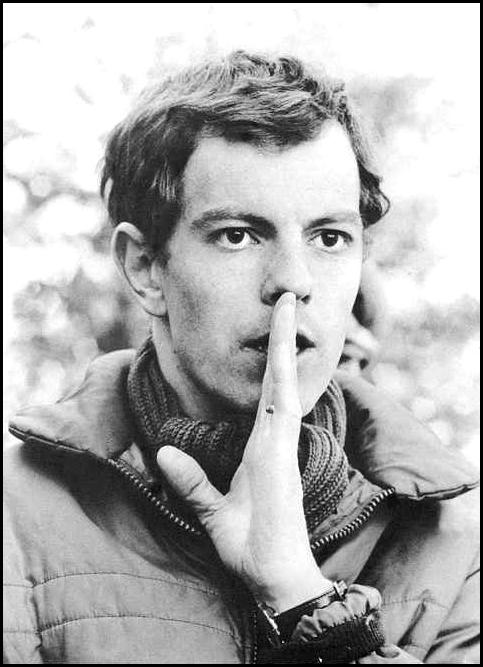
Amongst the members of the crew were Joan Churchill as photographer, and David Hancock as art director. [PHOTO OF JOAN CHURCHILL] In this photograph you can see Joan Churchill holding a 16mm camera, with which she accomplished one miracle of mobility and improvisation after another. If you’ve ever tried hand-holding a 16mm camera, attending to framing and focus, while running over a scrub- and rock-covered desert, with temperatures soaring into the 40s, you’ll understand what miracles Joan accomplished. In fact, the whole crew - not more than 10 people, including casting assistants - were marvellous, and we managed to film Punishment Park in just under 3 weeks.

Tell us about the cast, and the psychodrama you mentioned.

The cast were as amazing as the crew. With a few exceptions, none of them had ever acted before. In the film you have two categories of ‘performance’: those who were expressing their own opinions, and those who opposed their own personal convictions - who were role playing, if you like. The activists - whether in the desert or in the tent - were all portrayed by young people living in or around Los Angeles. [PHOTO OF THE ACTIVISTS IN THE DESERT] As I recall, in some cases we loosely modeled some of the roles on people like Joan Baez, Abbie Hoffman, Tom Hayden, David Dellinger, Bobby Seale and others, but in all cases it is the actors’ own opinions, arguments and convictions which dominate in PP. Most of the young people in the film were radicals, and some of them had already been in prison for their beliefs. So in the film they are expressing convictions which were very important to them.

[PHOTO OF THE TRIBUNAL JUDGE OR TRIBUNAL MEMBER] In the case of the conservative forces - the members of the tribunal and the law enforcement officers - some were expressing their own points of view, and others - as I say - were role playing. Some of the men playing the police officers had been police officers, others not at all... The amazing thing about this film is that you cannot tell which is which.

I think this says some interesting things about our possibility - even in polarized situations - to be able to see and understand (and even interpret on the screen) an opposing point of view. So, those who accuse Punishment Park of polarizing opinion have not really understand the further dimensions of what happened during the making of this film.

How did you get this level of improvisation from your actors?

First of all, I don’t ‘get’ improvisation from the actors in my films, they have the capacity to improvise within themselves. What I do is provide a framework and an environment for their self-expression. [PHOTO OF FILMING IN THE TENT] In the case of Punishment Park, to help the actors express themselves as freely as possible, and in order to heighten the reality of the circumstances for them, the ‘tribunals members’ and the ‘activists’ did not meet in front of the camera until we began to film their scenes. The main verbal confrontations in Punishment Park - the tribunal scenes - were filmed in a windowless, stiflingly hot military tent. There were no rehearsals. Each person had prepared their own background (largely based on themselves) - each worked out their own position and lines of defence or attack.

I have called this method of filming ‘psychodrama’, and most of my films have worked around the edges of this process. But the degree to which this happened on this film, and the extent to which we digressed from a written script here, represented a decidedly new step in the direction of my work. I had come to realize that allowing the actors - including the conservative members of the tribunal - spontaneity and freedom of expression, would not only strengthen the film, it would act as a practical demonstration of my critique against the traditional methods of the mass audiovisual media, with their rigid adherence to tightly controlled narrative structures, dialogue, and editing patterns, as represented by the Monoform. But what is most important to me about this film are the ‘ordinary people’, the public, who were participating in this challenge - in particular the kind of people, and the kinds of opinion, that you usually do not see or hear represented in, or by, the mass audiovisual media.

You often speak about the Monoform - what do you mean by this?

I have been writing about the Monoform for nearly 30 years, and sending out public statements to the mass media and to media educationalists... You can find an example of my analysis in my latest website at www.mnsi.net/~pwatkins. Basically, the Monoform (an expression I coined in the mid-1970s, after analysing this phenomenon with students at Columbia University) is the internal language-form (editing, narrative structure, etc.) used by TV and the commercial cinema to present their messages. It is the densely packed and rapidly edited barrage of images and sounds, the ‘seamless' yet fragmented modular structure which we have all been staring at on our TV and cinema screens. This language-form appeared early on in the cinema, with the work of pioneers such as D.W.Griffith and others who developed techniques of rapid editing, montage, parallel action, cutting between long shots/close shots, etc. Now it also includes dense layers of music, voice and sound effects, abrupt cutting for shock effect, emotion-arousing music saturating every scene, rhythmic dialogue patterns, endlessly moving cameras, etc.

What is the problem with this method of presenting films?

There are certain variations in how the Monoform is used, depending on how it is structured in a studio-filmed TV soap opera, a Hollywood film, or the TV evening news. But all these popular forms of mass audiovisual media have characteristics in common. They are endlessly repetitive and predictable in their form - no matter what their actual content - and they are closed in their relationship to the audience. Despite any appearance to the contrary, they all use filmic time and space in one rigidly structured and controlled manner: according to the dictates of the media, rather than with any reference to the expanded and limitless possibilities of the audience. It is crucial to understand that these variations on the Monoform are all predicated on the traditional audiovisual media belief that the audience (pople) are immature, and that they need predictable forms of presentation in order to become ‘engaged' (i.e., manipulated). This is why so many audiovisual professionals rely on the Monoform: its speed, shock editing, and lack of time/space guarantee that audiences will be unable to reflect on what is really happening to them.

There are two sides to the problem here. First, the professional and creative one, in which you have the audiovisual industry adopting repressive and widespread measures to standardize the potential complexity of the filmic form. Film can be an immensely fluid and complex form of expression and communication, with the potential for an almost unlimited number of varying forms and processes. To compare this potential with the reality of the Monoform is like comparing the work of thousands of different painters to a paint-by-numbers kit. The second aspect of the problem - in my opinion the more serious one - is the disastrous impact of the standardised audiovisual form on the social and political process.

What is this impact?

For one thing, the essential differences in the wide variety of subject matters and themes covered by TV and the cinema are reduced to one common audiovisual language denominator. I believe that this has had a devastating impact on our sensibilities and sensitivities over the past few decades - confusing and deadening our capacity to distinguish between the superficial and the serious, between (for example) actual death and staged violence.

Isn’t this exactly what Punishment Park is doing?

If this film is viewed and analysed superficially, then yes, you could say that. But as I argue elsewhere, I believe there are many factors structured into the presentation of this film, which - if understood and allowed for - create a critical dialectic which not only challenges its ‘factual’ appearance, but also throws light onto many of the standard practices of today’s mass audiovisual media - for example, the use of the Monoform.

What do you do in Punishment Park that is so different? Your film is also tightly edited, isn’t it?

In 1970, when I filmed Punishment Park, I had not yet made an analysis of the problems of the Monoform. This awareness did not come until several years later. So yes, Punishment Park is certainly using its tightly edited form to hold the audience, and to that extent I agree that this film has a traditional, hierarchical relationship to the audience - there is no question about that. However, at the same time, even in this relatively early film, there are signs that I was attempting to break out of the bounds of the standard structural forms imposed by TV and the commercial cinema, and to establish other forms of relationship and awareness with the audience. The use of improvisation, set within the framework of a quasi-‘realistic’ metaphor, is certainly one aspect of the film which is already straining the Monoform to its limits. Indeed, you could say that there is already an internal dialectic in this film which works against its own form. In a 1972 open letter to the press, I wrote that “Punishment Park breaks new ground in my work. It is a fusion of two seemingly contrasting elements: realism and expressionism.” So although, at this point, I was still using the Monoform to structure this film, I was also working with certain internal elements - including its complex sound track and fractured dialogue - to break with the traditional use of ‘documentary’, and to query its sanctity and its perceived relationship to ‘objectivity’ and ‘the truth’, which we in the mass audiovisual media still like to claim we are giving the audience.

Are you saying that there is no such thing as a documentary film which can give facts to an audience?

Joe Gomez responds to this question in his book Peter Watkins, written in 1979. He notes that in a review of Punishment Park in the London Sunday Telegraph on February 13, 1972, film critic Margaret Hinxman “cannot help wondering, too, about the morality of filming a fake situation (however possible or imminent) not as realistic fiction but as instant newsreel documentary.” “Indeed, - continues Joseph Gomez - for Hinxman, there seems to be something inviolate about documentary form, and thus no concern, no matter how genuine, can ‘excuse the assumption that you can picture as fact in the style of fact what is not scrupulously fact’.”

“Documentary forms, even the newsreel, must not be viewed as sacred cows, and perhaps Hinxman should have carried her analysis a bit further. Does documentary form really allow for the objective presentation of fact? Does the mere presence of the camera alter the event? Does the cameraman merely depict his own limited perspective of the event? Does the editor shape the event? Can a newsreel contain fabrication? Can ‘the style of fact’ deal with opinion and/or speculation? Is there such a thing as ‘the style of fact’?”

I would add to what Joe Gomez writes, by querying - is there any such thing as a concrete ‘fact’ when it is represented by any act of audiovisual media? It is these issues and problematics which Punishment Park is attempting to grapple with. Including - as I think we can now see over the distance of time - with its own form.

What other elements in Punishment Park challenge the notion of ‘documentary fact’?


The film has an ambiguous narrator (me), who takes a variety of shifting positions which confront the role of the God-like narrator used in the news and in so-called informational films. Likewise with the film crew, which on the one hand fulfills the typical professional mandate to be ‘objective’ (by not helping the activists in the desert by offering them water and so on), but at the same time challenges the law officers at the end of the film in a highly subjective reaction to what is happening. Plus, of course, those of us making the film have yet another role - that of producing a film which is challenging the traditional function of the mass audiovisual media! If the audience is prepared, or ready, to consider such devices, they have to ask themselves: “Just a minute, what is going on here?” And it is here that the first doubts about the inviolability of the seeming ‘fact’ emerging on the screen appear.

In a society where genuinely critical media education was allowed to flourish, the public would be more than ready to raise such questions. The audiovisual media would have much less of a hold on us, and a film such as Punishment Park would be seen for what it is - a complex, critical social metaphor. But we don’t have such a society at present. Instead, much of media education has become highly complicitous over the past twenty years in disseminating the popular TV culture and the commercial cinema, and in marginalising nearly all alternative and critical thinking towards the role of the audiovisual media.

What kind of reaction did you get when the film first appeared?

When Punishment Park first appeared in the U.S. at the 1971 NY Film Festival, it was very heavily attacked. The leading film critic for the NY Times wrote: “Peter Watkins’ Punishment Park is a movie of such blunt, wrong-headed sincerity that you’re likely to sit through the first 10 hysterical minutes of it before realizing that it is, essentially, the wish-fulfilling dream of a masochist.” The same critic later added: “...an extravagantly paranoid view of what might happen in America within the next five years... And because all literature, including futuristic nonsense like this, represents someone’s wish-fulfilling dream, I can’t help but suspect that Watkins’ cautionary fable is really a wildly sincere desire to find his own ultimate punishment.”
Another American critic wrote: “the most offensive of the recent festival films I have seen to date... The British director... undoubtedly doesn’t realize... that he is permitted to make and show here (a film) that declares the United States a totally fascist state... His achievement, of course, is in making a 90-minute film in the course of which no one voices an original or positive thought.”

What happened in the U.K. when the film appeared?

There were several positive reactions, but the majority were negative. The Guardian: “Peter Watkins is a sincere, honest and talented filmmaker who wears his heart so obviously on his sleeve that one almost weeps for him, since there are so few romantics left.” The Sun re Punishment Park and Fortune and Men’s Eyes: “... is sincerity a virtue when the eyes of both directors are hooded in the blinkers of their own extreme sickness?... Propagandist Peter Watkins is left hopelessly adrift in his own hopeless mind.” According to The Listener: “Mr. Watkins is a clever filmmaker. The events he describes are more than likely within our lifetime. But he is his own worst enemy. There is a hysterical stridency of tone that somehow, bafflingly, destroys all conviction.” Evening Standard joined the fray: “Punishment Park is an angry allegory whose passion is too hot for its own good. Directed by Peter Watkins, a man of great talent who is exhausting himself by continually imagining there exists a Media Mafia which is out to spite him and suppress his films, it exemplifies how the artist’s own sense of persecution sometimes rubs off fatally on his subject... The film ends with the voice of the camera director... screaming shrilly: ‘You wait till you see yourselves on television.’ It is too like the petulance of the small boy who screams out: ‘You wait till I put my Big Brother on you’.”

Was this film distributed in the United States?

The Hollywood studios refused to distribute the film, for fear - as they frankly told us - of retribution from the federal authorities. We managed to find someone to release it, but either for fear of counter-reaction, or because they could find no other place that would accept to show the film, Punishment Park was opened in an obscure cinema way down in the uninhabited financial district of Manhattan. The film opened - and closed - within four days. It was suddenly pulled off, and we could never find out why. As for American television, a conference of PBS producers (in my presence) all asserted that they would never show such a dreadful film on TV. And as far as I know, in 30 years they never have.

What response have you had from the education system?


First, with regard to the United States, I want to say that in the U.S. there have been at least three film teachers, Joseph Gomez, Scott MacDonald, and Ken Nolley, who have been very supportive of my work, and used a number of my films in their teaching. As I have noted already, Joe Gomez has written a book about my work, and Scott MacDonald has written a number of articles about my films, including on his own use of Punishment Park in the classroom.

However, this has not been the general pattern, either in the U.S. or elsewhere, and my films have been almost as heavily marginalised by film and media academics around the world as they have been by the mass media themselves. This is especially true of my critical media analysis, which has been pretty well marginalised or ignored by media academics. It is for this reason that there is still so little public debate on the role of the Monoform.

Perhaps your film was seen as an attack on the United States?

Yes, I am sure this happened, both in the media and in the education system. In March 1974, at an American state college, some of the faculty became very angry following a showing of Punishment Park to students. One teacher began calling out: “The film is a distortion... you are adolescent, Mr. Watkins! Where have you been all the time? You feel such anguish. We feel so sorry for you - don’t you know that man has always behaved like this, ever since he crawled out of the cave and began using a club?” This teacher, a professor of Romantic Literature, became more and more angry as he shouted: “And what will happen? You and I will be shouting at each other, on our different sides of the room, becoming more and more violent...” Another teacher admitted that a “fantasy” of his was that Richard Nixon might seize arbitrary control of the country with the armed forces, before his senate trial. But, the teacher cried out: “I would never inflict that fantasy on others! I don’t think you should deal with the future like this, you shouldn’t talk about the future... you shouldn’t inflict others with your feelings about the future...” A little later, this teacher left the room.

With all due respect to these people, I think they were missing several rather important points. First of all, although the idea of ‘punishment parks’ is certainly a metaphor of social and political conditions in the United States, at the same time, very much of the rest of what the film is showing - and the basis for the film - was actually happening: from the assaults by a racist police force, to the massive aggression against the people of South East Asia. And it was very disturbing at the time to see Americans, especially those within the media and the education system, go into a state of complete denial about what was happening in their country.

But far more important than this, is the fact that I was not dealing uniquely with the situation in the United States when I made Punishment Park, but with the psychic condition of our contemporary society. The problem of polarization and confrontation, as well as of the repression of alternative visions of society, are not confined to the United States in the 1970s; these remain an acute problem today, all over the world. As I wrote in 1972: “Punishment Park takes place tomorrow, yesterday, or five years from now.”

What do you reply to those who say that your film can cause violence?


As for the accusation that the film Punishment Park can cause violence... This is a complex issue. As I have repeatedly written, not only violent themes and images, but violent filmic structures, such as the Monoform, can themselves create aggression and social divisiveness. I believe this completely. And Punishment Park is filmed with the structure of the Monoform. But, as I have also said, in the form and process of Punishment Park there are a number of facets to the film which work against a strictly violent and hierarchical reading of this film.
In 1979, an article on Punishment Park, written by Scott MacDonald, appeared in the American film press. I quote at length from this article on my website, but in a key passage Scott MacDonald notes: -

“The most fundamental contributor to the widespread audience dissatisfaction with Punishment Park... [in the United States in the 1970s] ...is the fact that, like so many of Watkins' films, Punishment Park loses a great deal of its effectiveness when it is presented in a standard theater situation where the audience arrives for the screening and leaves as soon as it is over. As far as Watkins is concerned, Punishment Park is first and foremost an attempt to create an on-going discussion of the issues raised in the film. It is only when viewed in this context that Punishment Park can be recognized as the fine film it is, for when a screening is followed by a discussion, a fascinating thing frequently happens. Certain specific questions are usually asked, and a certain kind of interaction begins to take place as a result of the questions. Probably the most frequent question is, "Are there really such places as punishment parks?". Generally, the questioner is fairly sure there are not, but needs to be reassured. Almost inevitably, someone else will say something like, "No, of course, there aren't"; a third person - sometimes a member of a minority group - will jump in to say, "What the hell do you mean by ‘of course’?", and a heated argument about whether America is or is not a good place to live, and why, will be underway. In other words, when the film is followed by a discussion, the audience tends to break down into exactly the polarized divisions presented in the film; if the discussion is allowed to continue, one begins to hear the arguments enacted in Punishment Park, all over again...”

Your film has convinced some people that punishment parks actually exist?

Yes. As Scott MacDonald has documented, for example, there are - or were - a number of Americans who were persuaded by the film that punishment parks actually exist. And when Danish TV showed Punishment Park, the Danish press reacted in anger against the U.S. for having such an iniquitous system, then had to retract when they realized that the film was a constructed fiction. Quite why the Danish press should have been surprised by this, I’m not sure, since they should have been aware that all film and TV is constructed, that in many senses every audiovisual act is a fiction - including the evening news.

So despite its challenging form, your film really is manipulative?


I think this is becoming a circular argument! All audiovisual acts, to one extent or another, are manipulative. The key question is the audience’s awareness of how and why this is happening As I stated earlier, in a society where critical thinking towards the mass media was not only tolerated but encouraged in the education system, it would be unlikely that Punishment Park would be seen as ‘the truth’. The film is working with that problematic. We have to try to remove the arbitrary distinctions in the roles allocated to audiovisual ‘fact’ and ‘fiction’, ‘reality’ and ‘metaphor’, ‘objectivity’ and ‘subjectivity’.

For example, if a filmic metaphor is used to depict a social injustice, then what is more ‘real’ to the people who are suffering that injustice - the contrived images given by the status-quo mass media which ignore said problem, or an equally contrived filmic metaphor which draws attention to the injustice which those people are experiencing?

Punishment Park raises all these questions and many more. What remains most important about Punishment Park, in my own opinion, is that the film allows young people the possibility to express themselves, freely and with force, within the framework of an important social metaphor. I have no doubt that it is for these reasons that Punishment Park has been withheld for so long, especially on TV, and not only in the United States. Television remains very afraid of the public voice. The force of the young people in Punishment Park, who openly challenge the corruption and brutality of the existing system in which we still live, combined with the film’s implicit critique of TV’s self-assumed role to use its images to convey ‘the truth’, have undoubtedly led to the 30 year marginalisation of this film.

What is the relationship of your film to today?

There are 2 million people locked up in American jails and prisons - a higher percentage of its citizens behind bars than any other country in the world. There are the brutalities of the American concentration camp at Quantanamo Bay in Cuba, and the sordid U.S.-run prisons in Iraq, as well as the recent discovery of a hitherto unknown American military prison gulag in Afghanistan, in which the inmates - Afghan prisoners of war - are sexually harassed, deprived of sleep, subjected to other various degrees of abuse, brutality and humiliation. There is the loss of civil liberties represented by the recent U.S. Patriot Act, which was passed by Congress before any representative had read it, and which allows the state to treat dissenting citizens as if they were members of al-Qaida. In Britain, the Home Office is proposing to make it an offense to protest outside homes in such a way that causes “harassment, alarm or distress to residents” - in other words, all protest in residential areas could now be treated as a criminal offence. The British government is also seeking to “suggest remedies” for websites which “include material deemed to cause concern or needless anxiety to others”... With all this, and much more happening in our world today, to what degree can Punishment Park remain dismissed as a so-called ‘paranoid fantasy’?

Do you think that if you tried to make this film again, you would find people willing to participate?

Yes, certainly! I realize that it is said that young people today are much less radical and politically active than their forebears thirty years ago, and certainly many people today appear to be hopelessly sold on consumerism, comfort and style. It is true that young people are also being systematically denuded of history, by the mass media and by the education system. And this is very dangerous. But this may only be a part of the reality, because at the same time many people are increasingly seeking alternative paths to globalisation. When I produced La Commune in Paris in 1999, I was very moved by the anger and frustration of some of the cast towards the present world system. So I am sure that if I was to make another film along the lines of Punishment Park, that yes, we would find people who would express themselves very forcefully and cogently against the capitalist world order.

This question brings me back to a central theme of my work, and to my media critique. As I have already said, I believe that many people working within the audiovisual media are very afraid of the public, afraid of any sign of outspoken popular expression - especially if it is critical of today’s system - because this could in turn threaten the very power and privilege of media professionals and the corporations they represent. This fear underlies the central role of the Monoform, which is to homogenize, and thereby to hold potentially dynamic, expanding critical tendencies in check. But I believe that one day a form of revolution will come, and that we will have a far more pluralistic society than now, including one in which the present unequal balance of power between the public and the media will be a thing of the past. Indeed, it may be that the media will be created by the public, for the public, rather than according to the hopelessly hierarchical process of ‘professionals’ and ‘audience’ which exists at this time. This revolution may not happen in my lifetime, but it will come. Those who want to aid in this process can do so by helping the public to develop media forms and practices that use the voices and the visions of the community to dissolve the existing rigid structures.

Are you saying that we don’t need media professionals any more?

I am saying that we need to be open to developing a society where they have a different role. One which includes allowing the public into their decision-making processes and practices. Where they are open to a more equal balance of power. Why not allow what we call the ‘mass media’ or ‘public broadcasting’ to actually involve the voices and visions of the public in their creation and decision-making process? If this were to happen - and I believe it will one day - you would find a substantial number of people immediately opting for alternatives to the Monoform.

So you are not a pessimist?

Abbie Hoffman, founder of the American Yippie movement, and a defendant in the Chicago Seven Trial, was found dead on April 12, 1989. His death was later recorded as suicide. He left a note reading: “It’s too late. We can’t win, they’ve gotten too powerful.” I can certainly understand the meaning and the despair behind that sad message... But at the same time, I think it’s important for us to try to draw strength from the struggle of activists like Abbie Hoffman and Angela Davies, and so many others like them, and from the capacity of people everywhere to resist.

Sometimes, when I get depressed by what is happening in the world around us... I try to remember those scenes we filmed in the desert in 1970, and the faces of the young people in Punishment Park... their commitment to another way of living... And the way they look at us.

[PHOTO OF CAST MEMBER MARY ELLEN KLEINHALL LOOKING AT CAMERA]

Peter Watkins, Vilnius, Lithuania.
ã April 2005.

Saturday, May 20, 2006

Antonio Gaudi at the Cinematheque

Teshigahara's film of the architecture of Antonio Gaudi is a beautiful, eye-opening experience. I highly recommend it, and advise not attempting to see it in a double bill -- it's intense enough to stand on its own. I cannot recommend this film highly enough; nearly without narration, it simply shows us the buildings, letting their bizarre organic beauty speak for themselves. It's cinema of the highest order, a sacrament. GO SEE IT; trust me. It runs Sunday through Thursday at the Cinematheque.

The Naked Guy Kills Himself

I'm drunk-ish and I have to spend most of the weekend working on features on Nels Cline and Maurice Spira. The blog takes a backseat. Here's a crumb from Wikipedia's obits, to maintain a semblance of activity on the site, while I busy myself elsewhere...

Saturday, May 13, 2006

Bookscouting in Vancouver on a Pleasant Spring Morning


Getting ready to sell one of the last items in my Cormac McCarthy collection (now long gone, alas). I'd paid less than ten dollars for the US first of Blood Meridian, and considerably more for the UK first (which you see me holding here), but I couldn't afford to maintain the collection. It was a sad week, listing them on eBay... but it paid my rent that month.


I didn’t bother with the last library booksale, really. I wandered by late one afternoon, and scored a few interesting items out of boxes being just put out – one hardcover called The Decorated Body, while common, should go over well with the body-piercing crowd -- but to really do these sales justice, you have to come out in the early morning and be there when the thing starts. That’s when the bookscouts and bookdealers who have been queuing up for an hour or more are turned loose to gobble up the nicest items, ripping their way through the art section, the reference section, scouring the literature section for any modern firsts, grabbing whatever’s most valuable and, like a plague of locusts, leaving very little behind. They’re generally a humourless bunch; they can be civil in their shoptalk, sitting on the steps beforehand, talking about past finds, occasionally even giving each other tips, but once the doors open, most of them approach the matter with the dead seriousness of a starving shark, and I’ve had a few library volunteers comment that they can be downright rude, manhandling them to get at the new boxes they’re trying to wheel out (there have been stories of violent tussles over books; who wants that?). Not that I’m completely superior; there’s some dark adrenal rush that infects me, too, when I’m set loose in a competitive crowd, not unlike the surge of primal aggression I used to feel during high school wrestling matches, and I’ve gotten a few nasty glances from library volunteers, myself. I know that if I’m not the first to get at a new box coming out, or an unpicked-over section, the Darwinistic nature of the game will see me lose out to some OTHER shark; it’s generally a matter of survival of the rudest. But I don’t like offending people; nor do I care to receive the scowls and occasional disparaging comments from the mere readers, grazing in the aisles and blocking our way to the better books, idly browsing through some crappy thriller wondering if it's worth reading, when so much important matters are at hand. These more bovine types tend to resent the pros for their voraciousness and thrusting arms and I’ve had a few conflicts with them, as well. No, really, these big downtown booksales are not for me; I enjoy a nice leisurely scout, perhaps at an out of town library, or at a thrift store that doesn’t have some predator in the back room siphoning off the nice items before they even make the shelves (or some other local bookscout lurking in the aisles, the sadness in his eyes as I enter telegraphing immediately that the thrift store has long-since been picked over). Swimming in those sorts of waters is less lucrative, but, since I’m usually the only shark there, it’s far less stressful. Beside, for me, bookscouting is more of a hobby than a vocation, and I’m certainly, thank God, not dependent on it for my living.

The thrift sale this morning at St. Andrews Wesley was a bit less of a feeding frenzy, thankfully. There weren’t quite that many sharks this time, and the books were good enough that it seemed like, of the five or so pros there, all of us ended up taking out as many books as we could carry. One of my old tricks is to go straight for the paperbacks, at such sales; bookdealers are generally looking for higher-end items and tend not to bother with the paperback section, and in this case I was handsomely rewarded for the strategy: there were stacks and stacks of Patrick O’Brien novels, a few of Bernard Cornwell’s Sharpe books, a nice Gandhi book, a copy of Plagues and Peoples (it’s not Jared Diamond but it’s an easy sell), and even a copy of John Dunning’s The Bookman’s Promise, the third in his delightful Cliff Janeway series, about a cop turned bookdealer, investigating book-related crimes. (They’re packed with fun anecdotes about books and bookpeople and make an entertaining introduction to the life, though needless to say, they romanticize things quite a bit). I loaded up my backpack and one box, paid $15, and will probably turn them over for around $125, selling them to the bookdealer that I work for; he'll probably double that in time, so he'll be happy, too. The most awkward moments came from having to deal with the thrift sale volunteers, who, time and again, wanted to begin conversations with me – friendly enough – about how much “good reading” I was going to get out of these books. It’s an awkward comment to respond to; to be direct and honest – who, me, read Patrick O’Brien? Are you kidding? These are worth MONEY – would probably win me little favour. I smiled and faked it. "Oh, yeah, nautical novels, just my cup of tea!" It's a lie told for a greater good, since, really (if you look at things from the right angle), I’m doing a public service: not only am I making money for my boss at the bookstore, but I’m rewarding all the customers who weren’t at the thrift sale, but will come to our bookstore (who will be happy to get their favourite novels at a considerable discount from the new price). The only losers are any of the casual readers who hoped to score at the thrift sale themselves... but they had the option of lining up early, and the mere readers at such sales seldom KNOW what they wanna read anyhow. If I hadn't grabbed those books, some other shark would've.

Anyhow, my finds are all bagged up and ready for the bus ride. It’s been a good morning. Maybe I can hit a garage sale or two on the way to the store – the other scouts are probably all glutted now, having earned their keep at St. Andrews. Me, I sense there is still a little money to be made today, out there in the world… Nothing like wandering the west end, from garage sale to garage sale, keeping the wheel of capital turning...

Friday, May 12, 2006

Shh -- it's a secret

Hey. A band by th' code name o' Small Parts will be playing a gig on June 3rd at the (rather tiny) Anza Club, as part of a benefit for Removal (who have some pending, uh, legal fees to pay off in regard an episode in Europe -- info on their site). The Shittys will also be on the bill. Small Parts is a pseudonym for a somewhat well-liked local band. Since the Anza Club is very small and don't want to be mobbed, they're keeping the band's identity kind of discreet. Live Music Vancouver comment that if you can't figure out who Small Parts are, "you don't deserve to go" -- or perhaps wouldn't care anyhow, so go do somethin' else that night, it doesn't make a speck of difference to me.

Tickets are $15 at Scratch, Zulu, Red Cat, and High Life; doors at 8... All ages gig! See you there.

Late News Flash: Stroszek at Blim

Tonight, Werner Herzog's Stroszek, a black comedy of sorts about a smaller-than-life misfit who comes to America, will be playing at the gallery space Blim, at 17th and Main. It's a great film, well worth checking out, and stars Bruno S., the reputedly schizophrenic lead of The Enigma of Kaspar Hauser/Everyman for Himself and God Against All, who has since taken up music and painting and acquired a name as an outsider artist. The film is strange, sad, and bleakly humorous, as the protagonist slowly is pushed from a starting point at the margins to a space entirely off the page. Fans of the film 24 Hour Party People will recognize the dancing chicken sequence, which is playing on the TV when Ian Curtis hangs himself...

There are some cool JPEGS on Werner's site, but they're not for free download, so rather than incite the Wrath of Herzog, I have helped myself to the free ADVERTISEMENT they offer. But what the hell, a box set of Herzog documentaries is a pretty cool idea.

Also of note: scroll down the Blim page for my own event, coming up on May 30th. Watch this blog for more...

Tuesday, May 09, 2006

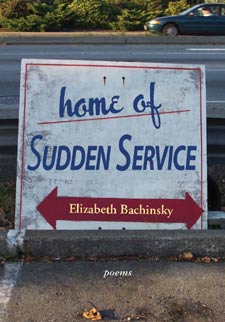
The Globe and Mail catches up with Elizabeth Bachinsky


I mentioned Elizabeth's upcoming booktour a month ago; I neglected to mention, this weekend, that she was reviewed in the Globe and Mail, and that the first chunk of her recently published Home of Sudden Service is featured in their Chapter One section online. I hadn't realized that they were this attentive to what's happening -- it raises them in my regard considerably.

Victoria residents can catch Elizabeth reading as part of the (fellow-blogging) Mocambopo Reading Series on May 12th, after which she, Michael V. Smith, and Jennica Harper depart for select dates in Toronto and Ontario. Tour dates and such here, on Michael's site. Say you read about it on my blog and tell Liz I promised you she'd give you a dollar off the cover price of her book if you mentioned this fact... ;)

(I never use smileys).

Wednesday, May 03, 2006

A Silent Hill for Liberals and a Hostel for Reactionaries


(Image lifted from the excellent Wikipedia article on the game series. Will remove it on request!)

Watched SILENT HILL last night. It does interesting things, but mostly on a subtextual level, and despite some fascinating, psychologically dense, and beautifully crafted images, it fails on various accounts. I'd still recommend it, if you enjoy trying to figure out what disruptions in the collective unconscious horror films are tapping into, and/or what their buried "politics" are; it's particulary interesting in that, like last year's HOSTEL, it's proven a huge hit, even though it's gotten mediocre reviews. (Joe Dante made the point in an interview I did with him recently that horror films are always popular in times of great social unrest, and the success of these two films seems to be proving his point). HOSTEL is the more coherent, more narratively "effective" film, but also the far more suspect, politically, since its point seems to be to blame antiAmericanism on corrupt and perverse European tastes -- while situating Americans as the victims, and not perpetrators, of torture, and in fact morally requiring them to become torturers in order to "fight back." I suspect it taps into the same unease as SILENT HILL -- a guilt at knowing what has been done in the name of preserving the creature comforts of Americans, and a fear that we cannot possibly expiate that guilt -- but in HOSTEL's case, the guilt is displaced, and Americans are ultimately vindicated and absolved; this seems an immoral and false move, to me, and seems to place HOSTEL roughly in the team Bush camp, helping to cover over Abu Ghraib guilt rather than holding viewers to account -- whether it knows it's doing this or not seems of little account. In SILENT HILL -- which ultimately (spoiler! -- highlight it to read it, if you don't care) takes as its bad guys a group of New-World type Christians -- the sins that must be atoned for are much closer to home, and we/the protagonists are left in a more compromised, thought-provoking, morally ambiguous position -- all of which I like considerably.

The story, very quickly: a young girl, after dangerous episodes of sleepwalking, shrieks "Silent Hill," the name of a deserted West Virginia town. Her mother (by adoption) drives her to the town, to try to find the cause of these episodes; after awhile, the father follows. The mother and young girl find that the town is a ghostly, strange place where bizarre and evil things happen. The girl is separated from her mother, and the mother -- along with some characters she encounters along the way -- tries to solve the mystery and rescue her daughter from the evil at hand; the town is figured as a sort of purgatory where sins must be atoned for, though the film doesn't necessarily explain why the central character must atone for anything.

Some of the flaws of SILENT HILL are as follows:

While I enjoyed the video game immensely -- tho' I've only played the second installment -- and am glad that the film captures the "look" of the series, with its creepy atmospheres and alternately ashen/moldy environments, a movie is not a video game, and really shouldn't feel like one. One scene where the main character finds a flashlight in a drawer feels exactly like you've just added an item to your inventory; another where we are dared to look in the mouth of a corpse to retrieve a clue has none of the effect that a similar scene would have in a game, simply because your hands aren't on the controls. Ditto, the constant walking through fog, the sound of footsteps, the need to explore creepy environments, memorize maps, etc.; they all feel like too-direct transcriptions of a game scenario; more effort in translating the idiom was required. Filmed novels shouldn't make you feel like you're reading, filmed plays shouldn't leave you feeling like you're watching characters on a stage, and filmed video games shouldn't make your fingers twitch with the corresponding keystrokes.

Another problem: the film tries to "explain" what is ultimately an inexplicable scenario. Since we're left confused anyhow -- and the film is quite gutsy in how vague it allows itself to be at various points -- it would have been fine with me to not have to sit through lengthy expositions and declamatory, "clarifying" speeches, which only serve to bog things down. In a video game, where you've committed ten or twelve hours to your explorations, a lengthy explanation of what's going on is proportionate, but the film, clocking under two hours, would have been more effective if it had left more stones unturned (or managed to flip them more elegantly). It doesn't quite seem to trust its viewers enough, and this ultimately lends to the sense that the film is a bit of a mess. Better to not try to explain yourself at all than to try so hard and fail.

Finally: the climax of the film is a particularly ludicrous eruption of spectacular violence, with (spoiler!) various fundamentalists being ripped apart by demon-animated barbed wire. While that has its own charm, the film began to remind me of RAIDERS OF THE LOST ARK at this point, and given how subtle and creepy it manages to be much of the time, that's a shame; it smacks of pandering and radically changes the tone of the film, making it a Hollywood spectacle movie when it doesn't need to be. On the other hand, it's quite surprising, given the degree of violence at the climax, that the film manages to cop out on one piece of suffering it shows that really matters, (spoiler!) where a character we care about is burned alive. The character is underdeveloped to begin with, such that the martyrdom is somewhat meaningless, but since the film purports to deal with the Christian persecution of witches in 17th Century America (the explicit "guilt" that the characters must work their way through in order to restore family harmony), we can't really be "let off the hook" without seeing this character suffer. There are some nice bits where we see (spoiler!) the skin begin to peel off her face as she is lowered over flames, but the film needed to do a full-on PASSION OF JOAN OF ARC and didn't. How can we expiate guilt sufficiently if we only see the bad guys suffer? The film misses an opportunity to sully us.

Here are some interesting things about the film:

The women and the men engage in separate dramas, facing different adversaries and undergoing different trials; the women must deal with women and the men must deal with men. This is interesting and opens the door to interesting gender-political readings of the film, if you want to go there; motherhood is obviously meant to be a theme of some sort. I'll leave it to someone else to puzzle that stuff out -- it didn't really excite me as much as it could have -- but clearly someone somewhere -- Roger Avary? -- had his thinking cap on.

There are moments early in the film, where we still don't know what's going on, that evoke other American guilts in ways that are singularly fascinating. There is a scene where, for instance -- in a destroyed town where ash falls from the sky and the atmosphere is poisoned by the lingering effects of the damage -- the main character is pursued by charred, glowing mutants. One immediately thinks of Hiroshima, another bit of American guilt that is generally denied/suppressed/pushed out of mind, but upon which at least some of middle America's creature comforts depend. Given that the video game series emerged from Konami in Japan, it is very possible that the invocation of the atom bombing is deliberate, if somewhat buried; even if it isn't, it's interesting that the film led me there. (Would be curious if anyone else interpreted this scene that way).

As befits a horror film, there is an abundance of other creepy and unsettling moments, too, and the inventive iconography of the game is carried over intact, with dark nurses, blade-dragging Pyramid Heads, and acid-spitting zombie-things; these are beautifully handled and spooky to look at indeed, even if the film doesn't give us any clue what they might mean (I guess they wanted to save some exposition for the sequel). It is hard to imagine a fan of the games not liking SOME things about this interpretation; it could have been far, far worse. The film also seems quite hostile to aspects of American culture that are worth being hostile towards, and even tho' its invocation of the (spoiler!) persecution of witches is handled a little ham-handedly and incoherently, that someone somewhere has their heart in the right place; so bring on the barbed wire. Worse horror movies have been made, with less sympathetic politics -- Robin Wood would like it.

(Is it unfair that I give Avary credit for the things I like about this film? But I enjoyed KILLING ZOE, and thought THE BROTHERHOOD OF THE WOLF was poop. Sorry, Christophe.)

One final bit of faint praise: SILENT HILL is an interesting experience in that it allows voyeurs like me to see what audiences are getting up to/getting off on/AFRAID OF. (Actually, on that note, so is HOSTEL). Sure, it all gets to feeling a bit like sticking a thermometer up America's ass, but how else can one tell the temperature? Those curious will find America cold, sweaty, and paranoid, haunted by demons of its own making.

In case you weren't clear on that.

Saturday, April 29, 2006

Signal+Noise +Womb-fear: a very male night at Video In


(Image: the "surgeon" from the Guinea Pig movie, Flower of Flesh and Blood -- click the link for an interesting description of the film. You can see what he is operating on here, though I would actually recommend not looking).

Hm. Somehow Friday’s Signal+Noise event ended up being all about gender politics, when it didn’t intend to be. No women performed music – at least not as part of the live show at Video In. Men hit each other, talked to each other, dined with each other onstage, and performed operations and art in equal measure, while women remained on the margins, were rendered “objects” of male performance, or were excluded entirely; by the time, midway through the evening, Jesse Scott Colin & Paul Warren Bennett performed Microclimate – which involved both men eating different courses of food while a female (uncredited in the online program) stood in uniform behind them, ready to take away plates and pour wine for them – some of the women in the audience were getting uppity. One threw a plastic cup in the direction of the stage as a protest; as I heard a woman sitting next to me remark: finally a woman appears, and she’s a servant? In fact, I’d had the same thought myself. Usually women are more widely represented in Vancouver arts events – politics demand it – such that the evening seemed to harken vaguely back to the 1980’s, when it was more common for men to dominate and exclude and make an evening all about themselves. My review will unavoidably hearken back to the humourless good old days of 1980's "pre-post," pre-Madonna, anti-porn, male-bashing feminism, but what can I say, that's where the evening took me.

Certainly none of the performers in the lineup should be held individually responsible for this. The woman who threw the glass could use a lesson in manners, at the very least, and perhaps needs to reflect that she was actually expressing disapproval at the performance that had, in fact, the most active participation from a female, servant or no (the other live woman of the evening, Christine Carriere, as the patient in Turbulent Bodies: An Aesthetic Odyssey, simply lay on a table immobile). Further, the individual performers are not responsible for the context in which they perform – they didn’t conspire to exclude women from the night, which women were indeed involved in arranging (note: Velveeta Krisp did not get any cell phone calls). Probably Microclimate would have seemed quite innocent of any questionable representation of women if the rest of the evening’s line-up had been more balanced. There is an even larger mitigating circumstance that needs to be taken into account, too: very few submissions came in from women – which is believable, since much of what we were listening to was relatively high-tech stuff, a niche that women don’t inhabit in great numbers. Signal+Noise can hardly be blamed for not representing women in equal measure, if almost none applied; and the festival organizers, cognizant of the issue, put out a sign-up sheet for workshops to get more women involved in making electronic music/noise/etc, which shows their hearts were in the right place.

All the same, the sheer maleness of the night did colour reactons to pieces. Austrian artists Stefan Brunner, Michael Wilhelm & Daniel Lercher began the live performances with a piece in which two men, wired with contact mikes, hit each other, producing sound – heartbeats, breaths, thumps, and so forth – in both a ritualistic/rhythmic fashion and in a bit of free sparring. I’d’ve liked to have gotten Michael V. Smith talking on that one – he was sitting beside me; even though we were seeing two shirtless men interacting, the violent nature of their interaction alone seemed to make it strictly heterosexual – as if by punching each other, they were able to fulfill the need for contact without crossing boundaries into queer eroticism. Michael Wilhelm’s photographs, mostly of his own distorted body parts, suggest that there is an erotic awareness in his art (and if anyone has a link to online images of these, I'd like to see them again). Still, the piece seemed more about militarism, competition, repression, and capitalism than it did about men touching; and regardless of its overt political intent (which could be read as a critique of the repression of eroticism among heterosexual men), reality in this piece was a contest between men, where women were insignificant, not even visible in the background.

Several chairs, a table and maybe some magazines by Benjamin Bellas, Justin Cooper and Reed Barrow of Chicago certainly also seems to be about men, in relations to each other that exclude women. Two men engage in a conversation: one a therapist, the other a patient. The patient describes a dream, which involves being watched by an audience who is waiting for something to happen, as the therapist – who, we are told, appeared in the dream – asks him questions. No women are mentioned – as if men in therapy talk about anything but! The routine is performed at first slowly; it comes to an end, and repeated with the main two men switching roles, talking at ever increasing rates. A drummer joins them and adds some rhythm to the routine, and a strange (uncredited) furry-costumed creature begins to wander the audience, hugging members (arguably this was a feminine role -- the hugs seemed nurturing and the body of the beast soft -- but the gender was completely invisible and it didn’t hug me, so who knows how "female" it really was. I’d be curious if there were breasts under all that fur). It was actually a really fun piece to watch, and had the quality of an elaborate game, but the male dominated nature of the night made the piece seem like a commentary on men talking to men, in closed circles, with women nowhere in sight, excluded from discourse, excluded from all but, perhaps, a role in the audience. It’s a man’s world. None of this was part of their intended theme; it was noise, not signal, but, given the context, it was growing difficult to tune it out.

Air Pressure by Michael Lloyd – which followed the restaurant piece – almost seems to have deliberately played off such themes. A trumpet player stands on stage – Lloyd, we assume – and performs, while images of a female face appear, very large and often at the margins of the screen, behind him. The woman seems "framed," unable to escape the screen, ie, her role as the object of the male gaze. Her eyes are occasionally shown in close-up, dominating the screen, staring at the audience as if asking us to acknowledge how trapped she is, staring out from the other side, TRYING to claim some degree of subjectivity by virtue of the intensity of her gaze, but unable to actually step through and speak for herself. At one point the eyes seem to focus on the trumpet player (Blake Smith, in the audience, and I apparently both wondered throughout the piece if the artist was commenting on male narcissism – he doesn’t even look at the woman, is totally involved in his own “performance,” which requires her only as silent spectator/object -- the eternal feminine as the background against which men play with their horns). At one point the woman is shown with her mouth open, such that we can imagine the strangled, discordant sounds of the trumpet coming from her, but she remains just an image on a screen, mute. Again, whether Lloyd intended these readings seems irrelevant (though one suspects he did); given the situation, they were inevitable, unavoidable, writ large on the screen – and in fact, he got points for at least seeming to comment on the silencing of women in our culture.

No points can be given to Dan Kibke or Ole Eldor on this account, though in a gendered reading of the evening, it is entirely fitting that their piece, Turbulent Bodies: An Aesthetic Odyssey, came as the night’s climax. If Lloyd crafted the least “politically problematical” piece of the evening, Kibke and Eldor crafted by far the most (it is hard to hold Christine Carriere to account, since her role, like that of so many women of yore, appears to have been to just lie there). To be aware of the politically problematic nature of their work doesn’t require us to condemn it: one does sense that these guys were TRYING to be creepy and evil, first off, so succeeding at making audiences uncomfortable can hardly be held against them. To give them credit, their piece was by far the most visceral of the night, was visually compelling, and had some very interesting sound texture, succeeding on a level of musical sophistication where many of the previous pieces failed (...though some of the samples they’d recorded themselves sounded just a bit clunky, particularly the in-flight announcements). They managed to craft something very provocative out of very simple sources; and their insensitivity to gender politic issues surely merits them the Brass Balls Trophy of the evening.

(Image from David Cronenberg's Dead Ringers -- it's not up as of this writing, but Moving Pictures will be screening Dead Ringers at the Vancity Theatre on May 18th. A rental, it is not listed in the Vancity online program, though you can find it in their printed guide)

It was simple enough in conception: both men are in surgical scrubs, with Ole in the role of doctor. Sounds are made by Ole and manipulated, along with a host of prerecorded material, including hospital-style beeps, by Dan on laptop. Intially they’d planned to actually draw some sounds from Christine’s body, as she lay there anaesthetized, but apparently their stethoscope/microphone combination didn’t work out. Some of the audio used had Christine taking a “trip,” using announcements by flight attendants and descriptions of flight conditions to represent the interior experience of being under anaesthetic (hence “an aesthetic – anaesthetic – odyssey”). If the video footage they used in the background had followed this theme, probably no one would have cause to be upset – if we’d seen images of an imaginary trip, say, of airplanes, skies, or Christine’s dreams and hallucinations. The piece would probably have been nowhere near as interesting (and required much more work to make, requiring actual filmmaking, rather than the use of found footage), but it wouldn’t have gotten anyone’s hackles up; in fact, we would have had the female, for the first time in the evening, PRODUCING something herself – the figuring of female subjectivity uncontained by male systems of power, dreaming away, free. Feminists in the audience would have been applauding with gratitude and relief. Instead, we were treated to a host of squirm-inducing medical images, taking us “inside” the woman’s body, showing us glistening organs and interior surgical images that could have been lifted from autopsy scenes in Brakhage’s The Act of Seeing with One's Own Eyes. The two men are shown as impassive technicians in impersonal, identity-obscuring uniforms, perfectly composed and controlled, drawing meaning from their exploration of interior female flesh. While one obvious connection to draw might be with David Cronenberg’s Dead Ringers, that film deconstructs and disparages the neuroses and insanities of its male gynaecologists, rendering them so vulnerable that it greatly problematizes and undercuts the scenes where, clad in red surgeon’s gowns, they “perform” on women. Their dominance and mastery is shown to be tied throughout to neurosis, dysfunction, insecurity, fear, and inadequacy – all of which are acceptable states to show a man in, in the current political climate; showing a man as having authority, mastery, and power, dominating and exploring the passive female is quite another matter, and that’s what Turbulent Bodies ended up doing. Having come of age in the 1980's, constantly provoked to contemplate whether all men are really rapists at heart, afraid that there was something fundamentally wrong with my sexuality that I had to atone for, the piece crossed a line of political correctness for me -- provoked a reaction. It, uhm, offended me a little. Why?

Any gender political reading of the piece needs to consider that bodies are scary, weird, fascinating places, when you get inside them; it is not easy to contemplate their interior without thinking of death, of fragility, of our meaty, slimy reality, so divorced from our goals and intentions and dreams and ideas about ourselves. Bodies are fucked up places, inside, and if bodies are fucked up, female bodies are doubly so, in part because they have a hole that allows us ACCESS to this sticky, bloody, weird interior, and in part because if you go up the tunnel to the end of that hole, you find a red, warm chamber where people are incubated, where each one of us, male or female, began. I derive no comfort from imagining myself a helpless tiny foetus ensheathed in my mother’s womb, and at age 38, in many ways I still feel myself struggling to leave its confines – the female enfolds and contains ALL of us, and it is an uncomfortable reality, something that annihilates our independence and threatens to smother the self; sure 'nuff, the reality of the womb sits ill-at-ease with the construction of male heterosexual subjectivity under capitalism (or somethin' like that), but I suspect feminists are kidding themselves if they say these issues are ONLY a matter of living in a patriarchal/capitalist society. The queasiness, fear, discomfort, etc we might feel at contemplating the reality of the womb, of menstruation, and of the non-being that predates us and will survive us, linking womb and grave, have deep primal roots and analogs in other cultures, from vaginas dentata to the Sheela-na-gig and beyond; as long as humans are born of woman, vaginas and wombs will exert a strange power, sometimes being figured as menacing.

For whatever reason, some men are more screwed up by all this than others. Jack the Ripper, for example, whose sexuality’s peak expression involved cutting open women and getting at their internal organs, seems to have had a definitely unhealthy fixation on dominating female insides. In “low art,” from The Last House on the Left, with its disembowelling of a female, to the Japanese Guinea Pig series, in which men cut apart female bodies and pull out their organs, so realistically and graphically that they were mistaken for snuff films (and used as a source of inspiration and ideas for a Japanese serial killer -- click the previous link for more) – these dark fascinations with the power of the inside of the female body are given free reign, such that men can experience the mystery “tamed,” laid bare, subordinated to masculine power and authority. It’s pretty hard not to see Turbulent Bodies in that light; it was as close as I needed to come to watching a Guinea Pig movie, and I noticed some women walking out, which really was no surprise. Once again, it seemed like they were reacting to noise, not signal, insofar as Dan and Ole's description of their piece in the written program was oddly "innocent" of any of these issues (Dan says that all of the above may have been how I reacted, but had nothing to do with his intentions or ideas). Still, for me, in Turbulent Bodies, the noise BECAME the signal.

Eric Lanzillotta’s final piece was one of two pieces in last night’s live performances, along with the rather serene Microforming (part II) by Jamie Drouin of Victoria, that DIDN’T appear to have any gender-political significance, save for the fact that again a man was alone on stage manipulating his tools. It seemed like an interesting excursion into straightforward noisy drone, but by that point (nearing 1 AM), I was exhausted, still dressed in my work clothes from the morning, and needed to consider getting on the last skytrain. Once again, as during the pancake noise breakfast, I only caught fragments of Mr. Anomalous' work. I promise, Eric – I WILL hear your music at some point. Really.

Note: if anyone is unclear, this article has been written by a man. Oh, and it is possible that some of the ideas Dan and Ole used took their genesis over a breakfast discussion between Dan and I, ie., I might have suggested them. Hypocrisy is a whole 'nother can of worms, tho'.

Post-script: this piece has generated a bit more correspondence than usual, from people who both agree or disagree with my take on the night. (Writers seem to be on my side and musicians on the other, tho' no clear pattern has emerged as of yet). Unfortunately, no one has posted their comments on my blog; you're all invited to, y'know...? I do gather that the next night of Signal+Noise was much more gender-balanced and "lighter," but I couldn't make it. I did enjoy the evening, troubled tho' I may have been by some of it... Er.

Wednesday, April 26, 2006

Upcoming Excitements: Signal and Noise at Video In

For fans of odd musical soundscapes: the next Signal and Noise festival lineup is up; the event begins on Thursday at Video In. I'll be checking out Dan (of G42), Ole (of the Creaking Planks) and Christine's piece, "Turbulent Bodies: An Aesthetic Odyssey" -- which gets bonus points for the clever buried pun -- and Eric Lanzillotta's performance on Friday night. Congratulations on Christine's 2005 prize in the Mandarin speech contest. Eric was last seen here during the Pancake Noise breakfast, doing some fairly mind-altering stuff (from what I could hear from the grill).

Tuesday, April 25, 2006

Vancouver International Jazz Festival listings: yeehah!

Ah, the jazz fest approaches... Y'all know already that McCoy Tyner is coming. I might go, actually, but try this on:

Zu!

(Plus they’ll be opening for Nomeansno’s June CD release party - question: what happened to John?).

The Nels Cline Singers and Mats Gustaffson/The Thing!

Rova!

Tobias Delius (with Han Bennink in tow... should make up for my having missed Ab Baars at the Ironworks this week)!

Fe-Mail!

(I hung out with Maja Ratkje a bit around the Merch tables at Vancouver New Music’s Vox Festival awhile back. She looks like a vaguely Satanic Pippi Longstocking and made music that had Paul Dutton and Koichi Makigami retreating into the merch area in fear (prompting me to go check it out). Noisy vocal/electronic experiments, in duo format with this project. Seems like a really interesting person).

Also exciting, tho' I don't know their music well enough to use exclamation marks just yet, are
Hilmar Jensson/Skúli Sverrisson (from Iceland) and AACM member Nicole Mitchell -- related to Roscoe? -- who will be taking over for Mwata Bowden as the High School Jazz Intensive educator... I might consider the cleverly-named Unconscious Collective (harmolodics, eh?) and the Joost Buist Astronotes.


Canadian-jazz-wise (since I may be perceived to be dissing the locals above), I'm hot to see Masa Anzai perform with Almost Transparent Blue (more here), and I don't just mean the free show! Haven't heard Masa blow since the Sugar Refinery days, unless you count the Black Mountain disc... I'm also curious about the Existential Angst Party and Field, mostly because I quite like some of Chris Kelly's sax work on the Little Stitches CD I have (noisebludgeon.com appears to be down, so I can't give y'all a link). Never have seen the Inhabitants, either... Like the name... Peggy Lee has been impressing me more and more in recent years (I loved what she did when she played with Torsten Mueller, Phil Minton and Maggie Nichols at a jazz fest awhile back -- was that only last year? -- and with Evan Parker and Fred Frith at respective shows)... but I've seen her a bunch of times -- maybe I'll check her out with Tony Wilson and Jon Bentley at Rime... and I'll definitely check out Torsten Mueller's solo show, and maybe the trio he's in... or the other trio that he's in... Maybe I'll do the NOW orchestra with Marilyn Crispell, too...

They aren't Vancouver-based, but I'm also keen to see Bourassa/Derome/Tanguay, especially Jean Derome, whose facility with little instruments at last year's Fred Frith concert really caught my ear, enough for me to check out Le Magasin De Tissu, a delightful album he put out awhile back focusing on unusual sounds made by unusual means. He's a fine sax player, too, don't get me wrong...

Anythin' else I should be excited about? (afternote: I missed the Yusef Lateef listings, cleverly hidden in the program under the Belmondo Brothers or somesuch...).

Monday, April 24, 2006

Wreckless Eric Takes Vancouver, plus the rest of the Big Smash Festival


The Big Smash festival is still pretty fresh in my memory, but I'm willing to venture that, looking back from some random future date, the most memorable moment (of a very memorable festival!) is going to prove to be the Wreckless Eric show at the Railway Club Sunday night. From an earlier vantage point, I didn’t really expect that would have been the case – I certainly was in no way as excited about it as I was about the Daniel Johnston, Albert Ayler, and Minutemen documentaries, or the chance to see Peter Watkins’ PRIVILEGE... Mr. Goulden has managed to usurp my sense of how I thought things would be, for which I am quite grateful (and a bit humbled). I also didn’t expect I’d end up buying his new CD – thought I might snag a greatest hits thing, if anything at all, for nostalgia purposes, which is all I figured he’d really be good for. He’s proven me wrong on a few counts, actually… Mea culpa…

I’ve already written quite a bit about THE DEVIL AND DANIEL JOHNSTON, below. One thing to add is that it’s interesting that Kier-la seems to have woven a thread of madness and death through the festival. Daniel Johnston at the start, Roky Erickson at the end, and Klaus Beyer in the middle (to say nothing of Tadashi – what exactly the hell was that, anyhow? Assumedly this is the same Tadashi described as Cinemuerte 6's "most retarded fan"), and an abundance of docs on dead musicians, often focusing on their last days – Jeff Buckley, Joe Strummer, D. Boon of the Minutemen, Esquivel, Nina Simone, Albert Ayler, Ronnie Lane (the last being the only show I missed – I needed a nap to be able to handle the Wreckless Eric gig, which started late). Her I WAS A TEENAGE QUINCY PUNK features an episode that circles tongue-cluckingly around the corpse of a dead punk rocker; PAYDAY ends in death; and STUNT ROCK is all about its defiance. Even the cartoon about the drunk being half-sodomized by a dog (click to view it!) has a bit of a dark side to it, really… (Insert arty-weird pseudophilosophical musings on the relationship between sodomy and death, namedropping Leo Bersani, here). Perhaps this is all coincidental, something emerging by chance from the selection of films; there’s something in the ephemeral quality of music – what was that Eric Dolphy quote, you know the one – that perhaps places it in relation to death, makes us aware that our celebration of life is transitory, fragile, like music. Maybe, tho’, Kier-la is the sort to plot things out in subtly buried themes… I’m somehow shy about pinning her down for an interview – or else I just prefer trying to second-guess her – but will be watching closely to see if any themes emerge at future festivals (BECAUSE THERE WILL BE MORE OF THESE, RIGHT? By the way, note that a chat with BJ at the merch table reveals that as of yet no one is taking up the Cinemuerte reins, not even Mr. Bougie of Cinema Sewer. Alas. Actually, it's kinda scary that Kier-la is ending the festival with a film called YOU'RE GONNA MISS ME. Maybe she's trying to convince the film geeks of Vancouver to move to Austin...).

Some reactions to films:

PRIVILEGE was an interesting experience, but I gotta admit, given my high expectations and current level of Peter Watkins interest, somewhat of a disappointment. It's kind of heavy-handed -- it comes across as a bunch of "filmed ideas," where each character represents their social role and little more -- and despite some very striking images and the odd effective moment, it tends to work on a fairly obvious, clichéd level: the Church, Big Business, and the Government want you to CONFORM and they conspire to manipulate the media to make you do it. (The film is obvious enough in its treatment of this that at a Christian rally one of the priests instructs the crowd, when he cues them, to shout WE WILL CONFORM en mass. Subtle, wot?). That a pop star is the "agent of conformity" and not the agent of nonconformity, as they seem to often consider themselves, was somewhat more interesting -- but the dramatization of the idea wasn't, very, nor was the character, who is entirely a pawn of the "system" (which is referred to monolithically, just so: "the System"); and the relationship between “nonconformity” and consumer capitalism really requires a more complex treatment to hold ones attention these days (see the very interesting book, THE REBEL SELL, for more of that – particularly the chapter “I Hate Myself and Want to Buy”). “Asserting one’s individuality” is in fact absolutely in harmony with consumer capitalism -- which thrives far more on nonconformity than conformity, as long as you're seeking your identity out there in the marketplace -- and the film ultimately doesn’t get there; it treats individuality as something that needs to be pursued AWAY from the marketplace, by rejecting it, as if capitalism strives to make us all the same...

And yet it did have its good bits, and was visually very striking. My favourite scene in the film is actually the first, when anticipation was still beating out disappointment -- a dramatic, operatic set-piece where the pop star central to the film enacts his suffering and desire to be liberated -- as policemen onstage beat and imprison him -- to the tunes of a song that Patti Smith would later cover as "Privilege/Set Me Free" (with slightly modified lyrics), on her album, EASTER. I'd always taken it to be a Smith original. Penelope of DISCORDER, in attendance, said the sequence brought to mind the description of public executions in Foucault’s DISCIPLINE AND PUNISH, which productively had me thinking of Foucault when watching the Klaus Beyer documentary on Saturday night. If PRIVILEGE was in some ways the disappointment of the festival (sorry, Mr. Watkins! I love your films! Everyone should come to my May 30th screening of PUNISHMENT PARK at Blim) -- THE OTHER UNIVERSE OF KLAUS BEYER was the unexpected treat.

Beyer is only “mildly” retarded – “mildly” being a word Kier-la added to her pre-screening description of the film, but omitted from the festival program (which strangely makes a point of saying that there is “no kinder way of saying it,” which clearly isn’t true. In fact, he seemed very nearly normal, if eccentric, to me – I’d be curious what evidence there is for mental deficiency, or if it’s just something people say based on his strangeness and apparent naïveté…). He’s obsessed with the Beatles, and likes to re-record their songs with him singing the lyrics in German, often making animated “rock videos” of his performances. He also does things like take photographs of himself in odd poses, cut out the images, and decorate objects in his home, such that he can be seen on the mantelpiece, riding a decorative elephant, or straddling the volume knob of the radio. This seems in keeping with his filmmaking and singing, which also have him inserting himself into his environment. His films often have him as the star – a typical moment being in his Germanized version of “I am the Walrus,” which has his face appearing on an egg as he sings “I am the eggman," and whatever the German equivalent of "goo goo g'joob" is. He seems to have a transparent, innocent need to see himself participating in the landscape of art and music that affects him, to be a star. It’s my theory that the popularity of Beyer has something to do with our own innocent desires to participate in the mediasphere; by celebrating him, we can cheer on our own vulnerable need to be important, to participate, to be seen – which we all have to be a little bit protective of. Karaoke buffs notwithstanding – and who among us has not thrown the odd rock at them? – most of us would find it embarrassing to get up on stage and do what Beyer does; his unselfconsciousness about it comes as a sort of gift and an affirmation of our own desires… Beyer admits that he finds it depressing when people laugh at him when he’s not trying to be funny, but I suspect that a great number of his fans – and he does have a following, as the film shows – greatly like him and feel protective of him and are actually getting something they NEED out of the transaction (as I think is also the case with Daniel Johnston). (There DID something to be a tad "ironic" about the cigarette lighters some were waving in the air during a live performance of his, tho'...).

Foucault comes into all this again in regard his book MADNESS AND CIVILIZATION. It’s been a long time since I (partially) read it (and even then only partially understood it), but one of the thrusts of the book is to follow the thread of madness through the development of modern civilization, from a time when the insane and the “different” were allowed to wander the streets as village idiots and holy fools. Just as in DISCIPLINE AND PUNISH we see a progress from public executions to intensely private, secretive ones, Foucault shows how the development of the modern condition has involved a sequestering away of madness, of placing the insane and different at a safe remove from the rest of us, such that we can no longer learn anything from them, no longer interact with them, no longer look in their mirror. I guess my current theory of Outsider Music is that what we’re seeing is a return of these repressed aspects of the human condition. It seems, in fact, quite a natural development, and not at all unhealthy. The democratization of information technology means that more and more marginalized figures will eventually claim their turf in the mediasphere. Beyer, Daniel Johnston, Wesley Willis, et alia are the pointmen for the movement…

(As a side note, there are a few other theories we could assert about the current Outsider Music thing. The Minimalist Jug Band, in a conversation at the bookstore that we both work at, has been pondering matters and opined that one of the reasons people might be drawn to such odd forms of music is as a sort of consumer rebellion against the stuff the big corporations want to stuff down our throat. "You want me to listen to THAT? To hell with you -- I'm gonna listen to THIS!" Certainly Daniel Johnston, Klaus Beyer, et alia exist on the far, far end of whatever pop spectrum Britney Spears is on... This fits nicely with one of the pet theories Irwin Chusid seems to nurse in his liner notes for the New Creation CD -- Kier-la, if you're reading this, you would love it -- that music geeks are using Outsider Music as a way of one-upping each other, seeking deeper and deeper vats of obscurity to plunge into to prove their all-knowingness and hipper-than-though savvy. Penelope at Discorder is a bit blunter, suggesting there's a "freak factor" here, a desire to see difference, weirdness, and so forth, which our praising artists like Daniel Johnston as a "genius" is a subtle compensation for, a way of letting ourselves off the hook... Everyone seems to have their own take on Outsider Art).

In any event, the Beyer documentary was the perfect second-course follow up to the Johnston one, and I’m very curious how the Roky Erickson film tomorrow will cap things off.

Some brief reactions to other films:

Re: Jeff Buckley: though the film was not terrible by a long stroke, and would be of interest to Jeff Buckley fans, recall that I said about last month’s Shane MacGowan film at the Cinematheque that I’m tired of the let-us-now-praise-great-men documentaries that indulge in a breathless hero worship and manage to say almost nothing, except that our heroes are great and we are great too for knowing this…? Not only was there such an abundance of effusive blather about Buckley in this film, but it didn’t stop praising Buckley long enough to really either get a sense of him as a man or to let us hear a single one of his songs to completion (a brief clip would play, interrupted by a talking head saying generally very obvious things about how cool Jeff Buckley was.) The interviews DID contain lots of snippets of Buckley talking -- the most interesting point for me was of his signing to Columbia just because of the musical associations the label had -- Dylan, Miles, etc -- even tho' he knew they weren't at all the same company now. Still, these too were cut down to soundbite size. The film also didn’t once mention his father, whose music was far more original and suffers even greater neglect than his son’s (tho’ Kier-la compensated for this a bit by playing footage of the elder Buckley singing “Song to the Siren” -- the only thing remotely classifiable as a love song that would make a shortlist of my favourite tunes, unless Bob Dylan's "Dirge" and Townes van Zandt's "The Hole" count -- before the documentary ran). In my opinion, the filmmakers greatly OVERESTIMATED Jeff’s talent, which I think is sort of a vice that his admirers fall into, perhaps as a way of compensating for the fact that he wasn’t a big star. There was a sort of self-conscious attraction to celebrity in Buckley, though – in the way he posed himself, styled his hair, and worked so hard to succeed, which the film didn’t really do justice to, wanting instead to repeat clichés about musical integrity, which was minor compared to that of certain artists who are far less famous, and make far more challenging music. I do LIKE his music, mind you, but, I rather would have watched an hour-long performance at Sin-E than this talky, unconvincing bit of film. (It almost feels like it could have been made by "professionals...").

Dick Rude did a better job at Joe Strummer worship; he had the sense to let a number of Strummer’s songs play out in full, and to let Strummer speak for himself (I don’t believe there was a single post-mortem interview with anyone about Joe in the film, though Mr. Rude – who gave a friendly video introduction to the film and shared his cats with us – had the advantage of being able to interview him in person, before his death). Having seen Strummer perform with the Mescaleros twice in Tokyo, it was great fun to see footage shot there, of him backstage (not, I believe, at either of the gigs I was at.) It was depressing to see how humble Joe was forced to be, during his last phase – we hear him tell that ROCK ART AND THE X RAY STYLE, which was one of my favourite rock albums of 1999, didn’t even break even, and there are many scenes where he’s obliged, in requesting interviews or trying to promote his show, to explain who he is. He seemed like a really sweet guy, though, and didn’t seem to let any of this bother him; one gets a sense of Strummer as a very down-to-earth fellow, with few pretensions (tho’ more interesting things could have been said about how what I think is a subtle utopianism in his later music, a mixing and matching of musical traditions worldwide and blending them into a celebration of daily life, where we can all find union).

The Minutemen documentary was similar; if you like these guys, you’ll love the film, even tho’ the vast number of talking heads in the movie don’t say a whole lot that’s new. (They’re all pretty cool heads, tho’ – I’d rather hear Thurston Moore or Ian Mackaye tell a Minutemen anecdote than someone I’ve never heard of talk about Jeff Buckley). Still: tons of performance footage, and interviews with all three bandmembers back in the day (plus interviews with Watt and Hurley now). Mike Watt – who, producer Keith Schieron told us in the post-show Q&A, is “a bit of a chatterbox” – toured the filmmakers around San Pedro in his van and talked without needing to be asked a question -- I remember reading Henry Rollins, in one of this vast number of old tour diaries, bitching about how Watt just wouldn't shut up -- but I kind of like hearing him speak (and was pleased to briefly meet him after his last performance here; he seems like a really nice guy, very open and personable). Apparently the DVD, when its released, will be a 2-disc set with some complete concerts of the Minutemen’s on the second disc – a must have, sounds like.

Strangely, the Albert Ayler documentary left me wanting more. The interviews are much more focused in the case of this film – Ayler’s surviving family and a few musicians, most notably Sunny Murray – and Ayler’s music is well used, as are some very interesting recorded comments from Ayler – his voice is softer and gentler and younger-sounding than one would expect and it seems very strange indeed to hear it, like something ghostly is transpiring. Still, the performance footage the film uses is generally interrupted after a minute or two; some aspects of his career are left out, perhaps because they’re too painful – there’s only a very brief treatment of Ayler’s embarrassingly wrong-headed attempts to gain a rock crossover audience, which are made to seem like they were his idea, which one hopes/prays they weren't; no footage of Mary Parks singing those FUCKIN’ WEIRD songs she did with him (check out "A Man is Like a Tree" sometime -- what universe is SHE from, anyhow?), and no commentary on the apparent bitterness of song titles like “Drudgery,” as attached to a routine blues number on MUSIC IS THE HEALING FORCE OF THE UNIVERSE, and apparently signifying an ironic protest on someone's part -- probably Ayler's -- that his music was being used in such a context. Though there is mention of the neglect Ayler’s music received in America, there’s nothing much like criticism of the music industry or its role in Ayler’s demise, and it seems like Impulse! are let off the hook a bit more than they could have been – the film acknowledges that they were probably going to “not renew his contract” prior to his death, but that’s about it – contrast it with Peter Brotzmann’s liner notes for the first DIE LIKE A DOG quartet release. Some tougher questions could have been asked of his family and friends, too – about the state of Ayler’s mind leading up to his suicide, if that’s what it was; if whether drugs played any role in his music or in the odd religious tenor to his later career (he speaks of being a “prophet,” and we’re told that he had taken up an ancient Egyptian practice of staring into the sun in pursuit of illumination); and so forth… Still, the things that the film does are pretty important, and I’d recommend the film to any Ayler fan. It would be impossible to make an entirely bad documentary, given the material the filmmakers had at their disposal (eg, footage of Ayler's father looking for his son's grave, to lay flowers on it; it’s very strange to discover that Ayler’s father is still alive, and to see him talking about the life and death of a son gone some 35 years). The most interesting anecdote of the film: Ayler talks about how he, on hearing that Coltrane had requested him to be one of the musicians to play at his funeral, thought “How could I do that? How could I play crying?”

Free promotional MY NAME IS ALBERT AYLER postcards were graciously made available by the distributor, as well as posters, which I bought two of. I don't know who I'll give the other postcards to, but I immediately mailed one to Eugene Chadbourne.

I don’t have a whole lot more to add about the festival’s films. PAYDAY is a good film and worth seeking out (it’s directed by Vancouverite Daryl Duke, who also made THE SILENT PARTNER; Duke’s wife attended as a special guest and introduced the movie); I don't have a whole lot to say about it but I really liked what it did. STUNT ROCK was not really as bad enough to be funny enough for me to enjoy it, which raises interesting questions of just how bad a film has to be... Maybe I actually had EXPECTATIONS of the film, though, having seen it previewed at the final Cinemuerte, in which case the fault is probably mine. TV PARTY had a little bit too much talking-head stuff at the beginning, and wasted some opportunities to hear some pretty fucked up performances by stoned NY hipsters of yore – many of whom (DNA, John Lurie, Debbie Harry, Jean Michel Basquiat, and a list far too long to do justice to) are only shown in a fragmentary, hurried way, teasing us with the potential of the footage and making us wish we had a video library of every damn TV PARTY to air; but it ended up really being a delight to watch, no less, and by the end even the talking heads were holding my attention (I am not referring to the brief David Byrne performance shown in the film, tho' that was charming, too). The show's host, Glenn O'Brien, gets the Quote of the Festival Award for his suavely stoned quip, "Socialism begins with socializing")...

What else? Nina Simone seemed like a pretty weird person and a bit of a diva (she is seen ordering an audience member to sit down before she continues a song she’s begun) but she did say she was “half-high” during the performance and that can explain a lot, including, perhaps, why this film is rarely seen. Great music, though. I liked the David Chance documentary, but have nothing to say about it, and I skipped THE MUPPET MOVIE – I just wasn't in the mood.
THE PHANTOM OF THE PARADISE is an amazing film and that Paul Williams looked great. I wish I'd had the guts to ask about the Winnepeg connection -- something offered to those In-the-Know, among whom I am clearly not numbered -- but what the fuck, I can always look it up on the internet. I guess this film counts as the "pleasant surprise/relief" of the festival. Having been recently disappointed greatly by SISTERS, which in no way merits the praise Robin Wood gives it (emphasizing its interesting ideas and ignoring just how clumsily they are translated onto the screen), I was kind of worried, but this appears to in fact be Brian de Palma's first masterpiece -- not to say anything against GREETINGS and HI, MOM, of course. (And I haven't seen all his early films -- maybe GET TO KNOW YOUR RABBIT would blow me away, I dunno). The Roky Erickson documentary is also a masterpiece of sorts. I'm not gonna say very much about it, save that it's a must-view for anyone concerned with psychedelic rock, abnormal psychology, the hell which is family, and healing: the film managed to convince me that grown men skipping in a circle in a sort of New Age-y, inner child-healing psychotherapy is IN FACT HEALTHIER and more productive than just wallowing in one's own illness... which is no mean feat.

One final note on the movies: to my surprise, one of the most promising of the filmmakers represented in the fest was festival organizer Kier-la Janisse herself. I was really interested in the Krautrock documentary she played a bit of between films, and I WAS A TEENAGE QUINCY PUNK was a most entertaining archival feat – a compendium of bad TV representations of punk rock. (Kier-la, if I forget to mention it, you know that SNFU wrote a song called "Real Men Don't Watch Quincy," right? It would make a great postscript to the film, having them perform it – “the punks respond”). I think she’s got a career as a documentarian, if she wants it – it would be easier than organizing festivals in distant cities! (And I mean it: you give me a way of buying a copy and I’d love to see the Krautrock documentary in full).

On to the main event, then:

I imagine that it’s only a fairly small percentage of people in Vancouver who remember Wreckless Eric, as I did (having owned his LP, BIG SMASH, which gave the festival its name, and, I think, having had “Semaphore Signals” on a tape I made off Co-op radio). Even those of us who do remember him from his late 70’s-early-80’s “punk/pop” days probably had no idea that he was still active – that he’s written a book, has a new album out (BUNGALOW HI), and has “matured” (I think given his self-descriptions and the richness of his current music, he won’t object to my categorizing BIG SMASH and such as “immature,” delightful as they may be; whereas early recordings by him are pretty much straightforward popsongs, BUNGALOW HI features a few very interesting instrumental assemblages of samples, and some very edgy, insightful lyrics -- using a torn Durex packet found under a bed as a signifier o' memories of a failed relationship is brilliant). With apologies to Eric – he seems sensitive (cranky?) about people being “condescending” in their approach to him, and/or regarding him as a sort of zombie, a pop failure too dumb to just lay down and die – I gotta admit that I approached him, the other day, as a sort of has-been; I’d read that he’d had problems with alcoholism and had been briefly institutionalized. While this fit with the odd aforementioned “theme” – or was it a subtext? – of the rest of the festival, I figured that he was someone Kier-la had unearthed from near-total obscurity, whose day was more or less done, not someone passionately still engaged in making music. (A chat with Kier-la reveals that when she started considering having him come down, she was of a similar mind as me -- it seems like I'm not alone in my path of rediscovering this man). I’d seen him wandering about the Cinematheque, not really seeming to be enjoying himself, looking vaguely disconnected from the people around him (which I know well is an easy feeling to cultivate in this city, where everyone seems nervous about crossing boundaries and protective of their own circles of comfort and/or cliques). Feeling vaguely sorry for him -- and having enjoyed his witty introduction to SYMPATHY FOR THE DEVIL ("being a British musician there's a lot I have to be grateful to the Rolling Stones for, and a lot I have to despise them for"), I went up and told him that I’d owned BIG SMASH and liked it when I was younger. He didn’t seem that excited by what I intended as praise. Having seen him perform – even tho’ I arrived late, since the show began much earlier than its listed 11:30 start time – I now understand why.

It was one of the odder gigs I’ve seen – the venue, the Railway Club – wanted him off the stage, so they could close down – due to regulations? Acrimony? Lazy stupid owners? I dunno. He refused to get off the stage, did about five songs after they told him (or, rather, Kier-la, standing up front with Adrian of THE NERVE MAGAZINE) to stop, and was seeming to really get OFF on the anger/defiance – the last number he actually kinda started shouting at the Railway people – “You can cut me off, I don’t care! You can’t cut a man down when he’s up this high! Go ahead!” – inviting cheers from the crowd and deepening the intensity of his playing. It was fiercely ALIVE music, and a couple of the songs on the new disc (“33s and 45s” and “Local”) which he played are as strong as anything I’ve heard a “rock” musician do – strong enough that I bought the disc, when I wasn’t planning to buy anything. He had the sort of fierce integrity that I associate with the New Model Army, actually, though his recent songs were far quirkier than that would suggest. He also read a passage from his book, A DYSFUNCTIONAL SUCCESS, which Kier-la recommends (tho' it doesn't deal much with his Stiff days, she says -- he doesn't much like writing about that). His website has a ton of writing on it, and is worth exploring – he’s a performer who deserves a LOT more credit than he gets… He has my salutations and my apologies if I too seemed to have been condescending to him… I didn’t understand…

Anyhow, it’s been a very fun few days, even tho’ my ass has gotten quite sore from sitting in the Cinematheque for such an extended period, which sitting in front of the computer now is doing nothing for. Cheers and salutations to Kier-la Janisse and Eric Goulden and everyone else involved in making this festival happen – I really enjoyed myself. I pray that there will be future festivals. Losing Kier-la would be akin to losing the jazz fest or the VIFF to me -- if anyone wants to buy my left testicle for the $10,000 she'd need to do it all again, I'd gladly give it -- assuming a sterile, anesthetized operation. If she screens a nice print of Timothy Carey's THE WORLD'S GREATEST SINNER I'll consider throwing in one kidney, too.