Sunday, February 20, 2022
Bowie Ball 2022!
My 40+ year history with Prophecy... a belated review of Shout Factory's 2019 blu-ray
The film Prophecy has stayed with me for decades, but it took me three years (from its release on blu in 2019 to now) to upgrade from DVD, which I ultimately did this week. That very nearly says all that I need to say about the film - much can be inferred from my hesitancy, as well as my ultimately succumbing; but there is still stuff that bears telling about my history with the film and the related book...
I began my experience with the movie through David Seltzer's novel, also published in 1979 (he wrote the screenplay before he novelized it, a bit of a bass-ackwards way of doing it, but actually probably not a bad way of going about telling a story, using the screenplay to get at the underlying structure before fleshing it out with description in the novel). It is very likely I got it second hand, a few years after it first came out; I was an avid reader, by the time I was 13, of horror writers like Robert Bloch and HP Lovecraft, and even more mainstream writers like Stephen King. While neither of these images were on the front cover of the first copy of Prophecy I owned - which in fact had a mere, boring forest scene on the front - I could not have resisted, as a kid, a novel with covers like this:
Or this:
The book fascinated me as a kid. I probably grew to esteem the outdoor ordeal films Clearcut and Rituals - my two favourite Canadian film productions - as much as I do because of my early childhood experiences with Prophecy. I formulated a rule of thumb at some point that any film that begins with people flying into a remote location in a small plane is probably worth watching, and in fact, Prophecy - the film - contains just such a scene, prefiguring the moment in Clearcut when Ron Lea looks out the window and sees logged forest. Here, we see not logged forest, but log booms, floating on the water:
...which of course says "BC" to those of us who live here, because this is a frequent sight hereabouts. As a kid - before the world went crazy for safety - I used to climb out on booms like these with my friends. I recall once that the oolichan - candlefish - were running, and I tested something I had heard was true, and indeed it was: if you plunged your arm down into the water - I would have been likely lying face-down on the edge of the boom at this point - you could come up with a fish in your hands. It's true! (I have no idea if oolichan still spawn in such numbers).
Of course, logging has always been an issue in BC for people who were environmentally-attuned, but it's not a major one in the book or the film. It isn't the cutting of trees itself which is the environmental issue at the core of the novel, but the effects of a chemical added to the logs to protect them as they float in the water. The story, when you strip away the white saviour and monster movie elements, is essentially one of a Native community in Maine that is impacted by methyl mercury poisoning, due to negligence on the part of the pulp mill; the presence of PMT in the food chain leads to both deformed babies - the book was where I first read about Minamata disease, too - and a rampaging mutant animal, shown in embryo form on the cover. The descriptions of activism on the part of two of its main Native characters in the book were among the first I ever read of any sort of activism - before I became aware, even, of the Squamish Five, say - and fit in with stories I had heard about land disputes and the other things that trickled into my childlike sense that something was not right in the world I'd been born into. I had heard stories about land claims in the news, had seen movies like Little Big Man and Soldier Blue on late night TV - the latter ending on some very stark images of whites committing genocide. And I was aware of the racism around me, though in a raw, childlike, innocent way, when white people around me went off on racist rants about - trigger warning? - "chugs" expecting the government to take care of them, while "ordinary folks" (= we whites) had to work for a living. It was a theme that came up frequently in discussions of the so-called Indian problem, the solution to which was invariably - to the suburban rednecks I grew up among - that "we should just stop giving them handouts and make them all assimilate; we won, they lost, and they've got to get over it." I think that it's safe to call that the dominant attitude towards First Nations among the people I grew up around, and I knew there was something very wrong with it, which I tried to argue with, using what few tools I had as a kid. Crap culture or not, books like Prophecy helped fill in a few blanks for me, were often the place where I could get exposed to the plainest speech about issues like this, and fueled my curiosity, too...
Even if the political angle hadn't been there - or if I hadn't been curious about it - Prophecy would have fascinated me as an outdoor ordeal story. I lived close enough to the woods, and went into the woods around me often enough, that stories set in them, or involving the creatures that lived in them, had resonance; I remember an even earlier outdoor ordeal novel I had signed out from my elementary school library, one written for children, prosaically called Sasquatch Adventure, involving kids held in a cave by a clan of Bigfoot (I am half-considering ordering that off Abebooks to revisit it - especially since I see it is a small-press BC publication!). I also read a sort of "outdoor adventure" of a different sort, in the form of Sir Arthur Conan Doyle's The Lost World (which I was into because of the dinosaurs, of course, but the most memorable scene - the giant tick attack - doesn't even have any!). And from devouring anthologies of horror fiction, I even recall a Canadian short story - not Algernon Blackwood's - about the Wendigo, which I have not yet been able to track down (I had hoped the film Antlers would maybe be an adaptation of that story, but it wasn't) - it was something about a kid in a basement with an artifact associated with the Wendigo, and the kid's fear that the Wendigo is going to come out of the woods to retrieve it. Hell, I might even have seen Day of the Animals and Rituals on late night TV before I encountered Prophecy, or around the same time. Anything about people fighting to survive when faced with the forest or its representatives - the more monstrous the better! - would have piqued my curiosity back then...
...which makes sense, because I had a more rural upbringing, out in Maple Ridge, than you might imagine. I remember a story - still repeated in cryptozoological circles - about a "lost world" discovered in the Pitt River Valley, with weird horned lizards and - what was it, barking frogs? - and other cryptids (I previously posted on that here). I also vividly remember a bigfoot hoax that made newspapers and traumatized a local bus driver. And while I never encountered any cryptids of my own, I often spent time in the woods, fishing in rivers in lakes, going out catching snakes and frogs, and exploring the ponds and ravines around me for wildlife. There is still something about a good rotten log in the forest that I can't resist turning over, to see what is living under it; and I vividly remember one pond where I used to play, where my friends and I, for fun, more than once put leeches on ourselves, to see what it felt like to have a leech suck your blood and to practice removing them, should we ever need to know how to (note: this proved less useful information for later life than we had imagined at the time, but in case you are curious the trick is to get a lighter hot and hold the metal close to them. You don't even have to touch them; faced with the close proximity of a heat source, the leech will curl up and let go, fall back into the pond, and swim away unharmed).
Anyhow, outdoor ordeal stories resonate against my inner Canadian and my fascination with the woods around me, and Prophecy was a fine read as a child. I don't think I saw the movie at the time, not catching up with it until much later, just due to its sheer unavailability; I don't remember ever seeing it on VHS tape. And though I was impressed with the pulp and paper mill footage (I think I remember reading the mill was in Port Alberni?) and the work of, in particular, Richard Dysart - the doctor in The Thing - as the mill owner - when I finally did see the movie, overall I felt strong disappointment - especially since Prophecy takes the embryonic monsters, shown on the paperback cover and ACTUALLY DESCRIBED THUS in the film's dialogue, and makes them into mere mutant bears - being played by men in costumes. I mean, if you're going to change the creature design, fine, but the art for the paperback and movie poster have a creature with a cat's eye, and Richard Dysart, when he first mentions Katahdin, also notes that it is supposed to have cat's eyes... why keep all that, if the monster isn't going to actually HAVE cat's eyes?
We learn from the extras on the blu that members of the FX team and crew took to describing this guy as the pizza bear:
...And the bears weren't even the worst part of the film. From the first time I saw Prophecy, I was pissed off to realize they had cast (Italian-Irish) Armand Assante, in redface, as John Hawks, the main Indigenous activist. I didn't realize until this week that Victoria Racimo, the other main aboriginal character, was Filipina-Irish, though that somehow seems less objectionable, as at least she doesn't need face paint!
Now, Assante and Racimo are both really good, and sell their characters. There's a scene where Assante, armed with an axe, squares off against a logger with a chainsaw, a key moment of which involves Assante lying on the ground with a running chainsaw at his neck, acting his heart out - which is a hell of a brave scene to shoot, even if the chainsaw had been modified to reduce the danger (as is explained in one of the film's extras, I think by Robert Foxworth).
You are further inclined to cut the film some slack for its laudable political intentions: Assante's character is an activist trying to defend his community against the ravages of toxic chemicals put into the water by the pulp mill, while everyone blames the symptoms they are experiencing - like staggering - on drunkenness. He quickly, given a sympathetic ear, turns on their heads the racist cliches spread about his people, though he remains a supporting player to Foxworth, as an EPA representative with a history of taking on lost causes. Nothing in this film is perfect, but I still don't recall another non-documentary that takes on the issue of water quality on reserves as its key problem, and while there have been a few films since - Erin Brokovich, A Civil Action, Dark Waters - that deal with the impacts of water pollution, they came much later, and had no Indigenous presence whatsoever. So all of this is ahead of its time, still sadly relevant, and very stirring.
Still, another measure of just how far behind the film production was when it comes to cultural sensitivity comes up in David Seltzer's mini-interview featurette on the Scream Factory blu. While a fair number of the interview subjects have very little bad to say about the film or its director, Seltzer is a brutal critic - hell hath no fury like a writer scorned - and provides the funniest and most eye-opening commentary, because he's clearly still pissed off with how far short the movie fell of his hopes. He characterizes director John Frankenheimer as a bit of an egomaniac "Hollywood"-type who was deeply out of his element in making the film, who was drinking too much, and who badly fucked up by making the monster into a mutant bear - though the other idea that gets described in the commentaries, of a chicken-footed, cat-eyed, gilled, beaked, and winged "fusion of all things created" sounds pretty risible too, to be honest. Surprisingly, though, Seltzer's most horrifying anecdote about how messed up things were - whether Seltzer realizes it or not - makes SELTZER HIMSELF look bad: he had wanted his native characters to occasionally speak their own language, but didn't want to do research into this, so used his own made up gobbledygook "Indian language" to fill in the screenplay with... which would be fine, I guess, if he made sure everyone knew that was what he had done, but he didn't. Later on set, he would notice Assante learning the faked-up garble phonetically, earnestly assuming that it was real... which Seltzer further admits he didn't give Assante a heads up about, when he realized what was happening! Presumably when the one actual First Nations actor in the film - Canadian artist George Clutesi, as Hector M'Rai - speaks his non-English lines, he is actually speaking a real language, but Assante is just replicating Seltzer's "filler." Ouch!
It's all kind of sad, and takes some grappling with, such that I think - even with my various predispositions - the first three times I watched the film, it was just about getting over the obvious flubs, coming to terms with them - especially the pizza bear and the Italian-Irish and Filipina-Irish "Indians." There is no getting around these problems, though listening to people who were actually involved in the production laugh about them actually eases some of the sting.
But attempt four to watch the film, last week on DVD, was far more enjoyable than I expected. The locations are stunning - especially the mill. There are some very effective scares in the film, like the raccoon attack! And if the film doesn't work so well as a horror movie, it fares a bit better as an ecological polemic and John Frankenheimer political thriller. Even if you have to rise above some of the bad choices that get made, the underlying story here is a good one, and there's still a lot of talent on display (Talia Shire is really strong, too, as a pregnant woman who realizes too late that she's eaten some potentially contaminated fish). Seltzer mentions at one point how much he'd like to see the film re-made - how much untapped potential there still is in the story - and I've got to agree with him; but in the meantime, if you haven't seen the original 1979 version of Prophecy - well, you should, especially if you have an investment in the BC film industry, because this was an important production, up here. The one extra that for me, as a BC film fan, that is sorely lacking, would have been a featurette on the locations used (akin to what you see on the Severin release of The Changeling, say). Why not tell us where the mill is, for instance, or give some history of it? I think it takes someone (Severin's Kier-la Janisse, say) with local ties to even think things like that are important for BC-shot films - and presumably Severin's new Out of the Blue disc will have a featurette on locations? ...but frankly, regardless of whether a film is Vancouver-shot or not, I don't know why every bonus section doesn't include a "locations" featurette, especially where cool location shoots are involved.
Trivial brag: I was pleased to instantly recognize the main drag in Fort Langley, even though it was being filmed some 40+ years prior to my most recent visit there... That's the Fort Langley Community Hall, masquerading as a hospital...
Finding myself thinking all these things while re-watching my old DVD, I went out and upgraded to blu-ray and started the movie over. Shout Factory's 2019 blu offers a really enjoyable presentation of the film - it looks and sounds great, and while it is not quite as packed with extras as I would have liked, it's cool that they got so many people to provide their stories of the shoot, with interviews with Talia Shire, Robert Foxworth, FX artists Tom Burman and Alan Apone, and one of the two guys in bear suits, a mime named Tom McLoughlin (who also is entertainingly take-no-prisoners in his stories, though not as savage to the film as its disappointed author was). In a rare move when it comes to bonus features, I watched them all. Now I'm half-tempted to watch the whole movie again...
It may be that Prophecy is the rare example of a bad movie that gets better each time you watch it... or maybe it's just not that bad in the first place? So if you find yourself put off by the casting or the pizza bear or the sheer indifference to details like you get with the "cat's eye" dialogue, the solution might just be to watch the whole movie again. And there's a good reason to watch it in the best presentation available: with so much else against the film, you don't want to be seeing it in an inferior format!
And don't turn away too soon, because just before the credits roll, you get this cheesy lookin' fella rearing up into the frame - presumably the bear daddy, come to get revenge for our heroes having killed his mate. Go, bear daddy! (Someone really should remake this movie... it could be so much better...).
Tuesday, February 15, 2022
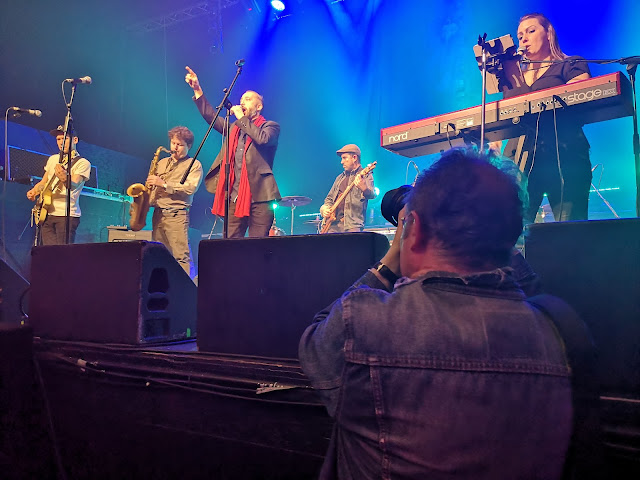
Bowie Ball this Saturday: a Who's Who, with links
ARTICLE HAS BEEN FULLY UPDATED AND EXPANDED WITH BREAKING NEWS!
The Bowie Ball is this Saturday!
This article has been updated to reflect that restrictions have apparently been lifted and MORE TICKETS GO ON SALE AT NOON TOMORROW, Feb. 16th. Apparently we can... dance again? We won't have to sit in little rickety chairs? What if I was GETTING TO LIKE those little rickety chairs? I am going to bring my own little rickety chair and sit right down in the centre of the floor and...
No, no I won't. We can dance! Yay. Hurt my back the other day, the exercise might do me good.
Look: buy tickets for this. Come to this. This is a lovely celebration of really great music, as performed by many folks very close to the heart of the local music scene... and some others, too, whom I know very little about! But they're prolly all REALLY GOOD. An event curated by one of the people who published me a bunch, early on, in fact. 7th anniversary, proceeds to cancer research, and it's THE RICKSHAW, which feels a bit homecoming-y for a lot of folks. The energy should be very very good. Postponed but unbowed! This Saturday night.
Y'all better sell it the rest of the way out.
The lineup is as follows:
7:40 - Coach StrobCam: I have articles on them! See here, or for even deeper background, here. Listen here. (You know the song "Hockey Sucks" off the Johnny Hanson Puck Rock Compilation Vol. 1? It was WRITTEN BY THE CAM IN Coach StrobCam! He was in Pink Steel, too! But he lies about his band name's origins.
8:00 - 20 Explosive Hits! (no website? They've gigged at LanaLou's and the Princeton and such, but I don't really know who they are and could not find it in the four minutes I spent on Google, since there are tons of compilation albums with names like 20 Explosive Hits! Fun name; they could rename themselves Needle in a Haystack for Googlin' purposes...)
8:20 - The Vanrays: amazing, soulful, largeish band made of Vancouver veterans; if you know that "muscle shoals" is not the name of a medical condition, you prolly need to see these guys. I have an article on them - see here; listen here.
8:40 - Brass Panda (see above, under 20 Explosive Hits!, but now I'm being sold Chinese figurines).
9:00 - Asian Persuasion All Stars - another local biggish band of local (and former Victoria) veterans; see here for my feature, which also has links to some of their songs - proceeds to the anti-racism wing of the VAFF!
9:20 - Danny Echo - website here. Seen him last time I was at the Bowie Ball and liked their smart cheat of smuggling in Who and Them covers under the pretext of the songs ("I Can't Explain" and "Here Comes the Night") having been also covered at some point by Bowie.
9:40 - Beau Wheeler - website here, describing her as a "queer artist and recent cancer survivor" (something she and I have in common, but which David Bowie does not, sadly). Interested to see what she does!
10:00 - Mel’s Rock Pile (no website discernible from many links to SCTV-related stuff, but this is Mellow Friesen, formerly the final female vocalist of the Little Guitar Army, with members of Roots Roundup (or that's what I said here).
10:20 - Daddy Issues - read my eye-opening interview with frontperson Betty Bathory - queen of transgressive burlesque - about her GG Allin cover band, as well as drummer Michael Nathanson about his playing with Betty in Daddy Issues
10:40 - Jimmy Baldwin Band (this guy, I am guessing. Reminds me a bit of Warren Zevon on first listen. That's not a bad thing to be reminded of!).
11:00 - Cass King and the Cassettes - see here for an interview with Cass, or here for her music. Great voice, great band, very funny and smart interview.
11:20 - Orchard Pinkish and the Old Canadians - see here and here for more on Richie's illustrious history! One of my favourite-ever Bowie Ball tributes was Cass King joining Orchard in a biggish band, for this cover of "Fame" at the end of the first Bowie Ball in 2016. And for a real fun Pinkish original...
11:40 - Jeevious Family - bandcamp here - what, they were from Roberts Creek, did I read that? Who? What, do I hafta say something about every band?
12:00 - Rebel Priest - bandcamp here. They have a song about being lost in Tokyo. I'VE BEEN LOST IN TOKYO! What are the odds?
I dunno if there will be any further changes or updates or late additions. Of course, the presence of Mellow makes me suspect she will be doing her Aladdin Sane face-paintings again. And of course, proceeds go to the BC Cancer Foundation; even if you can't get tickets, you can donate to them here.
Seeya Saturday? Buy tickets through the Rickshaw website, starting tomorrow at noon.
Tuesday, February 08, 2022
A belated RIP to Merrill Womach, and a Nardwuar the Human Serviette excerpt
I interacted once with Merrill Womach, who - I noticed the other day - died back in 2014. I had missed it.
Womach was kind of a strange story in the world of music: a burn victim and subject of reconstructive facial surgery who wrote inspirational (Christian) songs for other burn victims, assuring them that they were happy before, and would be happy again - as he does in his video for "Happy Again." It's bizarre enough a scene that the mind reels a bit when trying to take it in, but even the hardened ironist, I presume, will register that it's kind of a great thing that he did this, even while chuckling at the weirdness of it all - because in a world where 90% of what passes for "Christian" is repugnant - from hate speech against gays to hoarding wealth as a sign that you are among the elect to traumatizing children with one form of sexual damage or another to voting for vicious bastards like Donald Trump - with all of these things somehow associated with Christianity, trying to cheer up and give hope to the disfigured, using your own disfigurements as an example, is a shiningly moral and laudable calling. Having my own sorta-disfigurements lately, I've been thinking about Womach a bit and the example he set and wanted to repeat this story, which all took place due to Nardwuar the Human Serviette.... and a box of 8 track tapes.
Nardwuar - in an interview that initially ran on this blog, then ended up in Mongrel Zine - was telling the story about how he and the Evaporators released an album on 8-track tape, due to his ambitions to release in every format possible: "How we got 8-tracks going was, simply, we bought some 8-tracks, we bought an 8-track recorder, because you know, a lot of them are out there at Value Villages, and we simply went from cassette to 8-track! And Scott, the drummer of the Evaporators, drew some covers, got a shrinkwrapper, sealed it up, and bang! It looked like new. He's a bit of an artist himself, so he really made it totally store-ready. And we've probably sold about 1,000 8-tracks over the past, like, 15 years. At one gig, in the mid-90's, in Penticton, British Columbia, Canada, we sold 23 8-tracks. It was amazing. They were flying off the shelf like pet rocks."
The "hardest part of making 8-tracks," Nardwuar explained, is getting clean ones to record on. "There's lots of 8-tracks that are out there, but lots of times when you buy them, they're all dirty - y'know, like, trucker scum is on them. Or they're very old. So we were lucky that we actually happened upon a huge cache of 8-tracks, and those were found in Spokane, Washington. A guy we know called Cappy got the entire 8-track output from Merrill Womach, after he passed away."
At the time I had no idea who Womach was, so Nardwuar rounded out the story: "He's one of those guys profiled in that Incredibly Strange Music book that Re:Search put out. You've probably seen
a couple of volumes of those. He was sort of a preacher fellow, and
unfortunately he had an airplane crash and became terribly disfigured. But the
great thing is, he kept on with his life, and he always put his disfigured face
on the cover of his records. Eventually when he did die, he had a whole bunch
of 8-tracks in his garage. Cappy phoned up Scott from The Evaporators; Scott
drove down there in his 1967 Volkswagen bus, completely filled it up with
8-tracks, and then drove back to Vancouver. And that's probably why we don't
make any more 8-tracks: Scott is tired of making them, and also, we've run out
of 8-tracks! We can still buy them from Value Village, but it really sucks
having to buy them for $3 or $4, for something that's totally dirty and may not
work. These were 8-tracks that we taped over, but they had never been used,
they had all been sealed up. So that was kind of our 8-track foray."
But here's the thing - you interview someone in a case like that, you have to fact-check them, even when it's Nardwuar (ESPECIALLY when it is Nardwuar; you don't want to associate a person of his stature with incorrect information, which I did at one point when passing him on an incorrect Eugene Chadbourne story that I hadn't checked, back when he interviewed Eugene). I looked up Merrill Womach, read the Wikipedia page - and there was no mention of him dying.
Did someone just not update Wikipedia? I did a search for "Merrill Womach obituary" and found nothing - or at least not anything about him dying; I did seem to find what seemed to all appearances to be an email address. I had to think carefully about how I worded my message.
Mr. Womach -
Sorry to bother you; I am a music journalist currently writing an article on another music journalist, Nardwuar the Human Serviette. Nardwuar relates that he believes you are dead, but I can find no evidence of this online, and assume there would be an obituary somewhere, since you are a public figure. Since I can find none, I am basically writing to ask, um, are you still alive? (If so, are you still musically active?).
A.
I still have his reply: "Actually Allan, I died two years ago but I frequently check my email accounts. Actually, I’m alive and well. I’m 82 years of age. I’m not singing any more."
Thursday, February 03, 2022
Of Cosmic Dawn: a Jefferson Moneo interview on Cults, UFOs, and an Unusual Ontario Artist
Jefferson: We found this location through our location scout. He told us about Peter's place because we had asked him to show us only the most unique places he could think of. He immediately named Peter's place, so I went there with my producer and we spent the day with him. Peter very generously agreed to let us shoot there, so we decided to incorporate his artwork into the design of the film.
Tom Charity tells me that you had your own experience that inspired or informed this film; can you tell us about it?
When I was 12 years old, I was at my grandmother's ranch in southern Saskatchewan. I woke up at night to brilliant light pouring into the windows. I came downstairs and found my grandmother out in the yard, staring at the sky. There was crazy, colourful light coming from above and then all of a sudden, it disappeared. Just vanished. The really strange thing was that I remember looking at the clock beside my bed when I woke up. It read 11:32. After going outside and then returning to bed, the clock read 11:24. Naturally, nobody ever believes this story -- but it happened.
Would you describe yourself as a "believer," when it comes to UFO's, the paranormal, experiences with aliens, the paranormal, etc?
Absolutely. I saw those damn lights in the sky! It was bizarre.
How did you research the "cult" aspect of the film? Were there specific UFO cults you were thinking of? Were there any films about cults that inspired you? (Do you feel comfortable with the word "cult," by the way? It's a bit loaded...).
Well, I used to belong to a "cult" just like this in Costa Rica. We called ourselves Witnesses of the Third Kind. But then José, our leader, died in a motorcycle crash, so we all just packed up and went home. The food was terrible too. There are only so many plantains and beans one man can eat. Plus, all we really did was take hallucinogens and hang out on the beach.
Have you encountered any die-hard believers in the process of making/ screening this film? Has anyone reached out to you? Did you feel comfortable with that - did any weirdness ensue?
Not so far.
The thing about UFO cults: they tend not to end well for the people involved, in a lot of the stories one reads; no one blasts off into space or gets raptured away; they're all just found dead in a room, Heaven's Gate style. But somehow movies about cults or about people who are mentally ill often end with the cult (or the mentally ill person) being validated, correct, etc. Why is that? Does cinema lend itself more to belief than skepticism? Do you feel fully comfortable with this - do you worry that anything might be irresponsible in endorsing the group, here?
If you're susceptible to joining a cult, I don't think watching a film is going to make a difference, one way or another. People tend to give movies way too much power. I mean, most people watch films as a distraction, not for life advice. This is partly why I find the Academy Awards insufferable. Hollywood tends to think the movies they make "transform the world". Gimme a break.
As for the how and why of "cult films", I'm not sure I have an answer for that. Most movies about cults that I've seen involve a lot of rape and abuse, which Cosmic Dawn most certainly does not have. Or it's about dirty hippies living on a rural commune. One thing I'll say about Costa Rica, we were a good smelling bunch!
There are blue flowers with hallucinogenic properties. Are they based on anything in particular, or is that a reference to the blue flowers in A Scanner Darkly, or...?
José used to grow flowers just like this. I don't know what they were, but I entered another dimension when we ate them. Just pop a petal in your mouth and off into the cosmos you go!
Did I correctly read Alan Howarth's name in the credits? This is the same Alan Howarth who collaborated with John Carpenter? How did you connect with him? What pieces of music does he do?
Yes, the same Alan Howarth. He composed the entire score. We had a mutual friend who introduced us. We still talk. I love Alan. He's brilliant. He's full of crazy ideas and a genuine artist.
Was it tricky getting the rights to the Klaatu song? Where in filming were you when you made the deal to use it? (Did you have a backup song in place for the karaoke scene, if you couldn't get Klaatu?).
No, we had licensed the track before shooting. It was written into the script. Of course, since it was written in the script, it didn't come cheap, but that's life sometimes. You have to pay for the things you really want.
Tuesday, February 01, 2022
Kevin James Howes: the Grammies, Willie Dunn and all things Voluntary In Nature
Allan: What was being nominated for a Grammy like for Native North America Vol 1? (Do you know anyone else personally who has been nominated for a Grammy? I believe you didn't win, that time... who did you lose to, in what category?
Kevin Howes: The Grammy nomination for Native North America (Vol. 1) in the “Best Historical Album” category was a total surprise. I remember waking up that morning, perhaps a little later than usual, checking my phone, and it had exploded, all of my devices had exploded, with texts, screen shots, phone messages, links, and words of congratulations. There were media requests as well: print, radio, and even television. I received a call from CBC Vancouver to appear in person and in studio on the nightly news, which I did, being interviewed by an extremely professional broadcaster, makeup and all. Personally, I recall laughing at/with myself in the shower that morning in almost disbelief. I called my engineer and close friend, Greg Mindorff of Suite Sound Labs, who was also acknowledged in the nomination, but after the initial excitement, a type of dread kicked in. While it felt good for my hard work to be recognized - and it was very hard work, a true labour of love, the “Historical” nomination recognizes the album, producer, and engineer, not the artists. I felt that there was not enough inclusion for the musicians, families, and communities themselves in this acknowledgement, the people who really made the project possible and that there was no way that I could attend the award ceremonies in Los Angeles. I consulted Elder Dr. Duke Redbird in Tkaronto (Toronto, Ontario) about my concerns. He told me to go to L.A. and take lots of pictures. This put me at ease. Thanks again Duke!
Then there was the label, Light in the Attic, who I had clashed with during the production of the album. The last words the co-owner and founder said to me as we wrapped the project, was to paraphrase: “Kevin, you are insane. F%ck you. We are never working with you ever again…” And this was after 10 years of extremely generous offerings on my part to help create some of the landmark titles in their catalogue, so the nomination was also a vindication in that sense. All of a sudden I was the “golden child.” From my perspective, and with many of the artists still active with their music, poetry, and art, NNA was never going to simply be an album in the shops, which went out of print very fast and stayed that way until earlier this year, even with the extensive road work. Over 15 Native North America gatherings, which still continue to this day, over seven years after NNA’s release, have created stages and opportunities for many of the album’s artists. This was the victory, against the corporate music business, against the system, against the colonial mass media, and the racist nature of Canada itself. At the Grammys, we lost to Bob Dylan and The Band (The Basement Tapes Complete: The Bootleg Series Vol. 11). It cracked me up a bit because I don’t believe that the lead producer of that project had even met Bob Dylan. Duke Redbird, ever astute, said it was ok because at least an Indigenous person, Robbie Robertson, was honoured.
Ha! Indeed. Let's move on to Grammy nomination #2. The Willie Dunn liner notes are really unique. What liner notes have you been inspired by/ modeled yourself on? Do you have any favourite liner notes...?
Thank you. In my time, I’ve written quite a handful of liner notes for the likes of Sixto Rodriguez, Thin Lizzy, and Jackie Mittoo, but I remember veteran Canadian music publisher Tony Tobias once saying that in his opinion I’ve never bettered my first set, penned for the re-release of 1970’s Wayne McGhie and the Sounds of Joy in 2004. I just might agree. By then I had been writing for Vancouver’s The Georgia Straight newspaper for a couple of years and had long since graduated from Simon Fraser University (1996). That is to say, many words had already been written by then. Still, it was the early-to-mid 90s era when I was really delving into a breadth of liner notes. Apart from original 1960s write ups by the likes of Derek Taylor (Beatles For Sale) and descriptions on various jazz jackets, the words of Linton Kwesi Johnson and Steve Barrow on 1993’s Tougher than Tough: The Story of Jamaican Music, a four-CD box set that was released by Mango/Island Records, Tribute to Jackie Mittoo by Brian Keyo (Heartbeat Records, 1995), and Bob Marley and the Wailers’ One Love (Leroy Pierson, Roger Steffens) (Heartbeat Records, 1991) were very affecting. Honestly though, I prefer well selected photos and lyrics over supportive words, and the music most of all. To note, the Willie Dunn Notes were inspired by Akwesasne Notes, a seminal Indigenous newspaper that originated from the Mohawk Nation in the late 1960s. The idea is always to try and honour the original era of the recordings through our presentation.
What is the process of being nominated like? Is it like the Oscars, where the studio submits contenders to the academy - did Light in the Attic suggest you to them, or did someone else?
At one point in their journey, Light in the Attic Records started submitting some of their projects for Grammy consideration in the appropriate categories, a Lee Hazlewood retrospective box set in 2013 and 2014’s Native North America (Vol. 1): Aboriginal Folk, Rock, and Country 1966-1985. I guess that put my contributions on the Grammy people’s radar, which led to my participation as a voting member of The Recording Academy and their annual craft committees. Considering the lack of industry engagement with my work at home here in Canada, it felt good to be acknowledged and to participate in their process. My second nomination was in the “Best Album Notes” category for my Willie Dunn Notes essay. Once again, the competition is steep and I went from being “difficult to work with” to the “great Kevin Howes.” Echoes of the final days of producing Native North America still ringing through my head.In a case like this, do you check out the competition, to see who you're up against? What are the other nominees?
Well, there’s an incredible amount of talent in this year’s “Best Album Notes” category, so I hope that any interested academy members who are participating in that specific field take the time to read them all. It would be extremely nice to win, but it’s something that I can’t entertain the thought of. The nomination is always the victory and it pleases me greatly, but I am focused on my work. Creation Never Sleeps, Creation Never Dies: The Willie Dunn Anthology was eight years of effort for me and the focus is now on Voluntary In Nature, a grassroots and organic artist-to-artist initiative. To begin, our albums won’t be presented in a way that even fits into award categories. Perhaps, one or two projects that I can think of down the road, but not yet or anytime soon. I want to focus on the music itself, not the stories or even the format… Unless it can put money into artists' or families' pockets…
Shingoose, 2016, Amanda Leigh Smith, photograph
So are you done with boutique labels from here in? Do you have plans to collaborate again with LITA? What does that bode for the follow up to Native North America Vol. 1?
VIN is the focus from here on out, my life's work. I would never offer an original archival production to LITA ever again (or any other label for that matter) other than to follow up on projects that I have already done (NNA Series, Jamaica-Toronto series, Willie Dunn Anthology, etc...), but only for the benefit of the artists/families involved...For me, money is not the issue, it is respect, for myself, and to those who made the music...
Native North America Vol. 2 is currently in production and I would have to let LITA speak on that. It will be awesome no doubt and especially so if they treat the artists w/ the deep effort and acknowledgment that they deserve (beyond paying for PR)...
Formats (vinyl, etc...) on VIN releases are being created w/ the sole focus of putting money in artists/families pockets and ensuring that I don't lose my shirt in the process. I am of two minds: 1) the $100 LP at a limited number (250 or so) all direct sales or 2) a pressing of 500 given away for free like business cards... The latter does not help artists/families bar "promotion" and "exposure" and that doesn't put food on the table... The LITA/Numero-style option: Distribution, record stores, $25-60 retail prices do not serve artists to the level that is acceptable to me AS an artist...
Hence, no artist on VIN will have to recoup. Physical formats (w/ unique artwork) will be released in their natural time, the music must marinate in people's minds first, I think... It's what's important! Music over format any day of the week...
I wrote this on FB yesterday on a friend's post. Perhaps it might apply... [Note: Kevin added the mention of Amazon only after Neil Young's endorsement of them the other day as an alternative to Spotify].
To me, it's a shame that artists in positions of great power (Neil, Joni, etc...) are not leaving Spotify for that reason (greater streaming rates for all artists). Since it's beginning, the music business has rarely been fair or equitable (there is a vast gulf between those two words, music and business), but it's sad to acknowledge that it is the audience itself who has perhaps spoken loudest in regards to this dire situation. People prefer to pay a simple subscription fee to access an extremely large number of songs than to pay individual artists/groups a percentage of a living wage through the purchase of their music, whether that be through digital or physical music sales... The struggle of the independent artist or group continues, perhaps amplified through Spotify (and exacerbated through the pandemic, especially those who perform live), but nothing new. I view putting music on Spotify as a service where you are paying for your audience's convenience as well as an advertisement for your music as one would have done in a magazine, radio, TV, or newspaper ad back in the day... Unless one is generating millions of streams, it's equally hard to generate funds on any of the other streaming platforms (Apple Music, Tidal, Amazon, etc...) who give a slightly higher rate. Having just started an "outlet for sharing" on Bandcamp (deemed as perhaps the most equitable of the online platforms, but who also take a serious cut of sales in combination w/ Paypal who process the funds, and less usability in terms of listening "offline"), I can report that it's brutal everywhere (even w/ some positive mass media support for our releases)...
[End interview!]
An unknown album and a future landmark, the 1976 follow up to 1970’s soul, funk, and reggae masterpiece, Wayne McGhie & The Sounds of Joy, recorded by the legendary Jamaican-Canadian singer-songwriter/guitarist before succumbing to overwhelming mental health challenges and retreating from the music that he once held so dear. With the blessing of Wayne during his lifetime and continued family support and encouragement, we are honoured to share Wayne ’76 with the world!
Listen/support (and more information):
https://wayne76.bandcamp.com/
Willie Thrasher – Indian/Inuit Country (VIN 002)
A small-run regional, 1994, independent cassette by an Inuvialuit road warrior who has been traveling across Turtle Island since the 1960s and every bit as important as Canada’s much celebrated Stompin’ Tom Connors. Willie Thrasher sings songs about his people, their traditional culture, the human experience, and mother nature. It’s time for everyone to show Willie that “We believe in Native music!”
Listen/support (and more information):
https://indianinuitcountry.bandcamp.com/
Catseye – Self-titled (VIN 003)
Intimate, analogue, progressive folk reflections by two Canadians singer-songwriters in England, who, along with two British musicians, recorded a 99 copy demo album in 1973 aimed at the stars. Their disc received support from none other than the BBC’s John Peel and Elton John’s Rocket Records, yet missed the mark on the first go round… Or did it? Only the Catseye knows!
Listen/support (and more information):
https://catseyealbum.bandcamp.com/
VIN links:
Official website: https://www.voluntaryinnature.com/
Bandcamp: https://voluntaryinnature.bandcamp.com/
Blogger: https://voluntaryinnature.blogspot.com/
Instagram: https://www.instagram.com/voluntaryinnature/
Facebook: https://www.facebook.com/voluntaryinnature
Twitter: https://twitter.com/VoluntaryIn
Youtube: https://www.youtube.com/user/voluntaryinnature
Contact: voluntaryinnature@gmail.com