Friday, January 12, 2018

Flesh Eaters #1: Chris Desjardins interview (2015): "Dancin' with Mr. D."

The following interview is adapted from material that ran online and in print in Big Takeover magazine in 2015. Thanks to Jack Rabid for allowing me to reuse this, to promote the Flesh Eaters' upcoming January 25th gig at the Rickshaw, and also to plug (Flesh Eaters' vocalist, lyricist, and founder) Chris D's first ever Vancouver appearance at a January 24th screening of Border Radio. Chris will be present for that, and doing a Q&A with former Cinemuerte programmer, Spectacular Optical publisher, and House of Psychotic Women author Kier-la Janisse, who knows Chris (She was flying across Canada anyhow to see the band, so I helped arrange the screening, also with thanks to the Vancity Theatre's programmer and resident man of taste, Tom Charity). Note that I have updated this a bit since the 2015 publication to refer to the current tour and reflect recent conversations! 

The introduction bears some similarities with the Big Takeover online portion of my previous interview, but the actual interview has only appeared in full in print, previously - it is online here for the first time! 


No one sings quite like Chris D. His voice, along with that of fellow L.A. punk progenitor Darby Crash, was once characterized by no less than Richard Meltzer himself with the phrase “blabbermouth lockjaw of the soul.” 

Frankly, I’ve always thought those words, colorful though they may be, only scratched the surface of the manic howls, blistering word-spew, and snarling, tequila-soaked ferocity of Chris Desjardins’ singing voice.  (This applies only to his singing with the Flesh Eaters, mind you; his acoustic work, or his various other less intense projects like Divine Horsemen, is moving and accomplished, but it’s not quite so terrifying or singular; Chris may not care so much for his earlier vocal style now - which he considers undisciplined and maybe resultant from too much drinking in studio, but personally, I love it). If you’re not familiar, just check his whooping, demonic delivery of “ShallowWater,”  which appears on what I hold to be the Flesh Eaters’ masterpiece, 1982’s Forever Came Today, the most recent Flesh Eaters reissue (on vinyl and CD) from Superior Viaduct. The lyrics describe a maelstrom drowning out the singer’s voice. It would have to be quite the maelstrom.


So unique is Desjardins’ voice, in fact, that getting him on the phone, in late December 2014 - while a big deal to a lifelong Flesh Eaters fan - came as somewhat anticlimactic. It kind of reminded me of the first time I helped arrange transportation for Eugene Chadbourne to a Vancouver gig. Somewhat to Doc Chad’s irritation, I had expected him to get off the plane looking like a tripped-out mad scientist (Chadbourne later quipped that “my wife gets a lot of this from local yokels who think I sit around the house playing the electric rake all the time or something”). Just as Doc Chad behaved like a perfectly normal man-with-guitars-at-an-airport, Desjardins did not howl, snarl, growl, or roar once during our phone conversation (though he did chuckle at me once). Far from the possessed wildman of the most intense Flesh Eaters’ songs, he was entirely civil, articulate, even somewhat soft-spoken during our talk, which spanned a full 90 minutes.

This relative quietness, of course, only makes him that much more fascinating.

The Flesh Eaters’ are staging their second of two recent reunion tours as of this (2017) publication, both featuring the classic line up of the band, including, besides Chris, members drawn from the bands X, the Blasters, and Los Lobos, all of whom appeared on 1981's A Minute to Pray, a Second to Die (also reissued through Superior Viaduct): that means Dave Alvin, John Doe, Bill Bateman, Steve Berlin, and DJ Bonebrake will be onstage, and doing most of the Minute to Pray album (with a few additions to the set like "The Wedding Dice," a killer track off Forever Came Today). I caught the band in Seattle in 2015, with Mudhoney opening; it was a great night, and seeing them in Vancouver with dark-edged country swing band Petunia and the Vipers as openers - a band who has also collaborated with members of X and the Blasters when on trips to LA - is an opportunity for music fans not to be missed. 

More is to come - including talk of Chris D's junkie ghost vampire horror film, I Pass for Human, and his acting appearance in the 1980's cold war thriller No Way Out, but here's part one, the 2015 interview.


Let me start by asking you about the pronunciation of your name. It seems like it’s a French name - Desjardins? (Day-Jar-Dan) Is that right?

Yeah, you pronounced it right.

You took the name Chris D. because people typically didn’t pronounce it right?

Yeah, that’s part of it. And in 1977, I taught high school English at a private high school for about six months and none of the kids could pronounce my name. So I just told them to call me Mr. D, and that was right around the time when I started playing music, and I thought Chris D. would be a good moniker, rather than the whole name.

What was your family background like, did you grow up in a musical family? A well-to-do-family?

Not a well-to-do family. I would say we were, like, middle-middle class. My father was a professor, he was a scientist. We had a lot of books in the house. So I guess we were definitely a literate family. My mother was, I think, kind of a frustrated artist. She would have done that if she’d been single. But my father was a plant pathologist, which is studying plant viruses and agricultural diseases.

That sounds kind of dry. Were they influences on your development?

Not in terms of science, or her art. She didn’t really pursue the art much longer than when we were kids. She was taking mail order artist classes, drawing classes and painting classes, and she was doing it when we were all little, when I was about ten years old. (I’ve got a brother who is a couple of years younger than I am, and a sister who is three years younger than I am.) No, the way my parents were influential on me was through their being pretty strict, as far as religion goes. We were Catholic. I was an altar boy, stuff like that.

You went to a Jesuit university, as well, right?

Loyola  Marymount, yeah, I believe they were Jesuit.

I know that comes up in your iconography - you see the influence of Latin American Catholic art in some of your gig posters and stuff… but how else did it influence you?

Well, there was a lot of repression in regard to sexual matters, there was a lot of association of guilt with that and various other things that weren’t appropriate, supposedly, for a good Catholic to do. For instance, it was at times very difficult to go see certain movies I wanted to go see. I remember my mother wouldn’t let me go see the Dean Martin Matt Helm films because she thought he was too promiscuous a role model, with his freewheeling supposed alcoholism and objectification of women, which, looking back on it now, I kind of agree with, even though I love Dean Martin. But uh… It was just that kind of repressive feeling. Comic books were frowned on, even though they were allowed. But my parents were actually pretty easygoing in some respects. Once I got a driver’s license I was allowed to drive by myself and go out on the weekends - if I was home by a certain time. It wasn’t, like, super super strict, but it was strict enough that it had an impact. Especially the movie stuff, it was always a bone of contention until I was 15 or 16 or so.  I went to a Catholic boys’ high school, and the English teacher, who was a priest, he was actually pretty liberal, and he told my mother that I was mature enough to go see X-rated movies and stuff. R-rated. By myself, if I could get in, of course. You have to remember that X-rated films back then were like, Rosemary’s Baby…
Midnight Cowboy…A lot of mainstream movies were X-rated, and a lot of movies like Easy Rider were always kind of borderline.


So  your passion for violent and garish cinema, did that start at an early age? Do you remember any films that you saw that really opened your eyes, that really excited you?

You know, probably the biggest influences were when I was in high school, and I discovered Hammer films. I kind of remember going to see a good double feature of Dracula, Prince of Darkness and Plague of the Zombies. So they’re kind of exploitation movies which are relatively “high class,” if you want to call them that. I always wanted to go see any Hammer film that came through, once I was old enough. Those were the first two I saw in the theatre, and I was always looking for them on TV, because they were on TV a lot. Interrupted by commercials, of course.

Did you get to have late night viewings, left alone, when your parents were in bed, and you had time with the TV?

You know, I was supposed to go to bed at a certain time, but the TV was in a separate room which we called the den, and often, if there was a science fiction or monster movie on anywhere from 11:30 to one in the morning, I would sneak in and get up after my parents were asleep and go in and watch it with the volume way down. 90% of the time I got away with it. Fiend Without a Face, Killers from Space… Everything from well-done horror/ sci-fi to really grade Z bottom of the barrel movies like Phantom From Space.

Our backgrounds weren’t that different. I remember that Canadian TV fare sometimes had pretty risqué stuff late at night, and I was really interested in that; the first time I saw Zabriskie Point, say, it was the naked hippies that caught my eye, on late-night TV. Were the films you were seeing pretty censored, back then - what, in the early 70’s?

I was in high school in the late 60’s, so - the films were definitely censored for sexual content, but I remember seeing a Mario Bava movie, The Whip and the Body - it was under a different title. I also Joe D’Amato’s first film, Death Smiles on a Murderer, with Klaus Kinski and Ewa Aulin. I remember seeing those on TV late at night, but they were slightly censored. The last couple of years when I was in high school, and when I was in college - when I moved to Los Angeles - I was constantly going to see movies in Hollywood. Hollywood Boulevard just had so many movie theatres at that time. It was an ideal time for exploitation movies and horror films, with both domestic and European horror films getting showings at cut rate theatres on Hollywood Boulevard. There was also - when I’d come home on the weekends at times, there were a lot of screenings at the local university where my father taught. They had screenings on Saturday nights for the students,  and they were quite often pretty radical foreign films. I remember seeing Weekend, by Jean-Luc Godard, at one of those screenings.   

What was your exposure to Japanese cinema?

I was aware of Kurosawa from the time I was in high school, I started to see his films around that time, but I wasn’t aware of other Japanese films until I saw some of the Lone Wolf and Cub movies. I remember seeing clips from some of the ones like Shogun Assassin and Eight Swords of Death that got released here, and I remember really liking those, but my sensibility at that time wasn’t really discerning enough to distinguish between Chinese and Japanese martial arts films. Of course, like, Japanese giant monster films, like the Godzilla movies - I would always see those when they came out. There were a few of those I saw in the theatres, like Godzilla Versus Mothra, the original one, and Atragon - there were a few others. But as far as really getting into Japanese cinema, the first Asian cinema I got into was probably in the mid 1980’s, with the emergence of a lot of really violent crime movies by people like John Woo and Tsui Hark were doing, more Hong Kong based exploitation cinema. And it was probably around 1988, 1989, I had found out about the Kaidan horror films - Japanese horror films, a lot of them set in the Samurai period, and I discovered that there were six Lone Wolf and Cub movies. So I started going down to Little Tokyo and going to the Japanese video stores trying to find those movies. I couldn’t find any Lone Wolf and Cub movies at the time. They had kind of faded in popularity in terms of, at least, finding their ways into Japanese video stores of here, and the same with kaidans. But I found tons of Japanese Yakuza movies from the 1960’s and 1970’s. And I started renting those, even  though they weren’t subtitled, just because the video covers were so amazing - I thought these looked like amazing movies. I watched literally scores and scores of those movies without subtitles. That was my first real exposure - 88 to 89, then 90-91 getting into it heavily and actually starting to think about writing an encyclopedia of Yakuza movies, because there really seemed to be so many of them. That’s when I started working on that Gun and Sword book, that encyclopedia I wrote. It was in the works for 20 years.

Have you managed to track down subtitled versions of most of those films?

I’ve managed to track down subtitled versions of some of that stuff, like the Red Peony Gambler movies, and some of the films that have gotten released here on video - some of the Mieko Kaji films like Wandering Ginza Butterfly, the Female Convict Scorpion movies, the Lady Snowblood movies. And eventually they started releasing the Lone Wolf and Cub movies here… So through various fan websites and domestic releases I’ve seen a lot of stuff subtitled now, but there’s still a lot of stuff I’ve only seen in its un-subtitled state. There’s a lot of stuff in the book I’ve only seen without subtitles.

Do you speak Japanese at all?

No I don’t speak Japanese, but it got to the point where I could discern pretty much what was going on without the subtitles. The movies were so formulaic that it really became pretty easy to distinguish patterns and similar plotlines and variations, without understanding the dialogue. I got to the point where I could understand a little bit of the Japanese - I got to be able to recognize the names of hundreds of Japanese movie actors, directors, cinematographers, and screenwriters’ names in the original Japanese in the credits and stuff, so that was a big plus, but I never got to the point where I could understand Japanese well enough to be able to speak it or be able to translate much more than the movie credits.

So the interviews in something like Outlaw Masters of Japanese Cinema, all of those are done through translators.

Oh, yeah.

I’m jealous you got to speak to people like Fukasaku Kinji. That’s pretty amazing stuff. A fantastic filmmaker. Let me ask - okay, so a last question about film, but it seems like you must consume a lot of cinema? What’s your average?

I’ve really cut back quite a bit. It’s just a matter of having that much shorter an attention span. It’s not really due to age - I don’t know if it’s because of the internet or what. I don’t watch nearly as much Japanese cinema as I used to. I still watch maybe one movie a month that’s Japanese. I don’t watch more than two or three movies a week now, and I used to watch maybe one movie a day. But this whole last year has been a really hard year, for me, in terms of emotional/ personal stuff and financial stuff. I haven’t been motivated to watch as much film as I used to. I still watch anywhere from three to five movies a week.


It’s still a fairly high consumption… Okay, so, were there writers that were formative influences on your writing?

Probably the first... I mean, I was writing short stories when I was in high school, grade school. But the first stuff that I was really satisfied with that I was writing was poetry, which was in the early to mid 1970’s. I did write a first novel in the mid 1970’s, a couple of science fiction novels which will probably never see the light of day. They’re kind of uneven. But I read a lot of science fiction when I was in 7th-8th-9th- grade, during that time period - J.G. Ballard, Philip K. Dick, Cordwainer Smith, Andre Norton, Henry Kuttner, John Brunner, John Wyndham, who wrote Day of the Triffids.


Is any of your early SF, is any of that excerpted in the anthology of your collected writings, A Minute to Pray, A Second to Die?

The first science fiction novel I wrote is called Sacred World. There’s excerpts in there. It’s kind of a post apocalyptic kind of thing - not nuclear war, but nuclear energy having polluted a lot of urban and suburban areas. A lot of my writing, my poetry was very heavily influenced by William Burroughs, Jean Genet…

I thought I recalled someone referencing Beaudelaire and Rimbaud, in regard to you…

A little bit later on, in the later 70’s, I was getting more into people like Rimbaud, Beaudelaire, JK Huysmans, Lautrement. By the time A Minute To Pray, the album, came out those were big influences on me. Also Edgar Allen Poe and Gaston LaRoux, who wrote the original Phantom of the Opera novel, which I still think has never been filmed properly. I think all the films - the silent one, I think, comes closest to the book, but the book is so Grand Guignol and intricate in detail and I think all the movies have gone too much for the love story angle, and not been very faithful to the book.

In terms of hardboiled crime, writers like James M. Cain, when did they come into your life?

I started reading people like Raymond Chandler and Dashiell Hammett when I was still in high school probably. And definitely through college. But it wasn’t still the late 1970’s  until I started to branch out and find every writer I could. James M. Cain I probably didn’t start reading until the late 1970’s. In 1980, my friend Byron Coley, who I met around that time turned me on to a lot of people like Jim Thompson and David Goodis, Dan J. Marlowe and Harry Whittington.

Hm, I don’t know them at all. I’ll look into them. In terms of music, what was it like, growing up - what was the soundtrack? Was there rock music allowed, or…?

It was kind of frowned upon, it was tolerated. We had a record player in my room, we had a big stereo, and when my parents weren’t home I kind of went to town on the stereo in the living room and played a lot of stuff. We had a reel-to-reel tape recorder that was in the big stereo too, and I remember I had all the original Rolling Stones albums on tape. I got Steppenwolf’s first album when it came out, and all three of the Cream albums - the first three that came out… Iron Butterfly’s Inna Gadda da Vida album, stuff like that.


Were there important concerts when you were young?

A lot of the ones that I really wanted to go see, I was too young. I really wanted to see Janis Joplin and the MC5 when they played Swing Auditorium in San Bernardino. I was still in high school. I really wasn’t allowed to go to concerts until I was in college, in 1970. I went to go see a lot of live music back then, though. I went to go see - I don’t know if you knew who Lee Michaels was, I went to see a lot of his concerts. He was kind of famous for having an ear-splitting organ, and he would sing and play. He had a few top forty hits, although he’s kind of forgotten now. I went to go see people like Led Zeppelin and Traffic and pre-Buckingham/ Nicks Fleetwood Mac. Peter Green had already left the group. I saw Elton John, Leon Russell, Johnny Winter, people like that, and when I was away at college I saw the original Ziggy Stardust concerts of David Bowie, I went to go see Mott the Hoople, and the New York Dolls and Iggy and the Stooges and all those people when they were playing Hollywood in the early 1970’s.

I know you cover Mott the Hoople’s “The Moon Upstairs” on Dragstrip Riot…

Right, yeah.

So do you remember how you felt when punk started, what your first exposure was to punk?

To me it was a really pure expression of what I thought rock and roll would be. It was kind of like, ‘this is what rock music really should sound like,’ and not digressions into all this… I mean, by that time I was kind of disillusioned. I don’t know if you call Jethro Tull a prog-rock band, they were more of a jazz-rock-blues band at first, and I really liked their first three albums, but then with Aqualung and Thick as a Brick especially I thought was terrible. I really grew disillusioned. There were other bands like Jefferson Airplane where I really liked their early stuff, up to Volunteers, and then after that they kind of fell off.

What was it turned you off? Highbrow pretension?

Not really that, it was more a diffusion of energy, they were all losing steam, and a lot of them were getting more into noodling around on the guitar and jams and stuff like that. Songs that would go on too long.

So what was your first exposure to punk? I mean, you saw Iggy and the Stooges, and now retroactively they’ve been labeled a punk band, but I don’t think anyone was calling them that at the time.

In terms of when punk started I guess it was really the British wave of stuff. I went out and got import albums of the Sex Pistols’ first album, the Damned, the Clash’s first album, the Australian band the Saints. And those were the records that I really listened to a lot, but I was also listening to a lot of New York Dolls and Stooges. I was still listening to a lot of Bowie, too, up until Low. He kind of lost me with Low, but I liked everything before that. I really liked Diamond Dogs and Aladdin Sane


Was any of this influential on your singing voice? No one really sings like you - I love it, but it’s an unusual voice, and it strikes me as a really bold thing that you’re singing in this unprecedented way from your first single on. How did you develop confidence in that particular style? Do you just naturally sing like that, were the people who influenced you, or…?

There were singers who influenced me. Probably though even though you can’t hear it til later, Jim Morrison of the Doors, Captain Beefheart - I think you can probably hear that influence. Rod Stewart when he was singing on those first couple of Jeff Beck solo albums. Rod Stewart had a growling, gritty, sandpapery voice… but there were also black blues singers like Holwin’ Wolf, John Lee Hooker. But the singing style… a lot of that is so undisciplined and raw, it’s really hard for me to listen to now. The first single, and stuff that’s on Tooth and Nail and the first album, No Questions Asked, a lot of that’s very hard for me to listen to now. The singing is just all over the place. Some of it’s borderline okay. A lot of people love those songs from that period of the Flesh Eaters and that’s great, I’m glad they do. I like the songs. I don’t like my execution of the vocals on a lot of that stuff. It wasn’t until A Minute to Pray, which was the second album, where the singing was starting to get where I could live with it later on. I really have to give John Doe, from X, credit for that, because he kind of advised me to start trying to sing, as well as doing the screaming/ growling kind of stuff, to use the screaming and growling with more discretion, as punctuation. Just listening to music, I really got more into dynamics, in terms of highs and lows and how to build songs vocally. How to build songs that, even though I wasn’t a trained musician, I wrote a lot of music for the songs. As I went along, I just learned how to build songs, so it would work to a crescendo or a climax.

Do you have a particular favourite period or album?

Well, I really like A Minute to Pray a lot, I like the one that came after it, Forever Came Today, a lot. 

That’s my favourite. I’ve always wondered about A Minute to Pray. There are some great songs on it, but it seems to me that it gets the most attention of any of the Flesh Eaters’ catalogue, the one that people put up there, and it’s just such an odd album. It has the best cover of any Flesh Eaters album, but I wouldn’t pick it for the best album…


I think Minute to Pray is just so off kilter because of the jazz and blues influence, and the whole voodoo thing is just so pronounced on that album. You still get the same kind of lyrical stuff on Forever Came Today and Hard Road to Follow, but the music is… I hate to call it mainstream, it’s still not mainstream when you compare it to mainstream music, but it’s a little more traditional in terms of heavy rock music than A Minute to Pray. I think A Minute to Pray perhaps stuck out because of all the sax and the marimba that’s all over it. I was really trying to transcribe a lot of African and ethnic blues music and try to meld the two together, and I think a lot of that created a lot of really unique rhythms that hadn’t been heard in rock music so much. I think that’s one of the reasons its had its staying power, plus its reputation has only increased because its got a couple of people who were in X in the band [John Doe and DJ Bonebrake] and Dave Alvin and Bill Bateman, who were in the Blasters, and Steve Berlin, whose been in Los Lobos for the last few decades. The reputation of the album has only increased because of the cache of having those guys in the band with me.

You’re right, it’s a very eccentric album. Let me ask about the voodoo thing. The cover design is fantastic. Where did the idea come from, whose hand is that, where did you get exposed to the idea of the hand of glory?

Well, I actually took that image from a frame of the original version of The Wicker Man. There’s a scene where Edward Woodward, the really straight cop who goes to the island, he wakes up one morning and there’s a hand of glory on his bedside table, and that’s the hand. I took that image out of the frame, and did different colour enhancement and stuff. And I started reading up on witchcraft and demonology and stuff like that just because it was fascinating to me. I wasn’t wanting to practice it or anything; even though I wasn’t a practicing Catholic, I still have a lot of those kind of reservations. I didn’t want the album to be perceived as Satanic. I’ve said this in other interviews, it’s kind of an exorcism, the album is meant to be a spiritual/ personal exorcism of demons - demons of my love life…

So did you become aware of the hand of glory through The Wicker Man, first?

It was through The Wicker Man first, and then I read about it in various books on witchcraft.

It interests me because it crops up in a few of your songs - of course, “Hand of Glory” on Forever Came Today, but it’s also in “The Wedding Dice” - “it’s the story of the hand of glory.” I always assumed that that song is sort of like, the backstory of the hand of glory, how the criminal that the hand came from came to be executed. I don’t know if I’m reading that right…

Well, you know, it just rhymed well with the line, “the cops say to this day it’s no heartwarming story.” I wasn’t trying to make it being literal, I wasn’t thinking in horror movie terms, this guy had a hand of glory that somehow cursed him. I was thinking more in hardboiled crime fiction terms and using that as a metaphor than as a literal thing.

Makes sense. So - in terms of voodoo, I know in Vancouver there was actually a gallery in the 1990’s that had Santeria altars, where they did rituals, maybe they did some sacrifices, I don’t know. Was there a voodoo presence in the LA scene?

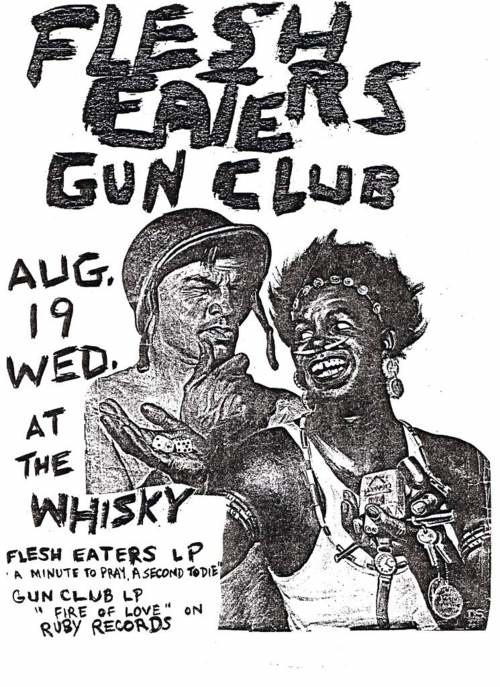
Not voodoo, but there was a Santeria presence in some of the bodegas. Like, you could go in and get little bottles of charm potions. The idea for the back cover of the Gun Club’s Fire of Love album, with all the little potion bottles. Judith Bell who did the drawings, she and I went to some bodegas that had ethnic shops that had charms and roots for sale, that were basically places you would go if you were into Santeria, and we bought some of those potion bottles just because the artwork on them was so bizarre. Judith, of course, drew her own interpretations of the Gun Club songs for the labels. The potion bottles on the cover were the closest I got to any of that stuff.


You never attended rituals or such.

No, no.

The idea of exorcism and possession and shedding demons. I can really see that in your songs. What is “Digging My Grave” about, the idea of being your family doctor. What is that referring to?

Well, there’s a screenplay I’d written that never saw the light of day. It got optioned by a couple of people and it almost got made, and it was this movie set in Louisiana. It was a swamp horror movie about a girl who grows up to become a vampire in a swamp. And the beginning scene in the movie is of her father murdering her whole family, and she was the only one who survived. I basically took the opening scene of that script and made it into a song. So that’s where that’s from. I would also occasionally get ideas from crime stories that were in newspapers or on television, true crime type stuff. That was around the time that I wrote that script - I can’t really remember what came first, I think I had already written the script when I wrote that song.

Hope you don’t mind my asking, but were drugs part of your life at that point?

I was really drinking a lot of hard liquor. I generally had a fifth of Stoli in the freezer and I would drink Jack Daniels quite a bit. 

Does having cleaned up change your relationship to any of this material? There’s a romance of self-destruction that runs through some of your songs.

Well, there’s still that kind of - I don’t know if you’ve heard the albums that I did when I was sober. There’s one from 1999 called Ashes of Time, and there’s one from 2004 called Miss Muerte. And I think songwise, the production isn’t quite as good on Ashes of Time, but Miss Muerte, the production’s really great, and it’s comparable in quality to a cross between Forever Came Today and some of the best of the Divine Horsemen stuff. Julie Christensen sings quite a bit on both those two albums, so they’re kind of a cross between Flesh Eaters and Divine Horsemen in their sound, even though they’re under the Flesh Eaters’ name… but there’s still that imagery. In some ways I think my writing is better on those last two albums than it was earlier on. It still covered all those bases that I was covering, but wasn’t quite as self-indulgent as some of the earlier stuff - some of the Hard Road to Follow songs, and then going through Dragstrip Riot, which is one of the early 1990’s Flesh Eaters albums that came out on SST, there’s some songs on that that I don’t really like. Especially the Dragstrip Riot album, I was thinking about that the other night. There’s only a few songs on that album I still like.

Oh really? Which ones?

I really like “Tomorrow Never Comes,” “The Youngest Profession” - the first side of the album [Chris tells me that he might try to work up a version of "The Youngest Profession" for the current tour]. It’s a double album, and I think it could have been improved if I’d whittled it down to a single album length. Some of the songs like “Take My Hand” I don’t like very much. “Slipped Tripped and Fell in Love,” which was another attempt to do some kind of Memphis soul-type covers. It could have been on Hard Road to Follow, which I think worked much better - “Rhymes” and “I Take What I Want.”

I like “Slipped, Tripped, Fell in Love” though.

Part of my problem with those covers - “Slipped, Tripped, Fell in Love,” “Moon Upstairs” and “Slow Death” is that my singing doesn’t have as much dynamics as it had at one time. There’s almost a strained quality in the vocals that bothers me. It’s just my opinion.

I don’t feel that way at all! I really kind of feel that Dragstrip Riot is an underrated album.

I’m glad you dig it! There’s some good stuff on there. I like the “Dragstrip Riot” song, that’s one of the really long songs… It could have been a little shorter, but I still like that. I like the background vocals on that song.

Coming back to A Minute To Pray, I want to ask about “Cyranode Berger’s Back.” I have an eccentric reading of that song. I don’t know if I’m off the planet, I don’t know if this makes any sense at all, but the lyrics about speaking for someone else and making someone else look good, it seems like it could be about being a music critic. That’s kind of what music journalists do. But am I reading that at all right?

I hate to tell ya, no. That’s a John Doe song, so he had written the lyrics to that. That was one of the few covers that I did early on, and I really liked that it was a love song and that it was different  from some of the other material on the album, but I also liked the fact that it had some "Chris D. imagery" in it, if I can be so egocentric as to say that. There’s a line - “your eyes are as blue as the coals that burn in your black corsage.” Lines like that, which I really like…


That’s a John Doe lyric?

Yeah.

I always thought that WAS your lyric, because it feels so much like you.

No. I had seen X rehearse that song. I used to go to X rehearsals in the 1980-1981 period, just to listen to them, because I love their stuff so much. And I always loved that song, and they hadn’t recorded it on their first album, and they weren’t going to record it on Wild Gift as far as I knew, and I just asked John if we could do it. He said sure. They did it later on I think on See How We Are, but they did it quite differently, they changed the arrangement quite a bit.

Okay. Well. I was hoping to segue into talking about your time with Slash magazine. There’s none of that in the book, A Minute to Pray, A Second to Die, that I notice. There’s none of your criticism. So what did you do for Slash? I have no idea!

I wasn’t really on a payroll or anything like that. It was Claude - Kickboy - and his girlfriend Philomena. They were the editors, and there was Steve Samioff who was the publisher, and his girlfriend Melanie Nissin, at the time she was the main photo editor. And it wasn’t until late 1979 , I think, that Bob Biggs bought the magazine, and it still kept in the same vein. The art direction changed a little, but Steve Samioff was still involved and he did a lot of the art direction, along with Melanie. But the writers… I wrote a lot of record reviews, a lot of live show reviews. I didn’t really do too many interviews, I can’t really remember interviewing too many bands for that. Judith Bell and I did interview Paul Schrader for one issue of the magazine, and we also interviewed Sam Fuller for the very last issue of Slash. But mostly I just wrote record reviews, and I wrote under a lot of different names. I had a lot of pseudonyms: Half-Cocked, Mr. OK, Bob Clone… There’s probably another one I’m forgetting. And I would write under my own name on some reviews.

Did you do any graphic stuff for them?

No, the only graphic stuff that ever appeared by me in the magazine was when I was doing ads for my albums, like the Tooth and Nail album, I did some artwork, did some of the ads that were in there, and when No Questions Asked came out. But the album went defunct in December 1980, before A Minute to Pray, so… but just some of the ads I placed in the magazine was the only graphics I ever did.


Did you have a visual arts background at all? You did the Gun Club's Fire of Love, and I assume a lot of the gig posters on the Greatest Hits Destroyed By Fire comp, are yours…?

Yeah… but it was just something that came naturally to me. I had some art training or something when I was a kid but not anything that would remotely lead to the kind of collage stuff that I would do later, with flyers and album covers.

There’s something of collage in your lyrics, as well. I was thinking: if the Misfits wrote a song called “Eyes Without a Face,” it would follow the plot of the film: it would be a song about a surgeon who cuts the faces off girls. Your song, “Eyes Without a Face,” has absolutely no bearing on the movie that I can notice.

Right.

So as devoted as you are to movies, you seem very willing to take this image here, this image there and completely transform it in the service of your own poetry.

Yeah. I totally agree. I don’t know what else to add to that, except that’s true.


Sometimes I can’t tell where something is you or something you’ve lifted from, like, a poster for an exploitation movie. A phrase like “twisted arm of illegal youth” - I could see that on a movie poster for something like Gun Crazy, you know? But maybe it’s just your writing!

Some of that - when I was in high school, I was really into student radical stuff like the SDS. I was living in Riverside California, so there was, like, no infrastructure or a group of people who were into that also. So I was like a lone wolf in terms of being into that kind of stuff. But once I went to college and I took LSD for the first time, all the political stuff kind of went out the window after that! But a lot of the resurgence of rebellious youth, it was just a general image, it wasn’t something that had anything to do with reality or anything that I’d been involved in. It wasn’t something where I’d gotten rousted by the police and gotten whacked on the head with a baton or anything. It was just strictly transposing stuff that was happening. There were some punk rock riots that would happen at some concerts where the cops would show up and get a little heavy-handed in breaking up the concerts.

I remember reading a very vivid description that Alex Cox wrote about cops beating people up and he’s just walking through the scene on acid getting totally left alone… You never had any problems, though?

I was really lucky, I was never at any of those shows that got broken up. Or if they did get broken up by the cops, I headed out early, I wasn’t going to stick around and try and stand up against the police! To me that was kind of a futile gesture that could only result in grief.

There’s still a hostility towards the police in some of your song lyrics. I always thought the hubbub over “Cop Killer” was kind of funny because I’d been listening to “We’ll Never Die” (with a chorus of “shoot out the eyes of the boys in blue”) since I was a teenager.

Well, no. There was nobody who took me to task for it. That was strictly imagery from hardboiled crime fiction and film noir movies like They Live By Night and Gun Crazy, transposed to more of an updated milieu.


What was “The Wedding Dice” about? There’s a few images of yours where I just have no idea. What are wedding dice?

That’s more metaphorical than anything else - just, “we threw the wedding dice,” we took a chance and got married. The crime imagery in there once more, I was starting to get into storytelling-type songs, and “Wedding Dice” segues into “Hand of Glory,” those two songs are linked, have the same kind of story. There’s no specific details spelled out. “My picture’s in the paper/ but you can’t see my face” - I just remember seeing pictures in the newspaper of guys that would get caught by the cops and they’d take them out to their squad cars and they would have their face shielded by their hands or they’d have a coat draped over their heads or something. So that’s where I got that imagery from.

Okay. A few other specific things that I’ve always been curious about. Why do you have, in “Father of Lies,” “eleven white roses” for your little girl, as opposed to the more traditional twelve?

I don’t know why I picked that, it was just kind of arbitrary. There’s some stuff now I look back on and I read those lyrics and I go, “I don’t know where I got that from.” I mean, there’s some stuff you just have to allow to come up from the ether, it bubbles up from the subconscious and you just grab onto it. I’m a big fan of David Lynch, and he’s somebody I think has a really good handle on how ideas come about, how they can kind of bubble to the surface. And you don’t really know where they came from, and it’s kind of purposeless to try to figure out where they came from. He likes people to get their own interpretation. I’m kind of of the same mind, I’m really fine with any interpretation somebody gets. I probably explain a little too much.


Uhm. I like Lynch’s point of view and I see what you mean. But I want to ask one more question. I’ve never known what a pony dress was or where that comes from.

I just imagined a girl wearing a dress made out of pony hide, instead of cowhide - like, a leather dress. A lot of people thought I meant a dress that had little ponies drawn or embroidered on the dress, but I was actually talking about a dress that was made out of the skin of a pony.

That wasn’t based on anything, that’s not a reference to anything else?

No, I have no idea why I came up with that idea, I really don’t. Out of the blue.

Awesome. I want to ask about a song that you wrote with Tito Larriva - “I & I” that the Circle Jerks covered. Did that ever get recorded?

No, there’s actually some songs from that period I really wish got recorded, like “I & I” and another one called “Under the Gun.” There’s another one called “Automaton Bombs.” Some songs, there was a song called “Achieve that Reject” where I threw the lyrics out and used the same music for the song “Shallow Water” that’s on Forever Came Today. But no, unfortunately, the lineups were so in flux at that time that when Minute To Pray came around, rather than carry on some of the old songs I’d been doing, I really wanted to record just a whole new batch with these guys, that I’d written specifically for that lineup.


Byron Coley implies somewhere that the reason the lineups fluctuated so much was that you were more focused on your writing, that you didn’t really want to have a single solid lineup, but is that true? Am I understanding it correctly?

It’s partly true, but - I hate to say it, but…  There’s a couple different reasons. There’s the reason of financial security, being able to pay for my rent, if I’m going out on tour and try to actually tour with a steady lineup. There was the fact that even though musically I would feel like people should have equal input, to some degree, I wanted to be autonomous in terms of decision making and be the leader of the band, so that my decision would go, as far as what the music sounded like. So there was some of that stuff. I would get together with people who I would like working with, but they wanted to be frontmen in their own bands, like Tito, he had the Plugz, and Stan Ridgway, who was in the band for a couple of months, he ended up having Wall of Voodoo. There were a couple of other people like that over the years that had their own ideas about what they wanted to do. Probably the most consistent lineups I had were during the Divine Horsemen period, but we went through several guitar players in that band. But the other thing too, is that psychologically I could never imagine being on the road as much as these other people I knew, friends of mine like the Blasters and X. They were just continually on the road, and I just couldn’t handle it, psychologically I couldn’t see myself on the road; it would drive me literally crazy, probably. So.

Did you tour a lot outside Los Angeles, in any version of the band?

The Forever Came Today/ Hard Road to Follow lineup, we did a tour in 1982, and Byron Coley was the road manager. We played quite a few cities… I don’t know how many. One…two, three… I think we did about twenty or twenty one cities.

All in the United States?

Yes.

So you never played in Japan?

No. Divine Horsemen came close to doing some European shows but then the band broke up when Julie and I broke up. So that didn’t happen. Divine Horsemen went on three tours. We did a southwestern tour in 1985, then we did 1987, two tours, one in the late winter/ early spring, and then one in the fall.

Let me ask, when you’ve gone to Japan, did you notice an international following - people listening to the Flesh Eaters? 

There was a guy, I can’t remember his name now, who I stayed with in Osaka who owned a record store, who was a friend of Byron’s.

His name’s not Toshio, by any chance?

No. Oh, god. His initials were K.K.  - something Kodama. I can’t remember his first name. He was a really good guy. But there wasn’t that much awareness of the Flesh Eaters. I mean, there was, they knew who the Flesh Eaters were, but it wasn’t like - there’s a huge Flesh Eaters following in Italy. I have a lot of Italian Facebook friends who are Flesh Eaters fans, and there’s definitely some following in England and France and Germany. We could definitely go over there and do shows. It would be nice to try and do a European tour, but it’s probably impossible, unless I put together a completely non-superstar lineup of guys that weren’t other really successful bands. Trying to get X to take a big break - and John Doe’s got his own solo band thing. Dave Alvin’s got his own solo band thing, and he’s also been doing all those gigs with his brother, and Steve Berlin - Los Lobos are on the road all the time.


It sounds like it would be kind of complicated.

I don’t know. This coming year is kind of an unknown for me, because there’s a lot of financial issues coming up. I’ve been really lucky this last year because I’ve been doing a lot of extra work in commercials, and I got upgraded in one of the commercials I was in to a principal, so I’ve been getting some residuals from that commercial.

Sorry, what commercial...?

I don’t even want to say what it was. I haven’t even seen it on television. Let’s put it this way, it’s a fairly popular candy bar. I don’t know if it’s just been on the kids’ stations, or what! But I haven’t seen it on the TV that I watch. But my TV watching of commercial TV is pretty limited, so I might have just missed it.

You were working pretty regularly as a programmer and a film teacher, weren’t you?

Yeah, I worked for American Cinematheque in Hollywood for ten years, and the last five years I was there I was the main programmer at the Egyptian Theatre, which is one of the two theatres that they had. But then I started to teach more, and I was teaching up in San Francisco. They were flying me up there, and I was at a point where I was teaching four classes a week… then about a year ago, the bottom dropped out with the budget. I’d been doing it for about five years, but they couldn’t afford to fly me up there anymore. And they had other teachers that were as qualified up there, so the bottom line kind of trumped having me. And they’d filled the hole at American Cinematheque after I’d left. Programming for repertory films is a very tiny niche market and trying to find a job doing that… if you can find one, you’re most likely going to have to relocate to Bumfuck Iowa, so… it’s been frustrating. I’ve really had a kind of frustrating last year, but anyway…

But Gun and Sword is out… is that making any impact? It seems like a very ambitious project.

It was associated with several different publishers before I ended up  putting it out myself. Originally Quentin Tarantino’s publishing company was going to put it out in the late 1990’s, and then they only ended up doing one book, their blaxploitation film book, What It Is, What It Was - I can’t remember what it was called. So that got curtailed, and then I was going to go with FAB Press in England and Harvey Fenton was really interested in doing it. And for about a year we were planning on doing it, but he had several big projects ahead, and he wasn’t going to get to it for a year or so. Then the recession happened in 2008, which was around the time he was going to start working on my book. And he had to curtail big projects for a couple of years, and that’s when I just decided to do the book myself, because I was starting to self-publish with the Minute to Pray anthology. And I was starting to do some of my fiction, my novels.

Is there one of those you’re proudest of, that people should start with?   


Probably No Evil Star would be a good one. [Opinionated interviewers note: I preferred Mother's Worry! There are several of his titles which you can find on the "Books by Chris D." Facebook page]

Let me ask, since the Minute To Pray album has just been reissued, and this is the lineup you’re touring, is the setlist going to include material from earlier or later versions of the Flesh Eaters, as well?

We’re going to do the whole album, we’re going to do the song “Pony Dress,” “Wedding Dice,” were’ going to do one song from Ashes of Time called “House Amid the Thickets.” We’re going to do a song from Miss Muerte called “Miss Muerte.” We’re going to do a Gun Club cover, “She’s Like Heroin To Me,” and we’re going to the Sonics’ “Cinderella.” [Note: Chris suggested in a recent talk that the 2017 shows would be similar, but may include a few more songs off Forever Came Today]. 

Cool! And just a final thing. The movie, A Minute To Pray, A Second To Die, is that a film you have any fondness for? That phrase, now - there’s an album, a song, and there’s your book now. Do you have particular regard for that movie, or do you just like the title?


I do like the movie, but I actually used that title before I ever saw the movie. I mean, I got the title from the movie, I was aware of the movie when it came out, but I didn’t get to see it when it came out in theatres. I was in high school when it came out. I saw it later on TV and got a DVD of it. You know what I found out that was interesting? I don’t know if you’ve seen the movie, but the lead actor Alex Cord plays an epileptic gunfighter and at the end of the movie, he gets reprieved, he gets amnesty from the governor. But the Italian version of the movie is about ten minutes longer, and after he gets reprieved, he ends up getting ambushed by two guys on the road and killed. The Italian version has the real downbeat ending, which makes me really wish they would release it uncut, because it’s an okay movie in the American version, but the Italian version sounds like it’s great!    


The Flesh Eaters, featuring Chris D. on vocals (and an all-star cast of LA punk royalty, and Petunia and the Vipers opening) play the Rickshaw on January 25th!

BB Allin and the Stabbers tonight!

The last time I saw Betty Bathory doing her GG Allin tribute, she wiped her shit on me and broke a bottle over my head.

I kinda think I might go see her again tonight. I need to let off some steam.


If you have, in any way, missed out on the legacy of GG Allin, take a minute and watch this video, before proceeding. Or, as a follow up, try this one. (Or to see the gentler side of GG, check out this clip, which begins with his cover of Warren Zevon's "Carmelita" and then cuts to him signing stuff for fans at an in-store, more or less professional, witty, engaging and even generous).

If any of that is eyebrow-raising enough to intrigue you, the bad news (some might say) is that you will never get a chance to see GG Allin live, since he no longer is (though there was an entertaining joke online awhile back about a holographic GG throwing feces at Coachella crowds).

(unattributed photo of GG lifted from this article, "Why GG Allin Matters").

But take heart! If you really feel like you've missed out, Betty Bathory's GG Allin tribute, BB Allin and the Stabbers, onstage tonight at Pat's Pub, is hilarious and brilliant and probably about as close as most of us would ever want to get to the real thing, anyhow. Even people offended by GG - a brutal, fucked-up human being, by most accounts, who spent time in jail for hurting a woman in an ugly and likely nonconsensual sexual transaction; who routinely assaulted his fans when he performed; who abused every drug he could find up until he died of an overdose, having had his last night alive, smeared with blood and feces, caught on film as he rampaged through the streets in his underwear after a gig; who occasionally, if memory serves, blew his brother (or had his brother blow him?) while they were performing; who had hookers pee on his face on film (see Todd "The Hangover" Phillips' film about GG, Hated); and who smeared himself (and others) when onstage with real shit, real blood, real pee - unlike Betty - can rise above their objections to him as an "artist" and human being (which, really, are kind of reasonable; if GG hadn't died of a heroin overdose in the 1990's, if he were somehow still touring, I would seriously think twice about going to see him live) and go to this show, assured that they're not seeing anyone who has actually hurt people onstage (at least that anyone has told me about; I mean, who knows how Betty spends her free time). Nor are you seeing anyone actually harming themselves, or being hurt, onstage (the bottle was fake and broke like water; it would have prolly hurt more if Betty had simply SLAPPED my head with her hand). It's theatre - Grand Guignol theatre, where instead of blood and guts you're seeing simulated drug use, self harm, and so forth - but it's DEEPLY interactive and unique, and being performed by a woman, to boot, which, you know, there's probably a feminist argument for endorsing, though let me off the hook in trying to construct one, okay?

I generally don't care much about tribute acts but this one is brilliant.


Betty Bathory as BB Allin by Bob Hanham, not to be reused without permission 

Bloody Betty has been doing horrifying, horror-themed burlesque for some time in Vancouver - I talked about her history a bit for my Westender article, awhile back, including the notorious "fish incident" - but she's also a pretty great punk singer. I enjoyed her Sex Pistols tribute, the Fuck Guns, plenty - but a Sex Pistols tribute seems actually pretty limiting for a woman of Betty's tastes and talents. GG Allin, in contrast, makes the Sex Pistols look like the Beatles, offering her a COMBINATION of transgressive theatre and music, that she might fully manifest her demons  onstage. I've missed her Fistmiss Misfits tribute, which looks from the photos to be pretty amazing, but I totally vouch for how WELL Betty and company do their thing as BB Allin and the Stabbers. It was in a different lineup that I caught them, of course - the band tonight now features - Little Guitar Army/ Strugglers/ Crummy frontman Bert Man on guitar - but Bert's great, too, so...

To be clear, there is stuff about GG Allin I don't like - songs of his I won't listen to, that I remove from any playlist they appear on, that I don't want to own on record, etcetera. Those who dig into his lyrics will find what may or may not be tongue-in-cheek references to exposing yourself to kids, for instance (say in the song "Expose Yourself to Kids"); or songs revelling in people dying of AIDS (or anything; GG often sung the praises of death and violence, with one of his last backup bands being called the Murder Junkies); or indulging in no-holds barred, ugly (though again, possibly not sincere) racism. You never QUITE know what GG "really" believes - since some of his lyrics seem homophobic, for instance, but he'll also say things like, "I've got nothing against faggotry" - an odd turn of phrase, but there it is - and then pose in photos with - I actually can't remember if the image in Hated is of a guy sucking GG's (famously tiny) penis, or GG sucking a guy's penis, but it's in there. I don't want to make too strong a case for his work, you know? There is probably some social utility to blowing off steam with an outpouring of every antisocial, misanthropic feeling or thought you can manifest, in a sort of foul-smelling "safe zone" where the only thing you're safe from is being told what you can't do. There is SOME reason (besides sheer voyeurism) that people went to see GG Allin's shows, you know? (Often, we gather, WANTING to fight, and hell, maybe even wanting to get some of GG's fluids on them, to boot).

But Betty isn't GG. In many ways, by virtue of being not real, of being theatre, she's better. Not that this act would ever EXIST without GG's, uh, "contributions," but there are times - horror movies themselves are another example - where the real thing really ISN'T what you want, where the distinction between reality and simulation is really, really important.

Plus, I sure had fun last time. (And I haven't caught Crackwhore yet, and gather they're pretty great as musicians, though grindcore isn't really my thing...). I wonder if there's anyone I can cadge a ride off...? I can't miss the last Skytrain - I gotta be up in the morning to work... Hmmm.

Thursday, January 11, 2018

Vancity Theatre Film Noir afternoon January 14th: In a Lonely Place and The Big Heat

Let me get this out of the way, just as an aside: I  have a friend - a sincere film geek, a talented painter, and an interesting fella, not much quirkier than, say, myself - who has a block, or a bad habit, or something, against correctly pronouncing "film noir." He likes noir, and often references it when we talk movies - but, you know, I guess he wasn't much of a French student, because he says it wrong nearly every time. I have actually gotten over my reluctance in correcting him a couple of times now, to point out that it sounds like "nwar" - rhymes with GWAR - and he will correct himself in the short term; but eventually reverts back to saying "nor-wah." I shit you not: film norwah. Eeek.

It drives me a bit crazy. It's like he's talkin' about nuke-u-lar power or something, but worse, because that's a pretty common mistake, easy to make, whereas people who discuss film noir tend to exist in a rarefied niche where correctly pronouncing things - who don't Frenchify "Jules Dassin," for example - is kind of valued. I mean, cinephiles can be snobs, right? If MORE people talked about film noir, they would probably mispronounce it, too, so he'd stand out less (I mean, let's get Donald Trump to say it. He prolly doesn't even know what it is). If the term were in more common currency, my buddy would also get more exposure to people pronouncing it CORRECTLY, too, of course. But, like, what am I going to do? I correct him, he fixes it, and bounces back to his habit. Film nor-wah. 

Arrgh. 

Anyhow. I've seen a lot of classic films noir, and generally love the genre. There are tons of lesser known films from the genre that I would champion if given reign, like, say, Women's Prison (available on an OOP Bad Girls of Film Noir box set, but I forget if it's volume one or two), with Ida Lupino as a somewhat sadistic but also somewhat well-intentioned prison warden trying to deal with rebellious female inmates. I love it precisely because Lupino is - unlike the totally monstrous warden in Wentworth - sympathetic and wrong at the same time. She means well, she just doesn't perceive herself correctly, making her a kind of tragic figure, in the classical sense, responsible for her own downfall. I love that noir is filled with characters like that - characters who are not black and white, but sketched from shades of grey (no reference to EL James intended), struggling, as humans do, with character and circumstance, trying to make the right choices, sometimes being lured into making wrong ones, but seldom being perfect. Save perfection for superhero movies and children's books: the universe of noir is one that adults can actually LEARN something from, just as much as they can learn from studying Oedipus Rex or such. 


Women's Prison isn't playing anywhere in Vancouver at present, note. I just like it, and thought fans of Wentworth might want to seek it out. 

Anyhow, there are other lesser-praised noirs that I would tip my hat to - including a couple of films with Lupino as director, like The Bigamist and The Hitch-Hiker - but I think if I were to go with just the true CLASSIC noirs, if I were to go to the canon to list my six favourites of the consensus masterpieces of the form, they would be, in order: 

Double Indemnity
Gun Crazy
In a Lonely Place
Night and the City
The Big Heat
Panic in the Streets

Pretty sure there are no other contendors for my top six. (I was going to do a top five but Panic in the Streets is so great I had to add it to the list). All of them involve flawed characters failing to perceive themselves, who ultimately have a role in their own downfall, and sometimes in the downfall of others; in some cases, there are virtuous characters as well, sometimes in the central position, like Richard Widmark's public health investigator in Panic in the Streets. More often than not, however - when she's not a femme fatale, as in Double Indemnity and Gun Crazy - the most virtuous character, and the person who suffers the most from the flaws of the tragic character, is a woman who loves him, who stands by him, who gets enlisted in his quests, and is either killed or left deeply disappointed when she realizes her folly.

Two of those canonical, classic noirs with sympathetic females allied to flawed men are playing Sunday afternoon at the Vancity Theatre, and both co-starmy third-favourite noir actress of all time, Gloria Grahame.

(Sorry, Gloria: Ida Lupino and Barbara Stanwyck top you on my list, but you're still terrific. If I can be superficial, you were prettier than either Ida or Barbara, tho' not, you know, "my type." You're great in these two films, though! No disrespect intended!) 


1953's The Big Heat, running Sunday afternoon, involves a cop (Glenn Ford) on a crusade against gangsters. It features some truly vicious character acting from Lee Marvin, as a thug with a serious mean streak. It's a perfectly-made thriller, stark and linear, directed by the great Fritz Lang. While Ford's quest is virtuous, his methods and excesses - which turn, as the Vancity site says, into a vigilante crusade - are excessive, such that I always wonder if Sean Penn's film The Pledge was intended in part as an homage; I actually forget if Ford's character achieves his goal, in the end, but it comes at quite a cost. 

Following that on Sunday is a more complex and tragic film, probably the masterpiece of Nicholas Ray, and certainly his most personal of his classic-period films. In a Lonely Place involves a Hollywood screenwriter (Humphrey Bogart in my favourite of his roles) who becomes implicated in a murder investigation. His bad temper and cantankerousness - generally seen as reflecting the director's own character flaws - make him into a suspect; the woman with whom he has been falling in love (Grahame, again) stands by him, then suddenly starts to wonder if maybe he really might be guilty? People mourning the loss of the Smithereens' lead singer, Pat DiNizio, last month, should note that they wrote a song inspired by this film's title... the chorus is drawn directly from the dialogue of this film! (Cool little video, there, featuring Suzanne Vega).  


I'm real busy this week (and I have both these films on DVD) but boy I'm tempted to make it out to this. Two of the greatest films from the greatest genre of film in American cinema history, running back to back! If you've somehow missed these movies - don't miss this chance to catch them on the screen. Fantastic, fantastic films, and a great place to begin an introduction, if you need one, to film nor-wah. 

NWAR! NWAR! NWAR! ...Ferchrissake...

Sunday, January 07, 2018

Happy 2018! (Weird 2017) plus David M's post-Christmas letdown show

2017 was a weird year. I got married and had cancer surgery in such close proximity that my speech as the groom made reference to the fact that scheduling surgery for a few days after the ceremony is a superb way to take care of any nervousness you might feel about marriage. I got a few laughs out of saying that, but never have I had a year like it, where I was - when I knew I had cancer but not how bad it was - forced to really consider my own mortality, where I would stagger occasionally when walking, I thought because I was sick, but really because I was just so fucking freaked out.

Then, when I was told it was probably just in my tongue, I got to be genuinely terrified for a couple weeks that I might lose my powers of speech, to be rendered - no offense to anyone - Ebertlike by my surgery, mute and maybe deformed. Maybe not quite as bad as Ebert, but since the surgeon was operating on a "go in and see" basis, I had no idea until after I woke up in recovery just how much of my tongue I would have left. Would I still be able to taste food? Would I be able to kiss my wife without feeling freakish? Was I ever going to be able to interview anyone, or teach a class, ever again? 

Turns out I got off rather lightly, but I really don't recommend any experiences that come parcelled with anxieties like these. In fact, I recommend doing everything possible to avoid ever having to go through stuff like this. (Which brings to mind: hey, Ed and Eric and Ken and - who else do I know that still smokes? I really recommend quitting. It's not so bad, if you get your mind in the right place. Just meditate on cancer and death and get really really really clear that you want to quit. If you don't want to quit, it won't stick - so don't waste your time - but if you're doing it for YOURSELF, because you like having a tongue and a throat and lungs and a heart and being able to breathe and being alive and independent, and you get clear that you really DO want to quit, and why, it's not that hard. Skip the patch or any of those bullshit fixes that prolong your addiction; do some breathwork; switch some really pure tobacco like American Spirit for awhile; and then taper down into a week that you've set aside for cold turkeying, where you place really low demands on yourself. Be shameless - listen to a Reveen record, even. Sex is good - especially if it gets you BREATHING. Steam is good. Exercise is good. Getting connected to your lungs and throat and even doing some yogic breathing exercises will help - I liked some of what I found in Donna Fahri's The Breathing Book. Meditate on the money you're spending on smokes that you will be able to spend on other things. Meditate on how you smell to non-smokers, including prospective sexual partners who cross you off the list as soon as they realize you smoke. Meditate on the fact that you are paying some very evil corporrations to kill you slowly, selling you a product they know is addictive and dangerous; kick up some resentment towards them, then ask yourself why you want to help support those assholes in their slowly killing you? It might take a few tries, but, you know, I was a 30-cigarette a day chainsmoker from about age 24 to age 31, and I haven't had a cigarette or anything with nicotine in 17 years. It can be done. You might miss it for awhile but you'll feel great when you get on the other side of it, believe me). 

Anyhow, to get back to the cancer narrative: also when I knew I was sick, at a HMV closeout sale in Langley, I bought, but did not watch, the doc about Ebert, which I am still afraid to look at. I remember following Ebert's later blogging, where he talked about how losing his capacity for speech made him a better writer - which seemed the case, to me, too, at the time; some of his later blogging is among the most engaging and reflective work I ever saw from him, and though I didn't go back and re-read it, what I recalled of what he wrote definitely empowered me as my surgery approached. I also read, somewhere in there, Christopher Hitchens' final memoir, On Mortality, which has very interesting things to say with his identification with and attachment to his voice. I had the same sort of cancer as Hitchens, note - squamous cell - albeit in a different place (his was esophageal). My voice has been fundamental to pretty much all paid work I have done in the last 20 years. And I didn't entirely dodge the bullet, where my voice is concerned: there is a wet, lispy quality that sometimes surfaces, nine months post-op, that I really don't care for, but have no choice but adapt to. (There is also still occasional discomfort in my tongue). 

My anxiety about what surgery might do to me, and my desire to do something special for my wedding, prompted one of my better choices for 2017, getting David M. to be best man (he was utterly charming), and further asking him to do something with a lyric of mine that had been kicking around for years, "If I Was a Bat."  He obliged me, and performed that, and a touching medley of "Stand By Me" and Bruce Springsteen's "If I Should Fall Behind" at the wedding, having commuted to the island after having worked a nightshift the night before and knowing he would have to work a nightshift that evening. It was kind of heroic, actually. Plus his doing a version of "If I Was a Bat" prompted me to do my own version of the song, which led to Pete Campbell and Coach StrobCam doing a version of it following my melody. M has done a totally different take on the song, since, inspired by the Monster Mash. This was all very fun to see, very gratifying and enjoyable. Thanks, David. Thanks, Pete. You were some very positive forces in my life this year. Much appreciated. 

(I hope that when David takes stock of this year he will also realize he had a pretty productive one. Some of his new songs are among the best he's written - "You Need Your Tongue to Stand Up," inspired by something Paul Leahy once said, is just great. As is his dusted-off reconstruction of one of Paul's funniest songs, "Robert Johnson Boxset," which I hope he'll do at his post-Christmas show on Monday - more on which to come). 

Of course, Erika stood by me through all of this, too, was patient and supportive and caring, even cancelling a work trip to Utah - she was gonna get to see Monument Valley - to be around to support me. She really needn't have done that, and I'm kinda bummed she missed out, but at the same time, I know I wouldn't have been able to leave HER alone at such a time, either, and it did mean something to me that she was there for me. These last couple of years would have been unthinkable without her. I don't know how to put it in words; I can express my gratitude to M. easily enough (thanks, David) but Erika's contribution to my life is kind of beyond measure at this point. Love her lots. (Love you lots, E.) 

Of course, besides cancer and marriage, there were other fairly unlikely things that happened in 2017, like the Slow reunion, or getting to talk to Art Bergmann at length, or to shake Bob Mould's hand, or to hang out with Marshall Crenshaw (whose music I didn't even know before this year, but it was still fun). Knowing that I would get to see the Flesh Eaters a second time has been pretty exciting, too (my favourite punk band of my youth, playing the Rickshaw on January 25th; more to come on that). Plus the school I worked at for 15 or so years went bankrupt; relatives I barely knew sent me money to help me get through my cancer recovery; and all of this done while I was still adjusting to no longer having either a mother or father around. (For those who haven't followed, I lost my Dad in 2009 and my Mom in 2016; losing her had some really complicated aspects to it - she had been helping me out financially just as I had been helping her out with daily life stuff, since her stroke of a few years previous had left her unable to take care of herself in various ways; but it turned out that the loss of having someone to take care of - the resulting sense of purposelessness after seven years as her caregiver - was harder to deal with than the loss of her support of me. I have muddled on more or less the same, albeit with a bit of help from without). 

I also did a shit-ton of writing, most of it "pro bono," for The Georgia Straight in 2017. Most of that was done just to get it out of my system - I don't think I'll be taking on many new articles this year, so I wanted to pay tribute to the music scene that has nourished me, and tip my hat to some bands I've really enjoyed, while there was still a Straight around and while I had the energy and time to do so (I had to do SOMETHING while recovering from surgery). Two other papers I had written for, Westender and BC Musician, folded this year. The Straight keeps getting thinner, and took only maybe five or six actual print articles from me this year, which trend I don't expect to change much in 2018. People bitch about them now, but they'll miss them when they're gone, and it's a sure to come as Keith Richards' eventual death is (because no matter how many jokes you crack about Keith and cockroaches, he's gonna die too, eventually. We all are... Though at this rate he might outlast the Straight). 

 As 2018 rounds the corner, I find myself training for a reasonably demanding ESL job, and hoping to look ahead towards a future maybe not so financially precarious, where I put more time into actual paid work than I do to hobbies and caregiving and "just scraping by." It is going to involve my working evenings and weekends for the forseeable future; I'll have the odd night off, but I doubt very much I will be nearly as involved in the music scene as I have been this year. Gigs have become more demanding to get out to, and my enthusiasm has waned a bit. 

All that said, here's a final (for now) David M. gig poster. 


Having worried about M. (see below) throughout a NO FUN-less Christmas (not alone) in No Fun City, I am pleased to report, as you see, that M. has rallied and will be performing a post-Christmas show this Monday, starting at 9pm, at the Heritage Grill in New West. Thanks for having been in my corner this year, David M! And thanks for having re-introduced me to Bruce Springsteen's "Open All Night," a song I had forgotten, during one of your shows this year. I can't stop singing it to myself for hours after I hear it - and I don't even HAVE a carborator in my life. And did I ever mention that Erika cracks a pee joke every time she hears the line about the "wee wee hours?" (They're the time, around 4am, when I wake up and need to urinate. And btw, thanks to the Pointed Sticks' covering "Down Home Girl" at Keithmas, I checked out The Rolling Stones Now, heard their cover of Chuck Berry's "You Can't Catch Me," and discovered that hey, whattaya know, Bruce was paying homage to Chuck in that song! Chuck also has wee wee hours! ...So much I still don't know about music). 

M. writes on Facebook (slightly tweaked by me):
More than a half-hour of the show is entirely new, plus there will be January 8th celebrity birthday Christmas songs, Ukrainian Christmas songs (Robert Rebselj has a new one), 80's NO FUN At Christmas Dance Party, NO FUN At Christmas beat poems and Dickens-style readings, evocations of NO FUN Christmases Past, plenty of "he's not going there is he oh my God HE'S GOING THERE", and all of the Christmas things that will not go as planned and will become the most magical Christmas things of all. You will dine out on stories about this show for many Christmases to come. 
Just go ahead and join David M. and the whole NO FUN gang - Lester Interest, Dave Dedrick, and Pete Campbell, with their special guests - for the post-Christmas letdown of your fondest nightmares. They'll kick the living s**t out of that f**king annus horribilis 2017 until it's as dead as the use of asterisks to camouflage swear words! Some of you will still be hung over and grumpy from Ukrainian Christmas the night before, but bring that; we NEED it! 
NO FUN AFTER CHRISTMAS - January 2018, more than ever, the WORLD needs it!!!

This may be the last show I go to (except, of course, the Flesh Eaters) for a long time. I have a lot of work ahead of me in 2018, recovering from 2017 and getting back on financial track. This blog will be seeing SOME action Flesh Eaters related, but not much else, for awhile. 

Hope 2018 is better for everyone than 2017 was. I'll take a kidney stone (my current worry, 9mm and lodged in my left ureter, with a urologist appointment in the near future) over tongue cancer any day of the week. These are strange days to be alive, but... let's keep the show going for a bit, eh? Keep the train a-rolling? Rally 'round the fort? Run it up the flag and see...

...ah, nevermind. Happy New Year, folks. I might not be around so much this year, but have a good one anyhow. 

Sunday, December 31, 2017

The Shape of Water no; Bright yes

I have almost always liked the idea of Guillermo Del Toro better than I have liked his films. I mean, he is a sincere fanboy, a lover of some of the same cinema as I am, and, I mean, anyone with ambitions to tackle At the Mountains of Madness (or a remake of Nightmare Alley!) has to get some respect. I like the clips I've seen of him speaking - he has an agreeable manner and face; and as producer he has supported some films I've enjoyed well-enough, like Mama or Don't Be Afraid of the Dark. But to be honest, I was blown away by neither Cronos nor The Devil's Backbone; I missed Blade II. and while I did like Mimic and Hellboy (and even Hellboy II), I haven't cared about anything else he's directed. Pan's Labyrinth was beautiful to look at and appeared to have its heart in the right place, but it didn't really engage me emotionally, viscerally, or intellectually. It might move me more on subsequent viewings, and might be a film that requires more than one sit-through to really appreciate, except it's hard to motivate yourself to watch a film a second time when your initial reaction, when you saw it theatrically, was "meh, this is overrated and overhyped." Pacific Rim was even worse - the very essence of an empty blockbuster, which utterly failed to engage me in its stories or characters. It was just a big unwelcome noise in my face. I might have gotten more out of a Transformers film, if I had ever brought myself to watch one. Crimson Peak was okay, but only just; I never bothered watching it a second time to see what I missed when I nodded off, and I didn't keep the copy I had.

All the same, Guillermo Del Toro has quite a name for himself in genre films right now, and I WANT to like him plenty, so I went with some excitement to see the critically praised The Shape of Water the other day. The theatre was packed. Our predispositions were definitely positive: neverminding the 93% positive on R/T - which means very little to me -  or the proclamations that it is his best film (or "best since Pan's Labyrinth" - hmm), Erika and I had both enjoyed Sally Hawkins in Maudie, which we've seen twice now. Hawkins reminds me of a young Pat Highsmith (and would be a great choice for a biopic of her). And we both really like Michael Shannon and Octavia Spencer; we both have enjoyed Richard Jenkins in things (especially, for me, Bone Tomahawk) and the fact that feminist film critic and "Flick Filosopher" MaryAnn Johanson has been expressing reservations about the film (I believe in advance of seeing it) for having its female lead have sex with the monster had me very curious to engage with it critically.

Turns out there's not much there. The production design is beautiful, of course, and the leads - especially Shannon, in the meatiest role - are all great. But these things, and Del Toro's obvious good intentions, to craft a tale of a lonely, alienated woman who identifies with and comes to love a monster, and to make embracing the monstrous a kind of redemptive option for all those on the margins, sort of in the manner of (the vastly more interesting and engaging) Nightbreed - are simply not enough to make the film exciting. Hawkins' character is undercooked, with all her character traits (being mute; masturbating in the bath; even her fondness for hard boiled eggs) seeming less about making a rich human figure out of her than about advancing the plot and motivating her choices and actions. Similarly, she has marks on her neck which are never explained, but which come in very handy at the climax. Hawkins does her best to make us care, compensating for her character's lack of spoken dialogue with an expressive face and subtitled sign language, but there still just isn't enough to make her an interesting, rich human figure. Instead, she's a symbol of purity - a victim, a martyr, and ultimately a heroine, but never fully realized or fully human. Even Octavia Spencer, as her friend and fellow cleaning woman, is given a more believable and entertaining role. Del Toro has obviously designed Hawkins' character to make her decision to make love to the monster believable - which is, obviously, a place he has to get to in the plot - but a few timid shots of her frigging herself in the bath aside, he doesn't really enter her erotic life at all, and when the sexy set piece (in a flooded bathroom) finally arrives, he treats it with a misty romanticism that would make a  superb centerpiece of a romantic musical - from "singing in the rain" to "fucking in the flooded bathroom" - but -

- I mean, I'm trying to think of how I might have cared about the film more, and I think if I had been inside or interested in Hawkins' character's desire, if she had seemed a horny agent of her own weird choices, maybe like Molly Parker in Kissed - the film might have been more interesting. If Del Toro had the slightest eye for the erotic, if he was approaching this as Nightbreed by way of In the Realm of the Senses or something - he could have been onto something. But he doesn't make the sex scenes breathe with any real understanding of sex or sensuality. He almost seems afraid of them, like he's mostly worried that kids won't be able to watch if he gets too kinky.

He should have been more afraid they'd be boring.

And for thinness of character, the amphibian man played by Doug Jones is a very moving "monster," but if he's got a rich inner life (besides being, again, a pure victim and then saviour) we don't much see it. Like Hawkins, he's more or less mute. Unlike her, he's given the chance to do one thing - involving a housecat - that might compromise his holiness, but Del Toro spends more time on the monster's remorse than his actual action, since he doesn't want (I presume) to alienate the audience. (Cronenberg is much much better at making monsters we care about). Richard Jenkins is thinly written, as well (gay failed advertising artist, rejected by the world, drawn into Hawkins' plot). It's nice to see a mute, a middle-aged gay man, a black cleaning lady, an ineffectual and deeply compromised bookish scientist, and a "monster" uniting to fight the powers that be - but the by-the-books feelgood parable about being compassionate that results, while it might make the stuff of a well-intentioned fairy tale for children, is nowhere enough to make you care about the characters. None of them even have to go through much in the way of transformations to become heroes, either - they're all kinda pure and good from the outset, with the only challenge they need to overcome being their fear of standing up for what's right. Which they all do, which you know they're going to do, so... who cares? The victims of the world get to feel good and pat themselves on the back and be reassured of how virtuous they are, and how nasty the mean white authority figures are, but - politically laudable intentions don't always make for an interesting film. Mimic is ten times as involving as The Shape of Water, and appears to have a politically inexcusable subtext to it, that women shouldn't have careers in the sciences, but should rather raise families instead...

In the end, the most interesting performance, the richest character, the person you end up most excited to see on the screen - is the bad guy, Michael Shannon, whose main direction from Del Toro seems to have been to be the most Michael Shannon he can be. He's great. No one Michael Shannons like Michael Shannon, and he indeed maxes out his Michael Shannonness here; he could only be more Michael Shannon if he paused occasionally in his villainy to flog himself with a belt (but that's been done before, by him, already, so...). His performance alone very nearly makes the film worth watching.

But not really. It's pretty to look at, but in the end, all you're left with is Del Toro's good intentions, packed into a story, to be unpacked by the viewer, at a cost of some $13 for a ticket. It would have been a better children's book. (Or if he'd had courage to really amp up the eroticism, it could have been a superb weird sex film). I would rather have spent the $13 on seeing Three Billboards Outside Ebbing, Missouri again, which is ten times the film this is.

Meantime, Mary Ann Johanson - one of the few interesting film critics I'm aware of these days - has been shitting all over Bright, on Netflix (which draws a mere 28% on R/T), but I have to admit, while it is trivial in the extreme, Bright was vastly more entertaining and even interesting than The Shape of Water. Charles Mudede captures some of that. Johanson might be right on in a few of her criticisms of the film - it is certainly silly as hell, and it does draw on some very broad stereotypes. But at one point in the old Wood contra Cronenberg debate, Cronenberg points at the example of Larry Cohen - whose It's Alive Wood had been favourably comparing to The Brood - and says something like, "would you rather watch a horribly made movie with laudable politics, or a well-made film that takes you to uncomfortable places?" (It's a very loose paraphrase). Of course, in the case of The Shape of Water and Bright, both films are very well-realized visually, so it's more like, "Would you rather watch an entertaining and engaging film that may be politically problematic as hell, or a politically admirable film with the human complexity of a slightly kinky Hallmark card?"

I know which I'll pick. Hell, I'm even more interested in THINKING about Bright, which, while it may not be that well-intentioned, is at least doing things that aren't obvious, that actually REQUIRE you to think about them a bit. Even the action of contemplating whether Bright is politically contemptible is more interesting than the cookie-cutter feelgood politic of The Shape of Water, from which I took away nothing more profound than a desire for my money back, and which left me thinking about nothing more profound than how the film might have engaged me more.

So there.

Sunday, December 24, 2017

Just a few touch-ups, plus David M., Red Herring, Alex Harvey...

Apparently (Nick Jones sez) the performance of Keithmas not to have missed, which I missed, was the Pack AD doing "Gimme Shelter."

Ah well!

And the Stones song I liked so much that the Pointed Sticks covered was "Down Home Girl." I figured that out on my own.

In other news, for anyone worried, David M. is fine - not entirely in the mood for putting on a concert this year, but he might still do something post-Christmas in January, because, let's face it, "XTUVVVVV" is gold all year round. But I checked in last night, en route to Red Herring (new live clip here), and he gave me a Diet Coke and a little private Christmas concert in his living room - including three new "Wenceslases" and "Santa Got Lost in Texas" off a Bonanza Christmas special. His battery-operated, Christmas-themed rockin' poinsettia danced along quite happily on the endtable. His apartment is full of Christmas decorations, all lit up and cheerful, even if he is a bit glum this year. M will rally, however. M. is fine.

Those missing the magic of a David M. Christmas are directed here, for a very fulsome Christmas Alone in NO FUN City from 2016.

Also, thanks to Gerry Hannah for turning me on to political Steppenwolf. I thought it was all just bikes and drugs and sex, but he directed me to "The Ostrich," and now I have Monster. It's real good! And thanks to whoever it was in earshot that likened the Slow shows to the Sensational Alex Harvey Band, I picked up Next and sure am enjoying it. Erika didn't really approve of "Gang Bang" though.

One wants a wife to disapprove of a song like that, really. 

Is it just me who thinks of Wreckless Eric's "Pop Song" when listening to that? You could do a pretty fun mashup between the two.

Thursday, December 21, 2017

Christmas 2017 - some shows and songs and news

Running around like a chicken with its head barely stitched on. New job, lots to learn and do - not to mention Christmas shopping and such. The gig I am most excited to see this weekend I will not be at - the superb guitar-centric lounge-exotica throwback music of Mr. Stephen Nikleva, paired with the superb, spooky, cinematic music of Big Top, with three guest vocalists: Al Mader, whose self-deprectating rants and twisted confessionals I deeply love; Ana Bon Bon, whose rude, raunchy squeezeboxin' is always entertaining, and Dennis Mills, of the Judys, who I have completely heretofore neglected (sorry, Dennis) - though I recall enjoying a Richard Hell cover he belted out the one time I caught the Judys live.

Anyhow, that's tonight - Big Top Sings, at the Anza, and I won't be there (gotta work).


Tomorrow, China Syndrome - a band whose songcraft I greatly admire and whose frontman, Tim Chan, I interviewed here - will be gigging at the Fairview. Tim points out China Syndrome's new Christmas single, here - a song of seasonal ambivalence, befitting his usual angstiness. It will be awhile before the world sees a new China Syndrome album but I caught a set of almost all new songs not too long ago at the Princeton and thought it was great. From the press release:

It’s about a kid who may be starting to doubt the existence of Santa Claus, after they see Christmas activities already starting up before Hallowe’en and realize the improbability of Santa coming down a blocked chimney, not to mention that reindeer don’t fly. But they also begin to understand how hard their parents work to provide for them and, because of this, will continue to wait for Santa’s arrival. It’s partly based on my own experience growing up in a household where both my parents worked long hours on opposite shifts to try to make ends meet. And as we get into the spirit of giving, we feel it is appropriate to donate the money from downloads of the song to the Greater Vancouver Food Bank, which greatly assists families in need. 
“Footsteps on the Roof” is the initial release from the recording sessions for China Syndrome’s upcoming and as yet unnamed fourth album which is currently being recorded and produced at Vancouver's JC/DC Studio by David Carswell (The New Pornographers, Tegan & Sara, Destroyer, the Evaporators, Adrian Teacher and the Subs). The album is slated for release in 2018. 

Also benefitting the food bank will be Rich Hope's new Christmas song, "I See Santa!" Not sure what he's up to for Christmas besides - is there a gig? Dunno. Lamely, I ain't got $2 free on my credit card - just call me "Allan Maxed Innis" - to donate to actually hear the song, but if you do, hell, it's FOR THE FOOD BANK! So cough up. The page describes the tune as a "return to the scene of the 2010 hit 'I See Trouble' for an expanded Yuletide regifting of your favourite Evil Doers song and a message of Hope in these most Troubled of times. (ie. 'I hope I get a new guitar.')"


Saturday night, meanwhile - the night before the night before Christmas - Red Herring, one of my favourite groups of reunited Vancouverites (and also featuring Mr. Nikleva) will be playing at the Princeton. (My old Red Herring interview is here). Stephen tells me "Enrico [Renz, lead vocals/ guitars] says he is going to surprise us with an Xmas song-that should be interesting!" Red Herring's Taste Tests, their original vinyl EP, featuring "Love Machine," "The Crab Song," "Taste Tests," and "If You Work for Me" (all of which can be found on Youtube in some form or other; I don't know if "Feelings" is online, but it's also great) is still available in dwindling quantities at shows, for $20. Though it's more a "New Wave" record - not in the pejorative sense - than a punk one, it is one of my top 10 Vancouver releases of the 1980's, along with the Subhumans Incorrect Thoughts, the Spores' Schizofungi, and Slow's Against the Glass. There is also a remastered CD version of that (and a solo Stephen Nikleva CD, Square Moon). They also are working on a new album for release later (we presume) in 2018...

The one thing sadly missing here is an alert for a David M. Christmas show. He had said to me last I saw him that he was thinking about not doing one - and despite a salvo of posters on Facebook and (apparently) at least one email to round up the "usual suspects" (Pete Campbell, Dave Dedrick, and Lester Interest) he has pretty much fallen out of touch. Pete and I have been worryin' together about M, since we know it's been a bummer year for him: he lost his closest musical collaborator and good friend Paul Leahy, and he lost his much loved dog Ozzy (whose birthday was during the Christmas season). I have considered trying to write a Christmas song in his honour, to cheer him, while he presumably stays home alone drinking eggnog and watching Christmas movies, but all I've got so far is something along the lines of:
Take the M. out of "Christmas"
And all you got left is "Christ ass." 
But that's all I got. (My big David M. Christmas interview from last year is here, which completely fails to recognize his box set of NO FUN Christmas material, The Fezziwig Files - which is a real cornucopia, though I still mostly just listen to The Five Wenceslases. That album - which features his brilliant reworking of "Moonage Daydream," "Elf Toymaker" - is included in the set, along with a couple CDs of subsequent bonus material; it's the perfect gift for both Christmas lovers and Christmas haters, and even for those on the fence, as long as they have a sense of humour (and some tolerance for rudeness and politically incorrect speech, which M. occasionally plays with). I was really looking forward to the Christmas show this year, and I'm sad it ain't happening - at least in no form that anyone I know knows how to access, M's Facebook posts notwithstanding - but I'm running around like a chicken with his head barely stitched on, anyhow, and probably couldn't have made it regardless. Hope you're doin' okay, David! 2018 will be better, right?

Well, we can hope.


Anyhoo - really, that's it. Merry Christmas, people. See you in 2018. Good luck with the rest of the year...!

Sunday, December 17, 2017

Half a Keithmas post-show report: Dec 16 2017 at the Rickshaw

All photos by bev davies, not to be reused without permission

Jeez, I haven't seen the Rickshaw that full since Electric Wizard (still one of my favourite-ever, even-if-I-do-say-so-myself pieces of writing about that show, here - also with bev davies pictures).

In fact, Keithmas 8 might have been fuller than the Electric Wizard show. Even the balcony was opened. Wild.

But the truth is, it was a hard sell for me to go out last night at all, even with the ticket. I had spent over 12 hours preparing for class on Friday, then woke up at 7am to go to work and teach said class; that was a pretty high-energy experience, taking place from 9-1:45, and left me pretty drained. Then I had a staff meeting til 3, then began the long commute out to New West (for dinner at this fab vegan Vietnamese place called V Cafe, kitty corner from the spaghetti factory - cheap and tasty eats, folks!) and then the commute to the Rickshaw. By the time Bev and I arrived, I was exhausted. She had her own considerations and wanted to go home early, herself, and I didn't mind at all (one of the things about going show in East Van with Bev is, I make sure she gets home safe - or at least to the Skytrain!).

Now, after nine full hours of sleep, I'm going - "I missed La Chinga? I missed Rich Hope? WHAT WAS I THINKING? WHAT HAVE I DONE? WHAT DID THEY DO?"

I will never know (Mack wrote in a text that they were going to cover "all of side one of  Their Satanic Majesties Request," but that was a joke, referring to the previous postings below. You know, Mack, Rich - I don't even think "Citadel" is one of the better songs on Their Satanic Majesties Request? I prefer even the obvious stoned jammy stuff at the end of side one - that authenic acidhead free-spiritedness that there's not a whiff of on Sgt Pepper's). People were digging so deep into the Stones' back catalogue for songs - many I did not know at all - that there were, as Bev kept remarking, tons of great songs untouched. She and I left just after the Pointed Sticks played. 


All photos by bev davies, not to be reused without permission

Elliot C. Way and the Wild North opened with a fabulous cover of the Blind Gary Davis' tune "Cocaine" (or was it the Dave Van Ronk arrangement? Did Dave base his arrangement on Gary Davis'? If Elliot was thinking Dave Van Ronk - or covering Keith covering Dave covering Gary, as I suspect was the case - who gets credit for whose version he was doing?). He followed with my favourite-ever country Stones' song, "Sweet Virginia" ("got to scrape the shit right off your shoes" is a real witty, biting lyric; it's figurative shit, though - it ain't THAT kind of country).  I didn't like his version of "Wild Horses" at all, though, which was weirdly mid-tempo and not as angsty as the Stones. Photogenic dude, though!


All photos by bev davies, not to be reused without permission

The Ballantynes were one of the acts I was most looking forward to seeing again, as soon as I realized who they were  - I have a habit of getting them confused with the Beladeans - but turned out to be kind of disappointing, sad to say, because ONLY THREE Ballantynes were onstage. They were game - particularly during their higher energy songs, first and last - but it was different enough from the awe-inspiring full-force six-or-seven piece I saw open for Roky Erickson at the Electric Owl a few years ago that it is almost not like having seen the Ballantynes at all (which is what I had been hoping to see, you know? ...the full band?). And their second song, a very faithful, quiet reading of "As Tears Go By," while movingly delivered, was definitely lessened by that curse of Vancouver concertgoing, "talking audience syndrome."

I was still seated at that point, grumbling in texts to my wife (who had bailed altogether) that I could either sit or see, but not both, that my feet were sore, and that I was lonely without her (since Bev was down in the pit).

All images by bev davies, not to be reused without permission

The Bad Beats did better at holding my attention, however (video here). I had a slightly hard time fitting my mind around "2000 Light Years From Home," because I'd just been spinning the original - punctuating my previous day's lesson planning with both sides of the mono of Their Satanic Majesties' Request, and found the disjunct between the two versions jangling in my head  - but I really enjoyed their next two songs - a smokin' rendition of "Bitch" (my favourite tune off Sticky Fingers) and a song I think called "Off the Hook," perfect for them, and one of many 'deep Stones' tunes from early in their catalogue that I simply do not know.

All photos by bev davies, not to be reused without permission

I took a break at that point to give my wife's ticket to a local artist who met me at the door, and then weinered my way through the crowd to get up front, to say hi to Bev and shoot video of the SLIP~ons. Who knew that the two songs I shot ("The Last Time" and "Ruby Tuesday." which cut before the end because my phone ran out of space) would be mere teasers for an AWE INSPIRING version of "Tumblin' Dice?" What a perfect SLIP~ons song! I hope they keep in in their set. You would never have known if they hadn't announced it that their drummer was borrowed from La Chinga. Fun moment: Rob, above left, threw his guitar in the air in a fit of passion near the end and you definitely could see flash across his face an "oh shit I better catch that" expression. That single song would have been worth the price of admission (the nice thing about proceeds going to the food bank is that never once in my early bail did I regret having paid for my tickets).


All photos by bev davies, not to be reused without permission

But I'm glad we stuck it out for one more act, because the Pointed Sticks were priceless (did Bev not include any photos of Ian Tiles here to chastise him for being late? Hmm. He arrived, in shades, at 9:59, with a 10:00 start time, drawing remarks from emcee James Hayden, who had tuned his kit for him, and a few chastising murmurs from the crowd about the "missing drummer" issue). But after some drama trying to find the winner of the first raffle (wasn't me), the Sticks took the stage, dressed in "old British dude" clothing, with only Tiles managing to retain his hipness. (You kinda wondered if Bill's sweater was something he wears around the house anyhow...). Nick and Tony and Gord all had their own charms, looking like they could be walking in from the set of a Harry Palmer movie, but it definitely seemed like dress-up (btw, in a brief chat in the band room earlier in the evening, Nick would "neither confirm nor deny" that the hat I found a pic of - see below - was the one Keith lent him). I didn't know most of the songs they covered - something about kissing someone who tastes like pork and beans? Another song about an airline flight, and a song about things being "complicated." Their bookends, "Mother's Little Helper" (erroneously previously identified as "Nineteenth Nervous Breakdown," but both titles have three multisyllabic words in them, so... oops) and "Out of Time" - which Nick led a singalong for, and dedicated to the old punks in the room who had never gotten the message - were definite crowd-pleasers, though. The thing Bev observed was that - how did she put it - every song they did sounded like it might have been songs the Pointed Sticks had written for the Rolling Stones? Or that the Rolling Stones had written for the Pointed Sticks? However she phrased it, the Pointed Sticks totally owned every song they did.

And that was priceless, folks - hearing a set of Pointed Sticks songs (or covers of Rolling Stones songs by the Pointed Sticks) the likes of which may never be repeated. So totally, totally worth it last night, even though I missed the next four bands altogether. (Sorry, Knast! Sorry, Pack AD! Sorry, La Chinga! Sorry, Rich Hope!).

Oh: as added fun, Trespassers/ Rocket Revellers pianist Michael Van Eyes stood next to me during the Pointed Sticks' set, chatting before the show started with Bev about a Stones song where the title was the address of Chess Records in Chicago (where some people claim Muddy Waters could be seen painting the walls, which Mike disputed). Once the band started, Mike did little hummed elaborations on Gord Nicholl's keyboard parts - "air keying" the metal bar in front of him - and singing along beside me, with Nick holding out the mike towards us. Pretty special moment, that.

Actually, the Rocket Revellers (also with Stephen Nikleva and Jimmy Roy) have a gig tonight at some brewery or something - Strangefellows? At, like, Clark and 3rd or something? Erika and I saw them open for Cousin Harley the other week and they were fantastic.

As for Rich Hope... I guess I am just gonna have to go to Keithmas again NEXT year! I gotta see what he does! (But ooh, am I so glad to have had nine hours sleep...). 

All photos by bev davies, not to be reused without permission

Thursday, December 14, 2017

Going out the window and Crimes and Misdemeanors

Crimes and Misdemeanors is by far my favourite Woody Allen film. I find a lot of his films annoying (his early comedies, for the most part) or strainingly pretentious (did it ever get worse than Another Woman?).  There is a vast swath of his cinema that I haven't seen - basically anything since 2005's Match Point, which is basically a tennis-centred remake of Crimes and Misdemeanors, reiterating the theme wholesale ("murder goes unpunished") while altering the plot and characters. I found it boring, if competent, and ultimately totally unnecessary (I could have just watched Crimes and Misdemeanors again!). I didn't mind Celebrity, the previous film of his (from 1998) that I'd watched, or Deconstructing Harry (only seen once, when Charlie Smith introduced it at the Vancity). There are a couple of others - mostly ones he made early in his career. Of his films I have actually seen more than once, and want to see again, there's (in order) Crimes and Misdemeanors, Interiors, Annie Hall, Manhattan, and maybe Hannah and Her Sisters (and that just for Max von Sydow's line about how if Christ were around today and saw what was being done in his name, he'd "never stop throwing up." Best single English-language line of dialogue ever put in Max's mouth!) The Front, about the Hollywood blacklist, is great too, though Allen only acts in that one, along with several actors, like Zero Mostel, who were directly affected by the blacklist. I might consider looking at Husbands and Wives again if it landed in front of me. But given that Woody has directed 48 films now, and I'd only re-visit five or six of them, which I have already seen, and that I have no plans to watch any that I haven't seen, unless someone gets very, very persuasive... I can't say that I'm exactly a fan.

Note that that has nothing to do with the question of whether or not he sexually abused his daughter. (Not his stepdaughter and current partner; he's definitely with her, though whether you consider that abuse or not is sort of open to discussion). With apologies to Dylan Farrow and her siblings, I can't say that I actually know what happened. I am prepared to give credence to the narrative that Mia Farrow cooked up the "child abuse" story as revenge for Woody hooking up with Mia's adopted daughter, to whom he was a father figure for a time - because, you know, I could see how that might REALLY PISS A WOMAN OFF. But maybe that piece has been debunked? I am not sure and don't want to go down the rabbithole; I am pretty much uninterested in Woody Allen ANYHOW, y'know? And, I mean, I still watch Roman Polanski movies, and he's definitely guilty of sexually abusing a child (though the fact that other people have been coming forward to add their  names to the list of people abused by Polanski is upsetting and would probably make me think twice about seeing a new film by him). It does seem to me interesting and possibly telling that both Crimes and Misdemeanors and Match Point deal with characters getting away with a heinous crime, being unpunished. It's also kind of troubling - nevermind Manhattan - to see the child-adult relationship Woody has in Crimes in Misdemeanors, which I'd totally forgotten about. (The child is also related to Woody's character, in the film - and he has an obvious affection for her that he shows to none of the adult women around her). But all of that might be Woody expressing guilt about Soon-Yi, and nothing more.

However, what really struck me about Crimes and Misdemeanors, watching it last night, besides how perfect it is, has to do with the Violent Femmes. See, I had always thought "Out the Window" was referring to Gilles Deleuze, the French philosopher who killed himself by throwing himself out a window in 1995. But the Femmes' song was written BEFORE Deleuze killed himself (the song came out in 1991). And it turns out their lyric - "he said yes to life for all his life til one day he said no" - is actually an almost direct quote from the movie.

For the record, Louis Levy - the philosopher in the film, who chooses to die by going out the window - is a fictional character, played by psychologist Martin S. Bergmann, who died of old age in 2014.

That's it. That's all I really had to say. It's still a pretty good movie - it holds up. Martin Landau is terrific. Some very funny moments, also some very sobering moments, and some great use of classic cinema in the clips where Woody sneaks his niece (and then Mia Farrow, who he hopes to woo) off to see matinees. I'm willing to separate the art from the artist when the movie is this good.

There aren't many others of its stature in Woody's filmography, that I've seen, however.

Newly discovered bev davies photograph!

...and by that, I mean a photo OF Bev, not a photo by her. Taken by Cindy LeGrier. Now is that a Modernette or a Manville in the foreground? From the Modernettes-Rich Hope show previously mentioned below!