Saturday, October 15, 2005

Too Damn Lengthy Piece Ostensibly about the Nihilist Spasm Band at the Western Front

My apologies to those who just want to read about the Nihilist Spasm Band show. I feel uncommonly reflective tonight, and am going to take awhile to come around to it; consider what follows a kind of roundabout dedication.

My own hard detective work aside, I believe I could fairly say that I owe my current Out-There tastes in music to about three people. (Victoria, Dan, Blake – I’m sorry that you aren’t on this list; you’ve all shared wonderful music with me – and Vic, introducing me to Zoviet France was a big deal, if your mention here puzzles you – but my tastes were already well-formed and ready for the music you turned me onto; I’m talkin’ about formative experiences here). The first of these three people was Ian Cochrane, a friend of my painter friend Thomas Ziorjen (Thomas, you also get points, but mostly for bein’ the guy I could share some of the stuff I was seeking out with – there wasn’t that much you introduced me to that stuck, tho’ I owe you my great love of the early albums of Brian Eno; it was more as co-traveller and articulate sounding-board that you played your role, not as music-introducer; in fact, my being able to introduce you to music is what I owe you the most credit for!). Ian was a former habituĂ© of the Funnel in Toronto, a filmmaker, painter, and all-round nice guy, who, because his work as a treeplanter made lugging records around too difficult, and because I’d made so many tapes for him of music I liked at the time (Sonic Youth, 80% of the SST roster, Sebadoh, and stuff like that, back in the 1980’s) decided to give me his record collection – about 40 slabs of vinyl, as I recall. Ian was responsible for my first hearing Ornette Coleman, Albert Ayler, James Blood Ulmer, the Vienna Art Orchestra, Meredith Monk, Marilyn Crispell, and a fair number of other artists, the like of whose sounds I had little or no conception of at that time (my early 20s). As a former punk rocker, hunting down odd music was like a connect-the-dots kind of experience, where one band I’d heard and liked would mention or pay tribute to another – the Minutemen’s cover of the Meat Puppets “Lost” led me to buying Meat Puppets II, for instance, something like 10 years before that other guy made them briefly famous and set them up for their eventual collapse... Henry Rollins really helped, too, with an article in an early issue of Spin where he praised the Stooges Fun House and, more significantly, the Velvet Underground's White Light/White Heat, neither of which I knew at the time. Mostly, tho', I still was sitting pretty close to popular music; I remember referring to Dinosaur Jr. as “noisy,” in conversation with Keith at Scratch (he also turned me on to a few good things now and then), but they sound positively top-40 compared to music I now consume. Ian’s gift radically resituated me outside the envelope of the music I’d been listening to and brought me into the world of art music, avant-garde music, experimental music, free jazz, noise – call it what you will, his gift changed my life, musically. (By the way, Ian has recorded his own CD, Vancouver Bridges: Six Sound Compositions Honoring the Bridges of Vancouver, which is quite a treat for Those Who Hear, tho' damned if I know how you can get a hold of it (ambient sound freaks are welcome to make requests here, though... the only references to Ian I can find on the web are a couple of mentions on Emily Carr sites and this curiosity
here, the minutes of an experimental film group from 1980; Ian has low web visibility). I delightfully ran into him during his collection of source sounds for the project, squatting at 11 PM on Burrard Bridge with his gear, gesturing to me to be quiet because he was recording – it was quite a surprise to meet him thus, but it’s a whole ‘nuther story, so we’ll have to set it aside).

The second person who I owe my music to, I do not personally know: a former jazz promoter named Mary Lou. I knew by hearsay that she’d been at Charles Mingus’ funeral (or was it Eric Dolphy’s?) and that she’d been on the jazz scene during 1960’s, in both New York and, primarily, I think, Chicago. Because of Ian, I was hunting for free jazz; because of Mary Lou, I found it. When she sold a big chunk of her free jazz collection, I bought it, including stacks of BYG/Actuel originals and
AACM related stuff (including Maurice McIntyre’s Humility in the Light of Creator, which is one of my favourite pieces from that time, tho’ o’ course it was the Art Ensemble of Chicago that were the major discovery, for me). It was her collection that turned me on to Archie Shepp, Cecil Taylor, Sonny Simmons, Muhal Richard Abrams, Dave Burrell, Alan Silva, Marion Brown, Anthony Braxton, and more; I basically bought any and everything from the Mary Lou collection that I could afford, and it was all I listened to for years (deluging poor Thomas with tape after tape after tape of stuff that just mostly registered as unlistenable noise to him). Ian’s collection whetted my appetite; Mary Lou’s fed it.

The person who sold me much of Mary Lou’s free jazz collection was the late Ty Scammell, who used to sell records in back of the Vancouver Flea Market, and he’s the reason for this roundabout dedication; he is actually the second most important person on the list, after Ian, but I wanted to build up to it, because I've been thinking about Ty all the way back from the Western Front, where the gig occured. This is in fact the second tribute to Ty on the web -- you can also read about his role in salvaging from permanent obscurity the sole LP, pressed in an initial run of 100, of the BC-based "outsider music"/"Godcore" project
the New Creation, in this bloggish thing here -- skip down to the paragraph that begins "In the 1970's..." if you're impatient). Ty was an elfin, friendly, self-described old hippie who knew I liked weird music and wanted to oblige me, because I was a regular customer. It was probably me he was thinking of when he bought Mary Lou’s collection; he brought me to his home so I could look through it, smoke a joint with him, and even invited me to join him to watch some hockey, tho' I declined; and it was my pleasure and enjoyment (and, well, his profit, too, but business isn’t always evil!) that led to him turning me on to a whole lot of other stuff, including Fred Frith (I still remember the copy of Skeleton Crew’s Learn to Talk that I bought off him – and Thomas could get off on that one, too! -- or, say, Bob Ostertag, Phil Minton, and Frith's Voice of America -- there were no other record dealers in Vancouver who were turning me on to stuff like that; when I'm at Mr. Frith's concert on the 19th, I'll have to tip my hat to Ty). And it was from Ty that I first heard of the Nihilist Spasm Band. I remember him deepening his voice and reciting, “No Canada! Home of the beaver!” as an illustration of their art – it didn’t, at the time, actually sell me on them, though his description of the music sounded interesting. Ty died a couple years ago of cancer, and I must admit I copped out on wishing him well the one time I had a chance to do so – I was at the flea market on one of the days when he was packing up, but I knew he had cancer, and I wanted to spare both myself and him the awkwardness that might ensue, if I approached him in public and tried to wish him well, particularly if it was obvious that I knew what was going on. Ty wasn’t telling people he was sick, I’d heard it from someone else; I didn't feel close enough to intrude into whatever he might have been going through, tho' I kind of regret it. I wish I’d run into Ty some other way, after that, in a less public spot. His life affected mine, and I liked him -- his sincerity, enthusiasm, his humour, and, well, his LPs... damn he had some good ones. Anyhow, I’m dedicating this blog entry to him, since he was the man who placed the words “Nihilist Spasm Band” in my ear all those years ago.

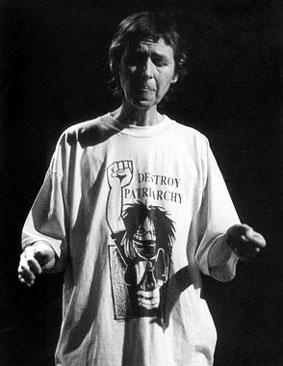
The Nihilist Spasm Band just played their first and probably (based on things Bill Exley was saying) their only Vancouver gig in their 40 year history. I am wearing a Nihilist Spasm Band t-shirt as I type this (see photo). I have a lyric from a Nihilist Spasm Band scribbled in Sharpie on my right hand, too (also visible in the photo, tho’ mirrored): it reads: “I care about what you think – it’s just wrong.” I would be listening to one of their CDs, but my ears are still ringing, so there’s no need. The band took the stage late -- Bill Exley dressed somewhat formally, his beard well trimmed and spectacles glinting, with a little pin on his sweater with a crossed out musical note on it, the symbol of the band -- and began the night with "What About Me?", with his deep booming baritone pushing at the outer ranges of his vocal control: "You say the CN Tower is the largest freestanding structure in the world? What about me?" It was one of the things that surprised me about the night: I recognized quite a few of the songs; I only own one of their CDs, but I must have listened to it (and the previous one of theirs I had for awhile in Japan, before deciding "one was enough," which decision I definitely went back on last night) more often than I realized. They did "Stupidity," "No Canada," "Indecision of the Night" and the piece about how the band have (or Exley has?) "Nothing to Say" but can say it very well, which actually seems more the band's satire of academia than a joke about themselves, tho' the band do joke about themelves a fair bit. (Exley at one point explained that they used to answer their critics by saying, very gravely, "It's the best that we can do.") Mostly they made noise. Art Pratten played the Prat-O-Various, a stringless violin-like thing that we assume he designed, and something else that they called a "water pipe," tho' no, it's not like that; it looked like the neck of some reeded instrument, tapering down into what may well have been a portion of a broomstick, apparently with pickups on it somewhere, since, tho' Pratten blew into it like a sax, it appeared not to have much of a chamber for the sound to resonate in, nor any visible opening for the sound to emerge from (I didn't examine it closely, tho'). John Boyle, the most playful-looking member, played a really big and complex kazoo (which you can see near the bottom of
this cool page on the band), a thumb piano, and sometimes drums; John Clement played guitar and drums; Murray Favro -- the most musicianly-looking member of the band, visible on the right, here -- played guitar and drums; and two guests appeared, replacing the late Hugh McIntyre and Greg Curnoe. I'm not sure of the name of the young guitarist -- Tim Classen, maybe (I'm trying to read the signature where I pestered him -- he's not on the band's website's "Member's Page"). The other, Aya Onishi, was a cute-but-not-too-cute (which, when you're talking about Japanese girls, is a Very Good Thing, because Japanese girls who are "too cute" tend to look like cartoon characters) drummer who also doubled on something identified merely as "pipe," a long horn with a weird extra chamber that seemed basically to operate on the principle of the kazoo, without sounding too much like a kazoo. Actually, from what I heard when she was manning the kit, Aya is probably the best "musician" of the band, ironically enough -- given how they've been playing together nearly-weekly since 1965, mostly at art galleries, clubs, and coffee shops, the maybe 30 year old Aya brought a hell of a lot of force to the music they played, and made some superb drummerly choices, bringing an edge of tribalistic fury to their racket, while still being damned noisy in her own right (I hope I don't get in trouble for praising the musicianship of an NSB member, given their feelings about amateurism!). We gather she's a member of the Osaka band Sekiri (not much English web visibility but I think you can find some of their CDs for sale on the Japanese-only Alchemy Reords site -- good luck!). My apologies to the rest of the band for doting on Aya, but damn, she's cute and female and she kind of stands out, you know? Apparently she started playing with the band in 1996, during their first tour of Japan...


Then, of course, there was Bill Exley. He played the cooking pot, or sometimes things in the cooking pot, at various points during the night -- holding it dramatically up to the microphone and dropping ball bearings into it, say, or closing the lid repeatedly, or sometimes shaking it with the ball-bearings inside. Sometimes he picked up a regular-type kazoo or other little instruments. Mostly he sang; usually songs began with him declaiming lyrics with a perfect balance of mockery and bombast, so that it at times could be difficult to tell what, exactly, he was serious about, other than the value of art; I'm pretty sure in "Meat Eater" that when he sings that "dolphin is delicious" and denounces the consumption of his plant brothers, he is joking, but the majority of the politically-sensitive Vancouver crowd didn't seem to think it safe to laugh too loudly at that one. (Similar humour can be found on their No Borders collaboration with Joe McPhee, on the track "United Nations," wherein Salvador Allende is called "worse than Hitler" but Pinochet "not so bad.") He looks more like a professor, which he is, than a noise musician; oh to have Bill Exley as a professor! He probably got his bigget cheers for performing a song the name of which I do not know, which the band used to leave from their set for being "too anti-American," but now -- he explained -- are including -- a piece that praises America's prowess and ends with Exley bellowing "Fuck me, America!" After such declamations, Exley would mostly moan into the microphone, sometimes with an arm raised to the sky. Often he would just stand back and grin at what the rest of the band were doing.

The great thing about the Nihilist Spasm Band is that, even tho' they have a hell of a sense of humour and humility, they actually make very interesting noise! (I at times tried to bliss out by closing my eyes, the best way to listen to noise being in the dark, but they were just too interesting to watch, so I didn't make it). For all their mock-intensity and clear self-confidence, I'm not sure, given their ironic approach to what they do, how seriously they could receive the standing ovation they received at the end of the night -- perhaps it was strange for them, given that they've had somewhat less warm receptions at other times in their long career... The band have to know that for some of us, seeing the Nihilist Spasm Band play was a pretty precious and unique experience, not something to be taken lightly; that they actually have an important place in the history of a certain kind of music, and that it's actually damned cool that a Canadian band occupies that space; that when Bill Exley said that art is "the only true vocation," those of us who agree with him (and can't make it to London, Ontario every Monday night) felt great privilige to be sitting in a room hearing him say it (tho' it's kind of unfortunate that Japan and Europe would see these guys tour before they'd come Vancouver -- but that's a can of worms I don't really want to open here, albeit a very Canadian one). There's probably a whole essay to be written on the role a sort of nationalist pride played during the gig, which in its own way would be full of irony, too, since much that Exley says about Canada (like that, unlike the US, it doesn't need to be destroyed, because "it's dead already") is fairly, uh, self-effacing...

Which brings me to the definite high point of the show, from an ironic nationalist point of view (tho' not from a noise-music one): at midway through the night, the band conferred behind the drum kit and decided, because a) he was in attendance, as his earlier raffle-win testified; b) because his birthday is coming up; and c) because he might not make it to his birthday, given "how old" he is -- the band are sometimes other-effacing in their humour, too -- they should invite George Bowering, the (I feel the desire to say "fucking" for emphasis here but don't want to offend anyone) Poet Laureate of Canada, to get on stage (or, well, given the level floor of the Western Front, to move to the front of the room) and jam with them, which George did, blushing and grinning in about equal measure as he a) spent about five minutes trying to figure out how to strap on his guitar; b) got up some confidence to start working out on the thing; and c) progressed to adopting for-fun rockstar poses, wiggling his hips, hitting cymbals with the neck, trading riffs with Murray Favro, and finally playing his instrument with his teeth (the broadness of George's irony actually points out something somewhat subtle about the rest of the bands approach to irony, but it seems weird to describe the Nihilist Spasm Band as subtle about anything, so I don't think I'll pursue the thought). Art Pratten (and a few members of the audience, myself included) broke into laughter over Bill's introduction to the first piece they did -- the idea of the Poet Laureate performing "Destroy the Nation" (including the bit about Canada being dead) was pretty satisfying. They then moved on to what I believe was one of their late bassist, Hugh McIntyre's, compositions, called "Hurting." George stayed onstage for about fifteen minutes and got a good workout. If he'd stuck around after the show, I would have gotten to sign the CD I bought, which I had the rest of the band autograph (I even asked Mr. Exley's wife, up at the merch table, but she didn't feel she belonged on it).

So... What about me? I was the guy who bought a copy of No Borders then won another at the raffle, which I later got to exchange for this neat t-shirt. I was the guy who borrowed a Sharpie off Anna, lent it to that guy from the Magic Flute that I always see, and proceeded, when he returned it (having gotten them in the interval to sign the repress of their first LP) to bug the whole band to sign my CD (asking Aya in polite Japanese, of course, which she got a kick out of). (By the way, Anna, I gave your Sharpie back to DB -- you were gone!). I was the guy sitting in the second row who initiated more applause than anyone else, who was one of the first five people to get the standing ovation going. I made contact with a couple of the guys from Psychform, who drove for seven hours up from Seattle to see this show, and got to chat with Heather of the Creaking Planks a bit (thanks, Dan, for directing me to their website). Mostly, I was the guy who went home after the show and wrote this, mostly while eating pizza I had delivered. I was a happy guy, last night.


So thanks to the Nihilist Spasm Band for coming to Vancouver for the first time in 40 years, and thanks to Ty of the Flea Market for having whispered their name to me so many years ago, so that I would know, when I saw their Alchemy CDs in Japan, that I needed to check them out.

Too bad I can't be at the tribute to Al Neil tonight... DB tells me he won't actually be playing, though!

Friday, October 14, 2005

Paradise Now at the VIFF

Hm. I have a Jewish friend who has considerable sympathy for the state of Israel, as the only democracy in the Middle East, and none at all for suicide bombers or for any Palestinians who would use violence against civilians to achieve their ends. I wish she'd been at this film, Paradise Now, with me -- she's exactly the person I'd like to talk to about it, though I think I can imagine her reaction. The film is an extremely well-crafted consideration of the interlacing political and personal reasons why suicide bombers do what they do; it is also far more sympathetic towards them than I expected it would be. For years, I've agreed with the left that western media is biased in favour of the state of Israel -- insofar as it never calls the occupation an occupation, and treats resistance to the occupation as terrorism -- but films like this one make it quite difficult to continue thinking that; it's particularly shocking that the film is being distributed by Warner Brothers (assuming they actually do distribute it). There are various passages in Paradise Now where suicide bombers justify their actions, both to themselves, to others, and to running video cameras, as they leave a sort of spoken will, explaining why they do what they do, as their only means of striking back against the unfair policies of Israel; though there are also passages that critique suicide bombing and call for a non-violent means of pursuing the Palestinian cause, the movie takes pains not to present bombers as fanatics, and tries to provide "reasonable motive" for them, so that even if you disagree with what they do, you can understand it, even sympathize. That's an interesting project, and the film indubitably succeeds at it.

I'm of two minds about all this, though. It's probably a good thing that there is greater sympathy towards what Palestinians experience during the occupation, since they've been excluded from public awareness and regarded as crazy, savage, bloodthirsty murderers for so long. It's probably not a bad thing that Palestinians have the ability to voice their cause to so wide an audience, either. The film seems a little less than honest, though, in downplaying hatred against Jews, religious extremism, and the attraction to violence that some people feel as part of the overall picture, though; it pretends that anti-Semitism and Islamic extremism don't even exist, but they do. In motivating its characters to do what they do, and ensuring that the audience can sympathize with them, the film comes dangerously close to justifying them. Israel, meanwhile, is pretty much made invisible, save in its role as oppressor. It's guaranteed to ruffle feathers. I guess Warner Brothers is counting on that -- in the post-9/11, Michael-Moored world, such calculated controversies are bound to make money. Perhaps it will stimulate productive debate, as well. I suspect, though, that many audience members will realize just how politically skewed the film is -- just as most people don't seem to think twice about how offensive and immoral films like True Lies are, in their depiction of Arabs as crazed, childish, uncivilized fanatics who kill with no cause or rationale whatsoever, whom even children can outwit (note: looks like there's an interesting book on this sort of phenomenon, called Reel Bad Arabs: How Hollywood Vilifies a People -- see here for a further article).

Anyhow, it was an interesting film to watch -- it would go great on a double bill with Avenge But One of My Two Eyes, reviewed a bit earlier. It made for a good "last film of the festival."

For those interested in these matters, there's an article here on some of the controversy surrounding a book that criticizes Alan Dershowitz and the ways in which the idea of "the new anti-Semitism" is used as an ideological construct to deflect criticism of the state of Israel.

Harold Pinter on the War in Iraq

Hm. There was a great article in the Independent on Iraq, but they've changed it into a "portfolio" feature that you have to pay money to access. What else can I offer, in its stead? There's a good appreciation of Pinter by John Pilger, here, tho' for some reason its riddled with spelling errors. There's Pinter's website, which has some interesting stuff on it, but not anything recent, I don't think. Ah, here's the original article, placed elsewhere. It's actually no big deal, but we like Harold Pinter. Congrats on the prize, man...

The World's Longest (Known) Nipple Hair

Everyone should measure their nipple hairs -- I'm pretty sure someone can beat this guy.

Thursday, October 13, 2005

Weird Skeletal Creature washed up by Tsunami

It seems like it's been awhile, giant squid photos notwithstanding, since I posted anything on cryptozoology. This video is pretty intereting, though -- purporting to show some sort of giant fossilized creature uncovered by last year's tsunami. You can read about it on this fellow's giantology blog. Probably a dinosaur or ancient sea animal or something else quite explicable, but... it's pretty damned big! Looks real, too, though the Fortean Times folks are speculating it might be an internet hoax.

Wednesday, October 12, 2005

VIFF: Police Beat, 13 Lakes, Low Profile, Beowulf and Grendel

So here I am on a day off, worrying that I'm coming down with something, feeling fatigued and weak: but I have time to write about films at the Festival, so I'm going to -- focusing only on the ones I've really liked.

Police Beat was a very interesting experience; it deals with an African man, Z., who gets a job with the Seattle police department as a bicycle cop, and we get to view the situations he has to deal with through his outsider’s view, which implicitly is of a man with more connection to family, government, society, the land than most of the people around him; he narrates in an African language, describing his own relationship worries and his sense of the strangeness of the things he is seeing (the things he witnesses – a man mutilating a goose for no apparent reason; a cyclist doing unsafe things on his bike then justifying his actions by complaining about George Bush, whom “someone ought to kill;” a deranged man wading out into the ocean, claiming sirens are calling to him; a woman high on cocaine running naked through a park; a woman complaining to the police because a dead tree branch fell on her – are all drawn from actual Seattle cases, and are shown as brief surreal sketches. Not at all like the crimes in a police thriller, they have almost no narrative impact; they just contribute to a growing sense of a society in disorder, with no moral stability, no centre). As things get stranger and his relationship with his (largely absent) girlfriend gets more complicated, Z., without being aware of it, starts to get drawn into the madness himself, starts to lose his own centre. I liked it and respected it – it has a darkly fascinating quality to it. Like many of the best films I've seen this week, it had an odd focus on water, with images of floating bodies and of Z rescuing the siren-lured man; there have been a lot of images of water in this years festival, though James Benning's Thirteen Lakes takes the cake for the most watery...

Speaking of which, I realize that I haven't yet written about Thirteen Lakes (or Ten Skies, Benning's other film at the fest; alas, when I saw it, it was screened without sound. I gather it's being used sometimes as an instillation at the lovely new venue, the Vancity Theatre. ) The film consists of thirteen ten-minute long static shots of thirteen American lakes -- Lake Winnebago, Lake Superior, Lake Okeechobee, the Salton Sea, others; the composition of each shot places the horizon at midscreen -- each one was filmed with the front two legs of the tripod in the water -- and all you see and most of what you hear are the lakes themselves, for 130 minutes. Benning, who had a friendly, solid, but quietly intense manner and long, grey hair, and who cites Robert Smithson as an influence, explained before the screening that, as an art teacher, he used to feel that you couldn't actually teach anyone to be an artist; when he turned 60, though, he "became arrogant" and decided that he would start trying to cultivate the skills of looking and listening -- of paying attention -- in his students, being to him the most important aspects of art. He would do things like drive them out to an oil field and drop them off, individually, for a ten mile walk through it (it had "elements of a P.E. class," too); they had no one to talk to, couldn't bring a Walkman, and were instructed to really observe what was going on around them, which they would then discuss when reunited. He would contrast this experience by then taking the students to a Native American sacred site up a mountain, and having them be attentive there. The film, he said, is basically the same thing -- a course in paying attention, "but without the ten mile walk;" and as the above exercise (contrasting a sacred site with an oil field) might suggest, is not without its environmentalist aspects. On the Salton Sea, we see people bombing around on jet skis, which, because we've already grown used to the sound of the lakes alone by that point, sound horrible and intrusive; at Crater Lake, we hear (though it wasn't entirely synch sound -- Benning recorded the sound at the lake, but shortly after he had stopped filming, deciding to use it no less) the sound of target practice -- which was "more than rude," he pointed out, because the land he was on belonged to Native Americans. A few of the other lakes bear witness to human presence; one is intersected by a bridge; a train passes in the soundtrack for another; at one point a ferry enters the screen from behind a rock and travels slowly by. Some of the signs of human presence were more intrusive than others -- particularly the jet ski guys -- and Benning, when I asked him about this, said that while the jet ski guys were annoying when they were on the water, they were really pleasant to him when they got off their jet skis ; "it's easy to be annoyed, but these are lower middle class guys who need an outlet" for their frustrations, "so they don't go home and shoot themselves." Benning also criticized himself; he drove his car over 10,000 miles to shoot the footage of the lakes, so how morally pure can he be? "I'm an environmentalist, but not one who knows how to behave." The film, in any event, was a beautiful experience. Unfortunately, even if it gets released on DVD, which is unlikely, it won't really translate to the small screen -- it would become a sort of virtual fireplace; it requires more respect than that.

A very different experience was had with Low Profile (the German title, Falscher Bekenner, means "False Confessor," a much more literal title). The film follows an alienated young man, Armin, as he looks for a job, tries to get a girlfriend, and deals with his upper-middle class, somewhat distant parents. The world of the film is grey and bleak and oppressive, with all feeling somewhat subdued; Armin, with a rich and disturbed interior world, apparently has a hard time connecting to anything around him, and instead pursues a fantasy life where he masochistically submits to fellating menacing motorcyclists, whose membership he eventually joins. His dark fantasies lead to him falsely confessing to a number of crimes, and eventually participating in some, which gives him an increasing sense of his own potency and strength (and pardoxically seems to help him have the confidence he needs to deal more successfully with the more mundane world around him -- for awhile, anyhow). Towards the film we are not always sure whether what we are seeing is in Armin's mind or in the world... The film subtly connects Armin's dark attraction to the taboo and transgressive with terrorism, and contains one absolutely brilliant sequence, which, much as I'd like to, I cannot allow myself to ruin for new viewers -- save for mentioning that it involves a bathtub (like I say, most of the best films this year seem to involve shots of water, tho' the polluted water of Armin's bath is probably the least appealing).

The Canadian/Icelandic/British co-production, Beowulf and Grendel, was a more conventional film, but also much more moving. It's odd watching a serious film with action sequences; I generally avoid movies wherein men clash swords, and am unaccustomed to seriously considering them, or indeed any film that deals with war, particularly if it involves themes of valour and honour and so forth. It's not that I'm immune to such things -- I sometimes brag that I wept during Rambo III, felt all the right things at all the right places; tho' of course I despised the Stallone film (which I saw at the insistence of a friend -- it needs justifying), I am sufficiently sincere in my surrender to cinema that it moved me regardless, and in fact I'm somewhat proud of this. Beowulf and Grendel deserves much more respect than Rambo III, of course, and does not belong on the shelf next to Braveheart or even Lord of the Rings, though I fear that it will be marketed thus. It modifies the original narrative somewhat -- the "trolls" of the film are nothing monstrous, merely outcast, "wild" humans, and there is probably more focus on contemporary political themes than appeared in the original (I suspect Sarah Polley's character is a radical departure from the poem -- which I haven't read since I was very young and only dimly remember; I'm considering reading the new Seamus Heaney translation). It's still, well, how to put it, a damned exciting movie? And I wept far more than during Rambo III. I suppose if I were to try to sell it to an artsy friend I would pitch the beauty of the photography and the lovely scenery -- which again, involves a lot of water.

I've seen other films I enjoyed -- in the program of Canadian shorts, Little Things, I was greatly entertained by a film called Hiro, about a Japanese insect collector caught up in an intrigue which is much, much larger than him (it opens and closes at the seaside; yet more water); and I was delighted to see the short by Andrea Dorfman, "There's a Flower in my Pedal," which had a wonderful rhythm to it. Certain shots of it remind me of a short I saw years ago at the now-defunct Blinding Light, involving girls, rings and superheroes; I always wondered who the filmmaker was, and now I suspect it might have been Dorfman. (I guess I should try to find Alex MacKenzie and ask him -- note that if you're reading this and have more money than I do, you should send some to Alex via the Blinding Light link above -- apparently they're still in debt, nearly three years after they closed). Featurewise, I watched Claire Denis' The Intruder, as well -- also a very watery film, following a man who appears to be some sort of retired cold war spook as he organizes heart surgery and sets about securing a legacy for his sons. The film leaves one with the feeling of having seen a complete and coherent work of art, but a fair number of narrative issues remain unresolved and enigmatic, at least at the end of the first viewing, and it leaves one at least a little dissatisfied, unsure of what has been seen... Again, I suspect I'd pitch this at friends on the strength of Agnes Godard's cinemaphotography. There are lovely shots of the French alps, in particular; I'm a sucker for mist in trees. An odd number of dogs in the film, too... but I like dogs...

Anyhow, these have been the high points of the festival so far, neverminding previous films. Time to check to see what I'm going to see today -- Heading South and The Prince Contemplating His Soul are definitely on the list.

Monday, October 10, 2005

God Told Me To

Y'all know that there's been a buzz out there about a BBC article that claims Bush told Palestinians that "God told me to invade Iraq?" The damage control boys at the White House are denying it, of course. The plus side of the story is that Palestinians are s'posed to get a state out of the deal. Don't hold your breath.

More notes on film festival stuff later in the week... no time to write, too many movies to see!

Friday, October 07, 2005

Avenge but One of my Two Eyes

Too busy to write much at the moment. Wanted to highly recommend, to anyone reading this, that they see Avenge But One of My Two Eyes, an extremely confrontational political documentary made by Israeli filmmaker Avi Mograbi (note: good link to Mograbi's desciption of a previous film, criticizing Sharon). The film deals with Israel's treatment of Palestinians; the VIFF guide compares the filmmaker to Michael Moore, but for those tired of Moore's relatively sanctimonious manner, his love of his own image, and his way of ambushing innocents, that's not exactly a compliment. Mograbi takes up far less screentime than Moore usually would, has much greater craft -- brilliantly juxtaposing, say, Jewish tourists talking about the walls that Romans built around the besieged fortress of Masada with footage of Palestinians blocked from going about their daily lives by security fences built by Israel -- and takes much bigger risks (we see him become quite surprisingly hostile to some young Jewish soldiers at one point, tho' for a very good cause). A negative review of the film can be read here -- I think it deserves far more consideration; a more detailed, more worthy review here. Skip reading them and just see it, tho' -- let the film surprise you. It next runs at 4PM on Sunday.

And now I must pee, bathe, and commence marking papers -- it's almost 7:30.

Monday, October 03, 2005

Morally Serious Cinema at the VIFF

Two films I can recommend, seen thus far: La Neuvaine, a Quebecquois drama about a woman enduring feelings of suicidal bleakness after a failed attempt to morally intercede on someone's behalf; she ends up helping, and being helped, by a young man who is on a pilgrimage to pray for his dying grandmother. The film is a little chilly at times -- there are lots of rather cold compositions of the woman sitting alone and stiff against bleak backgrounds, and I rather wish that the film had allowed itself to be a little more naturalistic at such times, rather than trying so hard, so obviously, to formally evoke her inner state -- but it is effective and well-acted and ultimately quite touching.

More interesting, I thought, was a rather bleak European film, Fallen, a Latvian/German co-production that follows the "investigations" of a somewhat detached, somewhat numb protagonist into a woman's suicide, which, though a witness to it, he did nothing to stop. The film reminded me at times of Wenders' early Alice in the Cities, perhaps because the protagonist looks a bit like Rudiger Vogler, or because of the use of black and white (tho' it is much darker than Wenders film); even more than Wenders, it has some of the feel of a Bela Tarr film, in that it is very slowly-paced, using long takes and bleak landscapes to enhance the mood, and deals with a certain absence of moral engagement in the world. Morally serious cinema, with a nicely gritty feel to it, and abundant shots of decaying and dingy landscapes (which, as my friend Marina rightly observed, appeal to me). There's also an excellent use of ambient sound. I found it very compelling viewing, though perhaps it would only be so to a very scopophilic cinephile such as myself; it's not particularly original, but it attempts to do something meaningful with the medium, and achieves its end quite effectively. The film held my attention very firmly, and left me with a mood of lingering disquiet.

A third film, which I actually brought my parents to, The Death of Mr. Lazarescu, deserves praise for its ambitions, but didn't really excite me; it chronicles the apathy, arrogance, and coldness with which a dying senior citizen -- somewhat drunk, disshevelled, and cantankerous -- is treated by the Romanian medical system. If you've been in a hospital for any length of time, you probably don't need to see the film, though it certainly is well-made; it feels like one is watching a documentary.

Looking forward to 13 Lakes and Ten Skies tomorrow night...

Saturday, October 01, 2005

Second Thoughts on Manderlay at the Vancouver International Film Festival

First reactions to Manderlay, even while you're watching it, can tend to the negative. It tends to be a little didactic -- most of what happens in the film so blatantly announces itself as an idea that von Trier wants you to think about that one wonders, at times, why he didn't just write an essay; it is hard to enter the film as story, to respond to the characters as characters, when the themes are so overt (reinforced further by John Hurt's chorus). It also looks and feels exactly like Dogville, and while that film's minimal, stripped-down-soundstage style had the virtue of being fresh, unique, inspired, and daring, seeing it in the second film in von Trier's trilogy on America prompted two reactions in me: oh, this again; and, does this mean I'll have to watch a third movie like this?

The final problem with Manderlay -- tho' one admires von Trier's balls, since he's never been to the US -- is that it really does come across as a somewhat smug anti-American tract, a bit of preaching that is perhaps just a little too easily accomplished, a little "much," even to someone who harbours a fair number of anti-American sentiments in his breast himself. This "what right does he have" approach to film criticism was widely circulated in reviews of Dogville, so I won't expand much on it here; Von Trier has addressed his critics by saying that


America is sitting on our world. I am making films that have to do with America
[because] 60% of my life is America. So I am in fact an American, but I can't go
there to vote, I can't change anything. I am an American, so that is why I make
films about America.


... and that's fair enough, actually. (Note: quote is from this interesting/useful article on von Trier). But around about the end credits (to the tune, again, of "Young Americans" -- guess we'll be listening to that a third time, too), where von Trier is showing us photos of Klan rallies intercut with those of lynched, beaten, dead, homeless, and otherwise victimized blacks, an image of Martin Luther King in his coffin, and so forth -- one starts to feel more sympathy for America than for von Trier; as my friend Karen remarked, aren't there any racial problems in Europe he can deal with? (AKA, why look to the mote in your neighbour's eye when there's a plank in your own?).

The theme, by the way, of Manderlay is racism, if that wasn't obvious. Grace, the protagonist from Dogville, now played by Bryce Dallas Howard, is passing through Alabama with her father (now played by Willem Dafoe) and his gangsters. They encounter a plantation where, 70 years after its abolition, slavery is still being practiced, and are asked to intercede in the whipping of a "proud nigger," Timothy (Isaach De Bankole, the Haitian ice-cream vendor in Jarmusch's Ghost Dog), who has committed a crime. Grace does intercede, and in the process the plantation owner dies; she then pressures her father, who clucks his tongue at her naive idealism, into leaving her several gang members so she can teach the blacks to be "free," and establish a new and democratic social order for them, where they run the plantation for themselves. The film follows a convoluted path, as Grace sets about reeducating the slaves, to an ending where Grace discovers that she wasn't being quite the liberator (and the blacks weren't quite the victims) she'd imagined, and where she briefly assumes the role of the former plantation owner, even administering the whipping she'd initially rescued Timothy from (and doing it with great personal zeal). Along the way, we explore the psychology of slavery and encounter several notes that strike one as a bit false and odd, as long as one thinks of the film as being completely about slavery and racism (which is the temptation). When Danny Glover, as an older "house nigger," actually defends the unusual social order of the Manderlay plantation towards the end of the film, praising its orderliness and security, one wonders how black audiences will react; it's a pretty dangerous statement to make, when viewed out of context, and one starts to wonder whether von Trier has the right to speak for African Americans in this way. Suffice it to say that on leaving the film, I felt tired and a bit disappointed with von Trier, a reaction that at least some of the other online reviews, like this one by Kirk Honeycutt, share.

This morning I flipped open my film festival guide and read the description of Manderlay through; I'd ignored it, since I intended to see the film regardless and wanted to see it fresh. I realized, reading the guide, something pretty bloody important that I'd entirely missed last night. Because the film seems to so strongly deal with "racial problems" in the US, the idea of the naivete and arrogance of Americans presuming to teach their "subjects" about democracy (while men with machine guns lurk in the background as enforcers) didn't really enter my perceptions. Manderlay isn't just the American south, it's Baghdad, or any other part of the world where Americans claim (and sometimes perhaps even believe) they are being liberators; the film is much bigger in its scope than it initially appears, big enough that one wonders why von Trier didn't slip a few Abu Ghraib photos into the lynching montage, to hammer that point home too.

So my initial reactions were a bit unfounded. I hope I can be forgiven for not noticing something, in a film made with hammers, quite so obvious (though more subtly presented) as Manderlay's contemporary applications; it seems to be "just" about American history, and about the failure of America to address the problems of racism and slavery, but in fact something much more interesting is happening. When America finally are forced to leave Iraq, the images of Grace tearing off across the map in panic and denial at the end of the film will acquire a haunting force they currently don't quite have; it's almost like von Trier is thinking ahead. It all ends up a weird testament to von Trier's intelligence and craft: last night I left the theatre disappointed and bored, and today I want to see the film again; I can think of no other filmmaker who inspires such reactions in me. I generally like cinema that people consider challenging, but von Trier's challenges, really, are in a class by themselves...

Acid Mothers Temple at Richards on Richards


Sumimasen, Kawabata-san... Chotto abunai shitsumon... Omoshiroi kuki ga arimasu -- totemo omoshiroi no... "Tour" wa zenbu daijobu? Kuki ikaga?

Which translates as, roughly, "Excuse me, Mr. Kawabata, but I have a slightly dangerous question. There are these really interesting/funny cookies -- really interesting ones. As for the tour, is everything okay? How about cookies...?"

Kawabata has what I think of as very Japanese teeth; they are small and brown and suggest a complete indifference to dentistry. His manner is polite and gentle and friendly. He laughs, his eyes glittering a bit, and says everything is okay, they have everything they need (perhaps the fact that the tour immediately proceeds into the United States after this gig has something to do with his refusal; Kawabata will announce on stage that several of their concerts had to be cancelled because the American government doesn't like the Acid Mothers Temple, and gave them a hard time about getting work permits). He doesn't remark at all on my speaking in Japanese, which I guess either isn't that much of a surprise, or just isn't very impressive, because of my rusty delivery -- I don't practice much and I've never before ventured into such waters with the language. Anyhow, he laughs, I laugh, I try to say in broken but polite Japanese that I just thought I would ask, in case it was of interest, and I wander away, grinning at what I'd just attempted.

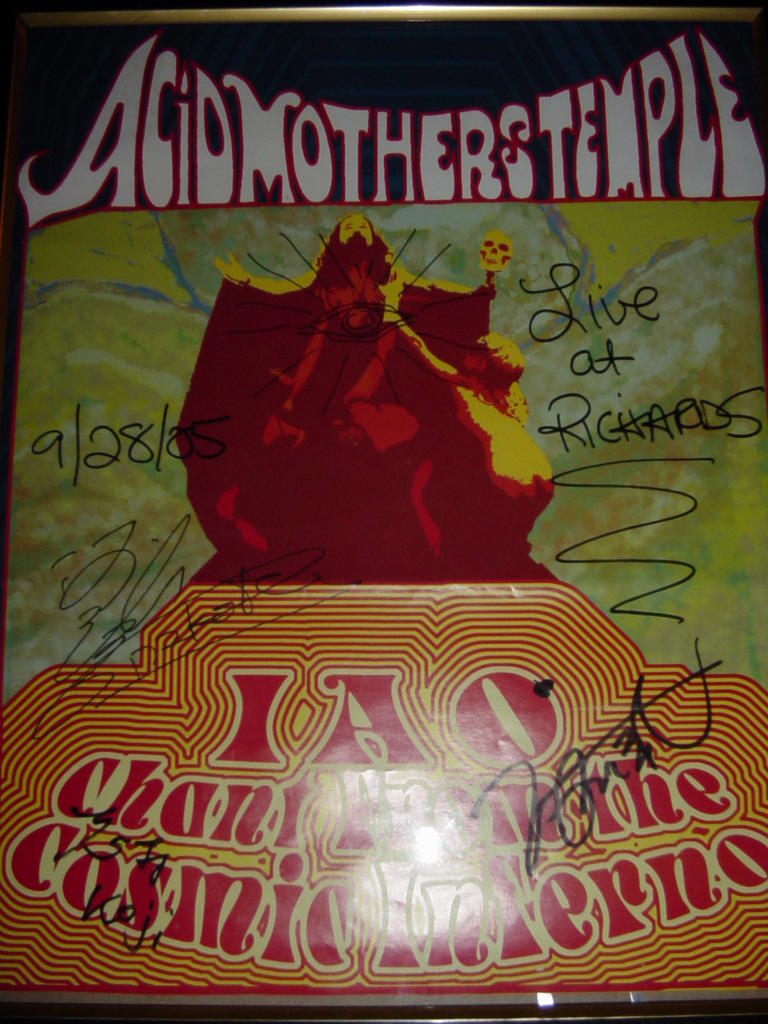
Walking through the crowd at Richards on Richards, everyone I run into seems to be in a band. Ole of the Creaking Planks (no website for them that I can see but here's Rowan's livejournal, including a bit of writing about the Zombiewalk gig), Harlow of Sistrenatus, and Scott and Dan of G42 (the latter being the reason I know these people). Scott has just gotten back from a visit to Japan and we chat briefly about his trip; he managed, apparently, to try a few onsen resorts there, which is pretty essential stuff, but it sounds like he didn't shop at any Disk Unions (I'd hoped to live vicariously through him by directing him to the one in Shinjuku, which is my favourite CD store anywhere). Afterwards, I'm telling Dan about my cookie conversation, when I realize that there's a pretty damn cool Acid Mothers Temple colour poster on the Ladies Room door immediately behind me. I promptly take it off, peel off the tape, and consider what to do.

Well, why not? I've already broken the ice, and the band are still sitting around the merch table. It has a very small smattering of CDs (customs make it too expensive to bring a lot of merch, Kawabata later tells us), a couple of t-shirts, and a guitar neck, broken onstage, which Kawabata is selling for $150. I'm broke, so nothing can be purchased, but a signed poster would be an excellent souvenir. I return and in my bad Japanese say to Kawabata, "Sorry, it's me again. Would you guys sign this poster?"

Kawabata smiles and produces a pen. He scribbles his name (he has a signature in English; assumedly if I were Japanese he'd sign in kanji) and draws an eye on the central image; I somewhat goofily explain that I have Otomo Yoshihide's signature, too. The rest of the band pass around the poster. Tabata Mitsuru, the bassist for the new lineup, has also played with Zeni Geva and the Boredoms (perhaps having been with the Boredoms on their 1999 tour, when I saw them at the same venue; he looked quite familiar. Apparently he has a solo album out there too). He gives the funkiest of signatures; a stylized black dot, visible on the O in Iao, above. Well, no language problems there -- the black dot is as universal as it gets. He's on singing duty, I will later discover, and has an extremely likeable onstage manner. I thank the band for their signatures and spend the rest of the evening protecting my poster, trying not to get it too wrinkled.

The band are fun to listen to, but it turns out that after the above interactions with them, and the delight I feel at having claimed a good anecdote for myself, the gig occurs in shades of anticlimax. They sound just like the Acid Mothers should, with a good balance between groovin' repeated mantraesque riffs and exploration/soloing/noise; they restrain themselves from kicking out too many jams, in the manner of High Rise or such, tho' they have a couple of brief outbursts. Higashi Hiroshi, the keyboardist and member-with-the-coolest-hair (pictured here) has some equipment issues, and a couple of times I did a doubletake at how-like-a-rock-god some of Kawabata's poses were (all that was missing was dry ice and the audience holding up lighters -- there's something I've noticed about how faithfully even cool Japanese bands sometimes seem to be self-consciously adopting the forms of their idols, an image-consciousness that is both endearing and a bit odd), but generally they aim to please and hit their mark, and Kawabata's two guitars (one mounted, so he can play both simultaneously, which is pretty damned interesting) sound great, generating swirling fields of mind murk. Songs like "Pink Lady Lemonade" are catchy enough you can dance to them, and many people do; I even undulated a little. It was fun. I've never been an overwhelming Acid Mothers fan, but I'm glad to have seen them.

But then I had to come home. Work the next day, and the necessity of doing a little marking, made it imperative I sleep, and I disappeared around 11:45. Who at work will I tell my cookie anecdote to, I wonder?

Well, really, it's not a conversation for the workplace. And no one knows who the Acid Mothers are, anyhow, really. So no one, I guess... Unless they read about it here...

Tuesday, September 27, 2005

Squid and Jello

A giant squid has been finally photographed in its natural environment by Japanese scientists. Does anyone else out there think this is cool? Pics here (not great but they're the first, so they get bonus points).

Otherwise, my life is a bit nuts right now and all I want to do is get my laundry done, clean the mildew out of my left boot (it's a long story) and air out the smell of Pine-sol (the cleaning agent in question) from my apartment. When I have extra time, I'm trying to make my way through the film festival guide... I will blog some other time (maybe once the movies start).

Concert update, tho': Jello Biafra is playing the Croatian Cultural Centre with the mighty Melvins on November 3rd. I'd buy tickets for this one early. Haven't seen Jello since the Dead Kennedys brought the Fall of Canada tour to the New York Theatre on Commercial Drive back in 1984. I was 17 and I was mightily impressed, and I don't think I've seen anyone (well -- maybe Iggy. No, not even Iggy. Maybe Eye, back when. Ah, nevermind) put as much energy and enthusiasm into a show as he did. I'm assuming he's slowed down a little -- actually, I'd hope so! -- but I need to see this show. They have two CDs out, Never Breathe What You Can't See and Sieg Howdy!, and both are great (tho' the latter recycles a couple of tracks from the former as "remixes," which seems a bit cheap, but...). Check out the "California Uber Alles" update on the new one ("I am governer Schwarzenegger..."), or the cover version of "Halo of Flies," by far Alice Cooper's best song (but who wants to own an Alice Cooper album? So thanks, guys!).

Wednesday, September 21, 2005

Oh Noooo!! Cinemuerte is Dead!!!

Bad news, shlocksters -- it seems this year's Cinemuerte festival will be the last! Curator Kier-la has decided that a horror/exploitation festival in the age of DVD is redundant, unnecessary. It's simply not true! There is much joy to be had, gathering together to share such experiences communally which will never be replaceable by the likes of Anchor Bay or Blue Underground, however impressive their catalogue; and no matter how big your TV screen -- and mine is pretty big -- it still isn't cinema. Plus where will I go for Exploitation All Nighters if you kill Cinemuerte? I'd open up my own living room, but my apartment just ain't that big!

I beg you, noooooooooooooooooooooooooooooooooooooooooooooo, Kier-la, pleeeeeeeeeease, don't retire the festival!

Anyhow, the disappointment to hear of the plan to let Cinemuerte die is compensated for slightly by the pleasure and anticipation of perusing the schedule for this season. Once again, Kier-la has managed to dig up a bunch of films I don't know but which I'm most eager to see (School of the Holy Beast? Night of the Living Dorks?), along with some really special items that I'm looking forward to seeing again (where/how else could I possibly see Class of 1984 on the big screen???? The best-ever Asphalt Jungle ripoff, and Roddy McDowell is great! -- I'm sure I'll enjoy his performance even more now that I'm actually a teacher...). I can only hope fans either a) pressure Kier-la to keep the beast alive or b) take up the banner themselves -- Cinemuerte is as vital to the fall-winter season in Vancouver as the Jazz Fest and that other film festival that goes on...

Iraq Options

Thought this was a worthwhile overview of the current options, tho' for me the predictions are pretty grim.

Tuesday, September 20, 2005

On the Backs (and Signs) of the Poor

Just read about "Bumvertising." Initially one reacts with disgust and outrage, but I suspect his only real crime is against decorum: he's making the inequities of capitalism as she stands far too obvious, is being insensitive not to the homeless that he's using but to those who would maintain a comfortable denial that such exploitations are an ingrained aspect o' the system...

Monday, September 19, 2005

One Billion Dollars Pilfered from Iraq?

I mean, Halliburton's no-bid contracts and abuses of American taxpayers are something, but what's been going on in Iraq is something else. It's hard to fit my head around the amount of anarchy, insanity, and flat-out corruption that seem to be reigning in global affairs in recent years. We seem to be moving into truly savage times...

Saturday, September 17, 2005

John Oswald, Mercury Theatre iii, and Eugene Chadbourne


Ah... so much has been going on, I'm feeling a bit dizzy; haven't had much time to blog, and I've now seen two very interesting shows that I doubt I can do justice to. John Oswald, of Plunderphonics fame, played a fascinating set at the Western Front last week, meditating on Bach and Glenn Gould, mostly arranged for a high-tech player piano, incorporating glitches, missed notes, and even live imitations of Gould's humming style by Christopher Butterfield (a Vancouver composer and professor who has several MP3s on Ubuweb -- Oswald is involved in these recordings, too). There was also a piece using samples of Gould speaking, the "Gouldberg Variations," by local, I think, composer Michael Vincent, whom Oswald introduced briefly -- an MP3 is available here, and will charm and please you mightily if you like Gould. All told, it was a delightful night, tho' Oswald, tho' obviously an extremely intelligent, perceptive, and dry-humoured man, was given to a muttering, meandering style of delivery as he explained different pieces -- how they were transcribed and "taught" to the piano. It made things a little difficult to follow -- it reminded me of having to take notes off certain tenured professors back when I was finishing my undergrad degree at SFU, and led my friend Dan to conclude that Oswald is "a little uppity" -- but the night was enjoyable no less, and seeing Oswald live served as impetus for me to buy the Plunderphonics 2-disc set, distributed by Negativland's Seeland (since Oswald himself cannot profit from this item). It's an amazing project, if people don't know it -- computer-manipulated, occasionally respectful, often satirical de-and-re-compositions of pop musics, from the Doors to Michael Jackson; there's a truly lovely take on Tim Buckley's music (his name is anagrammized into "A Timely Buck," which is much kinder than the reference to "Sir Jim Moron" for the Doors cut). The liner notes make for a fascinating read, and his mutations of pop tunes are uniformly more interesting than the originals (while still somehow conveying the "pleasures" of listening to pop music, however ground-up and reprocessed it might be); the artificial duet between Carly Simon and Faster Pussycat on "You're So Vain" is particularly hilarious. Oswald pops up in the documentary about Negativland, Sonic Outlaws, which is also worth catching... Someone new for me to be enthusiastic about.

Also: re: the gig, Al Neil, Canadian poet/pianist/novelist/painter, who is soon to perform (edit: or to be celebrated, while not necessarily himself performing) in Vancouver, was in attendance, as were Paul Plimley, the Winks, and my old friend Ian Cochrane, who recently released a CD of ambient soundscapes based on recordings of Vancouver's bridges (the project, Vancouver Bridges: Six Sound Compositions Honoring the Bridges of Vancouver, is available through Ian, and that's about it -- and he has almost no web presence, so if you want one, post a comment and I'll put you in touch...)... Thanks to Oswald, I finally learned that the heavy guy with the beard and glasses I see at almost every cool gig I go to is none other than Alexander Varty...

The other thing I don't have much time to write about is the Mercury Theatre iii presentation at Cathedral Square last week. Really cool environment and visuals (see pic, above -- thanks to Dan Kibke) and a tremendous display of musical, filmic, and even martial arts talent. I scribbled many excited stoned notes during the event, hoping to transcribe them later, comparing the music -- including a theremin! -- to that of Supersilent, Can, and Brian Eno (depending on which phase of the event we're talking about). Alas, I discover now that a great deal of what I wrote, in a state of high super-introspection, had to do with the effects of my relationship with my mother on my romantic life, my need to enter a more "tribal" value system and learn to serve the tribe through art, even if I don't actually have a tribe to serve at the moment (because these people around me are by and large not of my tribe), and other things that aren't particularly useful as a basis for a piece of writing about the show. Mostly, when the notes are lucid and relevant, I meditated on a) how cool it is that the Vancouver Parks Board is putting money towards events like these and b) how much of what is inspiring about seeing art of any sort performed is the display self-discipline it entails -- something the martial arts performers made particularly clear. How is live video manipulation and avant-garde theremin-centered music like a martial arts display, you ask? That was the most interesting question of the night, but you had to be there to really feel the answer. (It helps if you were as high as I was).

The funniest bit of the evening -- since the show was themed around the substation immediately below us, they'd constructed on the grounds some sort of a tent (out of plastic garbage bags) with a billowing fabric "tunnel" (funnel?) to illustrate the design; I only saw the shape of the tunnel briefly and imperfectly, as it moved about due to internal air pressure, and at first thought that it was a couple fucking in a sleeping bag. (Due to the angle I was at, I couldn't see how long the tunnel really was). My second theory was that the tent belonged to a homeless guy, twisting around in spastic discomfort in his garbage-bag tent as the music assaulted him (Dan quipped when I mentioned this theory, "Would you all just please go away?" as a possible expression of said putative homeless guy's response our descent on his turf). It was quite amusing to discover I'd been actually suckered in by art...

Further exciting news: D.B. Boyko at the Western Front confirms that I'm the official Eugene Chadbourne welcoming committee, which news Dr. Chad himself e-mailed me today... I'm so excited...! To get to meet the man whose music was just too scary to all my fellow acidheads, but usually (except for that one bad trip when I was lyin' in Benge's kitchen with a pukebowl in my lap, listening to Chris and Benge speculate on how bad it would be if I died) worked delightfully for me! Ah, joy!

Alas, this is all I have time to write -- a full life, these days. More soon.

Thursday, September 15, 2005

Maggie Nicols Interview Continues!


One of the great delights of the last Vancouver International Jazz Festival was seeing Maggie Nicols, Phil Minton, Torsten Muller, and Peggy Lee perform at the Ironworks -- a show I had to cut short to get over to the Subhumans' reunion at the Brickyard, but which I greatly enjoyed. I've known of the work of Phil Minton since my early 20's, when I bought Voice of America, with Fred Frith and Bob Ostertag, a noisy improvised piece themed on Reaganite interventions in Latin America. I was not so familiar, though, with the work of Scottish-born Maggie Nicols , whose work, unlike Mr. Minton's, contains a great deal of "singing," reminding me more of Meredith Monk (at times) and Lauren Newton (at times) than, say, the more sound-poet Paul Dutton-ish types out there. I was delighted by what she did, and by her subsequent performances with the Dedication Orchestra and with Paul Rutherford at the Roundhouse (I missed, alas, her workshop). Since she's more approachable than the serious and intense looking Phil Minton (who, through my long knowledge of his work, has a huge aura, too, which kept me well-back), I approached her, and managed to sneak a five minute interview behind the scenes; it was my first interview for this blog (and this is my first link to my own writing). It was cut short by a pending bus departure, but picked up via e-mail, itself complicated by computer problems on my part and Maggie's own need to settle in after the tour. It proceeds now, though alas, I no longer know what, exactly, my questions to her were -- about early influences and whether she can support herself through her art, apparently:

--

dear allan,

I am still intending at some point to answer your questions but i seem to be overwhelmed with unanswered correspondance. Vancouver was such a buzz for me.I suppose the singers I've been most influenced by, are Ella Fitzgerald (when I was sixteen) then Annie Ross; so original. I didn't hear Billie till much later but of course I love her. I've always loved soul singers like Aretha Franklin and one of my biggest passions, Otis Redding. I also love Joni Mitchell. There's too many to mention. From 16 onwards, I was very influenced by instrumentalists like Bill Evans, Charlie Parker, John Coltrane (a huge influence) and Scottish trumpeter Jimmy Deuchar who started off my intense love of jazz. I even liked Glen Miller cos I got a crush on James Stewart in the film 'The Glen Miller Story' One of my most favourite musics is Ska. I love dancing and I used to go down all the dives in Soho from the age of 15. They had great sounds on the juke boxes, Ska, Soul, Tamla, Afro Cuban and Jazz. I was very lucky to hear such great music while I was growing up. I suppose I'm answering your second question now. I love so many different kinds of music.I don't listen to music nearly as much as I used to. I love most sounds except warplanes.

Re Q.3 Maybe it's because the human voice is so original without even trying, unless people are trying to imitate, which some singers do but generally if a friend phones etc, you usually recignise their voice immediately. I think there are a lot of instrumentalists too with a personal sound but it's not as pronounced as with the voice maybe.The voice is so intensely personal for all of us, as long as we're not trying to be clones.

Q 4 It's an up and down living. As an improviser I find it easier to live on variable amounts rather than a much bigger but fixed wage or salary. You can get a well paid festival which keeps you going for a while and then a load of badly paid door gigs, then some workshops, then nothing for a while . I don't have to look for work cos I'm a Carer and get a small Carer's Allowance. Over the year, including my Carers Allowance, I earn between five and seven thousand pounds. I'm allowed to earn around £80 a week after work related expenses. It's hard for a lot of musicians otherwise cos there's pressure on them to take any job and be actively seeking work, if they're on state benifits.

Q5 I started as a dancer in a Revue show at The Windmill Theatre when I was 15, then I sang in a strip club at 16 and started meeting musicians who turned me on to jazz. I got into improvisation through John Stevens in the late sixties. I also remember talking in tongues, or what we called gibberish, with my mum when I was a child but that's another story. I didn't intend to answer the questions tonight but it's just as well cos I would have probably left it for ages again. Sorry if it's too late to use, love, maggiex

--

Thanks, Maggie, for getting back to me. Listening to Les Diaboliques as I type this, actually (the same disc that accompanied poet friend Elizabeth Bachinsky and myself as we drank wine and played with anagrams for "The Wasteland," now published in her book Curio: Grotesques and Satires for the Electronic Age, through Book Thug). I'm focused more on concerts of the future -- I wonder if you listen to Meredith Monk, soon to come to Vancouver? There are moments that remind me of her in your music. But I guess I'll e-mail you that question! Hope you come back here too, someday. I'd be all for it if Coastal Jazz brought back the whole dang Dedication Orchestra next year! Heck, I'll even write' em and suggest it.

Apologies to the site I lifted the pic off... I assume its public domain; the photographer is Ilka Schuster, and since the site is in German, and has no contact link, so...

Wednesday, September 14, 2005

Moral Chaos in Baghdad; Homophobic Rites of Passage

I rarely read the news about Iraq these days -- things have gotten so bad that it is difficult to know about it, difficult to maintain any sense of morality or sanity in the world and still see what's happening -- but sometimes one should inhale and check in: it has gotten so bad that suicide bombers are blowing up unemployed Shia to avenge American attacks on Sunni districts. A man lured drifters and unemployed towards a van, pretending to offer jobs in a square where such people gather to find work, then detonated explosives (and himself), killing over 150 and wounding about the same number. Al Qaida took credit online. Unfortunately, in such a state of anarchy and terror, police and soldiers are not to be trusted, because some are participating in executions and others, in a state of paranoia, will shoot anyone who approaches. Conspiracy theories are fomenting that the Americans are responsible for such violence, stirring hate between Sunni and Shia that they may "divide and conquer;" but this is too convenient -- certainly the Americans are ultimately to be blamed for this -- see Gwynn Dyer's pre-war Ignorant Armies for a lucid description of the likelihood of civil war, predicted by many of the antiterrorist experts that the Bushies sacked -- but Muslims need to own their own part in this insanity, too. You can read the original article from which this was summarized here. (Also worth reading: Riverbend has returned to blogging after a hiatus and has written her reflections on 9/11).

Strange about foreign war, though. However bad it gets, it's still foreign. However bad things get there, I now know that I will still drink Starbucks' Chai (my primary vice -- tho' a bit of pot or alcohol now and then is a pleasant diversion); I will still watch movies (I watched Deliverance again tonight, for the first time in a widescreen format -- thank the Gods of Moviedom for the DVD format -- and grooved on the beauty of the photography, the lovely sound design of the film, and the fascinating aspect of homophobic rite-of-passage to the film; contrary to my previous opinion, there IS a homoerotically charged moment between Lewis and Ed in the film, just as Ed is going to bed, drunk, looking soft, feminine, and vulnerable towards his reclining masculine friend; I thought that Boorman chose to underplay that element of the book, but for the attentive, the moment is there); I will still buy CDs (the new one by Dutch anarcho-avant-punk collective The Ex comes out this week, a singles compilation); and I will still buy DVDs (Roeg's Bad Timing: A Sensual Obsession is being released by Criterion this month). Such is life -- for all my debts, I am affluent and comfortable and very well off, while the unemployed of Baghdad are being blown to bits. Life goes on. I've marched, I've brought the war into my ESL classrooms (and still do so), and I've written online about it. Somehow it seems like it's not enough -- perhaps that's ultimately why some part of me just wants to forget its happening.

Most of North America, I fear, is in a similar state.


PS:
The existence of sites like Demonbuster, encountered while I was looking for an interesting Deliverance link, is even harder to contend with, harder to fit into my head, than the latest news from Baghdad. I challenge you -- particularly if you have the sound on -- to actually spend more than two minutes perusing their site. I won't.

Also trivially, the phrase "homoerotic rite of passage" gets 119 hits on Yahoo search; the phrase "homophobic rite of passage" gets none. Yet surely the suppression of homoerotic desire is far more important to the passage from boyhood to adulthood in a generally straight society than its cultivation -- I mean, that's what the high school boy's lockerroom is all about, isn't it? (And I assume most gay-bashings are done by high school boys from outside Vancouver -- like raiding chimps in enemy territory, they're going out to "prove" themselves men by ritually/symbolically overcoming their own homosexuality by projecting it onto, and then assaulting, a token gay man).

Anyhow, as soon as I click "publish," there will be ONE site with the phrase "homophobic rite-of-passage" on it.

Tuesday, September 13, 2005

Winks sighted at City Hall; Get Your War On; Katrina

What, is the Mayor a Winks fan? I gather they ushered him into session recently.

I saw'em play again at the Butchershop, but it didn't work for me, dunno why -- their energy was different, not as quirky/reflective/something. Mebbe it had something to do with them not facing the audience, I dunno -- I don't want to say anythin' bad about 'em, since I still think they're the most interesting ostensibly-pop-in-an-avant-baroque-kinda-way group in Vancouver; maybe I've just seen 'em too often in recent years. On the other hand, I really like some of the stuff on the new split Winks/Tights CD -- they give a great phrasing to "Cyclops," which was never one of my favourite live songs of theirs, but has suddenly become one of my favourite studio ones. Check out the 7 song medley MP3 on their music page, which kinda randomizes bits from the EP. (Why the use of a drum machine, tho'? That is what it is, right -- or are they havin' Paul play like a drum machine?).

I'm too worn out to write much else -- working two jobs for the last few days, and I am exhausted -- but hey, David Rees (Get Your War On) has posted his commentary on Katrina. It's pretty angry stuff, but it's got a necessary bite.

Come to think of it, I really hate that it has taken this storm to piss Americans off, after all the Bush regime has been doing in the world. (I bet there are more than a few people in Iraq and Afghanistan who feel a bit floored by how SURPRISED people are by the indifference and incompetence of their government). Still, it's nice to see that Bush is publicly "taking responsibility" this time. I don't recall him taking responsibility for much else of anything, before.

PS, Katrina contracts to Halliburton, who last gouged American taxpayers by $60 million plus for their no-bid Iraq contract, and who have a cozy relationship with Dick Cheney, are not open to Homeland Security investigation to make sure funds are properly used this time because they fall under the auspices of a contract a Halliburton subsidiary actually bid for and won in July (long before Katrina hit). I can't decide on which phrase to link the story to, so read about it here.

Saturday, September 10, 2005

More Katrina reading

On the namesake of Louisiana and the "faith-based" nature of the Bush administration, and the improvement of media perceptions in the face of local death and destruction wrought by them.

Great quote of a quote:

Ron Suskind, in a well-known article for the New York Times
Magazine, wrote that the Bush administration is a "faith-based presidency." He
quoted a senior White House official dismissing journalists and others of "the
reality-based community" and saying "We are an empire now, and when we act, we
create our own reality."
As frightening a thing as you could want a person in power to say. There's a passage in 1984, imperfectly memorized, as Winston Smith despairs: "What can you do against the lunatic who is more powerful than you, who listens politely to your well-reasoned arguments and then simply persists in his lunacy?"

This is the question facing America, it seems -- and, alas, the world.

Friday, September 09, 2005

The Devils on DVD

Anyone else out there been drooling to see Ken Russell's The Devils on DVD? (You know, the one with the orgying, vomiting, possessed and naked nuns?). Well, there's finally a version to be had -- not the best of all possible ones, but certainly the best that's ever been widely available; it's in widescreen (tho' not quite the original aspect ratio), and restores the controversial "rape of Christ" scene to its rightful place in the film (tho' it's at a different aspect ratio yet again -- the proper one). Alas, the scene where Vanessa Redgrave masturbates with Grandier's charred thighbone has not been edited back in, but it's in the extras. There's a review of the Angel Digital version here; I bought mine through ObscuraDVD on eBay, for $14.99 US and am delighted with it, and will remain so until such a time as Warner Brothers gets off its corporate ass and does justice to the film. Whoever produced this edition clearly intended it as a sort of labour of love. Now for a restored version of Tavernier's Death Watch...

Another thing about The Devils: it makes me want to find Devils set designer Derek Jarman's Sebastiane (another marytrdom film, but with a highly homoerotic bent -- and it's hot enough that it even gives me an erection). Perhaps I'd watch them back to back -- I could have a martyrdom week, alongside The Passion of Jeanne D'Arc, Bad Lieutenant, and... hell, I'd even stoop to The Passion of the Christ.

If I had a TV station I'd declare it "martyr week."

Thursday, September 08, 2005

Poetry Reading tonight at Robson UBC

Probably the only person I know with a successful career ahead of her in the arts -- ! -- is going to be giving a poetry reading tonight at the Robson campus UBC Bookstore. Liz is smart, ambitious, and a damned fine writer, even if she does think I talk about sex too much; and she's had some very good news about publication lately, which makes this a special event in her career. Those of you interested in the Vancouver literary scene should definitely be in attendance. The event starts at 7? 8? I've been told two different things, but here's the official information:

UBC Library & UBC Bookstore Robson Square
are pleased to announce
Robson Reading Series
Rhea Tregebov
Author of (alive)
&
Elizabeth Bachinsky
Author of Curio: Grotesques and Satires for the Electronic Age
at the UBC Library/Bookstore Robson Square
Thursday, September 8th, 2005
7:00pm, 800 Robson Street, plaza level
Free to the public, light refreshments provided.

The Robson Reading Series offers one free reading a month, ongoing, offering up some of the finest writers that Canada, BC & Vancouver have to offer. The Robson Reading Series would like to thank the generous support of the Canada Council for the Arts.

Wednesday, September 07, 2005

The United Nations Strikes Back...

...in a paper designed to highlight racial and economic disparities in the US, as recently underscored by the effects of Hurricane Katrina. Some parts of America are "as poor as the Third World," according to a former Oxfam director.

Passed up a book at Carson Books, where I work in the evenings sometimes, today, called September 11th and Karma, written by a westerner-turned-Buddhist. I wonder if there'll be a sequel on Katrina...

PS

Late update: check out this African perspective on the "Third World-ization" of New Orleans!

Spam Comment Issue

Somebody is spamming my blog, leaving comments to links to god-knows-what, probably some evil browser hijack site. Because of this, if you'd like to leave a comment, you'll now have to register -- sorry about that, but I don't want to deal with the hassle of this guy. Almost no one comments anyway, but hey, I'd love to hear from people, if anyone is reading this.

Monday, September 05, 2005

Giant Centipede in London

It's not much, but this is one big centipede.

(Plus I want to test to see if a bunch of spam comments are going to be posted to this entry. Note: do not click on links in the comments section).

Sunday, September 04, 2005

Not a Virgin Anymore

I walked through the Virgin Megastore as they made their closing gestures last night, playing Prince songs as the last few shoppers browsed the aisles. After 10 or so years in Vancouver, Virgin has decided having a sole Canadian operation is no longer profitable, and have decided to sell the location and the remaining stock to HMV, whom, ironically, they chased off Robson when they opened. I wanted to feel more than I did – wanted to see if I would feel any sadness as I shopped there on their last night. I checked to make sure no final markdowns had been added to the bins, and that whatever was left there was of no interest – delete bins in such places are usually the most exciting places to shop, and I’ve paid close attention to the Virgin bins this last month. Then I considered: if I were going to be bad, what CD would I want to buy here, for old time’s sake?

.

What to buy? I've bought my fill of avant-garde jazz lately -- they marked down most of their William Parker, their stuff on Emanem and Eremite, and a ton of European improvisers -- Ab Baars, Michael Moore, Ig Henneman, Available Jelly, Actis Dato; I've already binged on that stuff, and so last night (partly under the influence of Dan) I felt like finding some dark, interesting pop music. I walked up and down, scanning the aisles, thinking of bands to check... There's that overpriced copy of the Gun Club's Fire of Love... and Gang of Four's Entertainment is pretty cheap. Hm. Do they have that early KMFDM album? Blake likes it too. No, apparently not. Did any Residents stuff survive the markdowns? No. How about The Black Rider, by Tom Waits? I’ve been wanting to hear that for awhile, and you’ve been thinking about Burroughs a bit lately -- "The Briar and the Rose" and "Some Lucky Day" are great songs, necessary experiences. I finally put it back -- I can get it easily enough elsewhere -- and settled on White Light/ White Heat, which I don’t believe I’ve owned since I had it on vinyl, deciding I could use a listen to "Sister Ray" tonight.

It’s interesting to me to reflect on the evening, because for all of this time spent over the years, perusing items in the Virgin barn, even managing to occasionally enjoy the experience, not once since it was announced have I felt a flicker of sadness or loss that the store would be changing hands. The corporation has remained just faceless enough that it doesn't feel like anything particularly personal is happening; and HMV likely couldn’t do that much worse a job – with a space that big, they’ll have to fill it with something, and it might well be something somewhat cheaper. Hell, their restocking efforts might actually do us some good... and they're a Canadian company, too! It’s somewhat unfortunate that they will probably look with interest, in deciding what to stock, at the lists of stuff that Virgin marked down and pumped out at $1.99 – I guess you won't be seeing William Parker's back catalogue on their shelves -- but it won’t stop them from making the same predictable mistakes, stocking interesting stuff almost by accident. They’ll most likely do exactly what Virgin did – for example, stocking acts that are coming to the jazz festival, and waiting to see which ones sold (not that all the people listed whose discs I salvaged from the delete bins were jazz festival attendees). So who cares that the name will change? Granted, the kids who worked the tills were often hip, smart, and interesting – I hope some of them will keep their jobs – but other than possible staff changes, my prediction is that the HMV won’t really feel all that different; and even if it does -- if they actually manage to do a worse job than Virgin at bringing interesting stock in -- even so, not much is being lost. Zulu and Scratch will remain the places to look for music, if one actually needs to go to a store. There'll be even more incentive to make the trip there. That's not a bad thing, either.

Interesting to compare these feelings to my reactions to other local losses of late – with the closure of the
Granville Book Company last month, for instance. There, I feel I’ve lost a friend, someone I knew, someone who belonged to the community and was respected. Walking down Granville Street, it’s like I have a phantom limb, stretched out and itching in the direction of that one empty storefront. I have to remind myself that they aren’t there anymore, sometimes -- the impulse to turn in as I walk by will surface, and I'll have to catch myself. I wonder about what the guys will do. I miss bullshitting with Bob or Rod, miss stopping by there on impulse, miss seeing what interesting new items they’ve decided to bring in. With the Granville Book Company gone, I’m one step closer to leaving Granville to the drunken cancer that seems to be overtaking it. The loss of Virgin is more akin to the loss of Sam the Record Man -- remember them? Their husk remains, untouched on Seymour, graffiti on the doors, faded “closing out sale” posters still in the windows; but really, who cares?

There are places to shop that belong to the community, and then there are the corporations that feed off it. We might be content to let them feed, if we can gratify our own needs by that process, but they'll never fully be welcome or wanted. Here's wishing Virgin luck in finding a bigger host to salve its appetite... 'Bye.

Michael Parenti on New Orleans -- must read

Michael Parenti -- certainly the most dynamic and engaging speaker I've ever seen -- offers this vision of Bush's response to the disaster in New Orleans, and the role that free market capitalism has played in it.

The contrast with Cuba is interesting, because the benefits that he mentions result from rescuees being drilled like soldiers -- which seems more the result of totalitarian control of the populus than the result of enlightened economic behaviour. Military drills can be seen as a facet of education; in many statist societies they are; perhaps there is value to them. One can't help but note, however, that many of us would have to lose many of our freedoms, in such a world. I'm glad I'm not drilled on a regular basis, anyhow.

Interesting how leaders who arise from the people like this -- I think of Parenti as a sort of populist leader -- often have profound effects on society -- but not always for the better. There is a certain will to power, even in Christ, even in Gandhi; and certainly in Hitler and Stalin. George Carlin has said that "if you think you're part of the solution, you're part of the problem," and it is possible he is right, though wrong not to include himself in his own equation.

In any event: much of what Parenti says seems true, but one feels afraid of embracing the same alternatives he might. Faced with a choice between Bush or Castro, one does a cost/benefit analysis and decides that perhaps one is better off. Still, perhaps many people, perhaps less comfortable than myself, will agree with him that the Cuban model is not so bad. Certainly the free market has failed the city of New Orleans. Or is it mostly the Bush administration to blame?

A less ideologically driven, but no less passionate, account of the failings of the federal government to respond to New Orleans can be found here. Some elements in the Christian community, meanwhile, are likening the hurricane to a biblical punishment, akin to the destruction of Sodom.

I wonder... if from all this chaos in America, a "man of the people" were to arise, what would he do to the country, exactly? It's odd that so few people have taken up guns yet. America is starting to read like a thriller.

Saturday, September 03, 2005

It's Official: New Model Army gig cancelled

The band's website say the gig has been cancelled due to "venue availability" -- meaning that after Richards on Richards bailed, for whatever reasons, there was no other suitably-sized venue available for the band to perform at. Anyone want to drive me down to Seattle for their Sept. 20th show there?