Sunday, January 22, 2023

The Banshees of Inisherin vs The Forgiven (John Michael McDonagh's most ambitious film yet)

I liked The Banshees of Inisherin, don't get me wrong. Some witty dialogue, fine performances, interesting themes. It's just that I had kind of enjoyed the trajectory of Martin McDonagh's previous films, because he seemed, with Seven Psychopaths and Three Billboards, to be bucking against the tendencies of independent filmmakers, in the face of success, to either lose sight of whatever values informed their early films in pursuit of Hollywood riches, or alternately, to disappear up their own bums with a Southland-Tales-sized exercise in unwatchably excessive ambition and folly. I loved that McDonagh kept his own wit and aesthetic intact and made two great, commercially successful films - Seven Psychopaths and especially Three Billboards - without losing sight of how to tell a story or what made, for instance, In Bruges great. I was keen for the next step - "Conquering the American cinematic landscape on his own terms" - so for him to retreat to a small island off the coast of Ireland to offer what is essentially a chamber drama (or a pub drama?) about two friends - even if they are meant to figure aspects of the Irish Civil War - seemed a bit of a step backwards, a step to safety. It's great that it succeeded, and I'll probably watch it again...

...But his older brother's 2021 film, The Forgiven, which I finally caught up with last night, is MUCH more interesting and rewarding, I thought. John Michael McDonagh is MAYBE not as gifted a storyteller as Martin is, all things considered, but I've enjoyed following his work, as well. The Guard is half-brilliant, and a great film for Brendan Gleeson fans to catch up on, but it also doesn't quite seem to know whether it wants to be an action movie or a spoof of an action movie or...; and its material about race and about Irish perceptions of America is more awkward than insightful, as I remember it. Calvary, which is the film that The Banshees of Inishiren most reminded me of and probably his best film before The Forgiven, is, like Banshees, a small-scale story, very Irish, about a Catholic priest "investigating" (in a laconic but concerned way) a death threat made against him by someone who had been the victim of a pedo priest (but not Gleeson!) years earlier. That's a fantastic film to check out if you liked Banshees, and also has a very strong lead role for Gleeson, but War on Everyone, McDonagh's next film and first attempt to "go American," was a film I was less taken with, found its comedy too broad, its ideas about America seeming to come more from the movies than anywhere else. I didn't finish it, but will someday.  

The Forgiven is a much bigger deal, certainly the older McDonagh's most ambitious film to date; I don't know if it's a better film than Calvary - that's a really hard comparison to make, since they're very different movies - but it's a lot bolder, and probably could take in a bigger audience than Calvary. The plot is very simple: a couple (played by Ralph Fiennes and Jessica Chastain) hit and kill an Arab boy on the way to a party held by a decadent gay couple in Morocco (Caleb Landry-Jones is one of them;' the McDonaghs often share cast members). It's an accident, but informed by Fiennes' being drunk, driving too fast, and being distracted by an argument with his wife. Consequences follow for Fiennes, as the boy's father - a Berber who has previously lost his wife - comes to the party to demand that Fiennes come to his home to see the boy buried and pay his respects, which he claims is a tribal custom; there is some suspense around what will happen, so it is truly best to know no more, but the story reminds one very much of the work of two writers, Patricia Highsmith (who also has a novel involving a white man "accidentally" killing an Arab, The Tremor of Forgery) and Paul Bowles (who has his share of stories involving westerners being called to account for their failings in the desert). Fiennes' is initially so unpleasant as a character that you rather wish him (and, really, all the other Americans and Brits in the film, who come across as decadent, spoiled, cynical, and deeply uncaring about each other) harm, but as the story progresses, your attitude towards the character changes (as does the character's attitude to what is happening). It's gripping stuff, a powerful drama with plenty of political meat to chew; and much more moving - especially if you're a self-hating westerner with a Catholic upbringing, like me - than The Banshees of Inisherin was. I'd be very curious what reception it has in the Middle East...

Mind you there are two things that are overtly, obviously wrong with The Forgiven, but they're small enough (and the film is otherwise so great) that you can kind of forgive and work around them. The fossils that the Arab boys sells are quite bizarre-looking, not seeming like fossils at all. Not sure what to make of them; I've never bought fossils in Morocco but I doubt very much they look like this. There is also some sort of atavistic, a-synchronic thing that happens with the costumes and attitudes, which in many ways evoke the 1940s or 50's, despite the film being set in the present day. Maybe McDonagh is deliberately trying to summon the days of Bowles, Burroughs, Brian Jones and so forth in the International Zone, which is a fine ambition, but one wonders why he felt the need to set the film in the present day; a couple of references to ISIS aside, there's really no reason for it (tho' there's a good Twitter joke, I guess). It's like he didn't quite have the confidence (or backing?) to make the period piece he intended. So you end up with fossils that don't look like fossils and a contemporary setting that feels in many respects like 1947. 

But if you're a McDonagh fan, don't hesitate with The Forgiven. I may even like it better than Calvary (which would be a very interesting film to compare it to, actually; even though there is nothing overtly Catholic about the Fiennes character, no reference to religion at all, there is definitely a role for confession and atonement in the film). I am not running down The Banshees of Inisherin - I liked it, too - but if you loved that film, you should check out The Forgiven as well. 

Friday, January 20, 2023

Marrowbone, The Nightingale: underrated (folkish) horror at a discount bin near you


Here is something unknown to the majority, but well-known to relatively serious cinephiles (those who prefer their media physical - people who go scrounging for DVDs and such, who perhaps remember the days of the video store "previously viewed" bins): often, the most interesting movies in any given department store, drug store, or (back in the day, when it was still a thing) grocery store video sections are to be found in delete bins. While regular blu-ray and DVD shelves tend to only have the obvious blockbusters, Marvel and Disney and Spielberg, oh my (with the odd welcome digression into Criterion or other boutique labels by London Drugs), the delete bin is the place where you might find an obscure film noir (I've scored Crime of Passion and Moontide for a few bucks each, the first at a Superstore and the second at a Shoppers Drug Mart), classic costume drama (like the black and white "first version" of Cecil B. DeMille's The Ten Commandments, or Henry King's Prince of Foxes, with a memorable Orson Welles role, both maybe even now at a Shoppers' Drug Mart near you). I've found 70's action films (like Death Hunt, with Lee Marvin and Charles Bronson - and a young Maury Chaykin! - sourced at a Save-On-Foods on blu for $6.99, at a Save-on-Foods, on a tip from Anthony Nadeau), or other obscurity (I got my blu-rays of the complete Last Chance to See, including the infamously Youtubed kakapo head-humping sequence, and Microcosmos, for $2 each out of two different Dollaramas). The finds that you find are never a film you expect, maybe sometimes not even a film you know about, but it will always come as a more pleasant surprise than anything in the New Releases stand, and not just because the price will be much lower. Indeed, the great Mongrel video dump of 2021 still sees multiple copies of some great films (Small Town Crime and Maudie were our favourites) at $1 each at most London Drugs. You don't always come away a winner, but the consolation is the win-to-miss ratio is surprisingly often in the film's favour, and if it is, indeed, a dog, it cost you less than $10 to find out. 


So here are my two new favourite delete bin finds of 2021-2022, films far too good for this to have turned out to be their main method of distribution (at least here in Vancouver; they may have had screen presence - or not been widely remaindered - elsewhere): Marrowbone (part of said Mongrel dump, but only now just seen by me) and The Nightingale. 

Marrowbone is not really a folk horror film. There are no actual supernatural beings involved - no more than there are in Session 9, with which it shares an obsession over spooky places that house bad memories, that become an extension of haunted minds - and there are certainly no religious elements (though some of the places are imbued with archetypal, quasi-ritualistic connotations). But given that folklore is often bound to places, and often haunted by "the ghosts of the past," as the characters in this film certainly are, there is still something folkish about it, as well as its American Gothic settings. There are even moments where I thought a bit of Lovecraft, though the film isn't really Lovecraftian, either... It is probably a bit too ambitious to have ever been a commercial success -- it is one of those films that holds its cards close to its chest, so it can pull a switcheroo or two on you later -- but the strength of its young cast is such that it probably will not be completely forgotten: George MacKay, Anya Taylor-Joy, Charlie Heaton, and Mia Goth are all superb. It may be a film that works best a second time through; I have only done it once, and may not rush to a repeat, but I certainly recommend it, and recommend seeing it in a alert, focused state, because it does ask a bit more of its viewers than most current movies. Spoiler-free plot sketch: a family with a dark past in England arrive at a new home - in New England - and try to come to terms with their history, which is not so far behind them as they hope.  Directed by the fellow who wrote The Orphanage, there's really no more that can be said about the film without spoiling it, but it is one of the more successful films of its kind, really. 


Second recommendation: The Nightingale, directed by Jennifer Kent. Considering the success of The Babadook, the expanded scope and ambition of this project, and said film's timeliness at the present juncture in postcolonial history, you'd think this would have made more a dent on the public consciousness (and/or international box office) than it did. I've had a few distractions these past years, so it might just be me, but it still surprises me that I first learned of this movie when I found a DVD of it in a Shoppers Drug Mark standing rack (at Commercial and Broadway, if you must know, but there won't be any left by now). I flipped it over, and as usual looked straight for the director's name, because often this settles the matter right away (like when I found River Queen - a title that meant nothing to me - and flipped it over to see it was the new Vincent Ward, which has some similar ambitions, though set in New Zealand, not Australia). I didn't even need to read the box description, seeing Kent's name, but I did, and it turned out to be a violent rape-revenge film with a feminist angle intersecting with a postcolonialist one; it involves a Tasmanian Aborigine joining a female Irish settler in tracking down the British soldiers who harmed both their families. It's maybe slightly less gripping than it could have been, especially in the age of unsubtle crassness like Django Kill; you admire the film's "lack of Tarantinoism," but there are moments where the story seems to waver, with Kent preferring subtlety to full-on catharsis, where the average viewer might actually prefer a bit more of that catharsis. Still: it's a major film, and a powerful indictment of both racism and sexism. (Some fairly ugly violence in it, note, and potent depictions of racism; it's not a light entertainment, nor does it pretend to be). 
 

So that's two good films to seek out on the cheap. All I've got at the moment. Pretty swamped, somewhat ill (just a cold, I think) and needing some recovery time after all that Billy Hopeless transcription. Y'all know that FEAR is coming? And all you King Crimson fans are gearing up to see Stick Men at the Rickshaw? 

Friday, January 13, 2023

Is Cannibalism Vegan?: Billy Hopeless on the Black Halos (at the Rickshaw TONIGHT!!!!) ...plus candid Michael Monroe photo from Rich Jones, and Eating Miss Campbell, and...

My Straight article on the Black Halos went up on Wednesday; everyone's really  happy about it (as am I to be back writing features for the Straight - it is my first since the start of the pandemic). Ox Fanzine in Germany got another big chunk of the interview, and theyeach wanted exclusive content, so if you want to read what Billy had to say to me about "Tenement Kids" or his description of his nighttime dayjob in the DTES of how the Black Halos came to name an album after a lyric by Television (which seemed incongruous to me, because I think of the Black Halos as being more Dolls/Dead Boys than Television, but...), you'll have to learn to read German. But there's plenty left over for another feature for my blog. I'm stoked to see the Black Halos again tonight--last year's shows at the Rickshaw were awesome. Plus the Spitfires! Alien Boys! It's going to be one hell of a night... and How the Darkness Doubled is one hell of an album (My favourite tracks are "A History of Violence" - talk about coming roaring out of the gate! - "Forget Me Knot," and "Better Days" - and the cover of "Ready to Snap" (original here) with Michael Monroe on guest vocals, more on which below! Check'em out, if you want to know what to expect... 

All live photos are by Gord McCaw, from February 2020 at the Rickshaw. Thanks, Gord! 

Photo of Billy at the Cottage Bistro in Gastown, where our conversation took place before Christmas, are by me! 

And Michael Monroe photo by Rich Jones, I believe. None of it is to be re-used without permission! 

My conversation with Billy Hopeless began – as I finished a turkey-and-avocado sandwich and Billy tucked into his soup at the Cottage Deli, mentioned in the Straight - with my mentioning that it’s kind of startling to be back to work as an English tutor after my oral cancer surgery. I always feel like I need to warn people, in case they have trouble understanding me. But Billy was immediately reassuring about my weird new voice—“What are you talking about, you got this,” he says. It ends up being an interesting avenue into the interview, so—though it is an unorthodox starting point, that’s where we will begin. I am in italics, Billy is not.  

Allan: ...my voice is okay, but some of my students need help with pronunciation, and I now have problems making some of the same sounds!

Billy: That makes it better, in a way, because, like, say we are touring and stuff—Spain is so great, but Spanish people mostly just speak Spanish, and the last time [the 2016 tour that reunited Hopeless and Rich Jones] we had Star Mafia Boy on guitar, and he was just starting to learn English. He had that embarrassment of, "I don’t understand," and we were using an app on the phone to translate. He’s laughing, and I said, "It’s a good way for us, too, because I should really know your language, coming here, y’know? And touring here, all I’ve ever learned the bad words – show me something good!" It was funny—I was looking for pet stuff for my dog. "How do you say pet store?" And he’s using the translator, and he’s like, "Oh, pet store!" "Yeah, now, teach me!”

Do you bring Bean [Hopeless’ much-loved little dog, and frequent subject of his Facebook posts] on tour?

No, but in Spain, everyone loves him: “Donde es Bean?” Everyone knows Bean – fans in Japan and stuff, people love him. He’s the real star power, but we can’t let him know that, because of his ego…

Is Spain where you have the biggest following?

No, it’s all over the place. Germany’s really been good to us, Italy, France… there’s patches everywhere; but in Spain, they love rock’n roll. They’ve got a Dictators street, named after the Dictators. They’ve got an AC/DC street in Spain. They love art of all forms. We’ve played festivals – we played with Danzig, Arthur Lee and Love, and Zen Guerilla; and there was a zydeco band on the bill, too. It’s all mixed up, but people don’t leave, they don’t go, “I’m only here for this type of music.” Europe’s a lot more like that. They openly appreciate art. While here, people have subdivisions, everyone gets into little groups here, makes little sects. There, like I say it’s more open, they’ve got Arthur Lee and Love, and I’m, like, going, “This is the history of rock, right here! I’m hanging out with Arthur Lee!” It’s all respected there – I like that.

I just did an interview for Spain, for Popular 1 magazine,  and the guy asked, “So why did you guys get back together?” And I said, “I was you, it was Spain!” I did that“Gutterball” solo single, and asked Rich to play on it. And he played on it—he said it was a good song, and we were back talking, so… “Why don’t I go tour Spain as a solo gig… Want to come? We’ll do some old Halos songs.” “Well, if we’re going to do it together, we’ve got some Spanish musicians who will play with us, who are willing to be the rest of the band.” We called them the Basque Street Boys. Great guys. And that was it—we went and played Spain, and we had such a good time, me and Rich were like, “We should start writing songs; this is really good, that fire’s back.” So it’s Spain, really, that got us back together.

Did you say “the Basque Street boys”?

Yeah, the Basque country is the oldest country in the world, basically, the separatist area in Spain. I love the Basque area, they’re really passionate. When they changed to the Euro, they were like, “No Euro! No European banks coming in here, no American banks coming in here! We’re Spanish!” They stuck to the pesada. But they get sometimes a bit too passionate. We played a festival in the Basque country, it was called “the Nights of Terror” on the news, and we’re playing, and this guy comes up on stage and he grabs the mike and starts going bah-bah-bah-bah in Basque, and he’s yelling; they’re pulling him off the stage, and I’m like, “No no, let him speak, I’m okay, we’re Canadian, we believe in freedom of speech!” “No, he’s saying he wants to kill you because you’re British.” And I’m like, “No, we’re Canadian, we’re from British Columbia. Our ancestors are, but – tell him we’re Canadian! What’s he pissed off about?” And yeah, it was the invasion of the British and the banks and stuff, taking over. And I said, “I can get that – fuck the government!”

And I got a rubber ball that the riot police were shooting at the protestors, who they called terrorists. I remember our tour manager came up and said, “Well, there’s the choice: terrorists or disco?” She walked us into this discotheque and there was this fucked up music playing and we were like, “We’ll take the terrorists and the riot police.” But we ended up going to a different bar and drinking with Charlie Harper [of the UK Subs] into the wee hours of the morning – we walked in and he was like, “Hello” [Billy dons a British accent]. “Charlie Harper! We’ll I guess since we’re not playing tonight, so we might as well sit and drink…”

I was thinking about the darkness you had in mind with the album title, because this is one of the most positive fuckin’ rock albums I’ve heard in awhile. Even “A History of Violence” is exciting and fun and joyful.

Well, there’s some positive, but there’s also the negative, right? It’s not all black and white, it’s the in-between of everything, how you look at things in life. There’s good and bad, so let’s focus on the mid. It’s like with kung fu, I always say… there’s the right wing and the left wing [Billy demonstrates, holding his hands out to either side]; well, I like breasts and legs, so let’s get to the body. Why are we so concentrated on these wings, everybody? I’m a breast and leg man, and thighs: let’s go straight to the body. I think that’s the problem. Everyone is so focused on right wing and left wing, but find that happy medium in-between. You know what’s right…

I want to dig into the darkness a bit, though. “You Can’t Take Back the Night,” is that autobiographical?

That was written way back, actually, during The Violent Years’ time. That was the last song we ever wrote with that lineup as the Black Halos. We recorded a demo of it that never got released, because we broke up. I remember that I was working at a store on Granville Street, Cheap Thrills – an oddities and punk clothing store—and there was a “Take Back the Night” parade going on, actually, out front [a feminist/ female empowerment march protesting violence against women, among other things] and the girl in the lead was like, yelling “this is our town! This is our town!” And I looked and they had black balloons: “Hmm, I want a black balloon.” I went up and said, “Hey, can I have a black balloon?” And she looked at me and said “No you can’t” and started going at me, saying “We’re taking back the night from men in this city!” And I looked at her and said, “You can’t take back the night – it belongs to lovers! That’s what Patti Smith said. It doesn’t belong to you or me, it belongs to lovers, to all of us, and you can’t take it back—you never owned it!” And she walked away: “Grrr!” 

But I was young and full of foolish fun spunk back then. I have grown to have more understanding and respect for people's feelings and causes. Though I still would want a black balloon.

And [the song] was kind of autobiographical, too, because it was around that time where we were so beaten down from touring: “Looking back now I'm sure you have your doubts,” and that. And the breakup, type-thing, me and Rich splitting: a lot of that was like, “You can’t take back the night, buddy.” It's a classic, tragic “person meets person,  person has disagreement with person, person loses person, person is left with the weight of the loss of a person” story. Everyone loves a tragedy except the ones involved… 

You seem like you’re a lot more solid than you were. I remember you being a little out of control.

A death in the family will set you off, and also just being on the road like we were, and drinking like we do, and you’re doing it every night… and the fact that we’re never home… it got to where it was two twenty-sixers a night, and you’re looking at yourself like, “Yeah, if Steven Tyler saw me, he’d be shaking his head! What are we doing to ourselves, living like this?” But it’s the best times of our lives, right?

We didn't check the pic, so you can't read the t-shirt, but that's for Eating Miss Campbell. Cool shirt! Photo by Allan MacInnis, taken at the end of the interview. 

[Billy, continued...] We’ve got to talk about this. [Billy points at the t-shirt he’s wearing]. Eating Miss Campbell. This is one of the thrills for us happening right now—the new album is one thing, but for personal thrills for us… [Liam Regan], this friend/fan from Yorkshire, England, it turns out, he got hold of us. He’s a big fan. He’d made this movie called My Bloody Banjo, an independent horror movie, and it did really great, toured and got cult status. So Lloyd Kaufman from Troma saw it, and went, “I love this.” So he went to Liam and said, “I want you to do a movie and I want to produce it as a Troma film.” Liam said, “Oh yeah? I want to do a sort of 80’s bad high-school-girl movie, like Heathers, but I want to make this movie about a Goth vegan girl in a school where they’re basically promoting suicide and murder because the population is so high, who gets seduced by her female teacher, gets into lesbianism, then gets seduced into cannibalism. And the question is, “Is cannibalism vegan?” But anyways, it’s a great Troma film, but Liam goes, “Can you guys write a song for the soundtrack?” He’s got all these great bands on the soundtrack. We were like, “Write a song for a Troma film produced by Lloyd Kaufman? Sure, Liam, of course! We’ll write a song only for that.”

It's coming out on vinyl this year on the soundtrack for the album. It’s one of the only places you’ll hear it, the song “Don’t Thank Heaven for Little Girls.” Little girls are nasty, evil things—they’ll wear you down. Never trust them, especially if she’s smiling. I love that song, I think it’s a great song, but how is exciting is that, we have a song in a Troma film. Opening night was at the Prince Charles theatre, in London. It’s been touring, it’s getting great reviews. I watched it, it was over the top, repulsive, disgusting, totally un-PC, as any good B-movie should be. I just told Joe Bob Briggs about it, from The Last Drive-In, told him “You gotta check them out.”

It turned out Kaufman was a fan too, he tweeted when I did our first single that, “I can’t believe the Black Halos are back!” I went to Rich, “See? Lloyd Kaufman tweeted!”

Very cool. Could you talk a bit more about your job in social housing? 

I’m the overnight “Brother Wolf,” the all-night werewolf in a vampire shift, working with people who have gotten into zombie drugs, or with mental sickness. [Again, if you want to read about Billy administering NARCAN and waiting for the paramedics, you'll have to learn to read German]. And people seem to like me, they respect me. A lot of the time you get these young, fresh faces in there [ie., as staff], and people on the street see that a mile away, and they look at you and go, like,  “How can I relate to you? You don’t understand what I’m going through, you’re telling me what I’m going through, but also, you’re not street. And they see me coming in, and go, ‘Oh yeah, he’s one of us.’ 

I gotta tell you a story. I'm always amazed by how much community there is in the DTES. I was on the bus the other day, going down East Hastings, and some woman who had bummed a ride got back on saying she’d lost five dollars. She couldn’t find it, so she got back off, grumbling, but there was this old Chinese man, and he pointed under a seat and said “There it is!” And everyone looked to see if the five dollars was there, and he’s laughing at us. Then everyone is laughing with him - "good one!" - and telling stories, complete strangers telling stories about finding money, losing money. One woman had a story about finding balloons of cocaine. Everyone was having a great time sharing on the bus. You wouldn’t see that on a bus going down Granville Street. You wouldn’t see that kind of community anywhere else in Vancouver. 

No. When you’re down in the bottom, you have to. You still get people who don’t, the assholes, and part of my job is dealing with them. “Oh yeah, you called me rat goof again? Oh yeah. Go ahead! Do you know who you’re talking to? Google me!” I’ve had tenants look at guys and go, “Oh, no. You don’t want to go there with him.” When I worked security at Army and Navy with Geoff [AKA Caller of the Storms] from [Vancouver Satanic "war metal" band] Blasphemy… we’ve known each other for a long time, but I’d always say, if people were stealing from Army and Navy, “No, no, no, you don’t want to do that. Do you see that pit bull over there? [indicating an imaginary Geoff]. Do not poke the pit bull.” And at certain times, tenants have done that with me, jumping in, where I’m [dealing with a problem person] like, “I’m not legally allowed to do anything until you touch me, but I don’t even want to go there, why do you want to go there? I don’t need it, you don’t need it. I don’t want to have to call the cops, but I’m going to have to call them if you keep this up.” And then a tenant will walk in and jump in. But that’s the thing, I can’t do anything, but they can. Am I going to say anything, be like Willy Wonka: “Don’t—oh, please don’t, please stop?” And that’s my reputation. These young fresh faces, they can walk all over, but they look at me and, “Oh, that guy might go a few rounds!”


Let me ask about Michael Monroe’s guest appearance on the album. Did you get together physically with him?

No, originally I recorded it in Hamilton [Ontario] with Rich, but Michael Monroe was in Finland, and Rich went and played with him in Finland. They didn’t have a mike stand in the hotel room, so Rich set up one of those rolling suitcases, lifted the bar up, and they taped the microphone onto the bar, and you have Michael Monroe singing into this thing. Rich sent me a picture of it: “Look, Michael’s recording right now, that’s his mike stand!” It’s just beautiful, it’s so rock ’n’ roll.

For me it was huge. I mean, I know for Rich… like, Rich was the biggest Hanoi Rocks fans I’ve ever met in my whole life. If we saw an album at the time, he’d fight me over it, he’d grab it, even if he had multiples of it, so his playing and writing with Michael Monroe makes complete sense, because it’s like his dream come true. But I laugh, because even for me, I got to talk to him once on the phone, when he was on Century Media, when we were on Century Media and Hanoi did a comeback on Century Media, and even then I was like, “I got to talk to Michael Monroe! This is awesome” And now it’s like, “I did a duet with Michael Monroe! I know the guitarist! (Cough, cough). ” I joke about it, but really, it’s huge, right. Let’s face it, the guy’s amazing, and Hanoi Rocks...

Like, I thought Peacemaker was one of the best TV shows to come out in ages, one of the only superhero shows besides Deadpool that I thought was worthy, and when he’s going through all his old records, all this 80’s cock rock, and he puts on [Saxon’s] Dogs of War and then pulls out Hanoi Rocks and goes, “Best band in the world!” And one of the other guys in the FBI team goes, “Are you talking about Michael Monroe?” And he has an “11th Street Kids” tattoo on his arm, as a sleeve, and they start singing “11th Street Kids” by Hanoi Rocks. I’m like, “This is bloody amazing, not only did they play The Dogs of War, by my other favourite band of that era, but now you’ve just played Hanoi and said that Michael Monroe is the best frontman in the world!” 

(photo courtesy Rich Jones, not to be reused without permission)

I’m so happy for you and Rich.

It's so good. And having Jay [Millette] back… this whole new lineup, I gotta say. I’d been talking with Rich about who we wanted to ask back in, and I was like, “I don’t care, I won’t care. I don’t about anyone else really, some I might want, and some I don’t want, but I want Jay! Man, I miss Jay.” And Rich was like, “Me, too. ” Just having Jay around... I love that guy. I stay with him whenever I’m in Ontario, and it’s just the best. I think he’s everyone’s favourite Halo, probably mine.

Does he have another gig, too?

Yeah, he’s been doing a couple of things. He has his own solo stuff, he has a side band. [Billy says something about an AC/DC tribute band but the recorder kinda missed it]. He’s always up to something, but I think he knows that now it’s Halos time. 

Jay Millette, onstage with the Black Halos, February 2020, by Gord McCaw

So given that some of this was recorded in Hamilton, I'm assuming that "Frankie Come Home" was written about Frankie Venom...?

No! See, I didn't know either. You should talk to Rich about it, but it's this movie, about these two criminal, gangster brothers. I forget what it's called! [Rich and I end up interacting to clarify that the film is Legend, with Tom Hardy in the role of both Kray brothers - "It's a pretty good one!" Rich says, explaining that "Frankie is his wife (Frances), the song title is actually a line in the movie when she's finally had enough of his shit and she leaves him." I'm not sure which Kray is being talked about, but I agree with Rich, it's a great little film, if you're a Tom Hardy fan; it can be usually found for five bucks on blu-ray in Walmart DVD bins, note]. He goes, "It kind of reminded me of you and me." I watched it -- I'd heard of the movie but I'd never watched it; "It's a good song, but what's it about?" It makes complete sense if you watch the movie. It's a great song. It's something I would have written, which is exciting to me. Rich and me, we write really different, I think. When we write together, it's amazing, because the parts come together. But if I write a song, it's really different than when Rich writes a song. It's really cool.

Do you have a favourite lyric of your own on the album?

It's hard, it's like... I really like, "I was drinking til she looked like you." It's crazy, because we haven't put that song ["Forget Me Knot"] in the set yet, that song, and I keep bugging Rich. It's just such a great line, to point at a girl and go, "I was drinking til she looked like you." I've been there, right? I've had my times. when love has left, and I'm sitting drinking going, "Yeah, what am I doing, I don't love you, you're a rebound, you're a ricochet, and God - I'm just getting wasted with you because I don't know what else to do."


It's a profound line. Did you write that for that song, or was it kicking around for awhile?

No, it just came out. All the stuff just comes out. And I like "windshield trajectories" in "A History of Violence." It's the same, what came out of my mouth, and I was like, "Oh yeah!" Because I remember me and Rich and the guys in the van were in Washington DC or Colorado or somewhere and we're going down a spiraling road down a mountainside. And it's snowing, we have no brakes, and there's a hole in the bottom of the van, with the gas fumes coming up. It was freezing. I've got an old video of it somewhere. And I was sitting there in the front with Rich, everyone else was asleep; we had a Cliff Burton loft in the van, a little space where you could lay down, where we wrote "Cliff Burton Memorial Loft," after how he died in a car crash. And Rich is looking at me, going, "Well, this is it, we're gonna die." And we saw this semi-trailer truck on the side of the road that had tipped over, and there's this motorhome that had crashed into a tree, and this couple hugging, they were embracing each other in the snow, like, "Thank God we're alive," and I remember going, "Yep, this is it." So when that came out, "windshield trajectories," I was like, "How many times in this band have we felt that?" I think Matt [Charmichael, previous bassist] said once, in the van, "I wonder what the windshield tastes like?" That's it, "windshield trajectories." And pointing out of the van: "where are we going? THAT WAY!"

Ha. I had thought of both of those meanings, reading the lyrics, and I wondered which applied. Now I know: both of them! 

The things I’ve seen with this band—being the only guy who has stayed all the way through—are insane. What we survived personally, and then as a band… I look at it and go, ‘And we’re back doing it again? Are we too stupid to quit or too smart to say no? …Or just too in love?’ We’re trying to be smarter this time.

See you at the Rickshaw tonight? For tickets and more information, go here!


Wednesday, January 11, 2023

Jonathan Richman coming to the Rio!


I kinda wanted 2023 to be the year I saw Robyn Hitchcock again, but I think instead it's gonna be the year I saw Jonathan Richman again. I've seen both men twice, and Robyn more recently, so it's only fair. 

Richman is fascinating. I've seen him get unsettled, almost annoyed, at audience applause (at Richards on Richards) - he wanted to play a song and people kept cheering, so much that he almost walked off (or threatened to). I've also seen him looking directly into someone's cellphone and lecture them: "I'm right here, why are you watching me on your phone?"). Or words to that effect. His press statement is succinct, and probably all we'll see from him. It's probably also all we need: 

“The music we're doing now works well in quiet places like theaters and performing art centers. We still don't use a program or a set list so we don't know what we'll do until we do it. Please do not expect old songs. Many singers my age do a retrospective; this show is not like that. It's mostly stuff made up in the last 3 and 4 years. Some of the songs presented might be in different languages; this is not to be esoteric or clever, it's because the different languages help me express different feelings sometimes. One last thing, my idea of a good show has nothing to do with applause. It's about if all the songs I sang that night were ones that I felt.” - Jonathan

That quote is repeated on the Rio website for his March 9th concert (two days after my 55th birthday).

https://riotheatre.ca/event/jonathan-richman-live/

It would be a superb birthday gift to me if he did "Corner Store," which is my favourite Jonathan song of the moment, especially the Jonathan Goes Country version, but I really don't mind, I'll take whatever I can get. And I love that there's no setlist. I love that he does what he feels. Maybe he's feeling "Corner Store" too, wouldn't that be sweet?

Sunday, January 01, 2023

New Years' Resolution and vinyl "finite list"

Our new family member, Nicholas

Happy New Year's, folks! 

Resolution-wise, I dunno what I will be able to accomplish re: weight loss, paying off debt, or putting long-term writing projects to rest, but shopping-wise, I hereby declare my intention for 2023 to buy no CDs or LPs other than:

a) What I find at thrift stores (or other super-cheap dollar bins and the like)

b) Items purchased directly at the merch table of a band I am seeing, especially if I have a chance to get this item signed and/or am likely to never see it again

c) (Possibly) items sold or recorded by personal friends of mine. Facebook friends don't count, but if I have been to their home or they have been to mine, bets are off.  

d) (Possibly) items I need for the purposes of research, for example if I have a big interview to do; but this should only be if absolutely necessary, since it could lead to my writing about bands for the purposes of acquiring their albums. 

e) Items I purchase with money from stuff (books, records, CDs, etc) that I have sold (whether from my own collection or stuff I have picked up with the intention to flip)

f) That $6 record I still gotta pay Phil for.

g) Gifts for friends. That doesn't count.

That said, I will also now post my wishlist for 2023: records I will likely NOT buy, but that I would like, before I consider my collection complete. This is my long-rumoured "finite list," which Erika mockingly calls "the infinite list," though obviously this list does not include records that do not yet exist or things like the New Creation's Troubled, which I'd love in the original, but have no hope whatsoever of finding or affording. There may be one or two things I have forgotten about. Mostly I want these on vinyl, but sometimes CD will do. Ideally this list will still be good through my birthday and into next Christmas (hint, hint)...!

The Plugz' Better Luck - any edition, but vinyl only

Meat Puppets - Too High to Die on vinyl... maybe Huevos

Grateful Dead - Reckoning. The only live Dead album I've ever cared about, just a pristine C&W/ folk set, beautifully played, with lovely cover art. I lingered on buying a copy off the Sunrise Metrotown Wall for several months, then finally got up the resolve - I would LISTEN to this record! - to discover it was gone.

Mississippi John Hurt - Last Sessions

Gillian Welch - Boots vol ii and iii (any format, CD probably is more practical)

Guy Clark - My Favorite Picture of You (vinyl); perhaps other Guy Clark vinyl that I don't have

Lucinda Williams - Good Souls Better Angels (bought, sold, and regretted) and Essence on vinyl, if it is ever issued thus

Camper van Beethoven ii and iii on vinyl, and maybe Our Beloved Revolutionary Sweetheart on CD 

Soft Boys: Invisible Hits and A Can of Bees, again on vinyl only. Had them both at different times, sold them, and regret it...  

New Model Army - Love of Hopeless Causes

The Eugene Chadbourne 69th Sinfunny 2lp

Nomeansno - You Kill Me 12", not warped; and the Generic Shame CD; and whatever "new" releases A/T and John Wright cook up

Zappa: I think I'm pretty good, but Waka/ Wazoo is pretty compelling, as are Wazoo itself and the Hot Rats box. CD fine on all of that. Still my favourite period of Zappa. 

Tupelo Chain Sex - Ja Jazz. Have owned it twice, and sold it twice, but third time will be the charm. 

Bob Dylan: I kinda think I'd like Shot of Love on vinyl, for some reason. 

Steve Earle: Ghosts of West Virginia - vinyl preferred but not essential. 

I also have Matt at the Full Bug in Duncan keeping an eye out for the vinyl off the Butts' Independent Worm Saloon for me, but unless it's that copy, which he and I have discussed many times, I can let that one go. There are a few other hardcore-related items I have mentioned to him, too - but I very seldom listen to hardcore these days. Still, it would be fun to have:

Articles of Faith - Give Thanks 

Red Shift - Worst Possible Timeline (ideally off a merch table!). 

Victim's Family - White Bread Blues and The Germ 

Toxic Reasons: an album of theirs with "God Bless America" and/ or "War Hero" on it. Could be a comp

...and that's it. The finite list. Could I possibly keep myself to this? At least I have a kitten to play with.

Wednesday, December 28, 2022

RIP Tom Harrison

I got to talk briefly to Tom Harrison a couple of years ago when I was writing my article, "That Time the Clash Played Soccer with a Bunch of Vancouver Punks." I didn't actually use much of the conversation,  but I did run a photo of the young Mr. Harrison with Mick Jones, and the sentence of Tom's that I did incorporate seemed crucial to the article (which I hope y'all will go read). I had considerable respect for Tom Harrison, even though I never actually went the next step to see or hear Bruno Gerussi's Medallion, the band he fronted; but he was a stalwart champion of local independent musicians, a good friend to NO FUN, and an engaging writer -- a man of wit and taste; I used to also enjoy watching him review records live on Soundproof, when I was a kid out in Maple Ridge, though all I really remember of that experience is that he liked Lou Reed's Mistrial more than I did. I have not read an obit for Mr. Harrison, do not know the details of his passing, but all my music-oriented Facebook friends are posting their respects, so it seems apropos to say something here, as well. The world is lesser for your absence, Mr. Harrison. Condolences to those who knew you better than I...

Update: check out this great John Mackie article about Tom... 

Thursday, December 15, 2022

Back to work...

 So my disability leave is over, I am back to work, aaand I am having computer issues again. Plus Erika and I got hooked into Gareth Evans' Gangs of London, which is great, if very brutal at times. No one films violence quite like Gareth Evans.

I will have other stuff to say here at some point, but I won't be quite as active as I have been. Plus: Christmas!

But I am doing well! Happy holidays, see ya at the Black Halos or Bison or Yob or something... 

Monday, December 05, 2022

Thinking more on Robyn Hitchcock

I've been listening a lot to Robyn Hitchcock lately, while I still wait for Shufflemania! to land in Vancouver shops (which I wrote a bit previously about here). I nabbed Invisible Hitchcock the other day at Red Cat, in fact, on CD, because I'd never seen it on CD before and because there were four bonus tracks on it, all of which I probably have somewhere else but perhaps not in the same version, who knows? ("Eaten By Her Own Dinner," I think, is the best known, and very Soft-Boys-esque, enough so that it's a slightly weird fit for this record, in fact, but what the heck). The LP of this was the first Robyn Hitchcock I ever purchased, probably getting it when it was brand new at Odyssey Imports, circa 1986, when I was 18. As such, I have quite a bit of attachment to it; there are some very fun songs on it, some very catchy ones, some very pretty ones. And even the cover speaks of Robyn's weirdness: why is he holding that radish and looking at you like that? It was one of my best blind or near-blind buys ever, perhaps fueled by my having read about Hitchcock in an early issue of Spin, but perhaps simply because I had to know what kind of music went with a photograph like this. I think that first version I had was the US pressing with "Grooving on an Inner Plane" on it; since I sold off my record collection when I moved to Japan, then re-acquired it, I ended up with the Glass Fish UK version, with "It's a Mystic Trip" - the better song, really, though both are fun. It always amazed me that the album is basically a collection of outtakes, demos, and non-LP tracks, because it's just so cohesive - can something be "consistently eclectic?" - and enjoyable to listen to; if I were assembling a Desert Island Hitchcock collection, this would be in the top 5 must-keeps, beating out such worthies as Element of Light (which the Glass Fish CD represents on the Invisible Hitchcock disc as the title of the album, for some reason) and Fegmania! and... well, lots of other Hitchcocks that I love less.     

And yet, as well as I know this album, having purchased in now three times in three different versions, having to listened to many songs off it as repped in the While Thatcher Mauled Britain anthology, it still yields secrets. Because I knew nothing of the Soft Boys' anthology Invisible Hits at the time I bought this record, it never occurred to me until YESTERDAY (26 years late, basically) that the title is punning on the other record's title, in the spirit of Groovy Decay, Groovy Decoy, and Gravy Deco (an example of a Hitchcock I don't even have or want - I had the Decoy version for a short time and sold it, deciding it wasn't bad but that I just didn't care; it has very little of what I'm interested in in Robyn Hitchcock's music, is more of a straight pop album. I see that one track on one version of it, "Falling Leaves," is now back in my home on my new Invisible Hitchcock CD).  


Which brings us back to "The Sir Tommy Shovell," previously written about in that aforelinked blogpiece. Robyn's love of witty wordplay is evident at least from the days of the live side of the 1981 release Two Halves for the Price of One, Lope at the Hive (recorded live at the Hope, get it? It's a venue I do not know, but which is also namechecked on Invisible Hitchcock, rhyming with "dope" in the withering put-down "Trash"). Despite being long aware of Hitchcock's propensities here, I didn't put it together that "Shovell" might be a pun on "Shuffle," since I was distracted by trying to figure out if there was anyone who actually has that name. It also occurred to me, in listening to the song for the dozenth - is dozenth really a word? - time that the lyrics might be more complex and subtle than Hitchcock merely crafting a fantasy pub, where one finds like-minded individuals, good beer, vegan food, and none of those "racist losers" he pokes at at the end. He might actually be subverting his fantasy a little, in that he sings about wanting to find people who "agree with everything you say/ every single day," which immediately reminds one of the echo-chamber effect we get on social media: if people disagree with you, if they have different ideas or values, it's become somehow socially appropriate to belittle them, insult them, craft ad-hominem arguments, misrepresent their views, and/or block them from further interacting with you. Maybe there's some slight commentary on that, and on the tendency to demonize your opponents (calling them a racist is certainly a popular way, these days). 

Anyhow, that song has been on my mind, while other songs - "The Feathery Serpent God," which has resonated against my recent Graham Hancock binge and the restrained, bluesy near-rocker "The Midnight Tram to Nowhere" - have risen in prominence since I first heard them (that latter has a stellar bit of wordplay in it, involving a recontextualization of the cliche that "it takes all kinds of people," but I'll let you discover what he does with that for yourself.) The climactic track on the album, "One Day (It's Being Scheduled)" also has some uncharacteristically (but apparently sincere) heart-on-sleeve, emotive writing in it, but I haven't really come to terms with it yet, so... The album continues to grow on me, as does Queen Elvis, which is by no means a recent album, but which I've been happily re-exploring, since it contains plenty of mysteries that I have not yet unravelled and gave me a nice Hitchcock to trade off listenings of Shufflemania! with (I've also been re-exploring Eye, which I like much better than when it first came out). ...

But sticking with Queen Elvis, a lyric on a song off it really hit me in an unusual way the other day: "Freeze." It would be folly, perhaps, to take any of Robyn Hitchcock's lyrics too personally - as I say in that other piece, he seldom asserts a value with undermining or at least complicating it - but, as people who follow this blog (or my Facebook posts) know, I had a tongue surgery last year that left me with a speech impediment and problems swallowing, which means that sometimes I have excess saliva in my mouth. So there I am, walking to Metrotown Skytrain, Queen Elvis on my headphones, and I encounter THIS lyric:

I know who wrote the book of love
It was an idiot
It was a fool
A slobbering fool with a speech defect and a shaking hand
And he wrote my name
Next to yours
But it should have been David Byrne or somebody

Hey, wait a second there, Robyn! I'll leave the issue of whether I'm a fool or not open - I mean, maybe, but jeez, just because someone is slobbering and has a speech defect, it doesn't mean that they're an idiot! Ableism! Ableism! 

It gave me a moment's pause, but mostly amused me, to discover a lyric that would have blown by unobserved and unremarked-upon in any of my PREVIOUS 53 years, but now in my 54th is suddenly kinda fraught. 

It's true, you know, we judge people, especially their intellect, by the sound of their voice. Come to them with a stammer, a slurp, a lisp, a cleft palate, or just some goofy-sounding, imprecise mumbling, and you will likely be deemed mentally deficient in some way, until you prove otherwise. I used to do it, too, never thinking to question it. It's been a surprising discovery!   

I didn't write the fuckin' book of love, either, there, Robyn. It ain't me, babe. 

I do wish Shufflemania! would hurry up and get here, but then again, I can't really afford to buy it right now anyhow, and I can hear the whole thing online, so...

Sunday, December 04, 2022

Ad Astra: existentialist SF with a nod to Apocalypse Now (or Heart of Darkness)

Watched an exceptionally interesting SF film that I had missed theatrically: Ad Astra. Was first struck by the narrative similarities to Apocalypse Now (and/or Heart of Darkness, if you prefer), insofar it offers an impressionistic journey narrative whereby a younger man voyages, not up river but to Neptune, to find an older man (in the case of Ad Astra, the younger man's father), who has apparently gone insane (he is, in the case of Ad Astra, devoted to his mission of finding intelligent life in the universe to such an extent that he has, perhaps, become dangerous, though the less said about how, the better). The voyage gives us, perhaps, some insight into why the older man has gone insane, if that is what, indeed, has happened, as do occasional transmissions that have been recorded (I believe that one includes mutterings about "moral clarity," which is about as "Col. Kurtz" a phrase as one could wish, surely offered as a deliberate, explicit nod to the earlier text); and the climax of the film, the purpose of the secret mission, may or may not involve - what's the phrase from Coppola - terminating his command with extreme prejudice?

There are all sorts of pleasures in the film, from watching a never-better Tommy Lee Jones actually stepping outside his comfort zone as an actor to create the scarred and profoundly sad father, some subtle work from Donald Sutherland, and some surprising moments of suspense. There is a feeling that perhaps the film has been simplified a bit in the process of development - that perhaps initially there were more complex plot points that got trimmed, leaving a few inessential questions unresolved - but overall it's pretty darn thought-provoking and satisfying, especially when you do get to the end of the film, which is - I'm going to use a word I dislike - profoundly existentialist.

That's a frustrating term for me, I should note, and I don't use it lightly, because I have read just enough existentialism to feel like I have a firm toehold on what it means, but not enough that I feel confident asserting that this person or that is using it wrong, though that is what it almost always feels like when I encounter the word in popular media. Half the time one sees it, I think of it like I think of asafoetida, in Indian cooking: an expensive, exotic spice that one adds to a curry to elevate its status, make it seem more "authentic" and highbrow, which apparently also does something to the flavour of a curry, except good luck determining what, exactly (I was most non-plused when, after reading about asafoetida in Indian cookbook after Indian cookbook, I finally acquired a small bottle of the stuff, and added some to curry I was making, which I found to be entirely unchanged as a result, at least that I could tell. Subsequent uses of the stuff have been no more enlightening. Maybe I am using it wrong, but thus far, it seems the Naked Emperor of spices). 

Anyhow... to me, the concept of existentialism has to do with the denial of a transcendent realm: if there is value in life, it owes not to some Godlike, heavenly force to which we must answer, is not due to some beyond out there, drawn to it though we may be, but inheres entirely in how we treat each other, how we make meaning in this, the only life we have evidence of. The question becomes not one of answering to a deity or fulfilling a cosmic quest or achieving something in "the beyond," but living in an authentic, reality-based way in the here-and-now, even though it may seem inadequate. If that's all there is, my friends - then how, really, are we to live? 

These ideas are all very germane to Ad Astra, though it will be best for people who have not seen it if I do not elucidate how (if you haven't seen the film, it may be best not to finish this, in fact, but go watch it, then come back for the rest). Despite my earlier observations, once you finish it, the film ultimately does not read as a riff on Apocalypse Now, which leaves us embracing a sort of violent, quasi-fascist, and likely immoral realpolitik ("exterminate them all," and while you are at it, call in the airstrike and sacrifice that cow!) as a response to the horrors of life - which is the sort of thing that the word "existentialism" seems to correlate to most times, when I feel like people are using it wrong; nor does it read as a riff on Heart of Darkness, which ends on Marlowe embracing a lie (the-last-words-on-his-lips-were-your-name shtick) to protect others from encountering the horrors Kurtz whispers about. Neither option would appeal to Camus or Sartre or Kierkegaard much. The first approach, in the film, seems to stem from a sorta undergrad-level anger at discovering that meaning in life is not what we've been taught as kids - the pissed-off punk who uses the non-existence of God as a pretext for acting out and/or indulging an "everything is permitted" way of life; the second alternative, found in the book, is just a retreat into inauthenticity, a shameful cop-out, a dodge. 

You will, alas, have cause to feel a brief flicker of fear in Ad Astra that things will end tritely, in a variant on that dodge, but there is, in fact, a very nice little "psychological examination" that ends the film, that resolves a lot of the thematic-and-philosophical tensions, gives you a richly philosophical (truly existentialist) takeaway, and does some pretty nice things with language, to boot, ending on a word that - while used elsewhere in the film, since Brad Pitt's main character takes several psychological examinations as part of his job as an astronaut, decompressing to a computer at the end of missions or after upsetting experiences - takes on a new, profound meaning. It was nicely handled, an ending that makes a really good film into a great one, confirms that the movie is even smarter and more self-aware than you realized, that it isn't even really an SF movie, but a disguised philosophical investigation. I think Camus and Sartre and Kierkegaard would have loved it.  

About that one-word kicker, actually - it reminded me of something that I once heard Mickey Spillane say on a talk show, about wanting to have a novel where everything hinged on the last sentence, or even the last word, which makes you go back and re-evaluate everything you've read previously. I haven't read Spillane, in fact, but Charles Willeford did something like that in his novel Pick-Up, with the final sentence. Ad Astra would have probably pleased Spillane quite a bit, too, then, because hitting that final word at the very least makes you kinda want to play back the whole evaluation scene and apply it to yourself. What is this ending teaching us about how to live? What is it to be mission-ready? Am I?

That's how it seemed to me, last night, anyhow. I liked it. (A side note: I'm not 100% confident of the SCIENCE of the film - there's a few things that happen that leave me wondering - but nothing that interfered with my suspending my disbelief, which is really all I ask). 

Thanks to David M. for facilitating the viewing of this film! (Erika liked it, too). 

Thursday, December 01, 2022

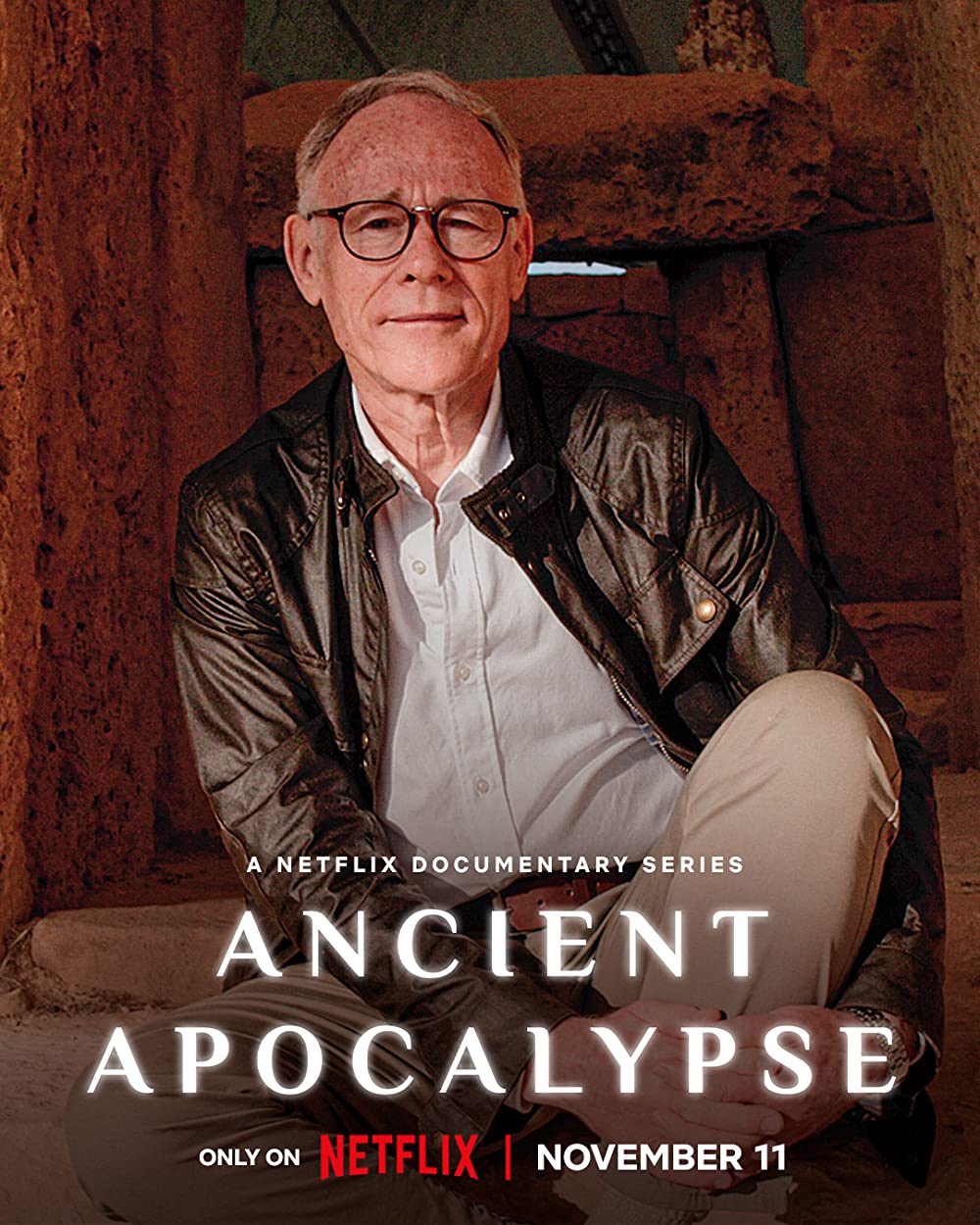
Graham Hancock rabbithole: What's wrong with Ancient Apocalypse?

It was Erika who wanted to see it: Ancient Apocalypse, the new Netflix "speculative archaeology" series. From the title itself, it sounded like one of those bullshit Discovery (or History?) Channel docs postulating that UFOs built my carport, or such (I don't even have a carport). As the trailer played while I was making our evening tea, I rolled my eyes and said something dismissive and asserted some other movie at her. But the next night, the "whattaya wanna watch" conversation came around, and she mentioned it again, so I looked the series up and saw that it was hosted by Graham Hancock. That fact changed my mind, so down the rabbithole we went.


It's not that I'm a Graham Hancock fan. But as someone who has occasionally worked in the used book game - minding the till at Albion Books for awhile in the 1990s and Carson Books in the 2000s - I am familiar with Hancock, have even made money on a couple of his books. His writing kind of had its day before this Netflix series premiered (which presumably will re-invigorate interest in it: take heed, thrifters!). I wouldn't actually ever make time to READ one of his thick tomes, but it's not like I'm not curious about the books that have passed through my hands. If I encounter a Fingerprints of the Gods on the shelf, I occasionally flip through and check out a few pages with idle curiosity: "So what's this guy on about?" Unfair or not, based on very little exposure, I quickly came to associate Hancock with other fringe stuff, like the Krishna fave Forbidden Archaeology or the works of Zecharia Sitchin or Erich von Däniken or - because the angle at which I'm coming at this is books one encounters fairly often - James Churchward, whose book on The Lost Continent of Mu one crosses paths with regularly, if you're a book guy. If this were my bookstore we were talking about, I'd put all of this stuff in the same place. With the possible exception of the (Hindu Creationist?) first book, these authors all posit that there was an encounter between early humans and some sort of now-forgotten civilizing influence, whether from outer space (Sitchin, von Daniken) or the diaspora of a now-forgotten civilization destroyed by a cataclysm (Hancock, Churchward, and anyone who has written on Atlantis, apparently). Anyhow, I figured that the series would at the very least be an easy way of getting a grasp on Hancock's ideas without having to read a three-inch thick book. It might also help me determine if there were anything in Hancock's work that might give me pause about the buying and selling of his books, or if (less likely-seeming) there was any merit to his ideas.  


Understand: as an adult, I've never much paid attention to this sort of fringe stuff, but I never really thought of it as problematic, either; even in a post-9/11 world, an Alex Jones world, a Donald Trump/ Fake News world, where conspiracy theory has been manipulated, weaponized, and used to undermine confidence in democracy, legitimate scholarship, and journalism, I would be no more disturbed to sell any of the books these people have written than I would be to sell a book about bigfoot or the Loch Ness monster. What does it hurt? It's the intellectual equivalent of watching episodes of In Search Of..., which I used to devour as a kid, or reading The Fortean Times (which I used to look at online every week; thanks go to Robin Bougie for reminding me of that magazine). And anyone who has worked at a bookstore knows that, while you may judge people inwardly for the stuff they buy, and you may have a line that you won't cross, for the most part, if your living in any way correlates to the selling of books, when a customer brings crap to the counter, you take their money and ask if they want a bag and let them be their own judge of the ideas they encounter. What you DON'T do is roll your eyes and say, f'rinstance, "What the fuck do you want to read Dan Brown for? At least buy Holy Blood, Holy Grail or, here, have you read Robert Anton Wilson? Dan Brown is just that stuff for dummies, for fucksake. Put it back!" (I haven't actually read Dan Brown, either, but I saw a movie once...). 

Brief digression: it's actually interesting to note what lines bookdealers WON'T cross. I once found a copy of The Protocols of the Elders of Zion, that ancient, malicious, and incredibly damaging anti-Jewish conspiracy theory tome, which I liberated from a "free book bin" on a rural road in Vancouver Island, of all places, because I thought the ideas in it are dangerous enough that it shouldn't be left somewhere where any kid could stumble across it and get polluted or confused or led down a toxic road. But then, with the book in my possession, I had to figure out what to do with it. I think it's entirely valid to read it, if you're researching, for example, the causes of the Holocaust or the history of anti-Semitism, but was shocked at how many of my friends told me I should burn it (Erika's dad, into whose house I briefly brought it, suggested the fireplace for it himself, while noting that there IS a contradiction between burning a book that inspired people - the Nazis - who themselves burned books). Most of my Facebook friends, liberal sorts all, were on that page as well, but I don't burn books... especially not when I figured a bookdealer might take it off my hands for a few bucks. I mean, I read a bit of it myself; it's not like the minute you open it, it infects you and corrupts you and you start listening to Burzum or something. (I mean, even viruses are worth studying, as long as you don't spread them; at least The Protocols has historical import, unlike, say, the crap put out by David Icke, whose books I feel vastly less comfortable with than Hancock's). However, I made a couple calls and was kind of impressed and surprised that no one - even bookstores that will stock Mein Kampf, which also has similar historical import - wanted anything to do with it. Unable to find a buyer, unwilling to burn it, and not wanting to put it back into general circulation at a thrift store or free bin, I ended up giving it to a buddy with an interest in the history of conspiracy theories, whose ability to bullshit-detect I have utter faith in; I believe he read it and then destroyed it himself, which is fine with me. 

Now: it might not occur to people who watch Graham Hancock's series that there is anything problematic about it at all. Erika and I are now six episodes into it, and I must confess, Hancock has tickled that part of me that used to LOVE my weekly fix of Leonard Nimoy musing about cryptids or creature storms or the lost colony of Roanoke (the actual In Search Of... about that is on Youtube! Whoa! I watched that when it aired, I believe - on October 25, 1979, when I was 11). Ancient Apocalypse is spectacularly well-made, with neat photography of ancient historical sites around the world, fun computer graphics that show how these sites might have looked when they were active, nifty observations (presumably in many cases quite trustworthy) about how ancient astronomers plotted the layout of the temples and mounds to correspond to events in the heavens, and Hancock himself, who seems sincere, if a bit of a character, as your host. It's amusing how his indignancy over how archaeologists exclude him and will will not listen to his ideas is tellingly mirrored by HANCOCK'S OWN REFUSAL TO LISTEN TO THESE ARCHAEOLOGISTS. If he's hell bent on advocating his own non-conforming version of ancient history, no matter what anyone might say to the contrary - if there is no sense of a free debate of ideas within his show - he's still engaging and funny and articulate and passionate. You kinda like him, and don't sense that he's, for instance, a dangerous hustler or utter fruitcake; he's just an eccentric non-conformist making a case for a pet theory of his, which on the surface seems no more dangerous than believing that nine foot tall ape men stalk the remote forests of British Columbia or that Kubrick's The Shining is about the faked moon landing (which also was an entertaining idea to, uh, entertain in that Room 237 documentary, so what the hell?). 

There may even be educational value in the series. Maybe it's not the kind Hancock intends, but, y'know, if I had kids, I would happily share the show with them, in the hopes of sparking wonder about the world and the past. I'd probably try to guide their viewing a little, mind you, because the real value in the series to me is that it is an object lesson in the dangers of confirmation bias: because with only a couple of tiny exceptions, Hancock only includes people on his show if they are willing to entertain (or themselves believe) his central premise, that the survivors and descendants of a forgotten lost civilization that pre-dates any known civilization by thousands of years, after an apocalyptic event some 12,800 years ago, brought their ideas about architecture, astronomy, and agriculture around the world, teaching hunter-gatherers about pyramid construction and so forth, which explains common features in the mythologies and construction principles of these people. Since it is not Hancock's purpose to find the truth about these ruins, but rather to defend and expand his own hypothesis, if you are an archaeologist who says anything that disputes this theory - unless Hancock changes his tune in the last couple of installments, which seems unlikely - you will not be included in the conversation. He's not interested in objectively unravelling the very real questions that might be asked about, say, Gunung Padang, one of many fascinating locations he visits, unless they are answered by his pet theory. Still, I'd be just fine with children of mine learning about Gunung Padang from Hancock, as long as their next step was to get onto the computer and look it up themselves and fact-check his claims. Teachable moment, eh? 


Of course, I would also hope that kids watching the series would ask the obvious question (which I am guessing Hancock doesn't get around to): if we need to posit the existence of some sort of prehistoric super-civilization (possibly Antlantean) to explain how different ancient societies came up with pyramids, learned about astronomy, and so forth - well, who taught that stuff to the prehistoric super-civilization? It's not that far off the standard refutation of the Christian argument from design: if we need to posit a God to explain the existence of the universe, then how was God created? (He wasn't, he's eternal, is the standard reply, which you then rebut with, "but if something can itself be uncreated and eternal, why can't that be true of the universe itself?" Checkmate, end game, seeya later).  

...which leads to the next obvious question: WHY might we need to explain how ancient societies built such structures? And this is where people are jumping up and down on Hancock, online, slurring him as a white supremacist - on Boing Boing, say ("Archaeologists reveal the the white supremacist nonsense behind Netflix's 'Ancient Apocalypse'), Slate ("The Ancient Absurdities of Ancient Apocalypse") or The Guardian (which calls the series "The Most Dangerous Show on Netflix"). The problem behind many of these "ancient civilization taught the hunter-gatherers everything they know"-type postulations - which is actually laid out most clearly in this article about the history of Atlantis theories, which doesn't even mention Hancock - is that Atlantis has historically been used to erase the accomplishments of the (mostly brown-skinned) people who built the pyramids, temples, and mounds that Hancock visits. Quoting from that last linked article - "The Harmful Pseudoarchaeology of Mythological Atlantis" by Stephanie Halmhofer, who chronicles the evolution of the concept through the late 19th century - we see that 

Atlantis became intertwined with human evolution and the idea of superior (those descended from Atlanteans) versus inferior (those not descended from Atlanteans) nations. In 1888 Helena Blavatsky, founder of the Theosophical Society, published The Secret Doctrine, which was inspired by Donnelly’s arguments with an added splash of esotericism and spiritualism. In The Secret Doctrine, Blavatsky discussed her theories of evolution and what she called the “root races”, in which Atlantis was considered the fourth root race. She believed Atlanteans were the ancestors to the fifth and most superior race – the Aryans.

Further, she writes that Atlantis

played a large role in 1930’s Nazi Germany when Heinrich Himmler and Herman Wirth founded the Institute for the Study of Atlantis. The institute’s purpose was to find proof Atlantis had once existed to prove the superiority of the Aryan race, because Himmler believed Blavatsky’s claims about Atlantis. Today, Atlantis and the idea of hyperdiffusion is still continually brought up in both discussions looking for explanations of the achievements of people in the past and discussions of nationalistic superiority.

That's all interesting and worth noting and very relevant. Perhaps Hancock is doing a grievous injustice to the hunter-gatherers he seems unwilling to believe might have come up with the complex architectural knowhow and astronomical knowledge that, say, the builders of the Serpent Mound in Ohio might have had? It still seems like it's not a fair game to call Hancock a white supremacist, though. The author of the Slate article, Rebecca Onion, quotes an archaeologist named John Hoopes on this point (which is also quoted on that Boing Boing piece):

If you research Graham Hancock and look at his books over time, as I have, one of the things that you discover about him is that he self-edits. He doesn’t use the word Atlantis now except very sparingly. He has also edited himself since 1995, when, in Fingerprints of the Gods, he came out and said that it was an ancient white civilization. He no longer says the “white” part in the series. If you pay careful attention, he does talk about “heavily bearded Quetzalcoatl” who arrives, according to myth, to give the gift of knowledge, but he doesn’t mention the other part of that trope, which all of us know about, which is that this visitor supposedly had white skin.

It’s similar to the way that Donald Trump operates. He will get to the edge of something, but he won’t say it, because he knows that his followers already know it. He can say, “I didn’t say that,” and he didn’t say it, but everyone knew what he said because it was already known, right?

There's a more charitable interpretation: perhaps Hancock doesn't mention that his ancient superior race was white (if he ever in fact said this - I wouldn't know) because he no longer believes it? There is certainly no mention of it in the series; should he be criticized and tarred as a white supremacist for NOT asserting that his proposed "master race" was white? (Maybe in Hoopes' circles everyone knows this aspect of the theory, as he says, but watching Hancock, I was assuming that his probably fictional super-civilization was ALSO brown-skinned, since most early civilizations were!). Of  course, there IS mention of the seafaring explorers who came ashore to offer lessons in pyramid-building being hairy, and being "giants," compared to the people they encountered, which COULD be code for "white" or something, I guess, but there is no mention of their skin colour anywhere in the show (that I've seen). The only relevant feature of this purported lost civilization is that it is more advanced than that of the hunter-gatherers its survivors/ descendants encountered. And while there may still be some troubling similarity between what Hancock offers to the racially-motivated history of Atlantis theories discussed in the article by Halmhofer, there's an easy way of clearing Hancock of all charges: would it still be white supremacist to argue that pyramid builders got their knowledge from a  - let's say it - earlier white civilization, if, in fact, it was historically correct? 

No. If Hancock could actually prove his claims, it would just be history, not white supremacy, that he was offering. And in the absence of that proof, while we might find the desire to ADVANCE such claims suspect - because Hancock's desire to believe this stuff does seem to come from somewhere OTHER than the evidence - if we wanted to say that all such theories are rooted in some neurotic need to believe that "whites were first" - it seems kind of unfair to read quite THAT much into the show, all things considered. The problem isn't that Hancock is racist or white supremacist; I see no reason to slur his name with that particular association, at least not based on the six of the eight episodes I've seen. The problem is, he's not in any way objective (Hoopes connects him with mystical/ New Age beliefs and gets into Hancock's history with cannabis and ayahuasca, all of which seems more plausible as a starting point than some sort of white-race neurosis). Why call someone a racist, when all you really need to do is note that he's a fringe figure who won't let go of a probably untenable theory regardless of what anyone says? Isn't that invalidating enough? 

Anyhow, though I disagree with Hoopes, above, the Slate article is fascinating and enlightening. There's also a review linked in it from Archaeology Review, written by a professional archaeologist, which makes the worthy claim that far from wanting to suppress Hancock's "discoveries," "every single archaeologist I know would be elated to discover any previously unknown civilization of the Ice Age. Or any age for that matter. Whatever their advancement is."

It's probably not the rabbithole Graham Hancock would have me go down, but I'm getting even more entertainment value reading the debunkings of his series than I am from the series itself. Value-added, eh? I'm having a damn good time with all this. And, you know, the places he visits in Ancient Apocalypse are fascinating and worthy of contemplation, even if the host is less than trustworthy. 

Thanks, Mr. Hancock! Good show.