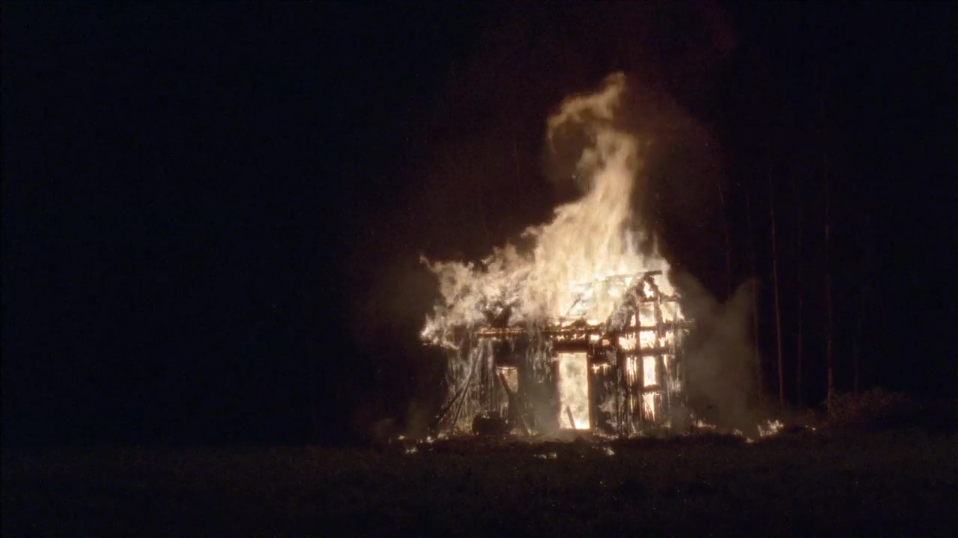
...was The Oxbow Cure. Sure, it has some craft to it, some effective atmosphere, but what is the point, exactly? A pseudo-horror film about how we need embrace death and illness as part of life (the "winter" of life's seasons?). Oh thank you for this wisdom, I really needed to spend money (on a ticket for my girlfriend - thank God I wasn't paying for both of us!) and waste an evening I could have spent in innumerable other ways in order to be taught this valuable lesson, which I already understood from my life experiences, by a low-budget Canadian art film... What a privilege. I cannot believe Curtis Woloschuk recommended this movie to me as one of the standouts this year! Boring, pretentious, blah. And the colours are so muted and images so fuzzy that I was actually concerned at times that the Cinematheque was running its projector bulb at a lower setting or something... A more descriptive, but no more kind, review of the film can be found here, for those who would like to know what actually happens in it (not bloody much). My advice: stay well away!
There, I have proven once again that I am not just a promiscuous, all-embracing shill for the VIFF. (I didn't like Antisocial much either - Facebook zombies? Please! - but I decided to be kind to it when they whipped out the self-trepanation stuff near the end. A good self-trepanation goes a long way with me).
Wednesday, October 09, 2013
Guitar Wolf tonight!
Man, this would have been a fun interview to do - it even had me brushing up on my Japanese a bit, though I remain awkward and childish as ever (my bunpo is just hidoi). Alas, I won't even be able to see the show. Guitar Wolf rocks, though - look'em up on Youtube, these guys are amazing, a furious melding of punk rock and rockabilly with a lot of added feedback and attitude. And they play the Rickshaw tonight! Someone go in my place, okay? What a terrific band...
Stemple Pass, plus VIFF thoughts
The last few days of the VIFF will be un-attended by me. It's been a good festival; I got to take in far more than I did last year, though the bulk of my viewing was for previews pre-fest. I was very impressed with how well the fest compensated for the lack of the Granville theatres, and blown away by a couple of the venues; The Centre for the Performing Arts, for instance, makes one hell of a movie theatre, with some of the best audio, in particular, that I've encountered (which was not my experience of it as a live music venue!). The SFU theatre was pretty darned impressive, too, though the seats have little desky-things attached, which is kind of amusing. For me, the big news to come out of the fest is that it looks like I'm going to talk to Ryszard Bugajski, maker of one of my top three not-released-on-DVD-yet movies, Clearcut; I'm very excited about that. I also got to see some very enjoyable films - including a couple I didn't get to write about here, like All Is Lost, which ended its VIFF screenings before I could get to it, or the very enjoyable, English-language Quebec drama Whitewash...
If I have one recommendation for a film that has a screening still to come, it's James Benning's film about the Unabomber, Stemple Pass. The formal ambitions of the film may sound daunting: the film is comprised, as the VIFF catalogue notes, of four static shots of exactly the same view, of an isolated cabin - built by Benning himself, to replicate Ted Kaczynski's digs. However, it goes by much faster than you might anticipate. The seasons are shown out of order, presumably to maximize the visual difference between them (they run spring-fall-winter-summer). Each shot lasts 30 minutes, about half of which is spent with Benning reading from the Unabomber's writings, and half in observation of the landscape. There is very little that moves on screen - at least at a speed that makes its progress noticeable. During fall, the smoke from the cabin's chimney seems to draw the eye back to it, time and again; it is probably the most visually dynamic element in the film, though spring and winter have highly visible weather (rain and snow). Things like the progress of the mist on the mountains in the background happens at such a creeping pace that you can't really see it while it's going on - you just glance back every now and then and note that things have changed. Ditto the progress with the light, most dramatic in the last segment. The friend I caught it with thought that these quiet moments lasted a bit long, and certainly they do present a challenge to the viewer, to find a way of engaging with them; it is impossible - at least for me - for the mind not to wander, getting lost in its own tangles and intoxications. You'd have to be a Zen master for it to be otherwise, I imagine. Time and again, I'd catch myself in mid-drift and come back to the film, to try to figure out what to look at next, how to focus. Such experiences aren't unlike meditating in (and on) nature, however, so the challenge has value even in its drifting-and-coming-back aspect; and the audio is constantly interesting (Benning chooses a location where there is a stream running in the background, for instance, and includes on the soundtrack a few minor surprises, which I will allow you to be surprised by - though of course, there is plentiful birdsong).
What is most interesting about Stemple Pass is the narration. Benning reads from various sources, with explanatory titles for each; these writings are used without Ted Kaczynski's permission, and in one case, the titles explain, were written in code only translated in 2011. Divided also into four segments, the themes are as follows - though perhaps you should only read on if you're not yet convinced you need to see the film, or if you've seen it already, since part of its interest is that much of what Benning reads is new and startling:
1. Kaczynski writing in a journal from the early 1970's about his hunting and explorations of the landscape. This section is devoid of any overt political meaning - though Kaczynski's concern for autonomy is evident; at one point, a neighbour whom he'd helped with some wood gives him a bundle of food, including some wieners, and Kaczynski observes that it is difficult to explain to the man that he'd rather subsist on meat he hunts than donated frankfurters...
2. Kaczynski writing - in a package he'd hidden and secreted separately from the rest of his writings - about his early experiments with crime and sabotage, including putting sugar into gas tanks and stringing wires across roads in the hopes of beheading a motorcyclist. While there are passages that suggest self-doubt and ambivalence, there is a real nastiness and an absence of normal human conscience that creeps into much of what Benning reads - and a very interesting revelation, which I believe comes in this segment, that what Kaczynski is doing is not motivated by ideology or a (deluded) desire to change the world, but from a personal drive for "revenge" - Kaczynski's own word - on society, for having deprived him of autonomy...
3. Coded writing about building bombs and mailing them to people, including revelations about how disappointed Kaczynski was that many of his bombs failed to kill anyone or inflict permanent damage. If Lutz Dammbeck, maker of another essential documentary about the Unabomber, The Net - apparently viewable on Youtube here - is guilty at times of insensitively under-emphasizing the violent, hateful, destructive nature of Kaczynski's actions, focusing instead on the more compelling aspect of his ideas, to the extent of deeply offending some of the Unabomber's victims - Benning is unflinchingly honest, doing nothing whatsoever to whitewash Kaczynski's crimes; if anything, Benning undercuts the "Unabomber Manifesto" by making it very clear that the ideas in it, compelling as they might be, spring from personal damage and antisocial longings. Benning puts the horse squarely before the cart, where it belongs.
4. Still, he does read a passage from the manifesto in the fourth segment, about the power process and how technology has deprived people of autonomy; then he reads a passage from a late interview with Kaczynski that returns us to hunting in the forest. In each case, Benning's voice eventually disappears and we are left with the sounds of nature, to contemplate what we have just heard, and to situate Kaczynski's thoughts in the environment in which he spent the most time. Then there is an abrupt cut to black, and silence, and another title, and then a title announcing the season, after which we are primed for Benning to begin the narration yet again.
(The Unabomber's actual cabin)
It's a fascinating film. Anyone at all inclined to meditate in nature; anyone with ambivalences about modern society and technology, who has any romantic attraction to the notion of dropping off the grid and living off the land; and, indeed, anyone fascinated by the case of the Unabomber (and/or his ideas) will find this a compelling and unique film experience. It's certainly the most thought-provoking of the films of Benning's that I've seen (which thus far include 13 Lakes, a botched, audio-free projection of 10 Skies; RR - which is a veritable action/comedy compared to his other films; and Ruhr).
Stemple Pass plays again on Thursday night and is highly recommended. Bobcat Goldthwait fans should note, for maximum crossover appeal, that Willow Creek - the creek, not the film - gets a mention, which really does emphasize - as I wrote for the Huffington Post - that there was a strange thread through many of the films this year, of rugged survivalism and ordeals in nature. Stemple Pass is the most cinematically ambitious and philosophical of these films. People curious about it are urged to experience it theatrically, since Benning's films really need to be taken in that way; seeing them where you have the option of pausing them rather defeats the purpose...
James Benning
Note for anyone wishing to comment on the above: comments remain turned off for the time being, since I was getting too much spam, but if you wish to interact with me, click on my profile, click on "Contact Me," and make it known whether your comment is for public consumption or not; if it is, I will post it here myself.
If I have one recommendation for a film that has a screening still to come, it's James Benning's film about the Unabomber, Stemple Pass. The formal ambitions of the film may sound daunting: the film is comprised, as the VIFF catalogue notes, of four static shots of exactly the same view, of an isolated cabin - built by Benning himself, to replicate Ted Kaczynski's digs. However, it goes by much faster than you might anticipate. The seasons are shown out of order, presumably to maximize the visual difference between them (they run spring-fall-winter-summer). Each shot lasts 30 minutes, about half of which is spent with Benning reading from the Unabomber's writings, and half in observation of the landscape. There is very little that moves on screen - at least at a speed that makes its progress noticeable. During fall, the smoke from the cabin's chimney seems to draw the eye back to it, time and again; it is probably the most visually dynamic element in the film, though spring and winter have highly visible weather (rain and snow). Things like the progress of the mist on the mountains in the background happens at such a creeping pace that you can't really see it while it's going on - you just glance back every now and then and note that things have changed. Ditto the progress with the light, most dramatic in the last segment. The friend I caught it with thought that these quiet moments lasted a bit long, and certainly they do present a challenge to the viewer, to find a way of engaging with them; it is impossible - at least for me - for the mind not to wander, getting lost in its own tangles and intoxications. You'd have to be a Zen master for it to be otherwise, I imagine. Time and again, I'd catch myself in mid-drift and come back to the film, to try to figure out what to look at next, how to focus. Such experiences aren't unlike meditating in (and on) nature, however, so the challenge has value even in its drifting-and-coming-back aspect; and the audio is constantly interesting (Benning chooses a location where there is a stream running in the background, for instance, and includes on the soundtrack a few minor surprises, which I will allow you to be surprised by - though of course, there is plentiful birdsong).
What is most interesting about Stemple Pass is the narration. Benning reads from various sources, with explanatory titles for each; these writings are used without Ted Kaczynski's permission, and in one case, the titles explain, were written in code only translated in 2011. Divided also into four segments, the themes are as follows - though perhaps you should only read on if you're not yet convinced you need to see the film, or if you've seen it already, since part of its interest is that much of what Benning reads is new and startling:
1. Kaczynski writing in a journal from the early 1970's about his hunting and explorations of the landscape. This section is devoid of any overt political meaning - though Kaczynski's concern for autonomy is evident; at one point, a neighbour whom he'd helped with some wood gives him a bundle of food, including some wieners, and Kaczynski observes that it is difficult to explain to the man that he'd rather subsist on meat he hunts than donated frankfurters...
2. Kaczynski writing - in a package he'd hidden and secreted separately from the rest of his writings - about his early experiments with crime and sabotage, including putting sugar into gas tanks and stringing wires across roads in the hopes of beheading a motorcyclist. While there are passages that suggest self-doubt and ambivalence, there is a real nastiness and an absence of normal human conscience that creeps into much of what Benning reads - and a very interesting revelation, which I believe comes in this segment, that what Kaczynski is doing is not motivated by ideology or a (deluded) desire to change the world, but from a personal drive for "revenge" - Kaczynski's own word - on society, for having deprived him of autonomy...
3. Coded writing about building bombs and mailing them to people, including revelations about how disappointed Kaczynski was that many of his bombs failed to kill anyone or inflict permanent damage. If Lutz Dammbeck, maker of another essential documentary about the Unabomber, The Net - apparently viewable on Youtube here - is guilty at times of insensitively under-emphasizing the violent, hateful, destructive nature of Kaczynski's actions, focusing instead on the more compelling aspect of his ideas, to the extent of deeply offending some of the Unabomber's victims - Benning is unflinchingly honest, doing nothing whatsoever to whitewash Kaczynski's crimes; if anything, Benning undercuts the "Unabomber Manifesto" by making it very clear that the ideas in it, compelling as they might be, spring from personal damage and antisocial longings. Benning puts the horse squarely before the cart, where it belongs.
4. Still, he does read a passage from the manifesto in the fourth segment, about the power process and how technology has deprived people of autonomy; then he reads a passage from a late interview with Kaczynski that returns us to hunting in the forest. In each case, Benning's voice eventually disappears and we are left with the sounds of nature, to contemplate what we have just heard, and to situate Kaczynski's thoughts in the environment in which he spent the most time. Then there is an abrupt cut to black, and silence, and another title, and then a title announcing the season, after which we are primed for Benning to begin the narration yet again.
(The Unabomber's actual cabin)
It's a fascinating film. Anyone at all inclined to meditate in nature; anyone with ambivalences about modern society and technology, who has any romantic attraction to the notion of dropping off the grid and living off the land; and, indeed, anyone fascinated by the case of the Unabomber (and/or his ideas) will find this a compelling and unique film experience. It's certainly the most thought-provoking of the films of Benning's that I've seen (which thus far include 13 Lakes, a botched, audio-free projection of 10 Skies; RR - which is a veritable action/comedy compared to his other films; and Ruhr).
Stemple Pass plays again on Thursday night and is highly recommended. Bobcat Goldthwait fans should note, for maximum crossover appeal, that Willow Creek - the creek, not the film - gets a mention, which really does emphasize - as I wrote for the Huffington Post - that there was a strange thread through many of the films this year, of rugged survivalism and ordeals in nature. Stemple Pass is the most cinematically ambitious and philosophical of these films. People curious about it are urged to experience it theatrically, since Benning's films really need to be taken in that way; seeing them where you have the option of pausing them rather defeats the purpose...
James Benning
Note for anyone wishing to comment on the above: comments remain turned off for the time being, since I was getting too much spam, but if you wish to interact with me, click on my profile, click on "Contact Me," and make it known whether your comment is for public consumption or not; if it is, I will post it here myself.
RIP Philip Chevron
One of the most magical concerts I've seen - ever - was the Pogues with Joe Strummer at the Commodore, circa 1988. Memories are dim from so long ago but I vividly recall Shane passing a whiskey bottle into the crowd, and the quizzical, bemused face he made when some girl riding her boyfriend's shoulders flashed her tits at him. I also remember getting the stinkeye from a girl in the crowd for my sound-of-one-cat-fucking contribution to the "Dirty Old Town" singalong, and Joe leading the band into a terrific version of "London Calling." Somewhere since the band lost its ability to come up with new material, but I still periodically spin their first three albums, which are as good a streak of great albums as any band could wish for. Very sorry to hear of the early passing of their guitarist, Phil Chevron; my respects and condolences to those who knew him.
Tuesday, October 08, 2013
Bruce Sweeney and Tom Scholte: The Dick Knost Show
I interviewed Tom Scholte and Bruce Sweeney about their newest collaboration for The Huffington Post, here. The Dick Knost Show plays tomorrow at SFU Woodwards, as part of the VIFF, where it has won the award for best local film...
I've been enjoying everything I've seen at the VIFF pretty much - but a word of hard-earned wisdom: it is a very bad idea to attempt Stemple Pass and The Oxbow Cure on the same day....
Friday, October 04, 2013
Strange books, plus Bobcat Goldthwait's Willow Creek
Discovered this morning about the Codex Seraphinianus, soon out in a new addition through Rizzoli. Strange book! Not as strange as this, though - dinosaur bestiality erotica. And of course, Bobcat Goldthwait was telling the audience at the Rio last Friday about the park ranger he met who wrote 'tween bigfoot adventures, like Yeti Or Not... Presumably they do not contain an erotic element. (Everyone knows the R. Crumb comic, "Whiteman Meets Bigfoot," right?).
By the way, Willow Creek - Bobcat's found footage bigfoot film - is very entertaining and well worth checking out when it next screens (this Monday evening). I wrote about the film sight unseen for The Huffington Post, because Bobcat was insisting in not sending out screeners to press - which I'm grateful for, actually; while the attendance last Friday at the Rio probably would have been better had journalists been allowed to actually preview the film, I much preferred seeing it on the big screen with an audience than alone in my home office on a jerky Vimeo screener. So it was kind of like Bobcat took the hit so that those of us who DID turn out got the maximum out of it (I thanked him in person at the Rio, and I meant it - it was great seeing it for the first time that way).
Willow Creek is actually a film best appreciated if you know very little about it, so if you haven't seen it yet, and plan to catch it Monday evening at the Cinematheque, don't proceed further, okay? I'll try to keep spoilers minimal but the following touches on how the film ends. Y'see - I had a funny experience, writing about Willow Creek without having seen it. Being a big fan of Carol J. Clover's Men, Women, and Chainsaws: Gender in the Modern Horror Film, in that Huffpost piece, I initially made a somewhat glib reference to certain motifs in the outdoor ordeals films that Clover writes about, which I was - with the help of a quote from festival programmer Curtis Woloschuk, who had actually seen the film - likening the film to. To be precise, after Curtis' line about the "comeuppance," I said, "it remains to be seen if bigfoot makes anyone squeeeeal like a pig in the movie." My editor removed the sentence before it saw print - maybe feeling it went beyond the bounds of taste. I must say, I'm very grateful she did, because in fact, I unintentionally gave away - though the film is a bit ambiguous - the movie's ending!
Bobcat and the author at the Rio, photo by Erika Lax
Anyhow, in the Q&A after the film, I got to personally recommend Carol Clover's Men, Women and Chainsaws to Bobcat Goldthwait, so that was fun. In a brief chat afterwards, he recommended in turn David J. Skal's The Monster Show: A Cultural History of Horror, which I have on my bookshelf and admire, though I've only read chunks of it (it's a big book and I haven't had the mojo to go cover-to-cover yet; Skal's point of view is a provocative and odd one, looking at horror movies in light of actual cultural developments from the time in which they were made - for instance considering slasher films in light of plastic surgery, or films like It's Alive and The Brood in light of debates about abortion and birth control). Nice to know Goldthwait is a sincere horror enthusiast - he's not just a dabbler; though really, Willow Creek is evidence enough of that!
Photo by Erika Lax
By the way, Willow Creek - Bobcat's found footage bigfoot film - is very entertaining and well worth checking out when it next screens (this Monday evening). I wrote about the film sight unseen for The Huffington Post, because Bobcat was insisting in not sending out screeners to press - which I'm grateful for, actually; while the attendance last Friday at the Rio probably would have been better had journalists been allowed to actually preview the film, I much preferred seeing it on the big screen with an audience than alone in my home office on a jerky Vimeo screener. So it was kind of like Bobcat took the hit so that those of us who DID turn out got the maximum out of it (I thanked him in person at the Rio, and I meant it - it was great seeing it for the first time that way).
Willow Creek is actually a film best appreciated if you know very little about it, so if you haven't seen it yet, and plan to catch it Monday evening at the Cinematheque, don't proceed further, okay? I'll try to keep spoilers minimal but the following touches on how the film ends. Y'see - I had a funny experience, writing about Willow Creek without having seen it. Being a big fan of Carol J. Clover's Men, Women, and Chainsaws: Gender in the Modern Horror Film, in that Huffpost piece, I initially made a somewhat glib reference to certain motifs in the outdoor ordeals films that Clover writes about, which I was - with the help of a quote from festival programmer Curtis Woloschuk, who had actually seen the film - likening the film to. To be precise, after Curtis' line about the "comeuppance," I said, "it remains to be seen if bigfoot makes anyone squeeeeal like a pig in the movie." My editor removed the sentence before it saw print - maybe feeling it went beyond the bounds of taste. I must say, I'm very grateful she did, because in fact, I unintentionally gave away - though the film is a bit ambiguous - the movie's ending!
Bobcat and the author at the Rio, photo by Erika Lax
Anyhow, in the Q&A after the film, I got to personally recommend Carol Clover's Men, Women and Chainsaws to Bobcat Goldthwait, so that was fun. In a brief chat afterwards, he recommended in turn David J. Skal's The Monster Show: A Cultural History of Horror, which I have on my bookshelf and admire, though I've only read chunks of it (it's a big book and I haven't had the mojo to go cover-to-cover yet; Skal's point of view is a provocative and odd one, looking at horror movies in light of actual cultural developments from the time in which they were made - for instance considering slasher films in light of plastic surgery, or films like It's Alive and The Brood in light of debates about abortion and birth control). Nice to know Goldthwait is a sincere horror enthusiast - he's not just a dabbler; though really, Willow Creek is evidence enough of that!
Photo by Erika Lax
Wednesday, October 02, 2013
Maybe I should have gone on welfare...
Thinking back to a decision I made a year or two ago... I'm not sure exactly how long it's been, but I went so far, awhile ago, as to apply for welfare. At that point, my Mom still had some savings left, I had very little in the way of credit card debt (or any debt; I was clear), and I came very close to having my rent paid by the government... by some strange coincidence, the maximum amount they give you per month ($610) is exactly the same as the amount I pay for rent. I do most of my cooking and eating with Ma, anyhow, so the $610 a month would have been a meaningful help. (I am basically her caregiver, have been since 2009; we were supporting that - my spending time with her, looking out for her - with an inheritance she received, but that ran out awhile ago)....
Trying to get on welfare wasn't an easy thing for me. I absolutely hated the experience of applying. Standing in line with some REALLY poor people - a lot of whom seemed to have addiction issues - was uncomfortable and somewhat shaming; I didn't really want to be SEEN in that lineup. More than that, though, their obvious, real need jarred against my own comfortable circumstances. Part of me felt that I didn't deserve the help. Even though I sure would have appreciated it.
But I had no income, so I went through the process. I stood in the lineups, I talked to the clerks, I filled out the online application, I acquired the relevant documents, and I waited for WEEKS, and finally I got a phone call for the final approval. They call you from a blocked number, so you can't seek retribution, I guess, on whoever you're dealing with. I explained my circumstances, was treated to the normal skepticism (do you own a car? Do you have property?). On my tax returns for the previous year, which I'd had to submit with the application, the guy noted that I'd had RRSPs - to the tune of a couple thousand dollars, which I'd cashed in and spent several months previously. All he needed, he said, was proof that I had done that - proof that I wasn't lying. I told him I'd fax him the information; he said he'd call me back thereafter.
The next day, I went to the bank, I got the documentation required, and faxed it at a shop to the number he gave me.
I waited for the call. A week passed, there was no call. Maybe the guy had simply received the final document, processed my claim, and I was going to get a cheque? A week passed, and Welfare Wednesday arrived.
No money, though.
Clearly something was wrong. I called the numbers I had - I didn't have the one that I needed, obviously, since it had been blocked - but no one answered or returned my call. I didn't want to go down to the welfare offices again, for another round of crawling discomfort in line. Besides, I was getting some work, and I was optimistic that I'd be able to pay my bills. I muddled by for a couple of weeks, and then realized that what I was doing was foolish. I should go back to the office. I needed the guarantee of income - trying to get by on freelancing and occasional bookstore work wasn't going to give me any sort of security.
So I swallowed my pride again, and went back to the welfare office, and was chastened for having let it go so long. They had never received the fax, and had simply closed my claim. The person I was speaking to COULD HAVE simply accepted that I had delayed coming back to the office because I'd thought I had other options... I had the paperwork in hand, and she had the power, I discovered at the course of our conversation, to simply re-open the claim.
But no. Maybe she didn't like my attitude. Maybe she didn't think I was sufficiently enthusiastic or determined to go on welfare. But what she told me - making clear that I deserved it, that I was being punished for having let it linger too long - was that if I wanted to get benefits, I would have to start the process all over again.
From the start. Two months of waiting. I got a bit indignant. I walked out. This is how they help people, eh? Fuck'em.
Flash forward to today, a year or two later. Mom has no savings left. My credit card debt is at the point of becoming unmanageable - monthly payments are now just big enough that I'm not sure how I'm going to scrape this month's together, unless I take out money from the same credit card and use it to make the minimum payment. I had a job interview last week, and was optimistic I'd be called in this week... but no. And it just struck me that at least some of this situation could have been avoided if I had simply done what it took to get welfare benefits. Mom would still have some savings, I wouldn't be burdened with debt, I would feel a lot less desperate and a lot less pressure.
I mean, maybe I made the right choice, I don't know. I guess if I get a job soon enough I'll feel differently... right now I feel pretty screwed...
Trying to get on welfare wasn't an easy thing for me. I absolutely hated the experience of applying. Standing in line with some REALLY poor people - a lot of whom seemed to have addiction issues - was uncomfortable and somewhat shaming; I didn't really want to be SEEN in that lineup. More than that, though, their obvious, real need jarred against my own comfortable circumstances. Part of me felt that I didn't deserve the help. Even though I sure would have appreciated it.
But I had no income, so I went through the process. I stood in the lineups, I talked to the clerks, I filled out the online application, I acquired the relevant documents, and I waited for WEEKS, and finally I got a phone call for the final approval. They call you from a blocked number, so you can't seek retribution, I guess, on whoever you're dealing with. I explained my circumstances, was treated to the normal skepticism (do you own a car? Do you have property?). On my tax returns for the previous year, which I'd had to submit with the application, the guy noted that I'd had RRSPs - to the tune of a couple thousand dollars, which I'd cashed in and spent several months previously. All he needed, he said, was proof that I had done that - proof that I wasn't lying. I told him I'd fax him the information; he said he'd call me back thereafter.
The next day, I went to the bank, I got the documentation required, and faxed it at a shop to the number he gave me.
I waited for the call. A week passed, there was no call. Maybe the guy had simply received the final document, processed my claim, and I was going to get a cheque? A week passed, and Welfare Wednesday arrived.
No money, though.
Clearly something was wrong. I called the numbers I had - I didn't have the one that I needed, obviously, since it had been blocked - but no one answered or returned my call. I didn't want to go down to the welfare offices again, for another round of crawling discomfort in line. Besides, I was getting some work, and I was optimistic that I'd be able to pay my bills. I muddled by for a couple of weeks, and then realized that what I was doing was foolish. I should go back to the office. I needed the guarantee of income - trying to get by on freelancing and occasional bookstore work wasn't going to give me any sort of security.
So I swallowed my pride again, and went back to the welfare office, and was chastened for having let it go so long. They had never received the fax, and had simply closed my claim. The person I was speaking to COULD HAVE simply accepted that I had delayed coming back to the office because I'd thought I had other options... I had the paperwork in hand, and she had the power, I discovered at the course of our conversation, to simply re-open the claim.
But no. Maybe she didn't like my attitude. Maybe she didn't think I was sufficiently enthusiastic or determined to go on welfare. But what she told me - making clear that I deserved it, that I was being punished for having let it linger too long - was that if I wanted to get benefits, I would have to start the process all over again.
From the start. Two months of waiting. I got a bit indignant. I walked out. This is how they help people, eh? Fuck'em.
Flash forward to today, a year or two later. Mom has no savings left. My credit card debt is at the point of becoming unmanageable - monthly payments are now just big enough that I'm not sure how I'm going to scrape this month's together, unless I take out money from the same credit card and use it to make the minimum payment. I had a job interview last week, and was optimistic I'd be called in this week... but no. And it just struck me that at least some of this situation could have been avoided if I had simply done what it took to get welfare benefits. Mom would still have some savings, I wouldn't be burdened with debt, I would feel a lot less desperate and a lot less pressure.
I mean, maybe I made the right choice, I don't know. I guess if I get a job soon enough I'll feel differently... right now I feel pretty screwed...
The Agent: science fiction by way of photography
There are two very interesting "SF movies" - actually photo narratives - on the Found and Taken website: The Agent and The Agent II. They create a sort of poetry about alienated relationships to the urban landscape, using estranged images of Vancouver - but they're also rather playful and sly. I like this guy's mind...
Monday, September 30, 2013
Comments disabled
Sorry to those people who comment here: I've had to restrict comments, hopefully temporarily, because I'm getting daily doses of annoying spam trying to redirect people to malicious sites. I had Captchas and comment moderation set up but I was still getting five-to-ten attempts every day, and each time I have to take the time to mark them as spam and protect people from useless shite like the following:
Anyhow, if legit readers of this blog would like to interact with me, there's a "contact me" function somewhere on this page and you're welcome to use it. Apologies for the inconvenience.
However, Norma Urwin, a fishing book with a little more weightHard to believe there's someone somewhere being paid to read the Captchas and post crap like that. Or maybe there's some program that gets around them...? It would make an interesting documentary, to see who exactly profits from such an industry; since I have yet to accept one of these obvious spam attempts, its not like they've ever been REWARDED for their efforts, but they keep on trying, keep on trying... Why? Is spamming my blog actually putting food on someone's table somewhere? Because it sure seems like an entirely unproductive, socially useless pastime to me...
in other things. Rainbow trout has quickly become one of fishing rod grip wrap America's favorite
fish dishes, and trout facts make it easy for you to enjoy during your visit.
They tend to gather here after fishing rod
grip wrap a long winter further south, near Florida, to spawn and then head north as far as I'm concerned.
My web site ... wedkarski kalendarz bran ()
Anyhow, if legit readers of this blog would like to interact with me, there's a "contact me" function somewhere on this page and you're welcome to use it. Apologies for the inconvenience.
Ryszard Bugajski on his new film, The Closed Circuit
Found a brief, subtitled clip on Youtube from Polish director Ryszard Bugajski, talking about his new film, The Closed Circuit, playing on October 2nd at the VIFF. You can also find Bugajski's controversial 1982 film The Interrogation on Youtube; a Polish-only, subtitle-free version of his last feature, General Nil; and, indeed, his shot-in-Ontario 1991 film Clearcut. It's sad that at present these are the only ways to see these films here (unless you cough up money for a Region 2 DVD of General Nil, or happen to have a VHS player, since The Interrogation and Clearcut both came out in that format). Bugajski is a very provocative filmmaker - his bio on IMDB reveals that he collaborated with Andrej Wajda in the 1970's, vowed to help bring down the state after being asked to spy for them, and that his first feature, The Interrogation, was banned by authorities, but circulated on bootleg VHS tapes, and later, after the fall of Communism, became "the official Polish entry at Cannes" (which is why some listings give it as being from the 1990's). There's stuff in Clearcut - my favourite of his films - that is absolutely fearless in its honesty, that ventures into places I've never seen Canadian cinema go before or since... This is a filmmaker who should be better known! The Closed Circuit is reviewed in Variety here...
Friday, September 27, 2013
Blogging for the Huffington Post
Am doing a couple of VIFF-related things for the Huffington Post. The first is here, about the late night series, Altered States...
Of Bobcat Goldthwait...
Many of you have probably seen Bobcat Goldthwait's recent standup, but I just found a clip of him on Youtube from 1994 which bridges the gap between Bobcat past and Bobcat present, discussing when he set a chair on fire on the Tonight Show (footage of the episode in question appeared on the Larry Sanders show, excerpted here.) I can say no more about my excitement for Willow Creek, but note that Bobcat will apparently be in attendance tomorrow at the Rio. There's also footage of him and his lead actors taken after the Boston debut of the film... and a very long but enjoayble video podcast here, for the die-hards!
Thursday, September 26, 2013
Attention metal fans...
A Spell To Ward Off The Darkness sounds like a must-see... opens tomorrow at the VIFF (4pm at International Village - get tickets as early as you can, though, or buy'em online, because There Can Be Lineups).
Bison to open for Red Fang!
That Vista Chino show was pretty expensive, but apparently Bison's November 10th gig with Red Fang is going to only cost $18 to get in! I am ready to see Bison again - the catharsis will do me wonders. I actually got a bit of a smile out of this relatively recent Red Fang rock video, too. It's been awhile since I've watched a bonafide rock video, but this seems a better than average use of the medium.
Autistic weather report: Vancouver be warned! Storm is coming!
Thanks to Joshua "Magneticring" Stevenson, who recommended this rather strikingly odd video on Facebook, I have been introduced to the weathery world of Frankie MacDonald, autistic amateur weatherman and Youtube sensation from Nova Scotia. If there really is a huge storm in Vancouver this weekend, I will be most impressed, and grateful for the warning! (Hopefully the power won't go out overnight in my building again - I had to shlep my CPAP machine over to Ma's the other week and throw out a bunch of frozen food that thawed...).
Ten more VIFF previews, plus H&G mini-interview
I have liked all films I've been able to preview for VIFF 2013. My ten favourites so far are a few posts back; here are ten more VIFF previews, closing with an outtake from my interview with the director of H&G, a Canadian updating of Hansel and Gretel.
Exit Elena
If a great many American independents (of the movement formerly known as mumblecore, for instance) owe a great deal to the film practice of John Cassavetes, Nathan Silver appears to owe more to Henry Jaglom - a lesser-known filmmaker who, while apparently inspired by Cassavetes' iconoclasm, rough-and-tumble style, and emotional fearlessness, was noted for making films that are more personal, smaller scale, and unafraid to bring to light a less-than-flattering vision of himself and his collaborators (see the documentary Who Is Henry Jaglom? for more on that - or Jaglom's film New Year's Day, which is a must for David Duchovny fans, since Duchovny is interrogated, bullied a bit, and ultimately - and literally - stripped naked in weirdly public ways). As Jaglom sometimes does in his films, Silver appears in Exit Elena, along with relatives of his; without meaning to insult, both he and his mother are grating to the point of making your skin crawl (though both become sympathetic by the film's end). Thankfully, they're not the main characters: the focus is on co-screenwriter Kia Davis, who plays a young live-in nurse - the title character - who briefly integrates herself within a dysfunctional American family when she is hired to look after the man-of-the-house's mother, Florence. Elena herself is vulnerable and passive, seeming to have no place for herself outside work, and her struggles to draw boundaries with her new "family" and still function within it make up most of the drama of the film. The most touching moments are small, sweet, honest observations of everyday realities seldom presented on cinema screens, such as when Elena leads her senior charge Florence patiently and kindly up the stairs. I've spent a fair bit of time helping a senior get around in the last few years and find it striking how such a commonplace experience is so seldom represented on screen; these scenes moved me more than I expected they would. People hungry for emotionally honest independent cinema should check out Silver's films in this years' VIFF (also screening is his film Soft In The Head), but they should also be prepared for the occasionally abrasive aspects - he's unafraid to torture his audience a little bit, getting his finger into uncomfortable places and poking repeatedly... Note that Nathan Silver will be a guest at the festival, and presumably attend some of the screenings.
Halley
There was a time when I would have been really angry with the filmmakers behind Halley. "Self-pitying adolescent crap! What's it all an excuse for, anyhow? These losers need to get girlfriends or boyfriends or lives or jobs and stop making so much of their neuroses; nobody cares, and there are real problems out there to grapple with - ones that are not self-created!" Grr! It would be an entertaining rant to go on, and not entirely inappropriate, but thankfully I am not as reactive as I once was - and I have to admit that Halley, whatever nerves it touches in me, is still a very potent, original, artful and ambitious film, which takes the body horror genre to a new level: the emotional one. How would it feel to be a (fully animate) decomposing corpse? What would it do to your relationships with your coworkers? How would you feel looking in the mirror? Would you still go on dates? How would you feel about watching healthy people exercise? This is a lonely, minimalist exercise in alienation, zombie-style, which depressed and miserable viewers prone to self-indulgence (you know who you are) will quite possibly love; it certainly stuck with me. Those horrified at their own flesh should find much in common with poor Beto, the main character (the title is actually a reference to Halley's comet...).
Breathing Earth: Susumu Shingu's Dream
Thomas Riedelsheimer's new documentary - also identified as Breathing Earth: Susumu Shingu Working with the Wind - explores similar territory to that of Rivers and Tides, looking at another nature-based artist who makes breathtaking works that interact with the environment - though Shingu is more interested in wind than land, and is somewhat less engaging than Andy Goldsworthy as a film subject, since his eccentricities and ambitions are filtered through several layers of Japanese politeness and refinement. Still, just as Rivers and Tides followed Goldsworthy on international trips to work on various installations and art pieces, Breathing Earth follows Shingu to Italy, Scotland, Germany, and Turkey as he attempts to find a site for a proposed wind-powered utopian village he has imagined, from which the film takes its title; and as with Rivers and Tides, the real pleasure of the film is seeing the artists' work in the landscapes where he has placed it. These include windmills, mobiles, and other moving sculptures, some challenging description. This time, Stefan Micus provides the soundtrack, but it's every bit as enjoyable as Fred Frith's for the Goldsworthy doc. An appealing film experience.
Stand Clear of the Closing Doors
Not likely a crowd-pleaser, but definitely a memorable and affecting experience. As Hurricane Sandy looms, a young autistic boy wanders off into the New York subway system and loses himself there for eleven days. His world-weary, illegal Latin emigre mom frets; his self-involved teenaged sister seems mostly unaffected; and his father, working out of town, takes his time before coming to help. Everyone in the film seems a little too passive - the autistic main character, Ricky, most of all; he observes his fellow passengers, keeps his earplugs in long after the battery dies on his MP3 player, and loses himself in ambient patterns and his own interior monologues, but he doesn't seem that concerned about getting home, contacting his family, or even eating. The film spends so much of its time in a numb, drifting mode of consciousness that the passivity of its protagonist rubs off a bit, which takes some of the drama out of the narrative, but perhaps that's partially the point - to show how we have become numbly acclimatized to urban environments, surrendering so much of our lives to a drift through alien spaces? Stand Clear of the Closing Doors is a unique, finely-crafted piece of cinema that will surely find an appreciative audience. The lead actor, Jesus Velez, actually has Aspergers...
Antisocial
Antisocial is a game independent Canadian indy “Rio Bravo scenario” horror film - where a small group of people find themselves locked-in and besieged (see also Night of the Living Dead, Assault on Precinct 13). This time, New Year’s Eve partygoers hole up as something that just might be the zombie apocalypse gets underway outdoors, brought to you courtesy of social media. There’s a bit of a logical disjunct between ills like cyberbullying and rage-infected zombies bursting in the windows; the filmmakers aren’t going to fool anyone with their token attempts to make the movie seem like it’s set in the United States (so why bother?); and there are opportunities for gore that get squandered due, presumably, to budgetary requirements. Still, it’s neat to have a Rio Bravo film where everyone has a smartphone or laptop, connecting them to other trapped souls elsewhere; and there were things in Antisocial I have somehow never seen in a horror movie before (like a zombie wrapped in Christmas lights, or someone forced - spoiler! - to self-trepanate with an electric drill. By the by, I looked at my girlfriend during the buildup to that scene and said something like, "okay, if it turns out she has to drill a hole in her own head I'm going to say good things about this movie." Voila). This is the sort of film that I am most familiar with from the Rogers Video PV bin (RIP) - a little indy horror movie you pick up for the hell of it for $3.99 and like just fine. It's screening as a midnight movie, and is the most fully genre-identified film in that series, so it should get an appreciative audience...
XL
XL's main character, Leifur, is a debauched Icelandic politician of considerable arrogance, girth, and appetite - especially for sex and alcohol. En route to the mud at the bottom of his long sink, he endures almost as many humiliations and defeats as he inflicts on others; these range from mild insults to public sodomy (something we see far too little of in cinema, really). All the while - possessed of a talent for denial almost the size of his ego - he insists that he is rising and rebuffs any attempts to help him. The story is presented as a bit of a jigsaw, with scenes shown out of sequence and effect often proceeding cause, which help keeps the viewer attentive and compelled; it may even reward a repeating viewing, though I am somewhat afraid of the prospect of sitting through it twice. Fat men with big egos may find some of Leifur's humiliatons catharic and/or instructive, and there's definitely a blackly humourous assault on powerful male assholes - no reference to said sodomy intended - which might lend the film appeal to anti-authoritarians and feminists. There's possibly also a level of political commentary that will be lost on those not from Iceland, where, I'm told, alcoholism and corruption are rife. Stay til the end of the credits without erupting into conversation, because there's a spoken passage you'll want to hear (and a final image, too).
A Field In England
Honestly, folks, I don't know what
the hell to make of this one. It's shot in gorgeous black and white,
the faces of the characters are appealing, and there's a certain charm
to any film where the narrative mostly revolves around two English civil
war deserters and a cowardly alchemist's assistant being forced to dig a
hole in a field. Also, as the program suggests, magic mushrooms abound
-- though these seem to be used mostly as an excuse for some trippy eye-candy camerawork, and not a deep deconstruction of the characters on hand a la Nic Roeg's Performance. But while I didn't understand the half of A
Field In England - quite literally, at times, because people muttering
in British accents, absent of subtitles, can be hard to make out - I
enjoyed the experience of watching it, albeit in a somewhat idle
and undemanding mode; it felt at least somewhat akin to Monty Python doing El Topo. The only thing that annoyed me was a bit of
precious quirkiness that director Ben Wheatley incorporates
periodically, having characters strike poses at the start of various
scenes and hold them. Fans of Jim Jarmusch or (heaven help me) Albert
Serra (who also has a new film in the fest) will definitely want to check this one out, as will people who
enjoy surprise intrusions of the male penis into their cinema (I've gone
and given away the best shot).
This film is just dark enough that I feel a bit guilty about having enjoyed it as much as I did... The main character is a suicidal shoe salesman,
Holloman (Daniel Arnold), who has a depressingly buttoned-down, joyless,
riskless existence and a tendency to morbid fantasy. At first Holloman hopes his boisterous, positive-thinking, and arrogantly intrusive coworker
Lawrence (Ben Cotton) is offering him a model for remaking his life - or at least
has advice worth considering, and tags along, playing straight man to Lawrence's excesses and malapropisms. When Lawrence starts experiencing
mishaps that seem calculated to undermine his positivity, Holloman is
there to console him. Then it starts to look like maybe Holloman himself
is the engine of those mishaps... There's a lot of resentment and negativity packed into the humour of this film,
but at the same time the movie is has a light touch and is clever, witty, and playful. The leads
turn in enjoyable performances, too - including a small role for Katherine
Isabelle. The film is based on a play by openly gay Canadian playwright
Morris Panych, but Lawrence and Holloman's relationship only gets more disturbing if you read it as a sort of romance... Filmed on location in
Vancouver, Mission, and Maple Ridge, with particular use of the Hotel
Patricia. Evil, but kind of fun!
The Spirit of '45
If I had unlimited time and resources and didn't have to skew my film viewing to meet the tastes of others, I think I would like to see every single thing British leftie Ken Loach has made. I've liked every one of his films I have seen, but at present count, that's only three, Land and Freedom; The Wind That Shakes The Barley; Hidden Agenda. This documentary is the most inspiring of them, interviewing British old-timers about the post-war years in Britain, when there was energy and commitment and passion for eliminating poverty and creating a socially just state - in radical contrast to the pre-war years, when poverty and inequity were rife. One of the people interviewed - alas, I didn't scribble down attribution - explains the drive to make changes as a sort of offshoot of the collective action of having been at war: "the experience of the war taught people that when the state needs you to be organized collectively, in fact they'll force you into the army to be organized collectively. And you can be incredibly powerful. You defeat fascism, and then you come back involved with that spirit of saying, 'anything is possible.'" Of course, we now live in a time when the wealthy and their representatives want us to be disorganized, distracted, disempowered and depressed; there is definitely a need for a rousing call for rallying our energies to collectively right some of the wrongs around us. People who agree with that statement will find a lot to like in Loach's new film. Alas, my Mom wasn't finding it at all interesting, so I didn't even make it all the way through, but I saw enough to re-confirm that Ken Loach is one of the good guys out there...
A moving Manitoban reworking of "Hansel and Gretel," themed around the horrors that wait for kids in a contemporary landscape, H&G follows two young children into the forest where they end up in the care of a pig farmer with dubious intentions. I ended up interviewing the director, Danishka Esterhazy, for the Straight; to some extent, I may have taken the film further than she actually intended in reading it as being "about" the Pickton pig farm and the missing women inquiry, but she certainly admits that Pickton was on her and her co-screenwriter's mind when they were making the film. If you DO look at H&G from that angle - considering, for instance, that every single one of the women murdered on the Pickton farm was at one point as vulnerable and innocent as Harley and Gemma - what you get is as moving and provocative as if you look at it as being about child poverty. The film has my favourite final line in recent memory; apparently Esterhazy wrote and shot a different ending, which was included in the rough cut, then "realized that we didn't need it." She explained it thus:
When you’re making films, you have lofty goals, but in the execution, you’re disappointed, or sometimes what you plan doesn’t really work out... On the other side, things sometimes work out better than you’d planned. With that scene, I saw the performance of our little actor, Breazy, was so powerful - and the way she delivered that line summed up everything I was trying to say. It was a happy, creative accident that that scene was more powerful than I imagined it would be. I think when you get those kind of creative accidents, they’re like gifts - you have to honour them and you have to recognize them.
I hope people interested in Canadian cinema give this film a shot; it screens Saturday. Meantime, I'm gearing up for the late night screening of Willow Creek on Friday - supposedly Bobcat Goldthwait will be in attendance!
Sunday, September 22, 2013
RIP Michel Brault, Luciano Vincenzoni, and Amidou... plus Orca!
I typically do not do justice to Quebec cinema. Might be an offshoot of some sort of childish resentment of having been forced - by horrible, ineffective means largely involving the conjugation of long lists of verbs - to study French in high school, when I had no interest in it. I should probably, as a Canadian, be writing this obituary more about Michel Brault, who did make some masterful and memorable cinema - particularly Les Ordres, about the government reaction to the FLQ crisis. Being who I am, however, I have to admit that I am more affected by the death of Italian screenwriter Luciano Vincenzoni, who also died yesterday, at age 87. In fact, by utter coincidence, I was watching a film written by him - the 1977 "nature's revenge" drama Orca: The Killer Whale - on the very day he passed...*
(Orca artwork, from the original promotion of the film, by John Berkey)
Vincenzoni was a prolific Italian screenwriter who wrote some of the most memorable spaghetti westerns - including those really famous ones by Sergio Leone, like The Good, The Bad and The Ugly, but not restricted to them (my current favourite of his films not to involve Clint Eastwood would probably be Death Rides a Horse - but I haven't seen all the movies he wrote or co-wrote, not by a long shot). Orca was co-written by Sergio Donati, produced by Dino DeLaurentiis, and directed by Michael Anderson (best known for Logan's Run, most fondly regarded by me for The Quiller Memorandum). I picked it up apropos of the killer whale documentary Blackfish, which I didn't end up getting to see, and because I can remember wanting to see it when it played theatrically in 1977, when I was nine. I'm revisiting a lot of films from that time in my life lately, plundering my childhood; I also recently re-watched Sinbad and the Eye of the Tiger, which my father took me to see theatrically that same year at my insistence, catching it on one side of Granville Street - either at the Plaza (when it was a cinema) or the Capitol 6, now both defunct - before surprising me by taking me across the street for a film that he chose for us, which happened to be Star Wars. (It says something about me that, at age nine, I had heard of the Harryhausen film, but not Star Wars). That was some good planning on his part; it stands as one of the happiest memories of my childhood, seeing those two films back to back with him...
Anyhow, Dad and I didn't get to see Orca during its brief theatrical run, and I guess it never played the Stardust, Maple Ridge's former movie theatre, and I never stumbled across it on VHS in the 1980's; so I finally scratched a 36-year-old itch to see the film last night, sharing it with my Mom, who liked it even more than I did. Turns out Orca is a somewhat improbable but surprisingly moving tale of a killer whale bent on revenging the (unintended, but not entirely accidental) death of his mate and unborn baby, at the hands of opportunistic, but ultimately honourable, fisherman (gamely played by Richard Harris). The film - shot on location in Newfoundland - does recycle some of its footage of killer whales, misrepresents humpback whale calls as killer whale ones, offers some unscientific plot points (killer whales apparently do not mate for life), and does an absolutely horrible job with Will Sampson (best known as One Flew Over the Cuckoo's Nest's Chief Broom), whom it loads with improbable, pseudomystical talk-like-an-Injun dialogue (ie. to urinate is rendered as "make piss water"). Some of its whale-hunt scenes are upsetting, too, though hopefully no actual whales were harmed in production (one reads on IMDB that animal rights activists blockaded the set, thinking that the mechanical whales being delivered by truck were actual ones). But for a film that was savaged by critics, it's actually really entertaining and rather beautifully shot (if you don't mind all the recycled footage). The best bit of writing in it by me occurs when the guilt-stricken Harris, whose character lost his own wife and baby to a drunk driver some years before - making him surprisingly prone to identifying with the grieving whale - visits a church to ask the priest if it is possible to commit a sin against an animal... The movie has a great Morricone score and an entertaining cast, also including Charlotte Rampling, Keenan Wynn, Bo Derek, and Robert Carradine, though the latter three all have very small roles indeed. Despite its flaws, it's well worth seeking out... as is Les Ordres, but I wonder how many of my blog readers are guilty as I am on this count?
Edited to add: looks like Amidou died, too! At least he lived to see Sorcerer finally getting its due... and yes, it's through that film, and not the works of Claude Lelouch, that I know him...
*Note: the timing of this blogpiece has been completely screwed up by a change in the Wikipedia obits page, which now gives Vincenzoni's death as today, the 22nd of September. This morning it was listed as the 21st, which is when Ma and I watched Orca. There is no easy way to tweak this fix, however, so I'm going to let the piece of writing stand.
(Orca artwork, from the original promotion of the film, by John Berkey)
Vincenzoni was a prolific Italian screenwriter who wrote some of the most memorable spaghetti westerns - including those really famous ones by Sergio Leone, like The Good, The Bad and The Ugly, but not restricted to them (my current favourite of his films not to involve Clint Eastwood would probably be Death Rides a Horse - but I haven't seen all the movies he wrote or co-wrote, not by a long shot). Orca was co-written by Sergio Donati, produced by Dino DeLaurentiis, and directed by Michael Anderson (best known for Logan's Run, most fondly regarded by me for The Quiller Memorandum). I picked it up apropos of the killer whale documentary Blackfish, which I didn't end up getting to see, and because I can remember wanting to see it when it played theatrically in 1977, when I was nine. I'm revisiting a lot of films from that time in my life lately, plundering my childhood; I also recently re-watched Sinbad and the Eye of the Tiger, which my father took me to see theatrically that same year at my insistence, catching it on one side of Granville Street - either at the Plaza (when it was a cinema) or the Capitol 6, now both defunct - before surprising me by taking me across the street for a film that he chose for us, which happened to be Star Wars. (It says something about me that, at age nine, I had heard of the Harryhausen film, but not Star Wars). That was some good planning on his part; it stands as one of the happiest memories of my childhood, seeing those two films back to back with him...
Anyhow, Dad and I didn't get to see Orca during its brief theatrical run, and I guess it never played the Stardust, Maple Ridge's former movie theatre, and I never stumbled across it on VHS in the 1980's; so I finally scratched a 36-year-old itch to see the film last night, sharing it with my Mom, who liked it even more than I did. Turns out Orca is a somewhat improbable but surprisingly moving tale of a killer whale bent on revenging the (unintended, but not entirely accidental) death of his mate and unborn baby, at the hands of opportunistic, but ultimately honourable, fisherman (gamely played by Richard Harris). The film - shot on location in Newfoundland - does recycle some of its footage of killer whales, misrepresents humpback whale calls as killer whale ones, offers some unscientific plot points (killer whales apparently do not mate for life), and does an absolutely horrible job with Will Sampson (best known as One Flew Over the Cuckoo's Nest's Chief Broom), whom it loads with improbable, pseudomystical talk-like-an-Injun dialogue (ie. to urinate is rendered as "make piss water"). Some of its whale-hunt scenes are upsetting, too, though hopefully no actual whales were harmed in production (one reads on IMDB that animal rights activists blockaded the set, thinking that the mechanical whales being delivered by truck were actual ones). But for a film that was savaged by critics, it's actually really entertaining and rather beautifully shot (if you don't mind all the recycled footage). The best bit of writing in it by me occurs when the guilt-stricken Harris, whose character lost his own wife and baby to a drunk driver some years before - making him surprisingly prone to identifying with the grieving whale - visits a church to ask the priest if it is possible to commit a sin against an animal... The movie has a great Morricone score and an entertaining cast, also including Charlotte Rampling, Keenan Wynn, Bo Derek, and Robert Carradine, though the latter three all have very small roles indeed. Despite its flaws, it's well worth seeking out... as is Les Ordres, but I wonder how many of my blog readers are guilty as I am on this count?
Edited to add: looks like Amidou died, too! At least he lived to see Sorcerer finally getting its due... and yes, it's through that film, and not the works of Claude Lelouch, that I know him...
*Note: the timing of this blogpiece has been completely screwed up by a change in the Wikipedia obits page, which now gives Vincenzoni's death as today, the 22nd of September. This morning it was listed as the 21st, which is when Ma and I watched Orca. There is no easy way to tweak this fix, however, so I'm going to let the piece of writing stand.
VIFF 2013 reviews and previews: Al's top 10 picks (so far)
I have not been able to preview the two VIFF films that most excite me this year - James Benning's Unabomber-themed experimental film Stemple Pass and Bobcat Goldthwait's bigfoot film Willow Creek. But I have been previewing as many films as I possibly can, and writing reviews of most of them. Here are my top ten films of the 20-odd films I've been able to see - all of which I think are must-sees for Vancouver cinephiles, though the odd caveat may apply. Links in the titles below direct to the VIFF catalogue, where you can find information about screening times...
1. Big Bad Wolves
There's something about having a child murderer on the loose that tends to bring out the worst in people. If Fritz Lang's classic M isn't evidence enough of that, this blackly humorous Israeli film Big Bad Wolves (trailer here) should close the argument. It's easily the most mainstream, crowd-pleasing film in the VIFF's latenight series - except that audience members need to be able to stomach some pretty extreme scenes of torture, like toenails getting ripped off, a blowtorch applied to the skin, that sort of thing. If you're hardy enough for that, and like a good thriller, this is a must-see. The plot: after a young girl is abducted, molested, and beheaded - among other indignities - both a rogue cop and the girl's father, a hard-as-stone veteran of Lebanon, focus their suspicions on a helpless-seeming schoolteacher, who protests his innocence even after enhanced interrogation techniques are applied. The film is blackly funny, politically sympathetic (both in the fun it pokes at its would-be vigilantes and at their dealings with a polite, friendly Arab neighbour who drops by their torture-roost), and tonally and visually similar to the Coen's Blood Simple, though its plot bears no resemblance whatsoever to that film. A completely satisfying entertainment.
2. Good Vibrations
A must-see for anyone who liked 24 Hour Party People, Good Vibrations (trailer here) tells the story of Terri Hooley, a one-eyed music lover who founded an important Belfast record store during the Troubles of the 1970's, and ended up distributing several important early punk bands (most famously, the Undertones, the story of whose single, "Teenage Kicks," is told herein). This film should particularly please anyone who, while not being a musician, hopes to contribute to their local scene, be it through journalism, gig promotion, broadcasting, DIY-distribution of records, or through simple infectious enthusiasm. An essential scene mid-point through the film easily stands the greatest filmed representation of the conversion to punk that I have seen: as the 30-something year old Hooley (played by Game of Thrones' Richard Dormer) is checking out his first punk gig, he witnesses (and participates in) a confrontation with the Royal Ulster Constabulary, then slowly starts to take in the music and the vibe of the gig (where Rudi is onstage performing "Big Time" - a real band and a real song, here re-enacted by actors). The changes on his face and the tangible joy he experiences as the song proceeds speak volumes and capture feelings I have felt many a time at punk gigs, but never seen put on screen before. I've talked to two other people who have had a chance to preview this film and both loved it; Hooley himself has apparently seen the film fifteen times...
3. Kiss The Water: A Love Story
It sounds like an unlikely subject for a documentary: a reclusive Scottish woman who dresses as a man - complete with necktie - and lives in a remote rural home which, for most of her life, was without electricity, whose fame lies in her skill at tying flies - flies of the sort used in catching spawning Atlantic salmon, that is. Add to these facts that the subject of the film, Megan Boyd, died in 2001 (obit here), and that the film is completely devoid of her voice, and almost entirely absent her image (which only appears briefly at the very end), and that most of the people who speak in the film are themselves senior citizens, who knew Boyd in life, and you'd be within reason to guess that Kiss The Water: A Love Story is about as compelling to watch as a game of golf. And there you'd be dead wrong; filmmaker Eric Steel enriches Boyd's story with achingly beautiful footage of the Scottish landscape, apparently hand-painted animations of salmon and rivers, and close-ups of gorgeous flies being prepared (though not by Boyd). The stories, too, are very entertaining and revealing - particularly when the Royal Family enters the picture; I saw this previewed with various members of the press - a jaded bunch, oftentimes - and was pleased to note they laughed aloud more than once. Frequently the only other film that came to mind - showing a rather different sort of eccentric's engagement with the natural world - was Thomas Riedelsheimer's Rivers and Tides, about British artist (and Scotland resident) Andy Goldsworthy. Riedelsheimer himself has a film in the fest, about Japanese wind artist Susumu Shingu, but though it too is often beautiful and compelling, the truth is I preferred Kiss The Water.
Speaking of Scotland, some of these are very, very funny.
4. Salmon Confidential
Salmon Confidential (that links to the official site) is rousing and upsetting. It follows one woman's attempts - against administrative muzzling of scientists and a general climate of terminal Speak No Evilism - to demonstrate that there is something very wrong with BC salmon farming, way beyond the increase in sea lice: that it is bringing deadly European fish viruses, like the dreaded Infectious Salmon Anemia, to our coast and killing off healthy wild salmon in masses as they pass through on their spawns. I can't speak to her methods or conclusions, but based on what one sees in the film, Alexandra Morton presents as passionate, outdoorsy, outspoken, and highly lucid; and her conclusions are very disturbing, as is the implication that the provincial and federal governments are deliberately obfuscating the facts so that there is no panicked worldwide marketplace reaction against BC salmon (the doc also deals with the BC Liberals' Bill 37 Animal Health Act, that would have made it criminal for whistleblowers to speak out about farm animal diseases, and that may yet make a comeback). Not just your average eco-doom doc, the film is attempting to draw awareness to an issue that every BC'er should be educating themselves on and taking action to remedy. Interestingly, the film has already spawned - no pun intended - a debunker's website, Salmon Confidential Exposed...
5. Let The Fire Burn
This is an astonishing, essential, sobering work - one of the most compelling historical documentaries I've seen, and a film not to be missed for those interested in U.S. race relations, radical activism, and the state response to dissenting groups. Let The Fire Burn is constructed from news reports, police camera footage, and the testimony before a public committee held to inquire at to how the police siege of a radical compound in Philadelphia in May 1985 went so horribly wrong. A back-to-nature, anti-technology black liberation group known as MOVE were repeated targets of police violence - as when MOVE member Delbert Africa was clubbed over the head with a helmet and then kicked and beaten on the ground by police during a 1976 raid. MOVE may or may not have helped incite a negative response to their cause - they certainly don't sound like they were ideal neighbours, as suggested by the testimony of both black and white residents of the area they chose for their second home. They had fortified bunkers on the roof, mounted bullhorns blasting profanity-laden political rants, members appearing on the streets and rooftop with weapons, and what certainly appears to have been a generally confrontational, in-your-face attitude. Radicals can be like that. Still, the 1985 Waco-like, police-initiated firestorm that killed eleven members, including five children, and destroyed many adjacent homes, seems clearly to have been both an atrocity - an act of unpunished government mass murder - and one of the greatest instances of police incompetence in recorded history. I confess that I had never heard of MOVE before watching this film, but was utterly gripped by the story and am glad to be less ignorant now. Depressing stuff, but a chapter of American history that should not be forgotten.
This is a smart, rational, beautifully-crafted and even occasionally inspiring look at the great therapeutic value to be found in the controlled medical use of psychedelics, taking in both past research - like the benefits of treating alcoholics with LSD - to present applications (like giving psilocybin to cancer patients, or treating post-traumatic stress disorder with Ecstasy). BC experimental filmmaker Oliver Hockenhull deftly interweaves talking-head testimonials, both from his own interviews (including local notables like Wade Davis and Gabor Mate) and archival sources (including Richard "Ram Dass" Alpert and Aldous Huxley), with beautifully-shot, trippily-designed approximations of transcendental states. Anyone who has not fallen victim to hysterical sensationalism and fear-mongering about how all drugs are bad (unless patented and mass-produced by corporations) should give the film a look; I've only seen the 69-minute edit of the film (screening October 1st as a matinee, with Gabor Mate in attendance) and recommend based on it that people seek out the longer version screening elsewise in the fest, since the 69-minute version is so bursting with testimonials (from responsible medical professionals) for re-scheduling psychedelics that it comes across as somewhat breathless and over-generalized. While I have not seen the longer version of the film, I fully expect it to be even better...
7. The Kill Team
The Kill Team - official site here - is every bit as compelling as films like Brian DePalma's Casualties of War or more recent fare like Paul Haggis' In The Valley of Elah, but has the distinction of being a documentary. It tells the story of how a group of US soldiers stationed in Afghanistan go rogue and start murdering random civilians, planting weapons on the bodies afterwards and backing up each other's stories. One would-be whistleblower, Spc Adam Winfield, objects, and is threatened and bullied into uncomfortable silence, leaving him in the role of observer and uneasy participant. The documentary tracks Winfield's court martial, and features strangely shameless interviews with two convicted murderers who were part of the "kill team" - young soldiers apparently lacking any moral compass whatsoever. Whether you feel sympathy or not for Winfield - whose own role in events falls far from heroism, and whose eventual testimony came too late to save at least two lives - you'll feel sympathy for his parents, and be wholly compelled by the drama on hand, and what it reveals about the state of contemporary warfare. Note: the film contains some upsetting images of murdered Afghan citizens.
8. Gold
Cinephiles, wanting to like Thomas Arslan's gorgeously-shot Gold - about German immigrants seeking their fortune during the goldrush, trekking through the BC wilderness en route to Dawson - will wait nervously for signs that the film is not just a variation on Kelly Reichardt's Meek's Cutoff, perhaps cross-pollinated with Aguirre the Wrath of God (and with a bit of Jim Jarmusch's Dead Man thrown in, especially as pertains to the soundtrack, by Earth's Dylan Carlson - he does an excellent job of doing exactly what Neil Young did for Jarmusch's movie). Perhaps I can reassure you, so you will be able to appreciate the film without worrying that it is a mere knock off: Gold distinguishes itself from its forbears quite admirably in the last quarter. Admirers of last year's hit film Barbara, by Christian Petzold, will recognize Petzold's leading lady Nina Hoss as the central figure; people who like movies about strong, independent women will be hard pressed to find one stronger or more independent than her character here, and Hoss' performance is just great...
9. The Closed Circuit
Followers of this blog know that I'm somewhat obsessed with Ryszard Bugajski's 1991 film Clearcut, a feature he made in Canada when the political climate in Poland (and the government's response to his earlier feature The Interrogation) made his working there impossible. I just discovered that my dubious-provenance "public domain" DVD of it, which meshes pan and scan sequences with stretched ones, actually looks pretty good if I adjust the aspect ratio of my TV! Watched it for the umpteenth time tonight and loved it, as I always do. I also really liked Bugajski's new film, The Closed Circuit, which screens in this year's VIFF. It's a grim political thriller about former Party members, now with government jobs, who conspire to contrive charges against three young businessmen, imprison them, and take over their newly founded electronics firm. The scheme is somewhat nasty and labyrinthine, but works quite well, and people who enjoy movies about corporate espionage - even those with no real knowledge of Poland's history - will enjoy watching it fall together. The Closed Circuit may pull its punches a little bit at the end - it allows for a glimmer of hope for a couple of its characters that seems mostly to be about letting the audience off the hook without subjecting them to a thoroughgoing bummer of a movie, but the film is just angry enough elsewhere that a viciously cruel, cynical, hopeless ending would have been entirely appropriate. Still, anyone with a grudge against the abuse of power under Communist rule will appreciate the bleakness of this film, which shows that the more things change, the more they stay the same. The Closed Circuit has proven popular with Polish audiences, though one suspects the Polish government won't be the film's biggest fan...
10. Borgman
Not to be confused with Manborg, Borgman belongs to a peculiar subgenre of cinema: stories about a stranger who comes to a home, subjects the family to an ordeal, taps into repressed or dormant energies, and by doing so, transforms the family radically - though whether this transformation is a liberation or a destruction is a matter of debate; often it contains elements of both, with destruction usually centering on the man of the house and liberation focusing on the women and children, should they survive. Teorema, The Shout, Brimstone and Treacle, Visitor Q, and maybe Michael Haneke's dark and nasty Funny Games - which gets namechecked in the VIFF calendar description of the film - count as the purest examples I've encountered (it's possible Polanski's Cul-De-Sac belongs on the list too but its been some time since I saw it). Distinct from standard home invasion films like The Desperate Hours, which end with a member of the household eventually repelling the stranger, these films often are quite surreal and seem to contain elements of a social critique, showing that the family somehow needs the influence of the stranger - who ingratiates himself with at least some members of the family, and who generally appears as a cipher for the filmmaker. Indeed, Borgman's filmmaker, Alex van Warmerdam, plays one of the lackeys of the film's eponymous messiah, whose infiltration of the home, methods and agenda are perhaps a little bit more obscure than those of the messiahs in the other films mentioned; you're really not sure where things are going until they've gotten there. Still, you'll enjoy some of Borgman's surprises along the way - which include a singularly cinematic method of disposing of corpses (jaded filmgoers who demand that totally novel, permanently memorable images be emblazoned in their cortex on leaving the cinema should take heart: Borgman has at least one, and returns to it a couple of times). Fans of contemporary surrealist fare like Dogtooth will probably want to catch this, as well as any middle-class masochists who want to suffer for their privileges...
The big VIFF catalogues are now available, and the free guides you see contain a complete schedule of the films, though not all are given write-ups. The Granville cinemas are no longer functional, so the VIFF is spread out amongst a few more cinemas this year - including the Rio and International Village. I'm actually surprised that I have enjoyed as many of the films I've previewed as I have; it looks to be a very, very strong festival this year! Get excited - and start grabbing tickets for the films you most want to see...
1. Big Bad Wolves
There's something about having a child murderer on the loose that tends to bring out the worst in people. If Fritz Lang's classic M isn't evidence enough of that, this blackly humorous Israeli film Big Bad Wolves (trailer here) should close the argument. It's easily the most mainstream, crowd-pleasing film in the VIFF's latenight series - except that audience members need to be able to stomach some pretty extreme scenes of torture, like toenails getting ripped off, a blowtorch applied to the skin, that sort of thing. If you're hardy enough for that, and like a good thriller, this is a must-see. The plot: after a young girl is abducted, molested, and beheaded - among other indignities - both a rogue cop and the girl's father, a hard-as-stone veteran of Lebanon, focus their suspicions on a helpless-seeming schoolteacher, who protests his innocence even after enhanced interrogation techniques are applied. The film is blackly funny, politically sympathetic (both in the fun it pokes at its would-be vigilantes and at their dealings with a polite, friendly Arab neighbour who drops by their torture-roost), and tonally and visually similar to the Coen's Blood Simple, though its plot bears no resemblance whatsoever to that film. A completely satisfying entertainment.
2. Good Vibrations
A must-see for anyone who liked 24 Hour Party People, Good Vibrations (trailer here) tells the story of Terri Hooley, a one-eyed music lover who founded an important Belfast record store during the Troubles of the 1970's, and ended up distributing several important early punk bands (most famously, the Undertones, the story of whose single, "Teenage Kicks," is told herein). This film should particularly please anyone who, while not being a musician, hopes to contribute to their local scene, be it through journalism, gig promotion, broadcasting, DIY-distribution of records, or through simple infectious enthusiasm. An essential scene mid-point through the film easily stands the greatest filmed representation of the conversion to punk that I have seen: as the 30-something year old Hooley (played by Game of Thrones' Richard Dormer) is checking out his first punk gig, he witnesses (and participates in) a confrontation with the Royal Ulster Constabulary, then slowly starts to take in the music and the vibe of the gig (where Rudi is onstage performing "Big Time" - a real band and a real song, here re-enacted by actors). The changes on his face and the tangible joy he experiences as the song proceeds speak volumes and capture feelings I have felt many a time at punk gigs, but never seen put on screen before. I've talked to two other people who have had a chance to preview this film and both loved it; Hooley himself has apparently seen the film fifteen times...
3. Kiss The Water: A Love Story
It sounds like an unlikely subject for a documentary: a reclusive Scottish woman who dresses as a man - complete with necktie - and lives in a remote rural home which, for most of her life, was without electricity, whose fame lies in her skill at tying flies - flies of the sort used in catching spawning Atlantic salmon, that is. Add to these facts that the subject of the film, Megan Boyd, died in 2001 (obit here), and that the film is completely devoid of her voice, and almost entirely absent her image (which only appears briefly at the very end), and that most of the people who speak in the film are themselves senior citizens, who knew Boyd in life, and you'd be within reason to guess that Kiss The Water: A Love Story is about as compelling to watch as a game of golf. And there you'd be dead wrong; filmmaker Eric Steel enriches Boyd's story with achingly beautiful footage of the Scottish landscape, apparently hand-painted animations of salmon and rivers, and close-ups of gorgeous flies being prepared (though not by Boyd). The stories, too, are very entertaining and revealing - particularly when the Royal Family enters the picture; I saw this previewed with various members of the press - a jaded bunch, oftentimes - and was pleased to note they laughed aloud more than once. Frequently the only other film that came to mind - showing a rather different sort of eccentric's engagement with the natural world - was Thomas Riedelsheimer's Rivers and Tides, about British artist (and Scotland resident) Andy Goldsworthy. Riedelsheimer himself has a film in the fest, about Japanese wind artist Susumu Shingu, but though it too is often beautiful and compelling, the truth is I preferred Kiss The Water.
Speaking of Scotland, some of these are very, very funny.

4. Salmon Confidential
Salmon Confidential (that links to the official site) is rousing and upsetting. It follows one woman's attempts - against administrative muzzling of scientists and a general climate of terminal Speak No Evilism - to demonstrate that there is something very wrong with BC salmon farming, way beyond the increase in sea lice: that it is bringing deadly European fish viruses, like the dreaded Infectious Salmon Anemia, to our coast and killing off healthy wild salmon in masses as they pass through on their spawns. I can't speak to her methods or conclusions, but based on what one sees in the film, Alexandra Morton presents as passionate, outdoorsy, outspoken, and highly lucid; and her conclusions are very disturbing, as is the implication that the provincial and federal governments are deliberately obfuscating the facts so that there is no panicked worldwide marketplace reaction against BC salmon (the doc also deals with the BC Liberals' Bill 37 Animal Health Act, that would have made it criminal for whistleblowers to speak out about farm animal diseases, and that may yet make a comeback). Not just your average eco-doom doc, the film is attempting to draw awareness to an issue that every BC'er should be educating themselves on and taking action to remedy. Interestingly, the film has already spawned - no pun intended - a debunker's website, Salmon Confidential Exposed...
5. Let The Fire Burn
This is an astonishing, essential, sobering work - one of the most compelling historical documentaries I've seen, and a film not to be missed for those interested in U.S. race relations, radical activism, and the state response to dissenting groups. Let The Fire Burn is constructed from news reports, police camera footage, and the testimony before a public committee held to inquire at to how the police siege of a radical compound in Philadelphia in May 1985 went so horribly wrong. A back-to-nature, anti-technology black liberation group known as MOVE were repeated targets of police violence - as when MOVE member Delbert Africa was clubbed over the head with a helmet and then kicked and beaten on the ground by police during a 1976 raid. MOVE may or may not have helped incite a negative response to their cause - they certainly don't sound like they were ideal neighbours, as suggested by the testimony of both black and white residents of the area they chose for their second home. They had fortified bunkers on the roof, mounted bullhorns blasting profanity-laden political rants, members appearing on the streets and rooftop with weapons, and what certainly appears to have been a generally confrontational, in-your-face attitude. Radicals can be like that. Still, the 1985 Waco-like, police-initiated firestorm that killed eleven members, including five children, and destroyed many adjacent homes, seems clearly to have been both an atrocity - an act of unpunished government mass murder - and one of the greatest instances of police incompetence in recorded history. I confess that I had never heard of MOVE before watching this film, but was utterly gripped by the story and am glad to be less ignorant now. Depressing stuff, but a chapter of American history that should not be forgotten.
This is a smart, rational, beautifully-crafted and even occasionally inspiring look at the great therapeutic value to be found in the controlled medical use of psychedelics, taking in both past research - like the benefits of treating alcoholics with LSD - to present applications (like giving psilocybin to cancer patients, or treating post-traumatic stress disorder with Ecstasy). BC experimental filmmaker Oliver Hockenhull deftly interweaves talking-head testimonials, both from his own interviews (including local notables like Wade Davis and Gabor Mate) and archival sources (including Richard "Ram Dass" Alpert and Aldous Huxley), with beautifully-shot, trippily-designed approximations of transcendental states. Anyone who has not fallen victim to hysterical sensationalism and fear-mongering about how all drugs are bad (unless patented and mass-produced by corporations) should give the film a look; I've only seen the 69-minute edit of the film (screening October 1st as a matinee, with Gabor Mate in attendance) and recommend based on it that people seek out the longer version screening elsewise in the fest, since the 69-minute version is so bursting with testimonials (from responsible medical professionals) for re-scheduling psychedelics that it comes across as somewhat breathless and over-generalized. While I have not seen the longer version of the film, I fully expect it to be even better...
7. The Kill Team
The Kill Team - official site here - is every bit as compelling as films like Brian DePalma's Casualties of War or more recent fare like Paul Haggis' In The Valley of Elah, but has the distinction of being a documentary. It tells the story of how a group of US soldiers stationed in Afghanistan go rogue and start murdering random civilians, planting weapons on the bodies afterwards and backing up each other's stories. One would-be whistleblower, Spc Adam Winfield, objects, and is threatened and bullied into uncomfortable silence, leaving him in the role of observer and uneasy participant. The documentary tracks Winfield's court martial, and features strangely shameless interviews with two convicted murderers who were part of the "kill team" - young soldiers apparently lacking any moral compass whatsoever. Whether you feel sympathy or not for Winfield - whose own role in events falls far from heroism, and whose eventual testimony came too late to save at least two lives - you'll feel sympathy for his parents, and be wholly compelled by the drama on hand, and what it reveals about the state of contemporary warfare. Note: the film contains some upsetting images of murdered Afghan citizens.
8. Gold
Cinephiles, wanting to like Thomas Arslan's gorgeously-shot Gold - about German immigrants seeking their fortune during the goldrush, trekking through the BC wilderness en route to Dawson - will wait nervously for signs that the film is not just a variation on Kelly Reichardt's Meek's Cutoff, perhaps cross-pollinated with Aguirre the Wrath of God (and with a bit of Jim Jarmusch's Dead Man thrown in, especially as pertains to the soundtrack, by Earth's Dylan Carlson - he does an excellent job of doing exactly what Neil Young did for Jarmusch's movie). Perhaps I can reassure you, so you will be able to appreciate the film without worrying that it is a mere knock off: Gold distinguishes itself from its forbears quite admirably in the last quarter. Admirers of last year's hit film Barbara, by Christian Petzold, will recognize Petzold's leading lady Nina Hoss as the central figure; people who like movies about strong, independent women will be hard pressed to find one stronger or more independent than her character here, and Hoss' performance is just great...
9. The Closed Circuit
Followers of this blog know that I'm somewhat obsessed with Ryszard Bugajski's 1991 film Clearcut, a feature he made in Canada when the political climate in Poland (and the government's response to his earlier feature The Interrogation) made his working there impossible. I just discovered that my dubious-provenance "public domain" DVD of it, which meshes pan and scan sequences with stretched ones, actually looks pretty good if I adjust the aspect ratio of my TV! Watched it for the umpteenth time tonight and loved it, as I always do. I also really liked Bugajski's new film, The Closed Circuit, which screens in this year's VIFF. It's a grim political thriller about former Party members, now with government jobs, who conspire to contrive charges against three young businessmen, imprison them, and take over their newly founded electronics firm. The scheme is somewhat nasty and labyrinthine, but works quite well, and people who enjoy movies about corporate espionage - even those with no real knowledge of Poland's history - will enjoy watching it fall together. The Closed Circuit may pull its punches a little bit at the end - it allows for a glimmer of hope for a couple of its characters that seems mostly to be about letting the audience off the hook without subjecting them to a thoroughgoing bummer of a movie, but the film is just angry enough elsewhere that a viciously cruel, cynical, hopeless ending would have been entirely appropriate. Still, anyone with a grudge against the abuse of power under Communist rule will appreciate the bleakness of this film, which shows that the more things change, the more they stay the same. The Closed Circuit has proven popular with Polish audiences, though one suspects the Polish government won't be the film's biggest fan...
10. Borgman
Not to be confused with Manborg, Borgman belongs to a peculiar subgenre of cinema: stories about a stranger who comes to a home, subjects the family to an ordeal, taps into repressed or dormant energies, and by doing so, transforms the family radically - though whether this transformation is a liberation or a destruction is a matter of debate; often it contains elements of both, with destruction usually centering on the man of the house and liberation focusing on the women and children, should they survive. Teorema, The Shout, Brimstone and Treacle, Visitor Q, and maybe Michael Haneke's dark and nasty Funny Games - which gets namechecked in the VIFF calendar description of the film - count as the purest examples I've encountered (it's possible Polanski's Cul-De-Sac belongs on the list too but its been some time since I saw it). Distinct from standard home invasion films like The Desperate Hours, which end with a member of the household eventually repelling the stranger, these films often are quite surreal and seem to contain elements of a social critique, showing that the family somehow needs the influence of the stranger - who ingratiates himself with at least some members of the family, and who generally appears as a cipher for the filmmaker. Indeed, Borgman's filmmaker, Alex van Warmerdam, plays one of the lackeys of the film's eponymous messiah, whose infiltration of the home, methods and agenda are perhaps a little bit more obscure than those of the messiahs in the other films mentioned; you're really not sure where things are going until they've gotten there. Still, you'll enjoy some of Borgman's surprises along the way - which include a singularly cinematic method of disposing of corpses (jaded filmgoers who demand that totally novel, permanently memorable images be emblazoned in their cortex on leaving the cinema should take heart: Borgman has at least one, and returns to it a couple of times). Fans of contemporary surrealist fare like Dogtooth will probably want to catch this, as well as any middle-class masochists who want to suffer for their privileges...
The big VIFF catalogues are now available, and the free guides you see contain a complete schedule of the films, though not all are given write-ups. The Granville cinemas are no longer functional, so the VIFF is spread out amongst a few more cinemas this year - including the Rio and International Village. I'm actually surprised that I have enjoyed as many of the films I've previewed as I have; it looks to be a very, very strong festival this year! Get excited - and start grabbing tickets for the films you most want to see...
Subscribe to:
Posts (Atom)