Yuriko has been sending me those distinctive emails again (get on their list by writing blimblim at telus dot net (in the usual fashion -- I'm trying to protect them from spam by writing it out). Yes, folks, everybody can cheer: the celebrated Blim is back, in a new venue, at #197-East 17th (at Main). There'll be some Hallowe'eny events (with a bicycle theme...?) and performances by Daddy's Hands and Kiku Haux (nope, I dunno them, sorry). Haven't been yet, so if any of y'all check out the new space, do let me know what it's like. I think I'll be occupied by Cinemuerte that day.
On that topic, those of you who pick up Terminal City might want to keep an eye open for a small feature/interview by yours truly (on page 13 of the print edition) about the controversial Zev Asher documentary, Casuistry: the Art of Killing a Cat, which plays at the Cinematheque as part of the Cinemuerte festival at 7PM on the 29th, one film before the Exploitation All Nighter. It was quite a stroke of luck -- I had just written Zev about getting a copy of his Nihilist Spasm Band documentary, What about me?, at about the same time as I was making arrangements to write my first movie review for TC; when Zev told me that Casuistry was his film -- I hadn't been aware of it -- I suggested an interview, and Terminal City decided it was an interesting idea. There was more than enough controversy over the film to make it an interesting, write-itself piece. Truth be known, I don't relish the idea of seeing the film -- I'm pretty sensitive and squeamish when it comes to things like that, and I've long avoided Cannibal Holocaust and Men Behind the Sun largely because of their animal cruelty scenes... but I guess if I'm gonna write about the movie, I should go see it. It sounds like it will be an emotionally devestating experience, actually, which sounds like it's exactly what Zev wants it to be. (If they run it, I'll also be in the paper with a movie review next-week, a brief hatchet job on The Weather Man).
Tuesday, October 25, 2005


Sunday, October 23, 2005
Fred Frith et alia at the Scotiabank Dance Centre, Vancouver

Fred Frith seems like a wonderful human being. He came into town at the invite of Giorgio Magnanensi (pic here, with a bio in French) from Vancouver New Music, gave a solo guitar concert on Wednesday (with all the inventiveness that that usually implies – manipulating his guitar with bows, bowls, rolls of string, chopsticks, drumsticks, and bits of God-knows-what, then looping bits of it and playing back over it); he then performed with Montreal improvisers Jean Derome and Pierre Tanguay later that night (a delightful show that started out in the mode of standard free jazz but got really exciting as the players got more interesting, with Derome putting down his sax and proving to be a delight with little instruments – party toys, odd percussive and vocal effects items, not sure what-all-else, and Tanguay drumming on a ladder, drumming on something in the back of the hall, drumming on a hardhat he put on, etc). After that, he took up the task of organizing a concert from seven of Vancouver’s most respected avant-garde musicians – cellist Peggy Lee, clarinetist Francois Houle, guitarist Ron Samworth, viola player and laptop guy Stefan Smulovitz, Paul Blaney (replacing Torsten Muller, who has low web visibility so no link) on bass, Jesse Zubot, and Dylan van der Schyff. The ensemble did two two-hour rehearsals for the event, the first of which was mostly about assessing the player’s strengths and styles, and the second of which Frith brought scores to, which he’d assembled the previous evening, largely from his film soundtracks, but including passages of improvisation and game pieces with directions like “everyone plays as loud and fast as possible, but never at the same time as anyone else” – any artist being free to take over at any time. (Other directions focused on given combinations of players doing improvised duets). Since these rehearsals – somewhat misleadingly dubbed “jam sessions” in the program – were open to the public, we got to watch Frith give direction, and got to observe how receptive our locals were to it – some, like Francois Houle and Peggy Lee, kept their ego out of the way entirely, took direction easily and graciously, and played their best, devoting themselves to producing the music in line with Frith’s vision of things (he thanked them at one point for “submitting to my unusual tastes”); others appeared to have a fair bit more difficulty with doing what they were asked. The most shocking moment coming when Fred Frith turned to Dylan van der Schyff during their “artist’s chat” and asked him quite directly, “as an improviser, do you have difficulty taking direction?” – making the relationship of performer-to-conductor/composer the topic of the next half hour of discussion, with Frith talking about how he has to subordinate himself to Zorn when he plays for him, about the difficulties of coming into town for such a short period and having to balance “being nice” with the need to get a decent performance out of people, and the difficulties some players have surrendering to the vision of the leader. Much of this, unfortunately, seemed only to provoke a certain defensiveness in van der Schyff (tho' I guess it's understandable that he might have been embarrassed by the thrust of Frith's question). He seems to be a sensitive and somewhat difficult man... There were surprises during the night – I had stopped paying much attention to Jesse Zubot after what I thought was a kind of half-assed Zubot and Dawson gig at the now-defunct Sugar Refinery some years ago, but I really liked what he did on violin; Stefan Smulovitz, tho’ apparently a bit neurotic during the rehearsals, did some pretty cool stuff with the computer software he’s designed, Kenaxis, which my friend Dan Kibke praises -- you can read a bit more about it here; and Paul Blaney made pleasing humming and buzzing sounds with his mouth as he played. A friend in attendance noted that Ron Samworth seemed like a “worrier,” but he played well and paid strict attention to Frith’s guidance – perhaps, like me, he was in awe of being in proximity to Fred Frith, who surely must be somewhat of an influence on him; there was a humility to his manner that isn’t normally as apparent when he plays around town (he usually seems one of the more confident of our local musicians). Overall, the music was wonderful, and I was impressed at how well it went off, particularly given the rehearsals (where Frith was heard to offer advice like “if a trainwreck happens, we’ll just have to move on to the next station” – a few trainwrecks having occurred by that point; Frith said during one chat that if he’d had his way, the whole experience would have been “more intense” and they’d have been able to rehearse together for a week, to get past the superficial niceness into really dealing with each other, pushing each other, working with each other). Most of the scored passages appeared to come from Frith's wonderful soundtrack to Rivers and Tides, the documentary about UK artist Andy Goldsworthy (more background here). At the end of the evening, the audience was thrilled, and the musicians and guest conductor appeared to be well-pleased.
Alas, other shows were not as well attended during the festival. A fair crowd came out to see Janek Schaefer, though as I was manning the merch tables that night, I only got to sample his aggressive blare as it emanated through the wall. Too many people missed Joane Hetu and Magali Babin’s wonderful performance, though (and only about seven people came to the artist’s chat, which was really quite instructive in giving us a picture of the very fertile Montreal scene – many of the artists of which sell their CDs through ActuelleCD, here). Hetu and Babin, who, we were all shocked to discover, had never worked together before, did something that sounded like the sacred music of an obscure tribe of pygmies with a penchant for variety, recorded in the heart of the rainforest on a misty morning on a day when there had been a few points of crisis that they wished to express as part of their song. (Fred Frith, who teaches composition and improvisation at Mills, jokingly gave people the homework assignment during a chat of “describing what Joane Hetu was doing in seven words or less… of your own invention!” I haven't quite written what he asked for, but I too am a difficult and sensitive man…). Hetu played saxophone and did vocal improv both; it was interesting to learn that she considers herself more of a sax player than a vocalist and rarely practices vocal stuff, because it was there that she shone – she deserves a place among the performers she admires -- she mentioned Jaap Blonk and Phil Minton, in particular, tho’ I’d include on the list the previously-interviewed Maggie Nichols. Given my fondness for this style of music, Hetu was the discovery of the festival for me (tho’ I also greatly liked the music of her partner, Jean Derome).
What else can I say? I really enjoyed Klaxon Gueule’s performance, though I think I’ll skip trying to describe it (a rapturous series of deliberately-provoked traffic accidents while on psychedelics?) and the quartet of Bernard Falaise (from that unit, tho' they somewhat mysteriously gave themselves incorrect names, which they printed on identifying cards placed on the floor), Pierre Tanguay, Dylan van der Schyff, and Ron Samworth (whom I spied upon for a few minutes while another volunteer spelled me on the merch table) sounded pretty cool, too – with van der Schyff seeming much more in his element, adeptly playing off Pierre Tanguay, who was probably the friendliest of the musicians in attendance (and most assertive giver of handshakes – I got two). Montreal looks like it might be the place to go – I have dreams of someday making it to Victoriaville for the festival, but who knows if they’ll ever come true.
The best way to sum up the music of the weekend was a comment that Giorgio made during the artist’s chat with Fred (which he briefly ran away with, before Fred – who is not shy! – gently and humorously shut him down): in English, we “play” as children, and we “play” musical instruments, and the coincidence of these two verbs (which does not occur in French) contains a lovely poetic truth. As Frith had said previously, the artist is someone who doesn’t lose the capacity to play, to explore, to look at the universe with wonder – which most of us get hammered out of us by a certain age. It was wonderful seeing people “play” together, then, at the Interference festival. It brings back some of that wonder to everyone.
Apologies to Kaffe Matthews and morceaux_de_machines -- I wanted to visit my parents, so I skipped your gig and gave my ticket to Dan. Family is important, too!
About the photo: the hip, creative, and musically talented teenaged son of Sunshine Coast artist Thomas Ziorjen (a buddy of mine from way back) was unable to attend the festival, so I got Fred to sign a program for him; it reads “Tristan, where are you? – Fred Frith” (and will be presently in the mail). The beetle came from Japan. (Matthew, I don't really know what you're listening to lately, but I owe you one).
OVERSIGHT POSTSCRIPT: thanks especially to Linda Uyehara Hoffman (web visibility zero, not even as a taiko drummer), for her role in directing volunteers, keeping us perked, and for reading this blog! She helpfully informs me that I should also thank "Giorgio, Jim, Heather (the Creaking Plank), Bernard, and Drey-san." Thanks!
Thursday, October 20, 2005
Iraq Future
A crisis group is predicting the breakup of Iraq along ethnic lines, if things continue as they are. Article here; thanks to David Rees of MNFTIU/ Get Your War On fame for posting it (new page up).
Wednesday, October 19, 2005
Man Sues God
Hm. I wonder if I could get a piece of the action, too? I was raised Catholic, after all...
Tuesday, October 18, 2005
Positive Effects of Evacuation of Gaza Settlement
Thought this was an interesting article on the effects one of the Gaza settlements, along with Israeli closure policies, had on the Palestinians in the area, and what the evacuation of what that settlement will mean for them. Unfortunately, the evacuations are balanced by the fact that Israel is building a wall through another Palestinian area, which will have massive effects on Palestinians -- you can read about that, and their protests, here, though the article largely focuses on media bias. (See my review of Paradise Now, below, for a counterpoint).
Monday, October 17, 2005
Russian SF Writer Predicted Internet, Blogging
Again, a neat little item off the Fortean Times site.
Saturday, October 15, 2005
Too Damn Lengthy Piece Ostensibly about the Nihilist Spasm Band at the Western Front

My apologies to those who just want to read about the Nihilist Spasm Band show. I feel uncommonly reflective tonight, and am going to take awhile to come around to it; consider what follows a kind of roundabout dedication.
My own hard detective work aside, I believe I could fairly say that I owe my current Out-There tastes in music to about three people. (Victoria, Dan, Blake – I’m sorry that you aren’t on this list; you’ve all shared wonderful music with me – and Vic, introducing me to Zoviet France was a big deal, if your mention here puzzles you – but my tastes were already well-formed and ready for the music you turned me onto; I’m talkin’ about formative experiences here). The first of these three people was Ian Cochrane, a friend of my painter friend
The second person who I owe my music to, I do not personally know: a former jazz promoter named Mary Lou. I knew by hearsay that she’d been at Charles Mingus’ funeral (or was it Eric Dolphy’s?) and that she’d been on the jazz scene during 1960’s, in both
The person who sold me much of Mary Lou’s free jazz collection was the late Ty Scammell, who used to sell records in back of the Vancouver Flea Market, and he’s the reason for this roundabout dedication; he is actually the second most important person on the list, after Ian, but I wanted to build up to it, because I've been thinking about Ty all the way back from the Western Front, where the gig occured. This is in fact the second tribute to Ty on the web -- you can also read about his role in salvaging from permanent obscurity the sole LP, pressed in an initial run of 100, of the BC-based "outsider music"/"Godcore" project the New Creation, in this bloggish thing here -- skip down to the paragraph that begins "In the 1970's..." if you're impatient). Ty was an elfin, friendly, self-described old hippie who knew I liked weird music and wanted to oblige me, because I was a regular customer. It was probably me he was thinking of when he bought Mary Lou’s collection; he brought me to his home so I could look through it, smoke a joint with him, and even invited me to join him to watch some hockey, tho' I declined; and it was my pleasure and enjoyment (and, well, his profit, too, but business isn’t always evil!) that led to him turning me on to a whole lot of other stuff, including Fred Frith (I still remember the copy of Skeleton Crew’s Learn to Talk that I bought off him – and Thomas could get off on that one, too! -- or, say, Bob Ostertag, Phil Minton, and Frith's Voice of America -- there were no other record dealers in Vancouver who were turning me on to stuff like that; when I'm at Mr. Frith's concert on the 19th, I'll have to tip my hat to Ty). And it was from Ty that I first heard of the Nihilist Spasm Band. I remember him deepening his voice and reciting, “No Canada! Home of the beaver!” as an illustration of their art – it didn’t, at the time, actually sell me on them, though his description of the music sounded interesting. Ty died a couple years ago of cancer, and I must admit I copped out on wishing him well the one time I had a chance to do so – I was at the flea market on one of the days when he was packing up, but I knew he had cancer, and I wanted to spare both myself and him the awkwardness that might ensue, if I approached him in public and tried to wish him well, particularly if it was obvious that I knew what was going on. Ty wasn’t telling people he was sick, I’d heard it from someone else; I didn't feel close enough to intrude into whatever he might have been going through, tho' I kind of regret it. I wish I’d run into Ty some other way, after that, in a less public spot. His life affected mine, and I liked him -- his sincerity, enthusiasm, his humour, and, well, his LPs... damn he had some good ones. Anyhow, I’m dedicating this blog entry to him, since he was the man who placed the words “Nihilist Spasm Band” in my ear all those years ago.
The Nihilist Spasm Band just played their first and probably (based on things Bill Exley was saying) their only

Then, of course, there was Bill Exley. He played the cooking pot, or sometimes things in the cooking pot, at various points during the night -- holding it dramatically up to the microphone and dropping ball bearings into it, say, or closing the lid repeatedly, or sometimes shaking it with the ball-bearings inside. Sometimes he picked up a regular-type kazoo or other little instruments. Mostly he sang; usually songs began with him declaiming lyrics with a perfect balance of mockery and bombast, so that it at times could be difficult to tell what, exactly, he was serious about, other than the value of art; I'm pretty sure in "Meat Eater" that when he sings that "dolphin is delicious" and denounces the consumption of his plant brothers, he is joking, but the majority of the politically-sensitive Vancouver crowd didn't seem to think it safe to laugh too loudly at that one. (Similar humour can be found on their No Borders collaboration with Joe McPhee, on the track "United Nations," wherein Salvador Allende is called "worse than Hitler" but Pinochet "not so bad.") He looks more like a professor, which he is, than a noise musician; oh to have Bill Exley as a professor! He probably got his bigget cheers for performing a song the name of which I do not know, which the band used to leave from their set for being "too anti-American," but now -- he explained -- are including -- a piece that praises America's prowess and ends with Exley bellowing "Fuck me, America!" After such declamations, Exley would mostly moan into the microphone, sometimes with an arm raised to the sky. Often he would just stand back and grin at what the rest of the band were doing.
The great thing about the Nihilist Spasm Band is that, even tho' they have a hell of a sense of humour and humility, they actually make very interesting noise! (I at times tried to bliss out by closing my eyes, the best way to listen to noise being in the dark, but they were just too interesting to watch, so I didn't make it). For all their mock-intensity and clear self-confidence, I'm not sure, given their ironic approach to what they do, how seriously they could receive the standing ovation they received at the end of the night -- perhaps it was strange for them, given that they've had somewhat less warm receptions at other times in their long career... The band have to know that for some of us, seeing the Nihilist Spasm Band play was a pretty precious and unique experience, not something to be taken lightly; that they actually have an important place in the history of a certain kind of music, and that it's actually damned cool that a Canadian band occupies that space; that when Bill Exley said that art is "the only true vocation," those of us who agree with him (and can't make it to London, Ontario every Monday night) felt great privilige to be sitting in a room hearing him say it (tho' it's kind of unfortunate that Japan and Europe would see these guys tour before they'd come Vancouver -- but that's a can of worms I don't really want to open here, albeit a very Canadian one). There's probably a whole essay to be written on the role a sort of nationalist pride played during the gig, which in its own way would be full of irony, too, since much that Exley says about Canada (like that, unlike the US, it doesn't need to be destroyed, because "it's dead already") is fairly, uh, self-effacing...
Which brings me to the definite high point of the show, from an ironic nationalist point of view (tho' not from a noise-music one): at midway through the night, the band conferred behind the drum kit and decided, because a) he was in attendance, as his earlier raffle-win testified; b) because his birthday is coming up; and c) because he might not make it to his birthday, given "how old" he is -- the band are sometimes other-effacing in their humour, too -- they should invite George Bowering, the (I feel the desire to say "fucking" for emphasis here but don't want to offend anyone) Poet Laureate of Canada, to get on stage (or, well, given the level floor of the Western Front, to move to the front of the room) and jam with them, which George did, blushing and grinning in about equal measure as he a) spent about five minutes trying to figure out how to strap on his guitar; b) got up some confidence to start working out on the thing; and c) progressed to adopting for-fun rockstar poses, wiggling his hips, hitting cymbals with the neck, trading riffs with Murray Favro, and finally playing his instrument with his teeth (the broadness of George's irony actually points out something somewhat subtle about the rest of the bands approach to irony, but it seems weird to describe the Nihilist Spasm Band as subtle about anything, so I don't think I'll pursue the thought). Art Pratten (and a few members of the audience, myself included) broke into laughter over Bill's introduction to the first piece they did -- the idea of the Poet Laureate performing "Destroy the Nation" (including the bit about Canada being dead) was pretty satisfying. They then moved on to what I believe was one of their late bassist, Hugh McIntyre's, compositions, called "Hurting." George stayed onstage for about fifteen minutes and got a good workout. If he'd stuck around after the show, I would have gotten to sign the CD I bought, which I had the rest of the band autograph (I even asked Mr. Exley's wife, up at the merch table, but she didn't feel she belonged on it).
So... What about me? I was the guy who bought a copy of No Borders then won another at the raffle, which I later got to exchange for this neat t-shirt. I was the guy who borrowed a Sharpie off Anna, lent it to that guy from the Magic Flute that I always see, and proceeded, when he returned it (having gotten them in the interval to sign the repress of their first LP) to bug the whole band to sign my CD (asking Aya in polite Japanese, of course, which she got a kick out of). (By the way, Anna, I gave your Sharpie back to DB -- you were gone!). I was the guy sitting in the second row who initiated more applause than anyone else, who was one of the first five people to get the standing ovation going. I made contact with a couple of the guys from Psychform, who drove for seven hours up from Seattle to see this show, and got to chat with Heather of the Creaking Planks a bit (thanks, Dan, for directing me to their website). Mostly, I was the guy who went home after the show and wrote this, mostly while eating pizza I had delivered. I was a happy guy, last night.
So thanks to the Nihilist Spasm Band for coming to Vancouver for the first time in 40 years, and thanks to Ty of the Flea Market for having whispered their name to me so many years ago, so that I would know, when I saw their Alchemy CDs in Japan, that I needed to check them out.
Too bad I can't be at the tribute to Al Neil tonight... DB tells me he won't actually be playing, though!
Friday, October 14, 2005
Paradise Now at the VIFF
Hm. I have a Jewish friend who has considerable sympathy for the state of Israel, as the only democracy in the Middle East, and none at all for suicide bombers or for any Palestinians who would use violence against civilians to achieve their ends. I wish she'd been at this film, Paradise Now, with me -- she's exactly the person I'd like to talk to about it, though I think I can imagine her reaction. The film is an extremely well-crafted consideration of the interlacing political and personal reasons why suicide bombers do what they do; it is also far more sympathetic towards them than I expected it would be. For years, I've agreed with the left that western media is biased in favour of the state of Israel -- insofar as it never calls the occupation an occupation, and treats resistance to the occupation as terrorism -- but films like this one make it quite difficult to continue thinking that; it's particularly shocking that the film is being distributed by Warner Brothers (assuming they actually do distribute it). There are various passages in Paradise Now where suicide bombers justify their actions, both to themselves, to others, and to running video cameras, as they leave a sort of spoken will, explaining why they do what they do, as their only means of striking back against the unfair policies of Israel; though there are also passages that critique suicide bombing and call for a non-violent means of pursuing the Palestinian cause, the movie takes pains not to present bombers as fanatics, and tries to provide "reasonable motive" for them, so that even if you disagree with what they do, you can understand it, even sympathize. That's an interesting project, and the film indubitably succeeds at it.
I'm of two minds about all this, though. It's probably a good thing that there is greater sympathy towards what Palestinians experience during the occupation, since they've been excluded from public awareness and regarded as crazy, savage, bloodthirsty murderers for so long. It's probably not a bad thing that Palestinians have the ability to voice their cause to so wide an audience, either. The film seems a little less than honest, though, in downplaying hatred against Jews, religious extremism, and the attraction to violence that some people feel as part of the overall picture, though; it pretends that anti-Semitism and Islamic extremism don't even exist, but they do. In motivating its characters to do what they do, and ensuring that the audience can sympathize with them, the film comes dangerously close to justifying them. Israel, meanwhile, is pretty much made invisible, save in its role as oppressor. It's guaranteed to ruffle feathers. I guess Warner Brothers is counting on that -- in the post-9/11, Michael-Moored world, such calculated controversies are bound to make money. Perhaps it will stimulate productive debate, as well. I suspect, though, that many audience members will realize just how politically skewed the film is -- just as most people don't seem to think twice about how offensive and immoral films like True Lies are, in their depiction of Arabs as crazed, childish, uncivilized fanatics who kill with no cause or rationale whatsoever, whom even children can outwit (note: looks like there's an interesting book on this sort of phenomenon, called Reel Bad Arabs: How Hollywood Vilifies a People -- see here for a further article).
Anyhow, it was an interesting film to watch -- it would go great on a double bill with Avenge But One of My Two Eyes, reviewed a bit earlier. It made for a good "last film of the festival."
For those interested in these matters, there's an article here on some of the controversy surrounding a book that criticizes Alan Dershowitz and the ways in which the idea of "the new anti-Semitism" is used as an ideological construct to deflect criticism of the state of Israel.
I'm of two minds about all this, though. It's probably a good thing that there is greater sympathy towards what Palestinians experience during the occupation, since they've been excluded from public awareness and regarded as crazy, savage, bloodthirsty murderers for so long. It's probably not a bad thing that Palestinians have the ability to voice their cause to so wide an audience, either. The film seems a little less than honest, though, in downplaying hatred against Jews, religious extremism, and the attraction to violence that some people feel as part of the overall picture, though; it pretends that anti-Semitism and Islamic extremism don't even exist, but they do. In motivating its characters to do what they do, and ensuring that the audience can sympathize with them, the film comes dangerously close to justifying them. Israel, meanwhile, is pretty much made invisible, save in its role as oppressor. It's guaranteed to ruffle feathers. I guess Warner Brothers is counting on that -- in the post-9/11, Michael-Moored world, such calculated controversies are bound to make money. Perhaps it will stimulate productive debate, as well. I suspect, though, that many audience members will realize just how politically skewed the film is -- just as most people don't seem to think twice about how offensive and immoral films like True Lies are, in their depiction of Arabs as crazed, childish, uncivilized fanatics who kill with no cause or rationale whatsoever, whom even children can outwit (note: looks like there's an interesting book on this sort of phenomenon, called Reel Bad Arabs: How Hollywood Vilifies a People -- see here for a further article).
Anyhow, it was an interesting film to watch -- it would go great on a double bill with Avenge But One of My Two Eyes, reviewed a bit earlier. It made for a good "last film of the festival."
For those interested in these matters, there's an article here on some of the controversy surrounding a book that criticizes Alan Dershowitz and the ways in which the idea of "the new anti-Semitism" is used as an ideological construct to deflect criticism of the state of Israel.
Harold Pinter on the War in Iraq
Hm. There was a great article in the Independent on Iraq, but they've changed it into a "portfolio" feature that you have to pay money to access. What else can I offer, in its stead? There's a good appreciation of Pinter by John Pilger, here, tho' for some reason its riddled with spelling errors. There's Pinter's website, which has some interesting stuff on it, but not anything recent, I don't think. Ah, here's the original article, placed elsewhere. It's actually no big deal, but we like Harold Pinter. Congrats on the prize, man...
The World's Longest (Known) Nipple Hair
Everyone should measure their nipple hairs -- I'm pretty sure someone can beat this guy.
Thursday, October 13, 2005
Weird Skeletal Creature washed up by Tsunami
It seems like it's been awhile, giant squid photos notwithstanding, since I posted anything on cryptozoology. This video is pretty intereting, though -- purporting to show some sort of giant fossilized creature uncovered by last year's tsunami. You can read about it on this fellow's giantology blog. Probably a dinosaur or ancient sea animal or something else quite explicable, but... it's pretty damned big! Looks real, too, though the Fortean Times folks are speculating it might be an internet hoax.
Wednesday, October 12, 2005
VIFF: Police Beat, 13 Lakes, Low Profile, Beowulf and Grendel
So here I am on a day off, worrying that I'm coming down with something, feeling fatigued and weak: but I have time to write about films at the Festival, so I'm going to -- focusing only on the ones I've really liked.
Police Beat was a very interesting experience; it deals with an African man, Z., who gets a job with the Seattle police department as a bicycle cop, and we get to view the situations he has to deal with through his outsider’s view, which implicitly is of a man with more connection to family, government, society, the land than most of the people around him; he narrates in an African language, describing his own relationship worries and his sense of the strangeness of the things he is seeing (the things he witnesses – a man mutilating a goose for no apparent reason; a cyclist doing unsafe things on his bike then justifying his actions by complaining about George Bush, whom “someone ought to kill;” a deranged man wading out into the ocean, claiming sirens are calling to him; a woman high on cocaine running naked through a park; a woman complaining to the police because a dead tree branch fell on her – are all drawn from actual Seattle cases, and are shown as brief surreal sketches. Not at all like the crimes in a police thriller, they have almost no narrative impact; they just contribute to a growing sense of a society in disorder, with no moral stability, no centre). As things get stranger and his relationship with his (largely absent) girlfriend gets more complicated, Z., without being aware of it, starts to get drawn into the madness himself, starts to lose his own centre. I liked it and respected it – it has a darkly fascinating quality to it. Like many of the best films I've seen this week, it had an odd focus on water, with images of floating bodies and of Z rescuing the siren-lured man; there have been a lot of images of water in this years festival, though James Benning's Thirteen Lakes takes the cake for the most watery...
Speaking of which, I realize that I haven't yet written about Thirteen Lakes (or Ten Skies, Benning's other film at the fest; alas, when I saw it, it was screened without sound. I gather it's being used sometimes as an instillation at the lovely new venue, the Vancity Theatre. ) The film consists of thirteen ten-minute long static shots of thirteen American lakes -- Lake Winnebago, Lake Superior, Lake Okeechobee, the Salton Sea, others; the composition of each shot places the horizon at midscreen -- each one was filmed with the front two legs of the tripod in the water -- and all you see and most of what you hear are the lakes themselves, for 130 minutes. Benning, who had a friendly, solid, but quietly intense manner and long, grey hair, and who cites Robert Smithson as an influence, explained before the screening that, as an art teacher, he used to feel that you couldn't actually teach anyone to be an artist; when he turned 60, though, he "became arrogant" and decided that he would start trying to cultivate the skills of looking and listening -- of paying attention -- in his students, being to him the most important aspects of art. He would do things like drive them out to an oil field and drop them off, individually, for a ten mile walk through it (it had "elements of a P.E. class," too); they had no one to talk to, couldn't bring a Walkman, and were instructed to really observe what was going on around them, which they would then discuss when reunited. He would contrast this experience by then taking the students to a Native American sacred site up a mountain, and having them be attentive there. The film, he said, is basically the same thing -- a course in paying attention, "but without the ten mile walk;" and as the above exercise (contrasting a sacred site with an oil field) might suggest, is not without its environmentalist aspects. On the Salton Sea, we see people bombing around on jet skis, which, because we've already grown used to the sound of the lakes alone by that point, sound horrible and intrusive; at Crater Lake, we hear (though it wasn't entirely synch sound -- Benning recorded the sound at the lake, but shortly after he had stopped filming, deciding to use it no less) the sound of target practice -- which was "more than rude," he pointed out, because the land he was on belonged to Native Americans. A few of the other lakes bear witness to human presence; one is intersected by a bridge; a train passes in the soundtrack for another; at one point a ferry enters the screen from behind a rock and travels slowly by. Some of the signs of human presence were more intrusive than others -- particularly the jet ski guys -- and Benning, when I asked him about this, said that while the jet ski guys were annoying when they were on the water, they were really pleasant to him when they got off their jet skis ; "it's easy to be annoyed, but these are lower middle class guys who need an outlet" for their frustrations, "so they don't go home and shoot themselves." Benning also criticized himself; he drove his car over 10,000 miles to shoot the footage of the lakes, so how morally pure can he be? "I'm an environmentalist, but not one who knows how to behave." The film, in any event, was a beautiful experience. Unfortunately, even if it gets released on DVD, which is unlikely, it won't really translate to the small screen -- it would become a sort of virtual fireplace; it requires more respect than that.
A very different experience was had with Low Profile (the German title, Falscher Bekenner, means "False Confessor," a much more literal title). The film follows an alienated young man, Armin, as he looks for a job, tries to get a girlfriend, and deals with his upper-middle class, somewhat distant parents. The world of the film is grey and bleak and oppressive, with all feeling somewhat subdued; Armin, with a rich and disturbed interior world, apparently has a hard time connecting to anything around him, and instead pursues a fantasy life where he masochistically submits to fellating menacing motorcyclists, whose membership he eventually joins. His dark fantasies lead to him falsely confessing to a number of crimes, and eventually participating in some, which gives him an increasing sense of his own potency and strength (and pardoxically seems to help him have the confidence he needs to deal more successfully with the more mundane world around him -- for awhile, anyhow). Towards the film we are not always sure whether what we are seeing is in Armin's mind or in the world... The film subtly connects Armin's dark attraction to the taboo and transgressive with terrorism, and contains one absolutely brilliant sequence, which, much as I'd like to, I cannot allow myself to ruin for new viewers -- save for mentioning that it involves a bathtub (like I say, most of the best films this year seem to involve shots of water, tho' the polluted water of Armin's bath is probably the least appealing).
The Canadian/Icelandic/British co-production, Beowulf and Grendel, was a more conventional film, but also much more moving. It's odd watching a serious film with action sequences; I generally avoid movies wherein men clash swords, and am unaccustomed to seriously considering them, or indeed any film that deals with war, particularly if it involves themes of valour and honour and so forth. It's not that I'm immune to such things -- I sometimes brag that I wept during Rambo III, felt all the right things at all the right places; tho' of course I despised the Stallone film (which I saw at the insistence of a friend -- it needs justifying), I am sufficiently sincere in my surrender to cinema that it moved me regardless, and in fact I'm somewhat proud of this. Beowulf and Grendel deserves much more respect than Rambo III, of course, and does not belong on the shelf next to Braveheart or even Lord of the Rings, though I fear that it will be marketed thus. It modifies the original narrative somewhat -- the "trolls" of the film are nothing monstrous, merely outcast, "wild" humans, and there is probably more focus on contemporary political themes than appeared in the original (I suspect Sarah Polley's character is a radical departure from the poem -- which I haven't read since I was very young and only dimly remember; I'm considering reading the new Seamus Heaney translation). It's still, well, how to put it, a damned exciting movie? And I wept far more than during Rambo III. I suppose if I were to try to sell it to an artsy friend I would pitch the beauty of the photography and the lovely scenery -- which again, involves a lot of water.
I've seen other films I enjoyed -- in the program of Canadian shorts, Little Things, I was greatly entertained by a film called Hiro, about a Japanese insect collector caught up in an intrigue which is much, much larger than him (it opens and closes at the seaside; yet more water); and I was delighted to see the short by Andrea Dorfman, "There's a Flower in my Pedal," which had a wonderful rhythm to it. Certain shots of it remind me of a short I saw years ago at the now-defunct Blinding Light, involving girls, rings and superheroes; I always wondered who the filmmaker was, and now I suspect it might have been Dorfman. (I guess I should try to find Alex MacKenzie and ask him -- note that if you're reading this and have more money than I do, you should send some to Alex via the Blinding Light link above -- apparently they're still in debt, nearly three years after they closed). Featurewise, I watched Claire Denis' The Intruder, as well -- also a very watery film, following a man who appears to be some sort of retired cold war spook as he organizes heart surgery and sets about securing a legacy for his sons. The film leaves one with the feeling of having seen a complete and coherent work of art, but a fair number of narrative issues remain unresolved and enigmatic, at least at the end of the first viewing, and it leaves one at least a little dissatisfied, unsure of what has been seen... Again, I suspect I'd pitch this at friends on the strength of Agnes Godard's cinemaphotography. There are lovely shots of the French alps, in particular; I'm a sucker for mist in trees. An odd number of dogs in the film, too... but I like dogs...
Anyhow, these have been the high points of the festival so far, neverminding previous films. Time to check to see what I'm going to see today -- Heading South and The Prince Contemplating His Soul are definitely on the list.
Police Beat was a very interesting experience; it deals with an African man, Z., who gets a job with the Seattle police department as a bicycle cop, and we get to view the situations he has to deal with through his outsider’s view, which implicitly is of a man with more connection to family, government, society, the land than most of the people around him; he narrates in an African language, describing his own relationship worries and his sense of the strangeness of the things he is seeing (the things he witnesses – a man mutilating a goose for no apparent reason; a cyclist doing unsafe things on his bike then justifying his actions by complaining about George Bush, whom “someone ought to kill;” a deranged man wading out into the ocean, claiming sirens are calling to him; a woman high on cocaine running naked through a park; a woman complaining to the police because a dead tree branch fell on her – are all drawn from actual Seattle cases, and are shown as brief surreal sketches. Not at all like the crimes in a police thriller, they have almost no narrative impact; they just contribute to a growing sense of a society in disorder, with no moral stability, no centre). As things get stranger and his relationship with his (largely absent) girlfriend gets more complicated, Z., without being aware of it, starts to get drawn into the madness himself, starts to lose his own centre. I liked it and respected it – it has a darkly fascinating quality to it. Like many of the best films I've seen this week, it had an odd focus on water, with images of floating bodies and of Z rescuing the siren-lured man; there have been a lot of images of water in this years festival, though James Benning's Thirteen Lakes takes the cake for the most watery...
Speaking of which, I realize that I haven't yet written about Thirteen Lakes (or Ten Skies, Benning's other film at the fest; alas, when I saw it, it was screened without sound. I gather it's being used sometimes as an instillation at the lovely new venue, the Vancity Theatre. ) The film consists of thirteen ten-minute long static shots of thirteen American lakes -- Lake Winnebago, Lake Superior, Lake Okeechobee, the Salton Sea, others; the composition of each shot places the horizon at midscreen -- each one was filmed with the front two legs of the tripod in the water -- and all you see and most of what you hear are the lakes themselves, for 130 minutes. Benning, who had a friendly, solid, but quietly intense manner and long, grey hair, and who cites Robert Smithson as an influence, explained before the screening that, as an art teacher, he used to feel that you couldn't actually teach anyone to be an artist; when he turned 60, though, he "became arrogant" and decided that he would start trying to cultivate the skills of looking and listening -- of paying attention -- in his students, being to him the most important aspects of art. He would do things like drive them out to an oil field and drop them off, individually, for a ten mile walk through it (it had "elements of a P.E. class," too); they had no one to talk to, couldn't bring a Walkman, and were instructed to really observe what was going on around them, which they would then discuss when reunited. He would contrast this experience by then taking the students to a Native American sacred site up a mountain, and having them be attentive there. The film, he said, is basically the same thing -- a course in paying attention, "but without the ten mile walk;" and as the above exercise (contrasting a sacred site with an oil field) might suggest, is not without its environmentalist aspects. On the Salton Sea, we see people bombing around on jet skis, which, because we've already grown used to the sound of the lakes alone by that point, sound horrible and intrusive; at Crater Lake, we hear (though it wasn't entirely synch sound -- Benning recorded the sound at the lake, but shortly after he had stopped filming, deciding to use it no less) the sound of target practice -- which was "more than rude," he pointed out, because the land he was on belonged to Native Americans. A few of the other lakes bear witness to human presence; one is intersected by a bridge; a train passes in the soundtrack for another; at one point a ferry enters the screen from behind a rock and travels slowly by. Some of the signs of human presence were more intrusive than others -- particularly the jet ski guys -- and Benning, when I asked him about this, said that while the jet ski guys were annoying when they were on the water, they were really pleasant to him when they got off their jet skis ; "it's easy to be annoyed, but these are lower middle class guys who need an outlet" for their frustrations, "so they don't go home and shoot themselves." Benning also criticized himself; he drove his car over 10,000 miles to shoot the footage of the lakes, so how morally pure can he be? "I'm an environmentalist, but not one who knows how to behave." The film, in any event, was a beautiful experience. Unfortunately, even if it gets released on DVD, which is unlikely, it won't really translate to the small screen -- it would become a sort of virtual fireplace; it requires more respect than that.
A very different experience was had with Low Profile (the German title, Falscher Bekenner, means "False Confessor," a much more literal title). The film follows an alienated young man, Armin, as he looks for a job, tries to get a girlfriend, and deals with his upper-middle class, somewhat distant parents. The world of the film is grey and bleak and oppressive, with all feeling somewhat subdued; Armin, with a rich and disturbed interior world, apparently has a hard time connecting to anything around him, and instead pursues a fantasy life where he masochistically submits to fellating menacing motorcyclists, whose membership he eventually joins. His dark fantasies lead to him falsely confessing to a number of crimes, and eventually participating in some, which gives him an increasing sense of his own potency and strength (and pardoxically seems to help him have the confidence he needs to deal more successfully with the more mundane world around him -- for awhile, anyhow). Towards the film we are not always sure whether what we are seeing is in Armin's mind or in the world... The film subtly connects Armin's dark attraction to the taboo and transgressive with terrorism, and contains one absolutely brilliant sequence, which, much as I'd like to, I cannot allow myself to ruin for new viewers -- save for mentioning that it involves a bathtub (like I say, most of the best films this year seem to involve shots of water, tho' the polluted water of Armin's bath is probably the least appealing).
The Canadian/Icelandic/British co-production, Beowulf and Grendel, was a more conventional film, but also much more moving. It's odd watching a serious film with action sequences; I generally avoid movies wherein men clash swords, and am unaccustomed to seriously considering them, or indeed any film that deals with war, particularly if it involves themes of valour and honour and so forth. It's not that I'm immune to such things -- I sometimes brag that I wept during Rambo III, felt all the right things at all the right places; tho' of course I despised the Stallone film (which I saw at the insistence of a friend -- it needs justifying), I am sufficiently sincere in my surrender to cinema that it moved me regardless, and in fact I'm somewhat proud of this. Beowulf and Grendel deserves much more respect than Rambo III, of course, and does not belong on the shelf next to Braveheart or even Lord of the Rings, though I fear that it will be marketed thus. It modifies the original narrative somewhat -- the "trolls" of the film are nothing monstrous, merely outcast, "wild" humans, and there is probably more focus on contemporary political themes than appeared in the original (I suspect Sarah Polley's character is a radical departure from the poem -- which I haven't read since I was very young and only dimly remember; I'm considering reading the new Seamus Heaney translation). It's still, well, how to put it, a damned exciting movie? And I wept far more than during Rambo III. I suppose if I were to try to sell it to an artsy friend I would pitch the beauty of the photography and the lovely scenery -- which again, involves a lot of water.
I've seen other films I enjoyed -- in the program of Canadian shorts, Little Things, I was greatly entertained by a film called Hiro, about a Japanese insect collector caught up in an intrigue which is much, much larger than him (it opens and closes at the seaside; yet more water); and I was delighted to see the short by Andrea Dorfman, "There's a Flower in my Pedal," which had a wonderful rhythm to it. Certain shots of it remind me of a short I saw years ago at the now-defunct Blinding Light, involving girls, rings and superheroes; I always wondered who the filmmaker was, and now I suspect it might have been Dorfman. (I guess I should try to find Alex MacKenzie and ask him -- note that if you're reading this and have more money than I do, you should send some to Alex via the Blinding Light link above -- apparently they're still in debt, nearly three years after they closed). Featurewise, I watched Claire Denis' The Intruder, as well -- also a very watery film, following a man who appears to be some sort of retired cold war spook as he organizes heart surgery and sets about securing a legacy for his sons. The film leaves one with the feeling of having seen a complete and coherent work of art, but a fair number of narrative issues remain unresolved and enigmatic, at least at the end of the first viewing, and it leaves one at least a little dissatisfied, unsure of what has been seen... Again, I suspect I'd pitch this at friends on the strength of Agnes Godard's cinemaphotography. There are lovely shots of the French alps, in particular; I'm a sucker for mist in trees. An odd number of dogs in the film, too... but I like dogs...
Anyhow, these have been the high points of the festival so far, neverminding previous films. Time to check to see what I'm going to see today -- Heading South and The Prince Contemplating His Soul are definitely on the list.
Monday, October 10, 2005
God Told Me To
Y'all know that there's been a buzz out there about a BBC article that claims Bush told Palestinians that "God told me to invade Iraq?" The damage control boys at the White House are denying it, of course. The plus side of the story is that Palestinians are s'posed to get a state out of the deal. Don't hold your breath.
More notes on film festival stuff later in the week... no time to write, too many movies to see!
More notes on film festival stuff later in the week... no time to write, too many movies to see!
Friday, October 07, 2005
Avenge but One of my Two Eyes
Too busy to write much at the moment. Wanted to highly recommend, to anyone reading this, that they see Avenge But One of My Two Eyes, an extremely confrontational political documentary made by Israeli filmmaker Avi Mograbi (note: good link to Mograbi's desciption of a previous film, criticizing Sharon). The film deals with Israel's treatment of Palestinians; the VIFF guide compares the filmmaker to Michael Moore, but for those tired of Moore's relatively sanctimonious manner, his love of his own image, and his way of ambushing innocents, that's not exactly a compliment. Mograbi takes up far less screentime than Moore usually would, has much greater craft -- brilliantly juxtaposing, say, Jewish tourists talking about the walls that Romans built around the besieged fortress of Masada with footage of Palestinians blocked from going about their daily lives by security fences built by Israel -- and takes much bigger risks (we see him become quite surprisingly hostile to some young Jewish soldiers at one point, tho' for a very good cause). A negative review of the film can be read here -- I think it deserves far more consideration; a more detailed, more worthy review here. Skip reading them and just see it, tho' -- let the film surprise you. It next runs at 4PM on Sunday.
And now I must pee, bathe, and commence marking papers -- it's almost 7:30.
And now I must pee, bathe, and commence marking papers -- it's almost 7:30.
Monday, October 03, 2005
Morally Serious Cinema at the VIFF
Two films I can recommend, seen thus far: La Neuvaine, a Quebecquois drama about a woman enduring feelings of suicidal bleakness after a failed attempt to morally intercede on someone's behalf; she ends up helping, and being helped, by a young man who is on a pilgrimage to pray for his dying grandmother. The film is a little chilly at times -- there are lots of rather cold compositions of the woman sitting alone and stiff against bleak backgrounds, and I rather wish that the film had allowed itself to be a little more naturalistic at such times, rather than trying so hard, so obviously, to formally evoke her inner state -- but it is effective and well-acted and ultimately quite touching.
More interesting, I thought, was a rather bleak European film, Fallen, a Latvian/German co-production that follows the "investigations" of a somewhat detached, somewhat numb protagonist into a woman's suicide, which, though a witness to it, he did nothing to stop. The film reminded me at times of Wenders' early Alice in the Cities, perhaps because the protagonist looks a bit like Rudiger Vogler, or because of the use of black and white (tho' it is much darker than Wenders film); even more than Wenders, it has some of the feel of a Bela Tarr film, in that it is very slowly-paced, using long takes and bleak landscapes to enhance the mood, and deals with a certain absence of moral engagement in the world. Morally serious cinema, with a nicely gritty feel to it, and abundant shots of decaying and dingy landscapes (which, as my friend Marina rightly observed, appeal to me). There's also an excellent use of ambient sound. I found it very compelling viewing, though perhaps it would only be so to a very scopophilic cinephile such as myself; it's not particularly original, but it attempts to do something meaningful with the medium, and achieves its end quite effectively. The film held my attention very firmly, and left me with a mood of lingering disquiet.
A third film, which I actually brought my parents to, The Death of Mr. Lazarescu, deserves praise for its ambitions, but didn't really excite me; it chronicles the apathy, arrogance, and coldness with which a dying senior citizen -- somewhat drunk, disshevelled, and cantankerous -- is treated by the Romanian medical system. If you've been in a hospital for any length of time, you probably don't need to see the film, though it certainly is well-made; it feels like one is watching a documentary.
Looking forward to 13 Lakes and Ten Skies tomorrow night...
More interesting, I thought, was a rather bleak European film, Fallen, a Latvian/German co-production that follows the "investigations" of a somewhat detached, somewhat numb protagonist into a woman's suicide, which, though a witness to it, he did nothing to stop. The film reminded me at times of Wenders' early Alice in the Cities, perhaps because the protagonist looks a bit like Rudiger Vogler, or because of the use of black and white (tho' it is much darker than Wenders film); even more than Wenders, it has some of the feel of a Bela Tarr film, in that it is very slowly-paced, using long takes and bleak landscapes to enhance the mood, and deals with a certain absence of moral engagement in the world. Morally serious cinema, with a nicely gritty feel to it, and abundant shots of decaying and dingy landscapes (which, as my friend Marina rightly observed, appeal to me). There's also an excellent use of ambient sound. I found it very compelling viewing, though perhaps it would only be so to a very scopophilic cinephile such as myself; it's not particularly original, but it attempts to do something meaningful with the medium, and achieves its end quite effectively. The film held my attention very firmly, and left me with a mood of lingering disquiet.
A third film, which I actually brought my parents to, The Death of Mr. Lazarescu, deserves praise for its ambitions, but didn't really excite me; it chronicles the apathy, arrogance, and coldness with which a dying senior citizen -- somewhat drunk, disshevelled, and cantankerous -- is treated by the Romanian medical system. If you've been in a hospital for any length of time, you probably don't need to see the film, though it certainly is well-made; it feels like one is watching a documentary.
Looking forward to 13 Lakes and Ten Skies tomorrow night...
Saturday, October 01, 2005
Second Thoughts on Manderlay at the Vancouver International Film Festival
First reactions to Manderlay, even while you're watching it, can tend to the negative. It tends to be a little didactic -- most of what happens in the film so blatantly announces itself as an idea that von Trier wants you to think about that one wonders, at times, why he didn't just write an essay; it is hard to enter the film as story, to respond to the characters as characters, when the themes are so overt (reinforced further by John Hurt's chorus). It also looks and feels exactly like Dogville, and while that film's minimal, stripped-down-soundstage style had the virtue of being fresh, unique, inspired, and daring, seeing it in the second film in von Trier's trilogy on America prompted two reactions in me: oh, this again; and, does this mean I'll have to watch a third movie like this?
The final problem with Manderlay -- tho' one admires von Trier's balls, since he's never been to the US -- is that it really does come across as a somewhat smug anti-American tract, a bit of preaching that is perhaps just a little too easily accomplished, a little "much," even to someone who harbours a fair number of anti-American sentiments in his breast himself. This "what right does he have" approach to film criticism was widely circulated in reviews of Dogville, so I won't expand much on it here; Von Trier has addressed his critics by saying that
... and that's fair enough, actually. (Note: quote is from this interesting/useful article on von Trier). But around about the end credits (to the tune, again, of "Young Americans" -- guess we'll be listening to that a third time, too), where von Trier is showing us photos of Klan rallies intercut with those of lynched, beaten, dead, homeless, and otherwise victimized blacks, an image of Martin Luther King in his coffin, and so forth -- one starts to feel more sympathy for America than for von Trier; as my friend Karen remarked, aren't there any racial problems in Europe he can deal with? (AKA, why look to the mote in your neighbour's eye when there's a plank in your own?).
The theme, by the way, of Manderlay is racism, if that wasn't obvious. Grace, the protagonist from Dogville, now played by Bryce Dallas Howard, is passing through Alabama with her father (now played by Willem Dafoe) and his gangsters. They encounter a plantation where, 70 years after its abolition, slavery is still being practiced, and are asked to intercede in the whipping of a "proud nigger," Timothy (Isaach De Bankole, the Haitian ice-cream vendor in Jarmusch's Ghost Dog), who has committed a crime. Grace does intercede, and in the process the plantation owner dies; she then pressures her father, who clucks his tongue at her naive idealism, into leaving her several gang members so she can teach the blacks to be "free," and establish a new and democratic social order for them, where they run the plantation for themselves. The film follows a convoluted path, as Grace sets about reeducating the slaves, to an ending where Grace discovers that she wasn't being quite the liberator (and the blacks weren't quite the victims) she'd imagined, and where she briefly assumes the role of the former plantation owner, even administering the whipping she'd initially rescued Timothy from (and doing it with great personal zeal). Along the way, we explore the psychology of slavery and encounter several notes that strike one as a bit false and odd, as long as one thinks of the film as being completely about slavery and racism (which is the temptation). When Danny Glover, as an older "house nigger," actually defends the unusual social order of the Manderlay plantation towards the end of the film, praising its orderliness and security, one wonders how black audiences will react; it's a pretty dangerous statement to make, when viewed out of context, and one starts to wonder whether von Trier has the right to speak for African Americans in this way. Suffice it to say that on leaving the film, I felt tired and a bit disappointed with von Trier, a reaction that at least some of the other online reviews, like this one by Kirk Honeycutt, share.
This morning I flipped open my film festival guide and read the description of Manderlay through; I'd ignored it, since I intended to see the film regardless and wanted to see it fresh. I realized, reading the guide, something pretty bloody important that I'd entirely missed last night. Because the film seems to so strongly deal with "racial problems" in the US, the idea of the naivete and arrogance of Americans presuming to teach their "subjects" about democracy (while men with machine guns lurk in the background as enforcers) didn't really enter my perceptions. Manderlay isn't just the American south, it's Baghdad, or any other part of the world where Americans claim (and sometimes perhaps even believe) they are being liberators; the film is much bigger in its scope than it initially appears, big enough that one wonders why von Trier didn't slip a few Abu Ghraib photos into the lynching montage, to hammer that point home too.
So my initial reactions were a bit unfounded. I hope I can be forgiven for not noticing something, in a film made with hammers, quite so obvious (though more subtly presented) as Manderlay's contemporary applications; it seems to be "just" about American history, and about the failure of America to address the problems of racism and slavery, but in fact something much more interesting is happening. When America finally are forced to leave Iraq, the images of Grace tearing off across the map in panic and denial at the end of the film will acquire a haunting force they currently don't quite have; it's almost like von Trier is thinking ahead. It all ends up a weird testament to von Trier's intelligence and craft: last night I left the theatre disappointed and bored, and today I want to see the film again; I can think of no other filmmaker who inspires such reactions in me. I generally like cinema that people consider challenging, but von Trier's challenges, really, are in a class by themselves...
The final problem with Manderlay -- tho' one admires von Trier's balls, since he's never been to the US -- is that it really does come across as a somewhat smug anti-American tract, a bit of preaching that is perhaps just a little too easily accomplished, a little "much," even to someone who harbours a fair number of anti-American sentiments in his breast himself. This "what right does he have" approach to film criticism was widely circulated in reviews of Dogville, so I won't expand much on it here; Von Trier has addressed his critics by saying that
America is sitting on our world. I am making films that have to do with America
[because] 60% of my life is America. So I am in fact an American, but I can't go
there to vote, I can't change anything. I am an American, so that is why I make
films about America.
... and that's fair enough, actually. (Note: quote is from this interesting/useful article on von Trier). But around about the end credits (to the tune, again, of "Young Americans" -- guess we'll be listening to that a third time, too), where von Trier is showing us photos of Klan rallies intercut with those of lynched, beaten, dead, homeless, and otherwise victimized blacks, an image of Martin Luther King in his coffin, and so forth -- one starts to feel more sympathy for America than for von Trier; as my friend Karen remarked, aren't there any racial problems in Europe he can deal with? (AKA, why look to the mote in your neighbour's eye when there's a plank in your own?).
The theme, by the way, of Manderlay is racism, if that wasn't obvious. Grace, the protagonist from Dogville, now played by Bryce Dallas Howard, is passing through Alabama with her father (now played by Willem Dafoe) and his gangsters. They encounter a plantation where, 70 years after its abolition, slavery is still being practiced, and are asked to intercede in the whipping of a "proud nigger," Timothy (Isaach De Bankole, the Haitian ice-cream vendor in Jarmusch's Ghost Dog), who has committed a crime. Grace does intercede, and in the process the plantation owner dies; she then pressures her father, who clucks his tongue at her naive idealism, into leaving her several gang members so she can teach the blacks to be "free," and establish a new and democratic social order for them, where they run the plantation for themselves. The film follows a convoluted path, as Grace sets about reeducating the slaves, to an ending where Grace discovers that she wasn't being quite the liberator (and the blacks weren't quite the victims) she'd imagined, and where she briefly assumes the role of the former plantation owner, even administering the whipping she'd initially rescued Timothy from (and doing it with great personal zeal). Along the way, we explore the psychology of slavery and encounter several notes that strike one as a bit false and odd, as long as one thinks of the film as being completely about slavery and racism (which is the temptation). When Danny Glover, as an older "house nigger," actually defends the unusual social order of the Manderlay plantation towards the end of the film, praising its orderliness and security, one wonders how black audiences will react; it's a pretty dangerous statement to make, when viewed out of context, and one starts to wonder whether von Trier has the right to speak for African Americans in this way. Suffice it to say that on leaving the film, I felt tired and a bit disappointed with von Trier, a reaction that at least some of the other online reviews, like this one by Kirk Honeycutt, share.
This morning I flipped open my film festival guide and read the description of Manderlay through; I'd ignored it, since I intended to see the film regardless and wanted to see it fresh. I realized, reading the guide, something pretty bloody important that I'd entirely missed last night. Because the film seems to so strongly deal with "racial problems" in the US, the idea of the naivete and arrogance of Americans presuming to teach their "subjects" about democracy (while men with machine guns lurk in the background as enforcers) didn't really enter my perceptions. Manderlay isn't just the American south, it's Baghdad, or any other part of the world where Americans claim (and sometimes perhaps even believe) they are being liberators; the film is much bigger in its scope than it initially appears, big enough that one wonders why von Trier didn't slip a few Abu Ghraib photos into the lynching montage, to hammer that point home too.
So my initial reactions were a bit unfounded. I hope I can be forgiven for not noticing something, in a film made with hammers, quite so obvious (though more subtly presented) as Manderlay's contemporary applications; it seems to be "just" about American history, and about the failure of America to address the problems of racism and slavery, but in fact something much more interesting is happening. When America finally are forced to leave Iraq, the images of Grace tearing off across the map in panic and denial at the end of the film will acquire a haunting force they currently don't quite have; it's almost like von Trier is thinking ahead. It all ends up a weird testament to von Trier's intelligence and craft: last night I left the theatre disappointed and bored, and today I want to see the film again; I can think of no other filmmaker who inspires such reactions in me. I generally like cinema that people consider challenging, but von Trier's challenges, really, are in a class by themselves...
Acid Mothers Temple at Richards on Richards
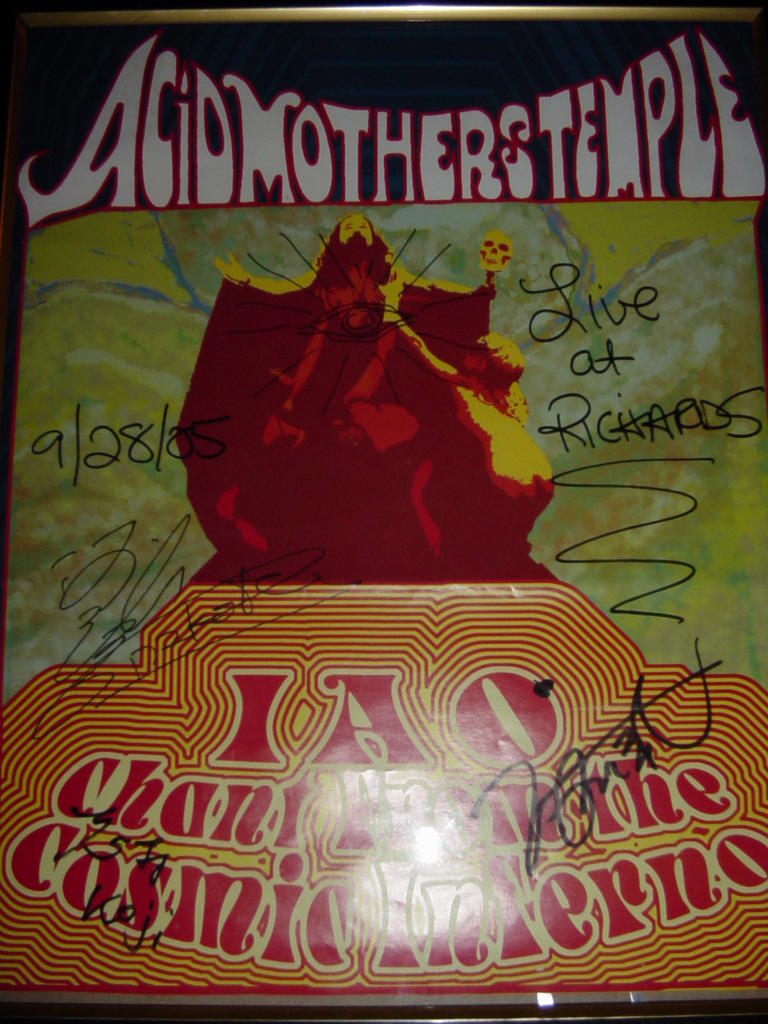
Sumimasen, Kawabata-san... Chotto abunai shitsumon... Omoshiroi kuki ga arimasu -- totemo omoshiroi no... "Tour" wa zenbu daijobu? Kuki ikaga?
Which translates as, roughly, "Excuse me, Mr. Kawabata, but I have a slightly dangerous question. There are these really interesting/funny cookies -- really interesting ones. As for the tour, is everything okay? How about cookies...?"
Kawabata has what I think of as very Japanese teeth; they are small and brown and suggest a complete indifference to dentistry. His manner is polite and gentle and friendly. He laughs, his eyes glittering a bit, and says everything is okay, they have everything they need (perhaps the fact that the tour immediately proceeds into the United States after this gig has something to do with his refusal; Kawabata will announce on stage that several of their concerts had to be cancelled because the American government doesn't like the Acid Mothers Temple, and gave them a hard time about getting work permits). He doesn't remark at all on my speaking in Japanese, which I guess either isn't that much of a surprise, or just isn't very impressive, because of my rusty delivery -- I don't practice much and I've never before ventured into such waters with the language. Anyhow, he laughs, I laugh, I try to say in broken but polite Japanese that I just thought I would ask, in case it was of interest, and I wander away, grinning at what I'd just attempted.
Walking through the crowd at Richards on Richards, everyone I run into seems to be in a band. Ole of the Creaking Planks (no website for them that I can see but here's Rowan's livejournal, including a bit of writing about the Zombiewalk gig), Harlow of Sistrenatus, and Scott and Dan of G42 (the latter being the reason I know these people). Scott has just gotten back from a visit to Japan and we chat briefly about his trip; he managed, apparently, to try a few onsen resorts there, which is pretty essential stuff, but it sounds like he didn't shop at any Disk Unions (I'd hoped to live vicariously through him by directing him to the one in Shinjuku, which is my favourite CD store anywhere). Afterwards, I'm telling Dan about my cookie conversation, when I realize that there's a pretty damn cool Acid Mothers Temple colour poster on the Ladies Room door immediately behind me. I promptly take it off, peel off the tape, and consider what to do.
Well, why not? I've already broken the ice, and the band are still sitting around the merch table. It has a very small smattering of CDs (customs make it too expensive to bring a lot of merch, Kawabata later tells us), a couple of t-shirts, and a guitar neck, broken onstage, which Kawabata is selling for $150. I'm broke, so nothing can be purchased, but a signed poster would be an excellent souvenir. I return and in my bad Japanese say to Kawabata, "Sorry, it's me again. Would you guys sign this poster?"
Kawabata smiles and produces a pen. He scribbles his name (he has a signature in English; assumedly if I were Japanese he'd sign in kanji) and draws an eye on the central image; I somewhat goofily explain that I have Otomo Yoshihide's signature, too. The rest of the band pass around the poster. Tabata Mitsuru, the bassist for the new lineup, has also played with Zeni Geva and the Boredoms (perhaps having been with the Boredoms on their 1999 tour, when I saw them at the same venue; he looked quite familiar. Apparently he has a solo album out there too). He gives the funkiest of signatures; a stylized black dot, visible on the O in Iao, above. Well, no language problems there -- the black dot is as universal as it gets. He's on singing duty, I will later discover, and has an extremely likeable onstage manner. I thank the band for their signatures and spend the rest of the evening protecting my poster, trying not to get it too wrinkled.
The band are fun to listen to, but it turns out that after the above interactions with them, and the delight I feel at having claimed a good anecdote for myself, the gig occurs in shades of anticlimax. They sound just like the Acid Mothers should, with a good balance between groovin' repeated mantraesque riffs and exploration/soloing/noise; they restrain themselves from kicking out too many jams, in the manner of High Rise or such, tho' they have a couple of brief outbursts. Higashi Hiroshi, the keyboardist and member-with-the-coolest-hair (pictured here) has some equipment issues, and a couple of times I did a doubletake at how-like-a-rock-god some of Kawabata's poses were (all that was missing was dry ice and the audience holding up lighters -- there's something I've noticed about how faithfully even cool Japanese bands sometimes seem to be self-consciously adopting the forms of their idols, an image-consciousness that is both endearing and a bit odd), but generally they aim to please and hit their mark, and Kawabata's two guitars (one mounted, so he can play both simultaneously, which is pretty damned interesting) sound great, generating swirling fields of mind murk. Songs like "Pink Lady Lemonade" are catchy enough you can dance to them, and many people do; I even undulated a little. It was fun. I've never been an overwhelming Acid Mothers fan, but I'm glad to have seen them.

But then I had to come home. Work the next day, and the necessity of doing a little marking, made it imperative I sleep, and I disappeared around 11:45. Who at work will I tell my cookie anecdote to, I wonder?
Well, really, it's not a conversation for the workplace. And no one knows who the Acid Mothers are, anyhow, really. So no one, I guess... Unless they read about it here...
Tuesday, September 27, 2005
Squid and Jello
A giant squid has been finally photographed in its natural environment by Japanese scientists. Does anyone else out there think this is cool? Pics here (not great but they're the first, so they get bonus points).
Otherwise, my life is a bit nuts right now and all I want to do is get my laundry done, clean the mildew out of my left boot (it's a long story) and air out the smell of Pine-sol (the cleaning agent in question) from my apartment. When I have extra time, I'm trying to make my way through the film festival guide... I will blog some other time (maybe once the movies start).
Concert update, tho': Jello Biafra is playing the Croatian Cultural Centre with the mighty Melvins on November 3rd. I'd buy tickets for this one early. Haven't seen Jello since the Dead Kennedys brought the Fall of Canada tour to the New York Theatre on Commercial Drive back in 1984. I was 17 and I was mightily impressed, and I don't think I've seen anyone (well -- maybe Iggy. No, not even Iggy. Maybe Eye, back when. Ah, nevermind) put as much energy and enthusiasm into a show as he did. I'm assuming he's slowed down a little -- actually, I'd hope so! -- but I need to see this show. They have two CDs out, Never Breathe What You Can't See and Sieg Howdy!, and both are great (tho' the latter recycles a couple of tracks from the former as "remixes," which seems a bit cheap, but...). Check out the "California Uber Alles" update on the new one ("I am governer Schwarzenegger..."), or the cover version of "Halo of Flies," by far Alice Cooper's best song (but who wants to own an Alice Cooper album? So thanks, guys!).
Otherwise, my life is a bit nuts right now and all I want to do is get my laundry done, clean the mildew out of my left boot (it's a long story) and air out the smell of Pine-sol (the cleaning agent in question) from my apartment. When I have extra time, I'm trying to make my way through the film festival guide... I will blog some other time (maybe once the movies start).
Concert update, tho': Jello Biafra is playing the Croatian Cultural Centre with the mighty Melvins on November 3rd. I'd buy tickets for this one early. Haven't seen Jello since the Dead Kennedys brought the Fall of Canada tour to the New York Theatre on Commercial Drive back in 1984. I was 17 and I was mightily impressed, and I don't think I've seen anyone (well -- maybe Iggy. No, not even Iggy. Maybe Eye, back when. Ah, nevermind) put as much energy and enthusiasm into a show as he did. I'm assuming he's slowed down a little -- actually, I'd hope so! -- but I need to see this show. They have two CDs out, Never Breathe What You Can't See and Sieg Howdy!, and both are great (tho' the latter recycles a couple of tracks from the former as "remixes," which seems a bit cheap, but...). Check out the "California Uber Alles" update on the new one ("I am governer Schwarzenegger..."), or the cover version of "Halo of Flies," by far Alice Cooper's best song (but who wants to own an Alice Cooper album? So thanks, guys!).
Wednesday, September 21, 2005
Oh Noooo!! Cinemuerte is Dead!!!
Bad news, shlocksters -- it seems this year's Cinemuerte festival will be the last! Curator Kier-la has decided that a horror/exploitation festival in the age of DVD is redundant, unnecessary. It's simply not true! There is much joy to be had, gathering together to share such experiences communally which will never be replaceable by the likes of Anchor Bay or Blue Underground, however impressive their catalogue; and no matter how big your TV screen -- and mine is pretty big -- it still isn't cinema. Plus where will I go for Exploitation All Nighters if you kill Cinemuerte? I'd open up my own living room, but my apartment just ain't that big!
I beg you, noooooooooooooooooooooooooooooooooooooooooooooo, Kier-la, pleeeeeeeeeease, don't retire the festival!
Anyhow, the disappointment to hear of the plan to let Cinemuerte die is compensated for slightly by the pleasure and anticipation of perusing the schedule for this season. Once again, Kier-la has managed to dig up a bunch of films I don't know but which I'm most eager to see (School of the Holy Beast? Night of the Living Dorks?), along with some really special items that I'm looking forward to seeing again (where/how else could I possibly see Class of 1984 on the big screen???? The best-ever Asphalt Jungle ripoff, and Roddy McDowell is great! -- I'm sure I'll enjoy his performance even more now that I'm actually a teacher...). I can only hope fans either a) pressure Kier-la to keep the beast alive or b) take up the banner themselves -- Cinemuerte is as vital to the fall-winter season in Vancouver as the Jazz Fest and that other film festival that goes on...
I beg you, noooooooooooooooooooooooooooooooooooooooooooooo, Kier-la, pleeeeeeeeeease, don't retire the festival!
Anyhow, the disappointment to hear of the plan to let Cinemuerte die is compensated for slightly by the pleasure and anticipation of perusing the schedule for this season. Once again, Kier-la has managed to dig up a bunch of films I don't know but which I'm most eager to see (School of the Holy Beast? Night of the Living Dorks?), along with some really special items that I'm looking forward to seeing again (where/how else could I possibly see Class of 1984 on the big screen???? The best-ever Asphalt Jungle ripoff, and Roddy McDowell is great! -- I'm sure I'll enjoy his performance even more now that I'm actually a teacher...). I can only hope fans either a) pressure Kier-la to keep the beast alive or b) take up the banner themselves -- Cinemuerte is as vital to the fall-winter season in Vancouver as the Jazz Fest and that other film festival that goes on...
Iraq Options
Thought this was a worthwhile overview of the current options, tho' for me the predictions are pretty grim.
Subscribe to:
Posts (Atom)